Default Linux configs are a liability. Harden on day zero, not post-deployment.
Download our free Linux Hardening Checklist (with CIS references): https://t.co/eyzvOx4ZAa
#LinuxSecurity#SysAdmin#CISBenchmarks
@abdussaboor The craziest part? An AI actually discovered this by chaining two decade-old flaws humans missed. By splitting cookie crumbs, it forces massive server RAM drains with almost zero payload. A brutal reminder that protocol complexity is the ultimate attack surface.
@TheHackersNews The brutal part is the architectural oversight. The extension feeds client-side cookie data directly into PHP's native unserialize() on every single storefront request. Attackers just drop base64-encoded Magento gadget chains in the cookie for instant, unauthenticated RCE.
Instead of trusting individual keys, your servers trust a single Certificate Authority (CA). After users authenticate via your Identity Provider (IdP), the CA issues short-lived, cryptographically signed certificates.
#LinuxSecurity#CyberSecurity#SSH
Static public/private SSH keys never expire on their own. Over time, they leak, get shared around, or become orphaned when employees leave.
The result is a nightmare of key sprawl where tracking who has access to what becomes completely impossible at scale. 👇
#infosec#linux #ssh
@TheHackersNews The wild part is how it bypasses limits. Instead of massive payloads, it sends nearly empty headers. The 32GB RAM drain comes from the server's own bookkeeping piling up while a zero-byte window holds it open. With nothing to decode, size limits never trigger.
@TheHackersNews The line between external attacks and insider threats is basically gone. Once an attacker has valid creds, perimeter tools are useless because the traffic looks legit. Security teams have to shift focus from "who logged in?" to "is this how they normally behave?"
@The_Cyber_News We're repeating old security mistakes in the AI era. Tying permissions to easily spoofed display names is a huge design flaw. You can't give an AI the keys to your system and guard it with a sticky name tag. Verifiable account IDs are an absolute must.
@TheHackersNews Another week, another ancient Linux LPE hiding in plain sight. Unused legacy modules are ticking time bombs. If your servers don't actively use SMB/CIFS, the module shouldn't even be loaded.
Hackers don't always steal data, sometimes they just choke your server to death.
A rogue container hoarding CPU = instant DoS. Enforce strict cgroups to throttle anomalies and protect your uptime.
Are you capping your containers?
#container#cybersecurity#linux#infosec
@The_Cyber_News This is exactly why "trusted vendor" registries are an illusion. If your defense relies entirely on a verified namespace, you're one compromised developer account away from a total breach. We have to shift from trusting signatures to monitoring build-time network behavior.
@TheHackersNews Seeing a 2024 WebLogic flaw hit CISA’s KEV catalog today means attackers are still finding exposed management ports on the public internet. Patching is critical, but a mature security posture means dropping external access to middleware entirely. Isolate, then patch.
@The_Cyber_News The VS Code 1-click flaw exposing GitHub OAuth tokens is a wake-up call: your IDE is a prime attack surface, not a trusted playground.
Guard your local dev environment like you do production. Audit your extensions, adopt zero-trust locally, and patch immediately.
@The_Cyber_News Supply chain attacks are evolving from static droppers to automated worms. Using compromised CI/CD pipelines to autonomously distribute credential stealers like Mini Shai-Hulud is a terrifying architectural shift.
Automated recovery tools are supposed to reduce operational friction, but outsourcing identity verification to an LLM creates an unquantifiable attack surface. It proves that no matter how advanced the AI is, security fundamentals must always dictate the architecture, not the feature list.
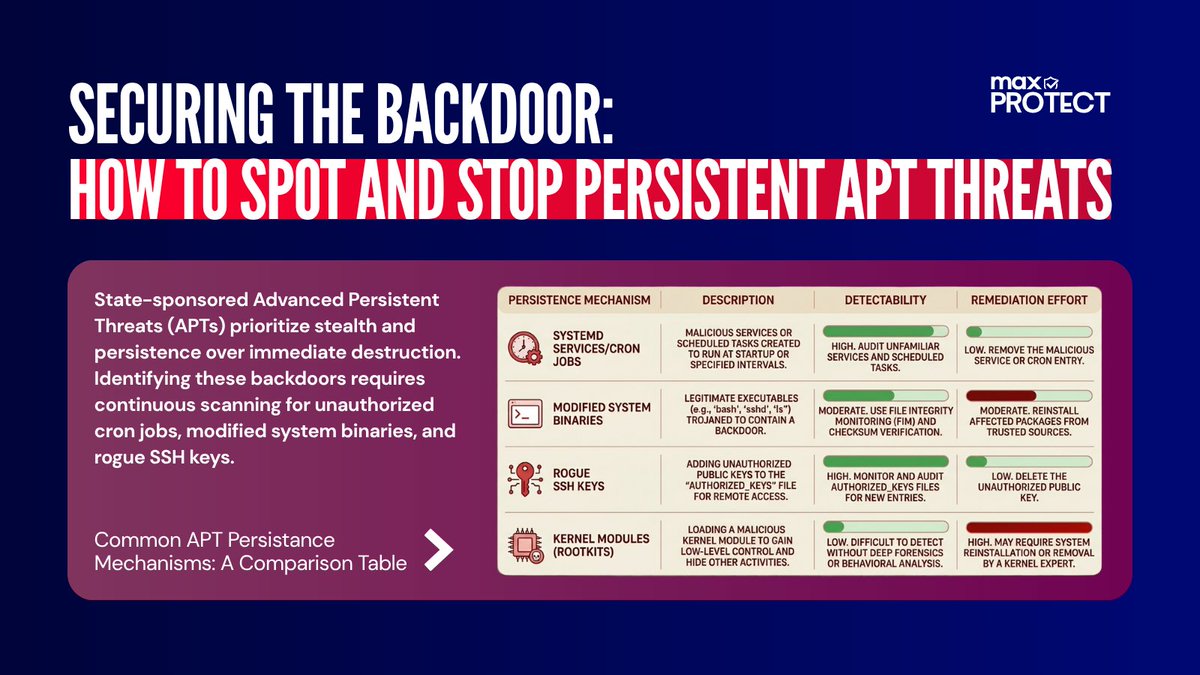
Advanced Persistent Threats (APTs) don't just smash and grab, they hide and stay.
Secure your backdoors by continuously scanning for unauthorized cron jobs, rogue SSH keys, and modified binaries. Spot them before they strike!
#CyberSecurity#APT#ThreatHunting#InfoSec
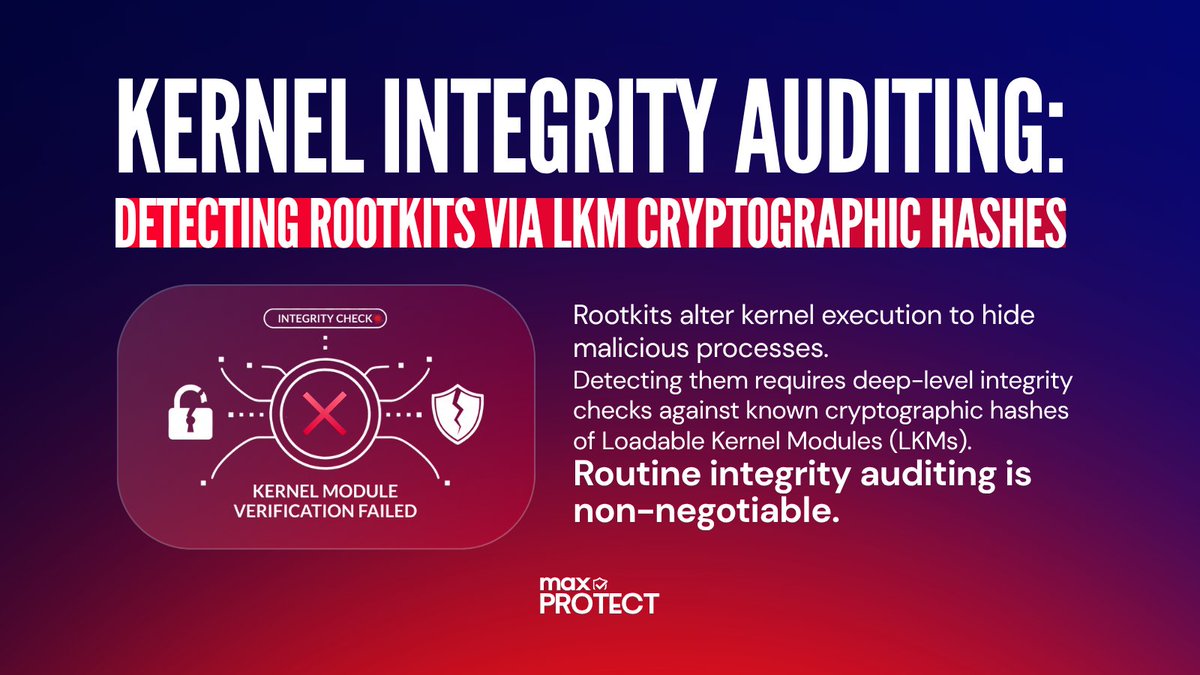
Rootkits hide malicious processes by altering kernel execution. How do you detect them?
Through deep-level integrity checks against known cryptographic hashes of Loadable Kernel Modules (LKMs).
Routine integrity auditing is non-negotiable! 🔒📉
#KernelSecurity#CyberSecurity #Rootkits #InfoSec
Container isolation is logical, not physical. Because containers share the host OS kernel, a single breakout can compromise your entire infrastructure.
Lock them down: drop ALL unnecessary kernel capabilities to prevent lateral movement!
#Docker#Kubernetes#CyberSecurity
The sheer volume of domains registered months in advance proves that modern threat actors operate with massive logistical foresight. Waiting for the event to start before hunting for these threats means you're already behind, proactive takedowns and continuous monitoring are the only ways to dismantle this pre-staged infrastructure before the attacks even launch.
The real threat here is the industrialization of trust. Jailbreaking allowed a solo actor to instantly automate a hyper-specific, emotionally charged political persona, turning bespoke social engineering into a zero-cost automated assembly line that easily bypassed human skepticism.
The brilliance of the ClickFix campaign lies in its brutal irony, attackers leveraged a highly technical server exploit purely to bypass endpoint defenses by tricking the user into manually copy-pasting their own doom.
It perfectly bridges a complex infrastructure compromise with the oldest trick in the book: human social engineering.