How can you understand real-world economics if you don't look at many different markets? My particular interest is the many & varied global food markets.
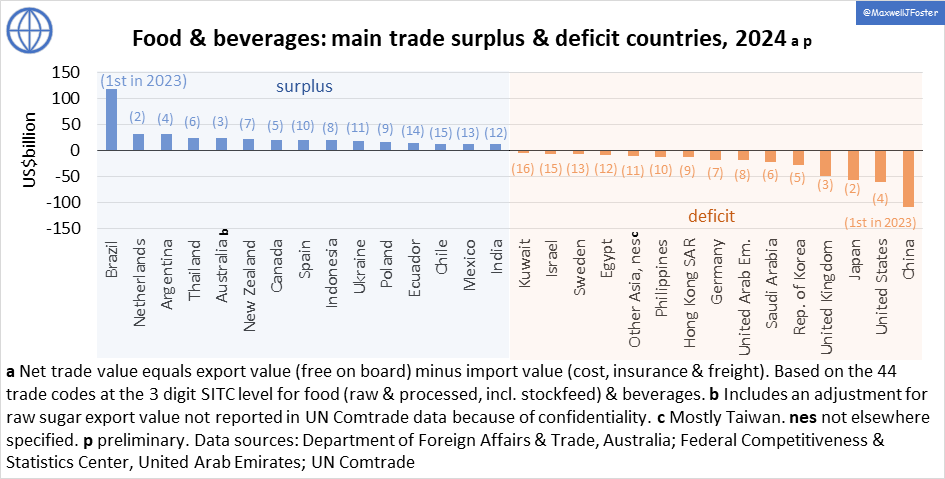
Ranking of the largest net importers (trade deficit) and exporters (trade surplus) of food & beverages updated to 2024. Some movements of note between 2023 and 2024:
🟦The United States moved from the 4th largest net importer to the second largest, behind only China
🟦Argentina & Thailand rose to 3rd and 4th, respectively, as net exporters
1/
If these Section 301 'forced-labor' tariffs are applied across the board to the host of countries reported in the Office of the United States Trade Representative (USTR) investigation, the impact on most Australian food & beverage exporters will likely be slight. Rather, it is largely US consumers who will pick up the tab for higher tariffs. https://t.co/pGDCm0N2UO
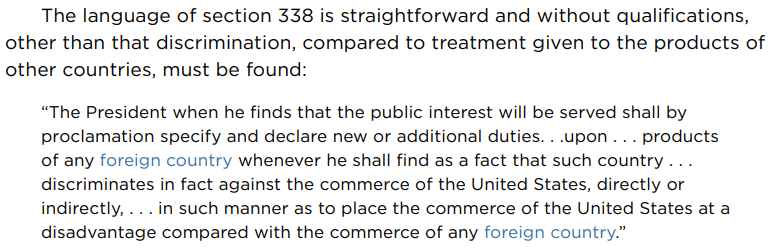
⁉️What is Section 338 of the Tariff Act of 1930, the newest tariff authority the Trump administration is using to impose 50% tariffs on Canada?
➡️Section 338 has not been invoked in 100 years & requires strong proof of discrimination against American goods.
➡️It was designed as a retaliatory tool specifically to counter discrimination against US trade by other countries...
...such as when an importing country treated US products less favorably than the products of other countries.
💡Section 338 can only be used in circumstances where a trading partner provides differential treatment for US goods that is detrimental to the US product & grants more favorable treatment to other countries.
🇨🇦The Trump administration claims Canada discriminates against American exports of cars, alcohol, & dairy.
🍻Note that for alcohol, it is most Canadian provinces & territories, not the federal government, that have halted the purchase, distribution, or retailing of US alcoholic beverages.
🐄In past USMCA negotiations, the Trump administration secured tariff-rate quotas (TRQs) for 14 Canadian dairy products, which allow a specified amount of a dairy product to be imported at a lower tariff rate, while imposing a higher tariff on imports beyond that threshold.
🥛The US enjoys an average annual trade surplus in dairy products with Canada of around $600 million since 2021.
🟢Even products covered by the USMCA could be subject to the Section 338 tariffs.
🔴But Canadian energy products, potash, fish, critical minerals, & some other products are exempted from the Section 338 tariffs.
🗓️The tariffs on Canada are set to take effect on August 19.
⚖️Courts would be rightly skeptical of a sudden finding of massive discrimination that warrants anything like reimposition of Trump’s “reciprocal” tariffs.
China’s imports of Australian barley have boomed since a prohibitive Chinese import duty that had applied for three years was removed in mid-2023. China imported 6.1Mt of Australian barley (worth US$1.6b) in the first half of 2026, 68% more than in the same period in 2025.
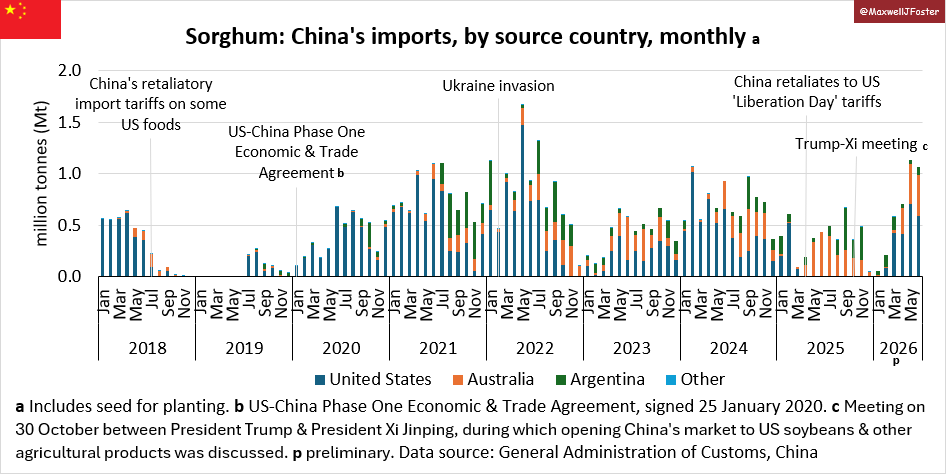
China's imports of US sorghum resumed after US President Trump and Chinese President Xi met in late October 2025 to ease bilateral trade tensions. But China's imports of US sorghum in the first half of 2026 were still roughly 30% lower than the average* for this time of the year.
*Based on the three years to 2024
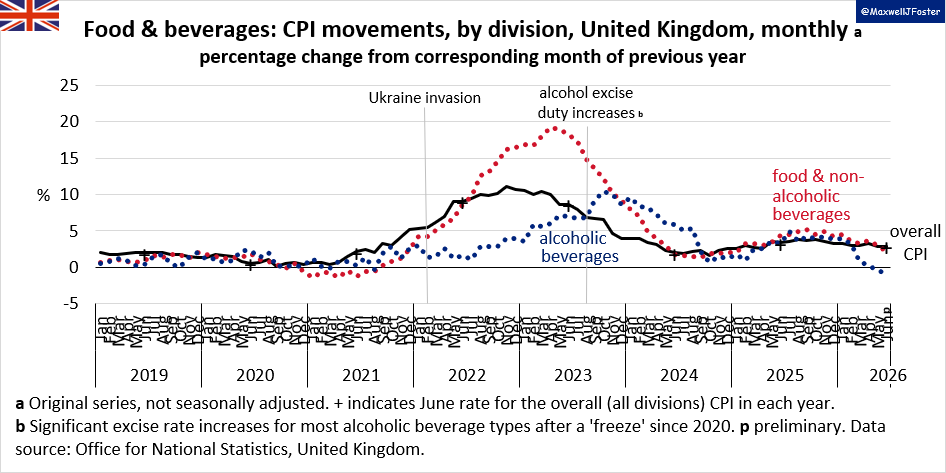
Headline inflation moderates in the United Kingdom. Selected annual inflation rates for June 2026, as measured by 12-month changes in the Consumer Price Index (CPI):
🟦Overall CPI, +2.6% (+2.8% in May 2026)
🟦Food & non-alcoholic beverages, +1.7% (+2.2% in May)
🟦Alcoholic beverages, -1.6% (-0.9% in May)
This is a shallow attempt by the WSJ to portray Norway as a country that isn't socialist.
Norway's contemporary economic model was built by socialists.
Norway's first post-war and longest-serving Prime Minister, Einar Gerhardsen, was a democratic socialist. In his youth, he participated actively in communist activities and was even imprisoned for his progressive views.
We call him Landsfaderen in Norway, which means "father of the nation." He is considered the main architect of the post-war rebuilding of Norway.
Today, Norway has one of the highest unionisation rates in the world, some of the most successful state-owned enterprises, and a welfare state that has made us one of the world's most egalitarian societies.
This is all a direct lineage of our explicitly socialist past.
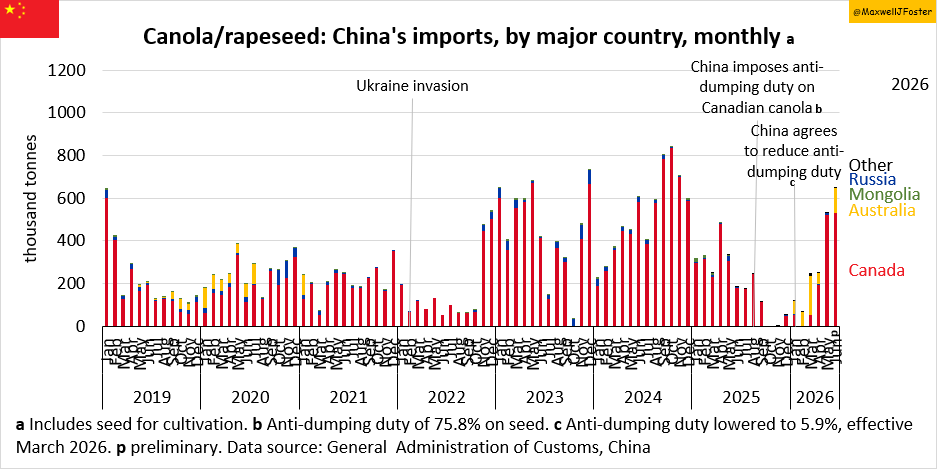
Canadian canola is back in the Chinese import market after a January 2026 meeting between Canadian Prime Minister Carney and Chinese President Xi. I think the trade-off was improved access for Chinese electric vehicles to Canada in exchange for a markedly lower Chinese import duty on Canadian canola.
Bitter-sweet: Australia is one of the largest beneficiaries of the Chinese electric vehicle (EV) revolution because we no longer have a car industry that needs to be protected with tariffs. https://t.co/HaGbSC3veT
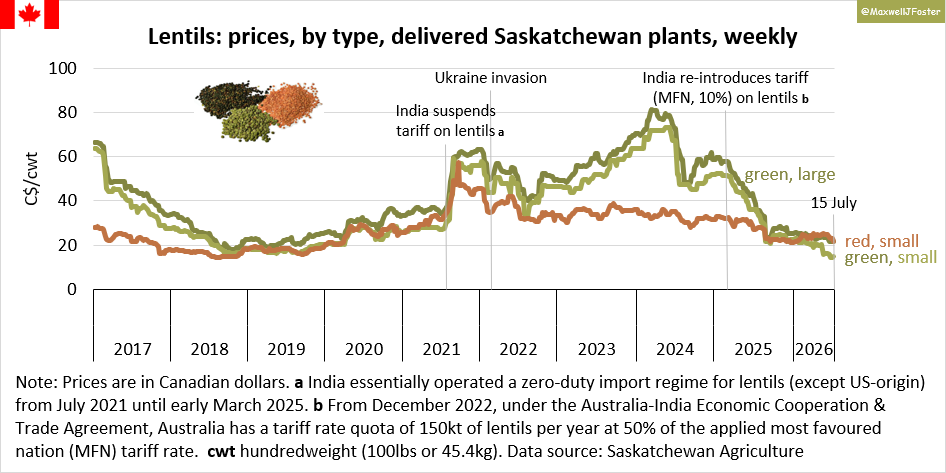
World lentil prices are in the doldrums because of large stocks and reduced demand from India. Green lentil prices are at a rare discount to red lentils because of large harvests of green lentils in North America.
The US will impose a 25% tariff on most imports from Brazil starting July 22, the US Trade Representative's office said, the first action under the Trump administration's new tariff strategy that could eventually affect dozens of countries. READ: https://t.co/rWrXYy0vEL
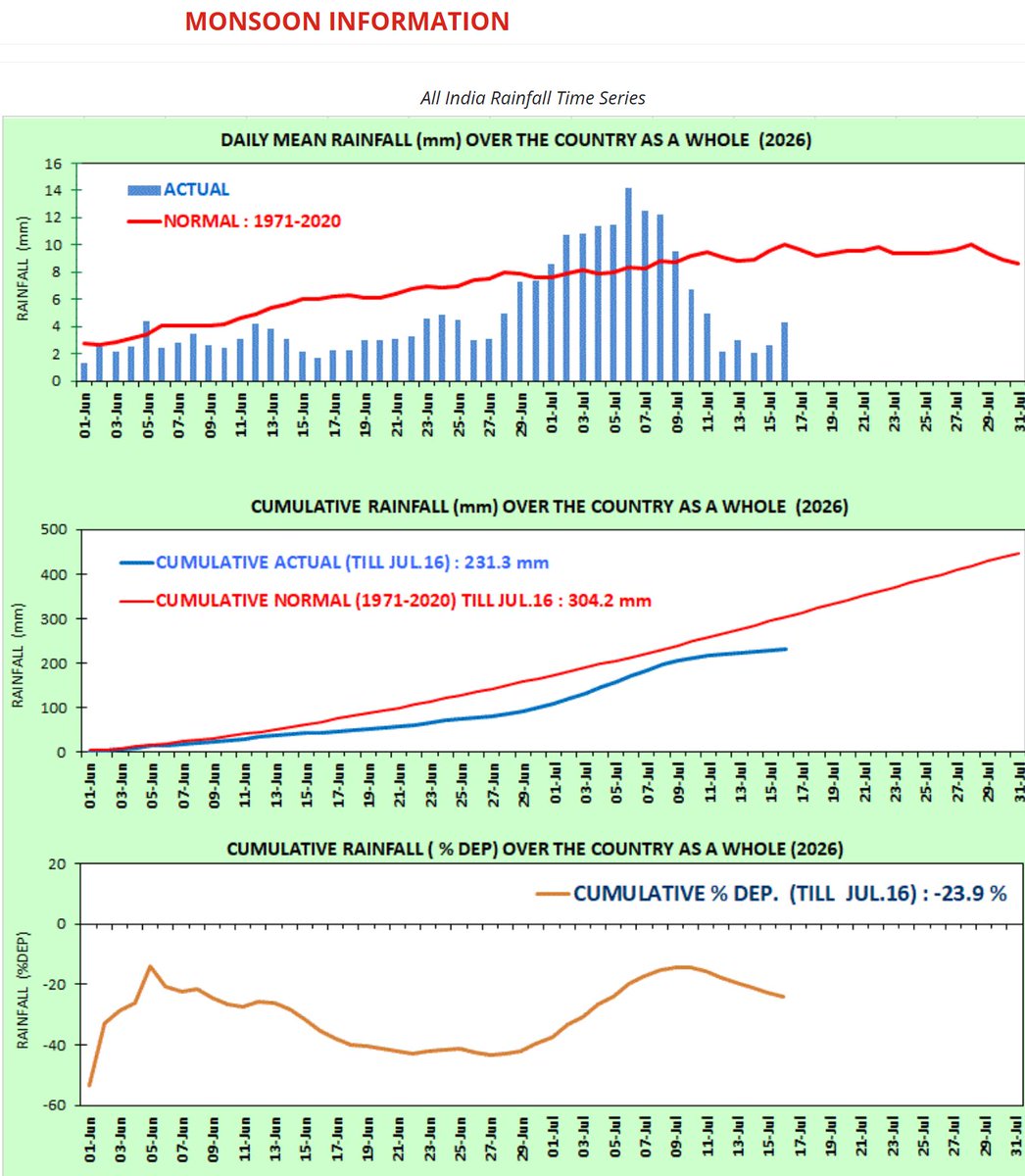
Cumulative all-India rainfall from the 2026 southwest monsoon is 23.9% less than normal for this time in the season. The unusually low rainfall at the start of the season would have significantly delayed or cut Kharif food-crop plantings and reduced yield potential, most notably for rice.
Turns out most of the world prefers multilateralism, respect for sovereignty and cooperation over bombings, regime change operations, and being lectured about democracy by people whose politicians are legally for sale.
Truly a mystery.
Gasoline and diesel prices fell in the United States in June 2026, helping to explain why the US annual inflation rate, as measured by the consumer price index, eased that month.