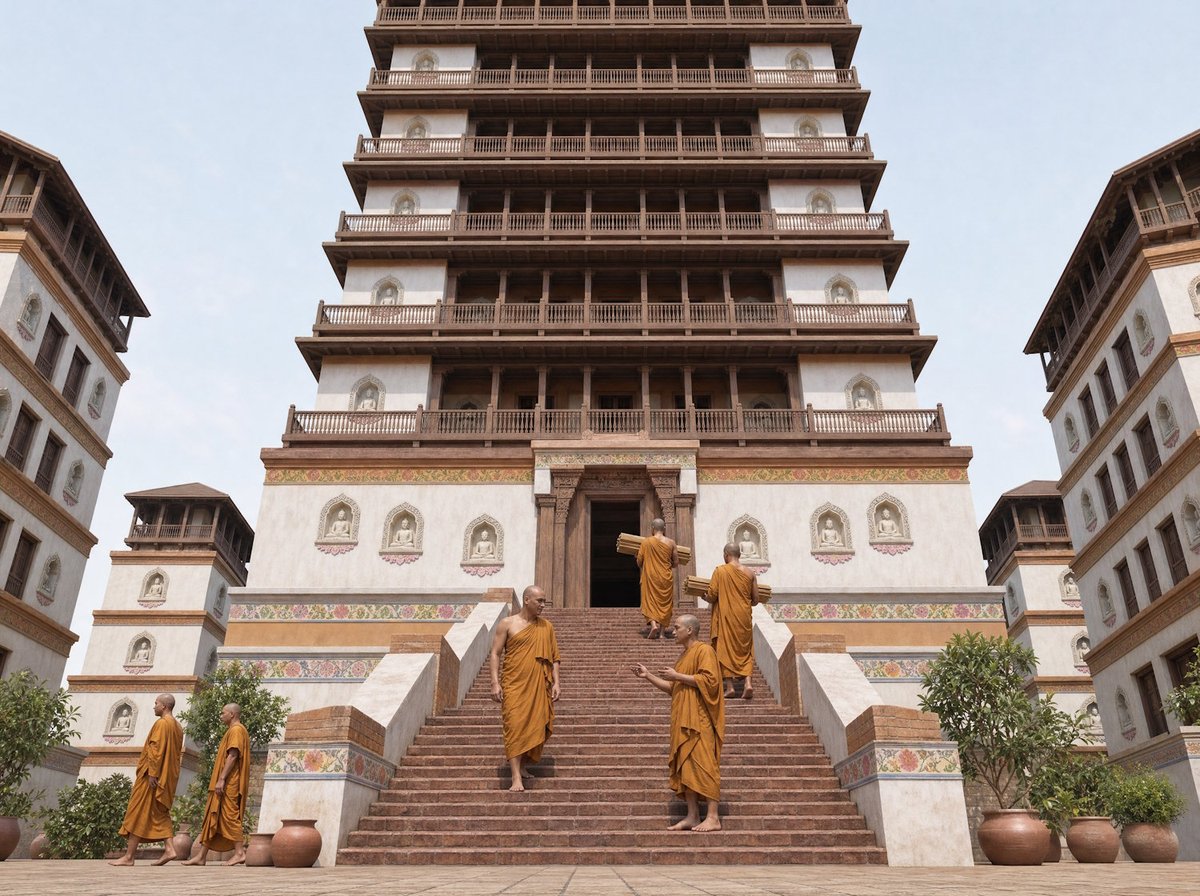
Our Nalanda episode looks like a vlog filmed in 640 AD. It isn't guesswork. There is an excavated site, two eyewitnesses who actually studied there, and one very contested chronicle. Here is what rests on what. https://t.co/7J4dcmhJGk
@pre_historic Thank you, this really means a lot. You said it, the key is the detailing. Every courtyard and monk cell in our Nalanda was grounded in the actual dig plans and in what Xuanzang described seeing. The small things are the whole thing.
@KhaliliOnline Great detail. Amanat Khan is also the only person allowed to sign the Taj, his name worked into the calligraphy by the south gate. The letters near the top are cut larger too so they read even from the ground. We covered him here: https://t.co/H3ez2y8Xcv
@ShubhamPathakIN Rakhigarhi being the largest is still underrated, it is bigger than Mohenjo-daro. The village sits in Hisar district, Haryana. The 2015 aDNA from a burial there pointed to local ancestry with no steppe signal, which set off years of debate.
@EvanKirstel This is the part I find most fascinating about the Indus cities. Whole neighbourhoods of near identical houses, solid drainage in each, and no palace or royal tomb anywhere. Hard to find another Bronze Age society that flat.
@africa_rebirth Love this. Worth adding that Nalanda in Bihar was already teaching by the 5th century, nearly 400 yrs before Al-Qarawiyyin. Students came from China, Korea and Tibet for it. It just did not survive to keep the title, Bakhtiyar Khalji razed it in 1193.
@NashuBR So true, and so sad. In Nalanda's time the traffic went the other way: students crossed from China, Korea and Tibet to study in Bihar. We were the destination then.
We tried to rebuild it as it stood before 1193: https://t.co/7J4dcmhJGk
@CopiumState The numbers back you up. Of the roughly 2,000 known Harappan sites the large majority sit in India, and Rakhigarhi may be the biggest of all at about 550 hectares, still mostly under farmland. We rebuilt it as a living city here: https://t.co/xI4dPgHqHP
@IGR_Media@palkisu Xuanzang's timing here is perfect. Once he reached India he spent years at Nalanda, the giant monastic university near Rajgir, and his travel diary is basically why we know how it ran day to day. We rebuilt that lost world here: https://t.co/7J4dcmhJGk
A new 2026 study traced carnelian beads from a tomb at Kish in Iraq back to the Indus. Harappan artisans etched white designs into red stone and shipped them 2,500 km west. A Sumerian king once boasted of 'carnelian from Meluhha', which was us.
(Photo: Vassil, CC0, British Museum)
https://t.co/efatIMFWfi
@anujdhar Thank you, this means a lot coming from you. Slowly it is finding its people. Almost like the real Nalanda, only about a tenth of which has been excavated. Ninety percent is still under the fields of Bihar, waiting.
Our Nalanda episode looks like a vlog filmed in 640 AD. It isn't guesswork. There is an excavated site, two eyewitnesses who actually studied there, and one very contested chronicle. Here is what rests on what. https://t.co/7J4dcmhJGk
@Ancient_Indus Beautiful piece. The detail I love about zebu seals: the design is carved in reverse, a mirror image, because they were stamps pressed into clay to seal trade goods. That controlled realism was actually made to be read backwards.
@nickcollins1953 The genetics point to deep continuity here. The 2019 Rakhigarhi ancient DNA study found the Harappan gene pool is the largest single source for people across South Asia today, on both sides of the border. A shared inheritance.
@BihariMan1 Love this. The old Nalanda library was called Dharmaganja, the Mountain of Truth, said to be so vast that when it burned the smoke hung over the valley for days. Good to see books rising on that soil again 🙂
(Photo: How the old Nalanda library might have looked like)
@VoidCommentaryX Good thread. The haunting part: when the Tibetan monk Dharmasvamin reached Nalanda around 1234, most of it was rubble, yet a few monks were still teaching there under aged Rahula Sribhadra. We rebuilt it at its peak here: https://t.co/7J4dcmhJGk
@atahasnain53 Wonderful to see. The old Nalanda drew students from China, Tibet, Korea and Central Asia for nearly 800 years. Nice that the reborn campus is picking up that same thread again, scholars from everywhere learning together.
Nalanda's reach was oceanic. A copper plate from 860 CE records a king of Sumatra, Balaputradeva, building a monastery here, and the Pala king Devapala gifting five villages to run it. A ruler from across the sea chose Bihar for his college. (Photo: National Museum, New Delhi)
@connectajitcpr Thank you for sharing this. Full episode is here if you want the whole journey:
https://t.co/7J4dcmhJGk
Nalanda ran for 600 years without charging a single student, funded by villages that kings gifted it.
@LegoRacers2 Too good. And not even far-fetched: Harappans really did trade with Mesopotamia, they called the land Meluhha. So a zebu-cattle guest showing up from Mohenjo-daro at a Sumerian feast is basically historically sound. 🙂
@krishpera Useful thread. One nuance worth adding: Nalanda ran close to 800 yrs and taught logic, medicine and math, not just scripture. Its Pala patrons were already gone before 1193, so the famous raid hit a place patronage had left. Nalanda could never recover.