Happy first rescueversary to darling Pips! Our plucky little giraffe folded right into Kaluku life – this first clip was taken shortly after her rescue – and remains just as comfortably settled today.
Her rescue was quite an ordeal. After losing her mother, Pips spent several days fending for herself, furtively appearing for water before evaporating back into the bush. By the time we caught up with her, she was running on her very last reserves.
A year on, ‘Pipsi’, as she's knows to her Keepers, is thriving – and there is so much more to come.
Adopt Pips and support her journey back to the wild: https://t.co/PhHUL6MgVg
A New Mother, a New Home for an Orphaned Foal 💕
The foal’s mother died shortly after giving birth, leaving behind a foal that was still far too young to survive without milk. The farm had to find a solution quickly, but the question was not simply how to keep it alive. It was also how to give it the chance to grow up as a normal horse.
People can feed a foal with milk replacer. But a bottle cannot provide everything that a mother horse can.
A newborn foal needs nourishment, but it also needs to be around an adult horse to interact, observe and learn the social behaviours of its own species. That is why the farm found a mare that had previously been a good mother and arranged for her to foster the foal.
But their first meeting was nothing like a reunion.
The mare called out and rejected the foal. She did not immediately accept a youngster that she had not given birth to.
Then, about an hour later, that changed.
The mare began to accept the foal and allowed it to stay beside her. This moment shows that the mother and foal relationship in horses does not always appear immediately. Recognition is built through scent, sound, physical contact and the first interactions between the two animals.
But accepting the foal still did not mean that she could immediately provide enough milk for it.
In foster-mare arrangements, a mare can be stimulated to begin producing milk, but the milk supply takes time to increase. During that period, the foal still needs enough nourishment, so people fed it milk replacer for around two weeks, until the foster mare was producing enough milk to meet its needs.
This is an easily overlooked part of the story, but it shows why a foster mother is different from a human carer.
People can temporarily replace the milk supply. But they cannot easily replace an adult horse in the interactions a foal needs to learn how to live alongside its own kind.
Once the mare’s milk supply was fully established, the foal began nursing and became healthier. From that point on, it had not only an appropriate source of nourishment, but also an adult horse beside it during an important stage of its life.
At the end of the clip, the foal is placed on a set of scales, and the two of them return home together.
The scales can tell us only how much the foal weighs. But behind that number lies another journey: from a young animal that lost its mother just after being born to one that now has a new mother and a place to return to.
This story is therefore about more than rescuing an orphaned foal. It shows something important about caring for animals: keeping a young animal alive is only the first step. The next is giving it the opportunity to grow up in the world of its own species.
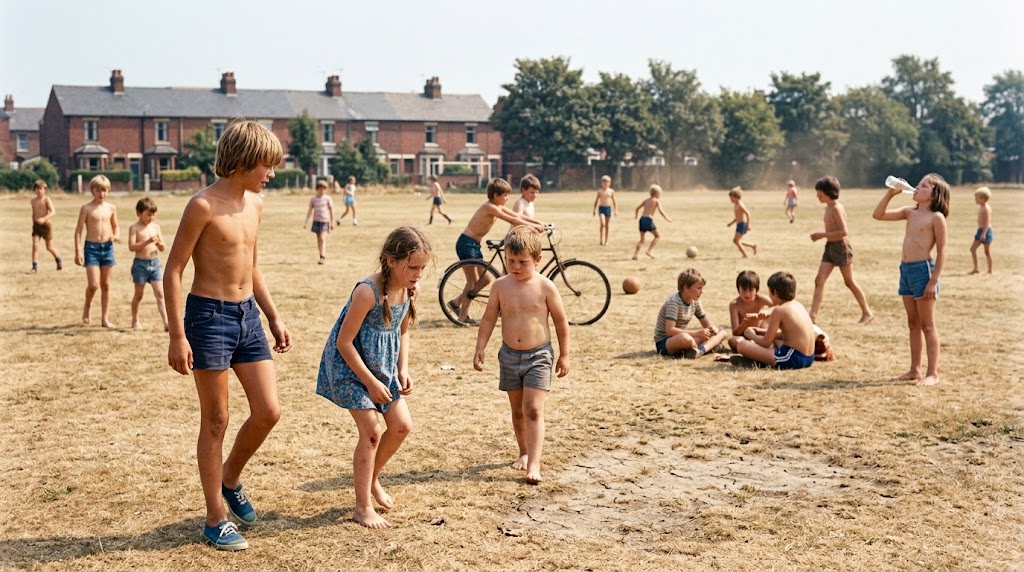
The summer of 1976 was the last one Britain spent outdoors without a bottle, and nobody came home from it blistered.
Fifteen days over thirty degrees. The reservoirs cracked into plates. Standpipes on the pavement in Devon and the Welsh valleys, and a Minister for Drought appointed in August, three days before the rain came and made him look like a genius.
You were out at eight and in at dark. The playing field went the colour of a digestive and stayed that way till September. The tar on the road went soft enough to take a footprint and your mother shouted about it.
Ladybirds. Millions of them, on every windowsill, in your hair, in the Tizer.
Nobody owned sunscreen. There was a bottle of Ambre Solaire in the bathroom that smelled of coconut and belonged to your auntie, and it went on in Spain, once, for the first afternoon. The word factor had not arrived. If it had a number on it the number was two.
Shirts came off in the first week of June and did not go back on. The men on the site worked in vests and came home the colour of a saddle. Farmers cut the hay with their backs bare. The lifeguard at the lido was brown as a conker by July and nobody thought he was doing anything brave.
You went pink once, early on, and then you did not. Your skin did what skin did: it darkened, it thickened, and it was fine for the rest of the summer.
And the chip pan on the stove was full of lard. Beef dripping in the tin under the sink. Butter on everything. Rapeseed was a crop on a few thousand acres that nobody had thought to eat, and the oil in the cupboard, if there was any, was for the Sunday roast tin and lasted a year.
That was the summer. Every hour of daylight, no cream, no shade, and a country built out of animal fat.
Fifty years on, the same sun, half the exposure, factor fifty on the school run, and skin that blisters walking to the car.
The sun did not change. The cupboard did.
This wonderful woman saw a frightened pigeon on the tube, scooped it up, held it until the train reached the next platform and released it.
Kindness costs nothing! ❤️
Lemur’s version of yoga is called sunning.
During this behavior, which helps them warm up after a cold night, ring-tailed lemurs sit upright with their arms and legs outstretched and their bellies facing the sun to absorb its heat
[📹 dani.villar_]
A Dog’s Journey to Find a Home to Return To 💓
Cactus was lying on the bed when Cowboy came over. The foster dog did not rush towards him. He moved a little at a time, then turned his head to look at his owner, as if waiting for a signal. Only when he seemed sure that he could continue did Cowboy slip into the space beside Cactus.
Cactus did not move away. He did not growl or push Cowboy aside either. He simply turned to look at him, then allowed the shy dog to lie close beside him. Before long, the two dogs were lying next to each other, cuddled up and asleep.
At first glance, this was simply a small moment in the everyday lives of two dogs. But it was the moment when Cowboy turned to look at his owner that made the story particularly noteworthy.
Cowboy was still getting used to a new environment. Cactus was already a house dog, familiar with the bed, the room and the people around him. Cowboy was not yet certain where he fitted into this new world. So rather than moving straight into Cactus’s space, he approached cautiously, one small step at a time.
Dogs are social animals with rich social lives, and they are highly responsive to signals from those around them. In an unfamiliar situation, they may observe the reactions of people or other dogs before deciding what to do next. For Cowboy, turning to look at his owner may have been a form of social referencing: he was gathering more information before deciding whether to move forwards.
What is particularly interesting is that Cowboy was not placed beside Cactus. He chose to close the distance himself.
He moved closer. He paused. He watched. Then he continued.
Cactus was communicating too, even though he was doing very little. He did not growl, move away or keep his distance. That lack of resistance became a clear enough signal for Cowboy to remain beside him.
So the final cuddle is only the most visible part of the story. The more interesting part lies in the seconds beforehand, when a newly arrived dog was watching both his human and his new companion, trying to understand how he might enter this new relationship.
After spending some time living together, Cowboy’s story took another turn. His owner decided that he would no longer be simply a foster dog, and chose to adopt Cowboy permanently.
That decision gives the image of the two dogs lying close together another meaning. Cowboy had not only found a companion to sleep beside on that bed. He had found a family where his presence was welcomed as a natural part of everyday life.
Perhaps the happiness of a dog who is adopted does not lie in any single special moment. It can come from very ordinary things: a familiar bed, someone who is always there, another dog to lie beside, and the feeling that tomorrow, he will still be returning to the same home.
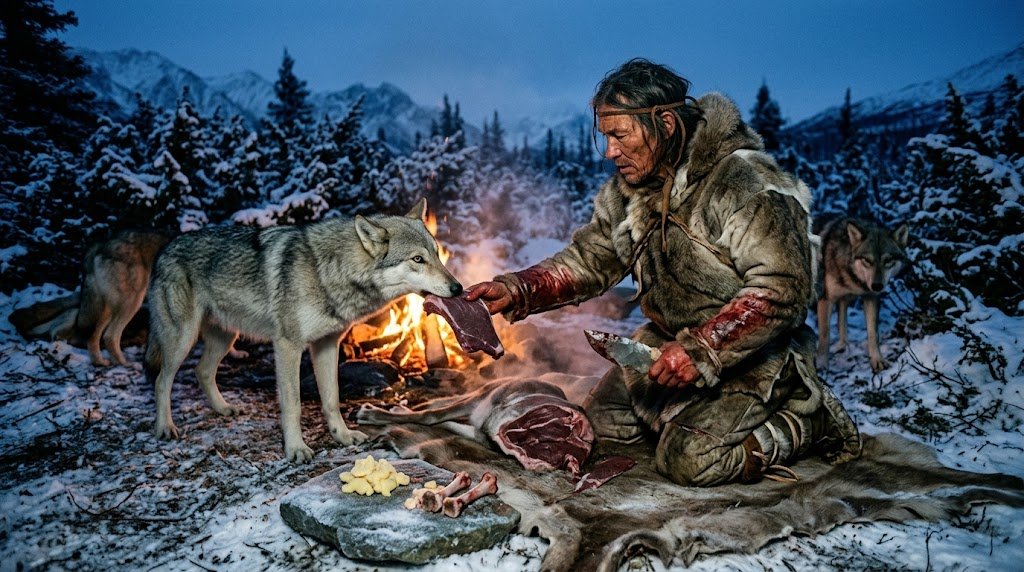
The dog exists because our ancestors kept killing animals they could not finish, and the part they could not eat was the lean.
Every archaeological site from the Pleistocene with dog or proto-dog remains in it sits in what was, at the time, an arctic or subarctic environment. That is the first fact. The second is that a human liver can only clear so much nitrogen. Push much past 35 to 40 per cent of your energy from protein and the ammonia backs up faster than you can turn it into urea, and you get headaches, then nausea, then weakness, then something considerably worse.
Put those together in a northern winter between 29,000 and 14,000 years ago. The game is horse, moose, reindeer. By midwinter those animals have burned their fat off and are close to pure muscle. There are no carbohydrate plants left to speak of. A hunter needs fat and there is barely any, so he kills more animals to get at what fat there is, and every carcass leaves behind a mountain of lean meat he physically cannot metabolise.
A wolf has no such ceiling. A wolf will run on lean meat for months and be perfectly content on it. The two species were hunting the same animals, in the same country, entirely capable of killing each other, and eating them differently.
So a Finnish team ran the energy numbers on the prey species and found exactly what the constraint predicts: a surplus of animal protein that cost the humans nothing to hand over. Wolf pups taken as pets normally become competitors, because in a hard winter people feed themselves before their animals. In this one case the competition disappears, because the thing the pup wants is the thing the human cannot use.
Feed the pups for a few generations and you have dogs. Then you have hunting companions, pack animals, guards, and a species that reshaped itself alongside us.
It is a hypothesis and it is argued over, and the mechanism underneath it is not argued over at all. The protein ceiling is real, it is in every physiology textbook, and it is the reason lean meat alone kills people.
There is a tidiness to that which is hard to walk away from. The most successful interspecies partnership in the history of the planet, resting on the fact that a man cannot eat as much lean meat as a dog can.
We took the fat. We handed the chicken breast to the wolf. He was grateful, and he is still in the room with you.
Three lives lay buried beneath the mud for nearly three days, and after all that, the mother dog broke down in tears after being rescued 💖✨
After heavy rains in Kerala, India, a minor landslide occurred near a residential area. Local people heard a faint whimper but could not work out where it was coming from.
The rain gradually eased, but the sound continued. Unwilling to ignore it, they began digging around the place where the cries seemed to be coming from and discovered a mother dog buried in the mud, with two newborn puppies beside her.
The three of them are believed to have been trapped for nearly three days without food or water. The puppies were trembling, their bodies covered in mud, while the mother remained trapped and unable to free herself.
The rescuers quickly brought them out. They washed the mud from the two puppies, dried them with towels and wrapped them in cloth to keep them warm.
Immediately after being rescued, the mother dog broke down in tears. She stood close to her puppies, watching as they were cleaned and kept warm, while her faint cries could still be heard.
No one can know exactly what the mother dog was feeling. But after nearly three days trapped in the mud, perhaps those cries were a mixture of stress, exhaustion and relief that she and her puppies had finally escaped the danger.
What is particularly striking is that the two puppies were still beside her. After days of being unable to free herself, the mother could now see her puppies being cared for and have them right beside her.
The people then built a small temporary shelter for the three of them beneath a telephone pole, giving them a place to stay and protecting them from the cold rain. They brought them food and water and continued caring for all three until they gradually recovered.
What still puzzled those who witnessed the rescue was how the three dogs had managed to survive beneath the mud for so long. There is not enough information to know exactly what allowed them to remain alive in those conditions.
But one thing is clear: without those cries, the people might never have known that a small family was trapped beneath the mud.
For an animal buried underground, making a sound may be one of the few ways it can signal that it is still alive. People do not need to understand exactly what that sound means to recognise that there is a living creature beneath the mud that needs to be found.
Natural disasters do not threaten only people. When landslides occur, water rises or shelters are destroyed, animals can also become trapped, lose their homes, become separated from those they depend on, or be unable to find food and water.
Rescuing an animal in such circumstances is therefore more than an act of compassion. It shows that people can extend their sense of responsibility to the other living creatures that share the same environment.
A society is judged not only by how it protects its most vulnerable people, but also by how it treats creatures that cannot speak for themselves. People cannot prevent natural disasters from happening, but they can still decide what to do when living beings are left in danger afterwards.
Perhaps the most memorable part of this story is that three lives survived because a very small cry was heard.
The Sea Otter is a marine mammal native to the coasts of the northern and eastern North Pacific Ocean.
Adult Sea Otters typically weigh between 14 and 45 kg, making them the heaviest members of the weasel family, but among the smallest marine mammals.
Sea Otters have loose folds of skin under their forearms that act as natural pockets to store food and a favorite tool rock.
The baggy pockets sit right under each of the otter's front legs (forearms).
Food Storage: Otters dive deep to forage and use these pockets to stash extra snacks like crabs, clams, and mussels so they can bring multiple items back up to the surface.
Carrying Tools: Many Sea Otters keep a prized, perfectly sized rock inside this pocket to use as a hammer or anvil for cracking open hard-shelled prey on their bellies.
Lifelong Bond: Otters are selective about their tools and often keep the exact same rock for months, years, or even their entire adult life.
🎦 Credit: Dr Geetha Plackal.
Detail of All Saints church in Loughborough
I attend lots of great events and gatherings at this church. It's not my main one, but definitely a sister church for me. 🙏
They're dragging girls into the mountain, gang raping them, and killing baby dolphins.
Dirty Sánchez opts to give them amnesty and make them Spanish citizens.
Get Pedro Sánchez out!
When a Dog Can Find His Way Back into the World ❤️✨
For the Golden Retriever in this story, that had once become impossible. Abandoned in the middle of the road with injured hind legs, he could no longer stand or move like an ordinary dog. After being taken to a vet and undergoing surgery, he had to begin learning how to use his body in a different way.
That was when the wheelchair appeared.
From the outside, it was simply a device supporting his hindquarters. But for the dog, the wheelchair restored his ability to move independently. His front legs carried him forwards while his hindquarters were supported, allowing him to go where he wanted rather than waiting for someone to carry or take him there.
What happened next was what truly stood out.
He went outside, moved across the grass and explored new spaces. His bright expression, tongue hanging out, wide eyes and constantly wagging tail showed a dog enjoying the freedom he had just regained.
A dog's psychology can sometimes be wonderfully simple. When his body allows him to do the things he naturally wants to do, he will walk, play, explore and seek interaction. Those behaviours are how he experiences and enjoys the world around him.
For this Golden Retriever, the most precious part was the return of those very ordinary things. He could make his own way to where he wanted to go, run across the grass, dig in the ground and experience his surroundings again as a dog.
It is also another way of looking at recovery in animals. Surgery can repair an injury and a wheelchair can support movement, but life truly begins to open up when an animal can use those abilities to interact with the world around it.
That is why the final scene of the Golden Retriever is particularly memorable. He lowers his head and digs into the real grass, performing an entirely ordinary action that his injured body had previously prevented him from doing.
He does not need to walk as he did before to have a meaningful life. As long as he can move independently, explore and do the things dogs naturally enjoy, his world has already become much larger.
Some rescues begin by getting an animal out of danger. But the journey of this Golden Retriever shows that the important step that follows is helping an animal regain the ability to live in that world on its own terms.
Judge allows nearly 2,000 non-native Catalina Island deer to be killed to protect native plants
The deer were introduced to the island decades ago and are now damaging native vegetation
It’s heartbreaking to see wildlife caught in the consequences of human decisions