Every trading educator tells you the same thing after a loss.
“Review it. Journal it. Find out what went wrong. Learn from it.”
This sounds like good advice.
It isn’t.
It is one of the most damaging habits the industry has normalized.
Almost no one questions it, because it feels like the responsible thing to do.
Here is what actually happens when you “learn” from a losing trade.
You open the chart after the fact.
You see where price went.
The entry, the stop, the outcome.
All of it is laid out in front of you with the clarity that only hindsight provides.
And then you start looking for the mistake.
“I entered too early.”
“The trend was weak.”
“I should have waited for confirmation.”
“The spread was too wide.”
You find something.
You always find something.
Because when you look at any trade with full hindsight, there is always a detail that could have been different.
So you write it down.
You feel productive.
You feel like you’re improving.
And then you adjust.
You add a filter.
You tighten a condition.
You tell yourself, “Next time I’ll wait for this extra confirmation before entering.”
You just broke your system.
Not in a dramatic way.
In the worst way possible, a way that felt like improvement.
Here is what you missed.
Your system was built on a sample.
That sample contained wins and losses.
The losses were not errors.
They were part of the distribution that produced the edge.
When you “learned” from that one loss and changed a rule, you didn’t fix anything.
You optimized for a single data point that was already accounted for in your tested results.
That one loss was supposed to happen.
Your system was designed to absorb it and keep moving.
Because you changed the rule, every trade from that point forward runs on a system that has never been tested.
This doesn’t mean you never learn from wins and losses.
You learn from them during testing.
Before you risk real money, you put your system through a sample large enough to see everything it can produce.
The wins, the losses, the winning streaks, the losing streaks, the drawdowns.
You study all of it.
You adjust.
You refine.
You keep going until the data shows you that consistent execution across that sample leaves you profitable.
With your own hands, and through your own experience.
That is where learning from results lives.
Once that phase is done and you move to live trading, that learning is over.
Live trading is not a place to retest your system.
What remains is execution.
This is what the industry doesn’t tell you.
They tell you to journal every trade.
They tell you to study every loss.
They tell you that improvement comes from analysis.
They trap you in a cycle of improvement based on a small sample size.
That loop never ends.
So you keep coming back to them.
But they never ask the only question that matters.
Did you follow your rules?
If you followed your rules and the trade lost, there is nothing to learn.
Nothing to fix.
Nothing to journal about that loss except “Rules followed. Outcome irrelevant. Next trade.”
The loss is not feedback.
The loss is not a lesson.
The loss is the cost that was already priced into the system before you clicked.
If you didn’t follow your rules, then yes, there is something to fix.
But what you fix is your execution, not your strategy.
You don’t need a new filter.
You need to do what your rules already told you to do.
The traders who keep “learning” from their losses never stop changing.
They add a filter after a loss.
They remove it after a win.
They tighten a rule during a losing streak.
They loosen it during a winning streak.
They call this “adapting.”
It is not adapting.
It is a slow, invisible destruction of a system that was never given enough trades to prove itself.
The traders whose equity curves finally smoothed out are the ones who stopped learning from individual losses.
Not because they became better analysts.
Because they stopped analyzing what was never meant to be analyzed.
They let the system run.
They let the losses happen.
They let the sample grow large enough for the edge to appear.
And the edge appeared.
Not because they found better entries.
Because they finally stopped breaking the system every time it produced a loss.
Your job after a losing trade is not to learn from it.
Your job is to take the next trade exactly the same way.
That is not stubbornness.
That is how probability works.
DAY 259 | $SEPTEMBER Monthly Review
+3.2% | 🟢 (+5% in NQ Swing Trade)
Posted Every Trade before $ENTRY
Wins - 7
Loss - 5
WinRate - 58%
If you wanna checkout the $TRADES 👇, check Highlights
September was good, i made few mistakes
W1 - +3.6% 🟢
W2 - +1.1% 🟢
W3 - -0.5% 🔴
W4 - +0% 🟢 (+4%, but fuckedup)
W5 - -1% 🔴
Made mistakes in W4 - Fucked up in 2 Trades, else it was +4% Week
Made dumb mistakes in taking Weak HTF SMT's
Learned lessons, didn't repeat any mistake
Let's nail this Fkn Q4 Guys
Process > Outcome
🐉
Every trader needs to understand what stage they’re in.
In Stage 1, your job is to build the edge.
Stop worrying about making money. Stop worrying about scaling. Your focus should be developing a model with clear rules, repeatable conditions, and positive expectancy.
In Stage 2, your job is to master execution.
You already have an edge. Now you need to prove you can execute it consistently without hesitation, overtrading, revenge trading, or changing the rules mid-session.
In Stage 3, your job is to master yourself.
The edge is no longer the biggest problem. Your ability to remain disciplined through losses, winning streaks, boredom, missed trades, and uncertainty becomes the real game.
Different stage. Different problem. Different focus.
FOR FOREX TRADERS ONLY: WHY IS TRADING FOREX SO DAMN DIFFICULT?
Dr. David Paul explains the emotional battle behind every trade — the fear of losing, the greed of winning, and the discipline required to stay in the game.
1. Build ONE setup
It needs to be:
→ Backtested
→ Clearly defined
→ Proven to have an edge
→ Easy for you to identify
→ Easy for you to execute
No changing strategies every week.
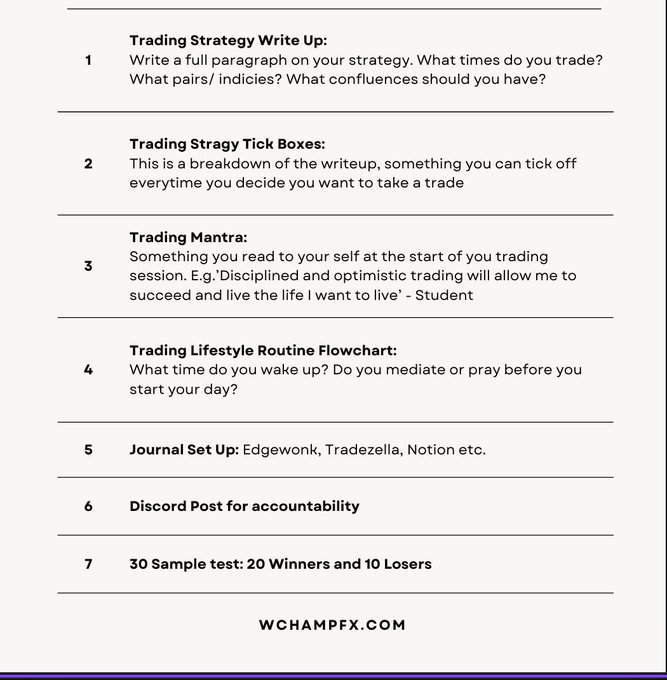
Here’s the checklist I use:
“The best traders don’t try to predict every move they manage risk and execute their edge consistently. Your job isn’t to be right on every trade; it’s to follow your plan with discipline. In the long run, consistency beats certainty every time.” Mark Douglas
I spent four years revenge trading, blowing accounts, and repeating the same week over and over.
Until I tried something that would make me a completely different trader months down the line.
I stopped trying.
Stopped trying to pass eval after eval.
Stopped trying to end the day green.
Stopped trying to be a profitable trader.
For all intents and purposes, I’d given up on this trading thing.
But I hadn’t.
I realized discipline and willpower can get you a working strategy.
But consistent profitability requires something completely different:
Knowing your patterns like the back of your hand, and having the tools to act differently when they show up.
So I started doing everything I wished I didn’t have to do.
Every week, I wrote down EXACTLY what I did wrong and somehow felt like an even bigger idiot than before.
I dug up the trades I pretended never happened, plotted them back on the charts, and retraced every micro-decision.
I stopped obsessing over my P&L and started tracking my emotional states:
9:10 — heart racing.
9:30 — wanted to end the day green.
12:00 — needed to make my losses back.
At first, it felt like the biggest waste of time and the biggest mistake I’d made in my trading career.
While I was scrolling past payout after payout, I was sitting there keeping an emotional journal and reviewing trades that happened two years ago.
It was probably the hardest six months of my trading career.
You’d think this was the turning point.
I did the work I was supposed to do.
And still...
Nothing.
So I changed course.
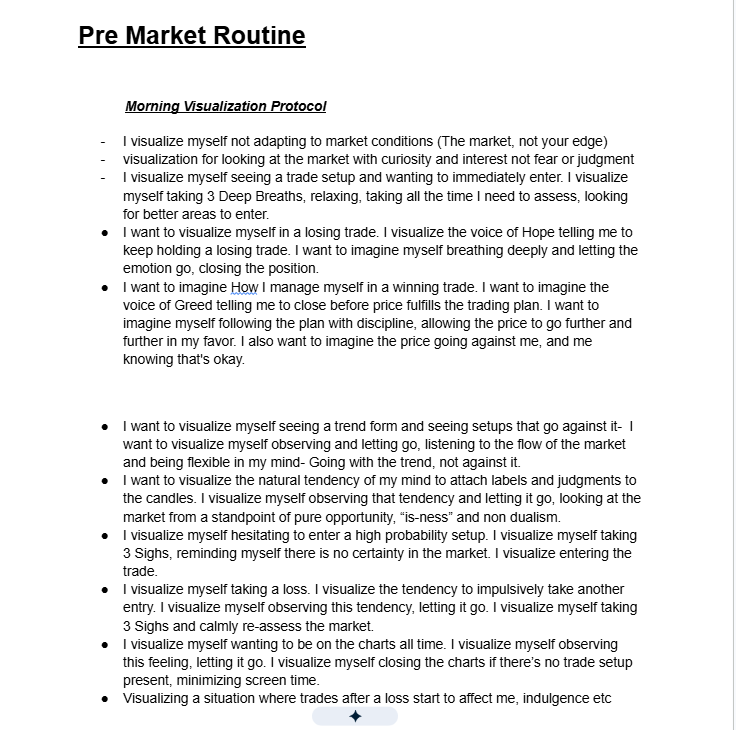
I built visualizations around every mistake I kept repeating.
But I didn’t visualize myself effortlessly following my plan.
I didn’t visualize myself breathing through my emotions like some perfectly disciplined trader.
I imagined the worst possible scenarios.
And made them ten times worse.
I took a screenshot of a day where I took 11 trades when my edge offered maybe one a week, and forced myself to look at it every morning.
I went back through every stupid, emotional, impulsive trade I could find.
I replotted them.
Screenshotted them.
And looked at dozens of them every morning to etch into my mind the decisions I never wanted to make again.
Then cracks started appearing in my losing-trader armor.
I revenge traded two trades instead of four after a loss.
It took me ten seconds longer to enter an impulsive trade.
I felt the urge to force something and, once in a while, actually caught it.
Tiny things.
At the time, they meant nothing to me.
All I saw was my peers getting ahead while I was doing work that didn’t even feel like real work.
Then, about three months later, it hit me:
I didn’t revenge trade this week.
I didn’t rush my entry.
I didn’t take a trade because I was bored.
The things I’d spent years trying to force myself to stop doing...
I just wasn’t doing anymore.
I changed my psychology.
Not by wanting trading success more.
Not by visualizing payouts.
Not by getting more motivated.
But by facing the mistakes that made me feel stupid.
By letting go of the need to win this week.
And by confronting the side of myself I’d spent years hoping would just disappear on its own.
I’ve attached the exact document I used below.
The visualizations.
The mistakes.
The screenshots.
All of it.
But don’t get it twisted.
Don’t copy my demons.
Find yours.
Every trader has specific trades, days, and moments they secretly wish profitability would erase.
The account they blew.
The revenge trade they knew they shouldn’t take.
The day price broke them and they completely lost control.
Don’t erase it.
It happened.
You did it.
Price broke you.
But that doesn’t mean you can’t get back up.
Stop running from the decisions that haunt you.
Study them.
Because they might contain the exact information you need to finally stop making them.
If you’re serious about trading, study your own trades.
Go through last week and separate:
Strategy mistakes vs. Execution mistakes.
Because these are two completely different problems.
If your strategy works but you keep executing it poorly, learning another strategy won’t save you.
Master what you already have.
I used to think becoming a better trader meant finding more setups.
More confirmations.
More concepts.
More reasons to enter.
So I kept adding things to my chart.
Until one day I realized…
I wasn’t becoming a better trader.
I was becoming a more confused trader.
The more I learned, the harder it became to make a decision.
I could find an FVG anywhere.
I could find an order block anywhere.
I could justify almost every move.
And that’s dangerous.
Because when you can find a setup everywhere…
you eventually start trading everywhere.
I had to completely change the way I looked at trading.
Instead of asking:
“Where is my entry?”
I started asking:
“Has the market given me a reason to trade?”
HTF direction first.
M15 alignment.
M5 confirmation.
M1 execution.
Defined risk.
Defined time.
And a rule that doesn’t care how badly I want to trade:
No setup = no trade.
That’s when trading became simple.
Not easy.
Simple.
I stopped trying to catch every move and started waiting for one setup that matched my model.
One setup.
Repeated for years.
That’s the game.
I put the complete framework behind this approach into my TFS Framework ebook especially for traders who understand ICT concepts but still struggle to turn them into a clear execution model.
If you’re in that stage, check the link in my bio.
Day trading is actually really simple, you just need to:
1. Stop trying to get rich this month.
2. Accept that randomness exists.
3. Define one model.
4. Delete the other five.
5. Master one setup before adding another.
6. HTF narrative first.
7. DOL second.
8. Entry confirmation last.
9. Stop treating every V-Shape as a setup.
10. Understand WHY the V-Shape is forming.
11. Know what price is drawing toward.
12. Know what liquidity has already been taken.
13. Respect time.
14. Stop ignoring context because the entry looks clean.
15. Trade one session.
16. Trade one instrument.
17. Stop staring at charts all day.
18. Define exactly when you are allowed to trade.
19. Define exactly when you are NOT allowed to trade.
20. If all DOLs are taken, be done.
21. If there is no clear draw, don’t invent one.
22. Stop trying to predict every candle.
23. Wait for price to come to you.
24. Learn to sit on your hands.
25. Learn to watch a move happen without you.
26. Missing a trade costs $0.
27. Forcing one can cost an account.
28. Accept that you will never catch every move.
29. Stop watching other traders’ PnL during your session.
30. Stop comparing your day to somebody else’s screenshot.
31. FOMO is self-sabotage.
32. Decide risk before entry.
33. Never move a stop further away.
34. Stop micromanaging every candle.
35. Don’t move BE emotionally.
36. Move BE because your model tells you to.
37. Let the trade invalidate properly.
38. Let winners reach the planned target.
39. Know your win rate.
40. Know your average R.
41. Know your max historical drawdown.
42. Be emotionally prepared for worse.
43. Risk less than your ego wants to.
44. Cut size in half.
45. Then cut it again if you still can’t execute.
46. Stay small until your execution is boring.
47. Never scale emotionally.
48. Never increase size just because you feel “locked in.”
49. Stop trading after revenge impulses.
50. Stop trading because you’re bored.
51. Stop trading to feel productive.
52. Stop trading because yesterday was a loss.
53. Never trade to recover money.
54. Never trade to prove anything.
55. Never trade because you “need a winning day.”
56. Trade to execute. Nothing more.
57. Journal the trade.
58. Journal the narrative.
59. Journal the DOL.
60. Journal the time of entry.
61. Journal what liquidity was taken.
62. Journal your emotional state too.
63. Review your losses deeper than your wins.
64. Stop calling every loss “unlucky.”
65. Find what YOU could have done better.
66. Accept that a correct bias can still produce a losing trade.
67. Accept that a bad trade can still win.
68. Outcome ≠ execution quality.
69. Grade the execution, not the PnL.
70. Backtest hundreds of examples.
71. Screenshot every clean setup.
72. Build your own database.
73. Build conviction through data, not Twitter.
74. Stop strategy hopping.
75. Stop indicator hopping.
76. Stop adding confirmation until the trade is gone.
77. Stop needing every LTF candle to agree with you.
78. HTF structure matters more than one random 30S move.
79. Time matters.
80. Context matters.
81. Location matters.
82. Delivery matters.
83. The V-Shape is just the trigger.
84. The V-Shape is NOT the entire edge.
85. Understand what price is reacting from.
86. Understand where price is likely drawing next.
87. Stop trying to make every day a trading day.
88. One clean setup is enough.
89. Zero trades is still a valid trading day.
90. Focus on one mistake at a time.
91. Protect capital aggressively.
92. Respect your maximum daily loss.
93. Accept flat weeks.
94. Accept slow months.
95. Accept boredom.
96. Stop looking for a holy grail.
97. Accept that YOU are the main variable.
98. Think in years, not individual trades.
99. Trust your data more than your emotions.
100. Stay in the game long enough for your edge to actually work.
Trading isn’t complicated.
Most traders just make it complicated because waiting for one clean setup feels harder than taking ten bad ones.
Profit factor is all that matters.
RR and win rate is irrelevant.
A 2R trade only has a 33% chance of winning where a 0.5R trade has a 66% chance of winning.
Very few traders understand this.
“Bro I’ve been trading for 6 months and I’m still unprofitable what do I do?”
You can start by building some patience
It took me 4+ YEARS to become a profitable trader
That whole time my daily routine would be:
•Check for trade setups before work
•Go to work (I was a bricklayer and worked in Tesco)
•Check for trade setups at lunch and after work
•Go to the gym
•Backtest my strategy or watch trading YouTube videos
This was my daily life for 4 years
Really boring, but I kept consistent and now I’m a 7 figure funded trader doing what I want, when I want
It’s going to take longer than you expect - but it’s worth it in the end