A French engineer who lives quietly in Paris has spent 30 years writing software that the entire internet now runs on without knowing his name.
He wrote the code that streams every YouTube video, every Netflix show, every TikTok clip. He wrote the code that runs the virtual servers underneath AWS, Google Cloud, and Microsoft Azure. He calculated more digits of pi than anyone in history. He has no Twitter. He has no marketing. He just keeps shipping.
His name is Fabrice Bellard.
Here is the story, because almost nobody outside the systems programming world knows what one man has built.
Fabrice was born in 1972 in Grenoble, France. He studied at École Polytechnique, the top French engineering school. He never went to Silicon Valley. He never built a startup empire. He just wrote code.
In 2000 he started a project called FFmpeg, an open-source multimedia framework for encoding, decoding, and streaming video. He was 28. The project did one thing nobody else had done well. It handled every video and audio format that existed, in one library, on every operating system. He led it himself for years.
Today FFmpeg is the invisible engine of the internet. YouTube uses it. Netflix uses it. VLC uses it. Chrome and Firefox use parts of it. Every Android phone, every iPhone, every smart TV, every video editing tool you have ever touched runs FFmpeg somewhere underneath. If you have watched a video on a screen in the last 20 years, Fabrice's code processed it.
He was not done.
In 2003 he started QEMU, a machine emulator and virtualizer. He wrote it solo until version 0.7.1 in 2005. QEMU lets you run any operating system on any other operating system. It became the foundation of modern virtualization. KVM, the Linux kernel hypervisor, runs on top of QEMU. Every major cloud provider, AWS, Google Cloud, Microsoft Azure, IBM Cloud, runs virtual machines on infrastructure built around it. The Quick Emulator is the most cited piece of cloud infrastructure code on Earth.
He kept going.
In 2001 he won the International Obfuscated C Code Contest with a small C compiler that grew into TCC, the Tiny C Compiler. TCC can compile and boot a Linux kernel from source in under 15 seconds. In 2004 he calculated the most digits of pi ever computed at the time, using a personal desktop computer and an algorithm he derived himself called Bellard's formula. In 2011 he wrote a complete PC emulator in pure JavaScript that runs Linux in your browser, a project called JSLinux that engineers still cannot believe is real.
In 2019 he released QuickJS, a small but complete JavaScript engine that fits where V8 cannot. In 2021 he released NNCP, a neural network based lossless data compressor that immediately took the lead on the Large Text Compression Benchmark.
Then he turned his attention to large language models. He built TextSynth Server, a web server with a REST API for running LLMs locally. He released ts_zip and ts_sms, compression utilities that use language models to compress text and short messages at ratios traditional algorithms cannot reach. He released TSAC, a very low bitrate audio compression system. In December 2025 he released Micro QuickJS, a new JavaScript engine for microcontrollers, separate from QuickJS, designed for environments with almost no memory.
Fabrice co-founded a telecom company called Amarisoft in 2012, where he serves as CTO. Amarisoft builds 4G and 5G base station software used by carriers and labs around the world. He has been running it for over a decade while continuing to ship personal projects from his own home page at bellard dot org
He has no Twitter. He has no Instagram. He gives almost no interviews. His personal website is a flat list of projects with no styling, no fonts, no marketing copy. Just titles and links.
A quiet French engineer who never moved to Silicon Valley wrote the code that quietly runs the internet.
He is still shipping.
Krishna Rao is the CFO of Anthropic, and this is his first podcast appearance.
He joined the company two years ago when run-rate revenue was about $250M. Today it is $30B. He has helped raise ~$75B and is responsible for the procurement and allocation of compute.
I feel lucky we get to hear what it is like to sit inside a company this consequential at a moment this pivotal.
We discuss:
- The cone of uncertainty
- How he allocates compute across Trainium, TPUs, and GPUs
- What investors misunderstand about model companies
- Why the returns to frontier intelligence keep rising
- Platform vs application and where Anthropic builds its own products
- How Anthropic uses Claude internally
I have asked my closing question about the kindest thing more than 500 times. Krishna's answer is one I have never heard before.
Enjoy!
Timestamps:
0:00 Intro
2:38 The Compute Canvas
6:51 The "Cone of Uncertainty"
11:58 Why the Returns to Frontier Intelligence Are So High
16:45 Recursive Self-Improvement
20:20 Scaling Laws
23:30 Sourcing $100 Billion in Compute
28:05 Platform vs. Application Strategy
32:52 Pricing Dynamics
38:48 How Anthropic’s Finance Team Uses Claude
43:24 Raising Capital & Overcoming Investor Skepticism
52:32 Public Perception, Risks, and Government Regulation
57:25 Mythos Release
1:12:33 What Could Derail the AI Revolution?
1:13:47 Biotech and Healthcare
1:15:31 The Kindest Thing
Today we're sharing our work on interaction models. A new class of model trained from scratch to handle real-time interaction natively, instead of gluing it onto a turn-based one.
https://t.co/MoS5s4cm60
The @CVPR Report.
I've been seeing lots of computer vision papers being passed around here on X, since many AI researchers just learned their papers have been accepted.
So I asked @blevlabs to find them all for me. It's not complete because I'm still not pulling down many posts each day, but it is interesting enough to share.
Congrats to all the people who have been accepted. These papers give you a little taste of the future.
https://t.co/baFRJiI03M
To build safer AI, we need to understand how models "think". 🧠
Enter Gemma Scope 2, a new set of tools to interpret Gemma 3: our family of lightweight open models.
It can help researchers trace internal reasoning, debug complex behaviors and identify risks → https://t.co/W3UmLx2DlN
My first ever camera appearance interviewing Nobel-Prize winner John Jumper. I was SO nervous! 😅 This was meant to be an exclusive one-off celebration for Episode #1000. Really hope you'll have as good as time as I had there! Full video: https://t.co/Pr5PWHWK4X
With profound sadness, we say goodbye to Piyush Pandey. The world has lost an advertising giant, India its greatest storyteller, and Ogilvy a piece of its soul. His legacy and spirit will forever inspire us. https://t.co/wAzE0qRXHU
#PiyushPandey
Introducing NotebookLM for arXiv papers 🚀
Transform dense AI research into an engaging conversation
With context across thousands of related papers, it captures motivations, draws connections to SOTA, and explains key insights like a professor who's read the entire field
An exciting milestone for AI in science: Our C2S-Scale 27B foundation model, built with @Yale and based on Gemma, generated a novel hypothesis about cancer cellular behavior, which scientists experimentally validated in living cells.
With more preclinical and clinical tests, this discovery may reveal a promising new pathway for developing therapies to fight cancer.
Today Thinking Machines Lab is launching our research blog, Connectionism. Our first blog post is “Defeating Nondeterminism in LLM Inference”
We believe that science is better when shared. Connectionism will cover topics as varied as our research is: from kernel numerics to prompt engineering. Here we share what we are working on and connect with the research community frequently and openly.
The name Connectionism is a throwback to an earlier era of AI; it was the name of the subfield in the 1980s that studied neural networks and their similarity to biological brains.
https://t.co/lrJioBmpbT
I watched this like 3 times because it is so mind blowing
“This is a microprocessor, how did humans make this. How as human beings did we even come close to making something like this”
He takes a microscope and keeps zooming:
I’m Russian.
My girlfriend is Italian.
We’ve been together 2+ years…
And her culture still blows my mind.
11 bizarre things about Italian life
I just can’t comprehend: 🧵🤌
Very excited to share the best coding model we’ve ever built! Today we’re launching Gemini 2.5 Pro Preview 'I/O edition' with massively improved coding capabilities. Ranks no.1 on LMArena in Coding and no.1 on the WebDev Arena Leaderboard.
It’s especially good at building interactive web apps - this demo shows how it can be helpful for prototyping ideas. Try it in @GeminiApp, Vertex AI, and AI Studio https://t.co/7FbP3R1cmF
Enjoy the pre-I/O goodies !
I'm Singaporean.
Everyone credits Lee Kuan Yew for Singapore’s success.
But in every great nation, there's also a real genius behind the scenes person - The "COO of the nation".
Here's the story of the greatest right-hand man (and lessons you can learn): 🧵
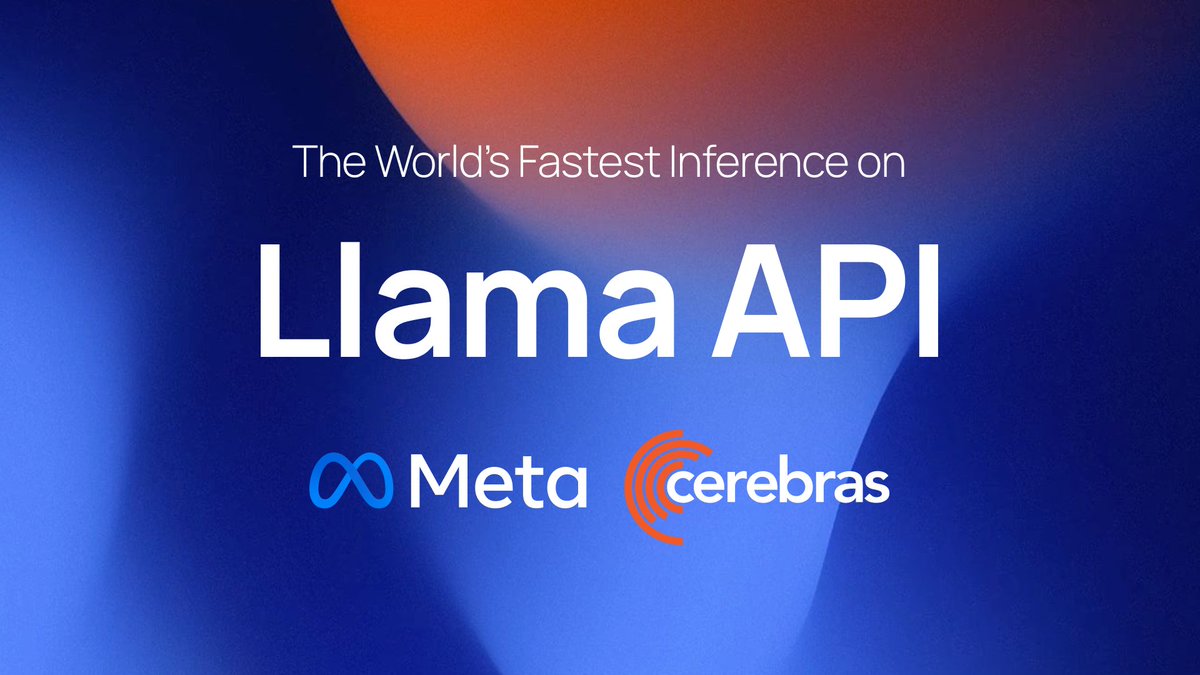
Cerebras and @Meta Collaborate to Drive Fast Inference for Developers in New Llama API
🦙The world’s most popular open-source models — now with the world’s fastest inference.
🔑 Native to @AIatMeta Llama API with 1-click API key generation.
🗣️ Unlock next-generation applications like real-time voice assistants, instant agents, sub-second reasoning
@karpathy There is something for everyone—a great leveller. A kid learning math ✏️, a grandpa writing poems ✍️, a homemaker planning meals 🥘, a CEO brainstorming 💼, a lawyer drafting ⚖️, a driver navigating 🚚, the blind using voice 🧑🦯, the deaf chatting 🧏, the lonely finding company ❤️