No, you don't get it.
He does not have $1 trillion sitting in cash, it is 99% stock in his companies.
To make that wealth liquid would mean selling all that stock which would swiftly destroy *both* the companies (Tesla, SpaceX, others) and the wealth. If he sold it all, he'd end up with maybe $100b max, several hundred thousand people would be out of work, the companies ruined and many of their suppliers also ruined.
Okay, but now Elon has $100b in cash, and can "solve the world's problems".
$100b divided by the world's 8 billion people is $12
If you were in charge, several of the most innovative industrial companies in the world would be destroyed, hundreds of thousands out of work, and space would again close to human civilization for another generation.
But everyone on earth could have one nice meal and you could revel in your altruism.
For aeons, the confident quickly wound up dead unless they knew what they were doing, so we evolved to equate seasoned confidence with competence. But today, there is rarely a price for being wrong, so our attraction to confidence now attracts us to the most confidently idiotic.
Katherine Boyle just identified Elon Musk’s most important contribution to America, and it has nothing to do with the products he shipped.
Boyle, General Partner at a16z: “I think Elon’s most important contribution to this country is training two generations of engineers to work with their hands again.”
For ten years, America’s sharpest technical minds optimized ad clicks and built messaging apps. Software consumed ambition. The physical world became something you abstracted into APIs, not something you touched or understood.
Elon didn’t reverse that through inspiration. He reversed it by building companies that required understanding manufacturing or failing completely.
SpaceX and Tesla forced engineers to learn how metal fractures, how tolerances cascade through systems, how physical iteration costs months and millions per failure. No debugging. No patches. Just physics that doesn’t negotiate.
Boyle: “Training two generations of engineers.”
The product isn’t the cars. It’s the people. Look at who’s founding America’s critical hard-tech companies now. The common thread isn’t Stanford or MIT. It’s time on factory floors at SpaceX or Tesla.
They learned welding. They learned that “impossible” just means unsolved engineering, not violated physics. They learned failure in the physical domain where mistakes compound instead of reverting.
Elon didn’t build companies. He accidentally rebuilt industrial knowledge that had been decaying for thirty years while America’s best minds chased digital scale.
Boyle: “Work with their hands again.”
Three words that sound quaint but describe a civilizational inflection point.
Software dominated because it scaled infinitely at zero marginal cost. Physical manufacturing was slow, expensive, unfashionable. Building real things became what you did if you couldn’t code.
Elon made atoms matter again. Made manufacturing the hardest problem worth solving. Made physical engineering prestigious in ways it hadn’t been since humans walked on the moon.
The evidence is everywhere now. Technical talent that doesn’t default to “which app” but asks “which physical thing should exist that currently doesn’t.”
Ambition redirected from optimizing engagement metrics to building rockets. From scaling users to scaling factories. From virtual products to physical infrastructure.
That shift matters more than any vehicle or spacecraft Musk delivered. Products obsolesce. Redirecting an entire generation’s engineering ambition from digital to physical compounds across decades and rebuilds industrial capability at civilizational scale.
We stopped just coding the future. We started machining it, welding it, breaking it in reality until physics confirms it works. That transformation from virtual to tangible ambition is reconstructing American manufacturing one engineer at a time.
And those engineers are now training the next wave. The compounding has started. The School of Elon doesn’t need Elon anymore. It’s self-sustaining, spreading through an entire generation that learned building real things matters more than building virtual ones.
That’s not just a business achievement. That’s a civilization remembering how to make things that matter in the physical world again. And it might be the only thing that saves American technological leadership when the competition is just building faster because they never forgot.
FROM ONE TO ZERO
There is a scenario in which Silicon Valley could literally go to zero in the next ten years. The successors would be China and the Internet: namely Chinese tech companies and Internet-based crypto protocols, because those have embedded political protection in a way Silicon Valley simply doesn’t.
Here’s why this is possible.
(1) The first and most obvious factor is that wealth seizures are now on the ballot in the most literal sense. The 2026 “Billionaire Act” referendum[1] directly targets the founders of billion dollar tech companies, which is to say that it directly targets the power law, which is to say that it targets the very economic logic of venture capital itself. No prospect of billionaires means no angel funding means no Silicon Valley. And if the first ballot doesn’t land, more referenda are likely to follow, till the ballots hit the target.
(2) The second factor is that while some individuals have realized the threat, and have exited California for places like Texas and Miami (or Dubai and Singapore), many companies still have not. Unless the CEO makes it a priority to rebalance the entire team out of CA to another office, unless they viscerally realize that everything they’re building will be seized if they remain in California, they won’t prioritize it. The very smartest like Elon made this move years ago, but political normies won’t.
(3) That brings me to my third point: the Bay Area tech scene is increasingly selected for political normies. They seem not to understand that companies incorporated in Delaware, listed in New York, and headquartered in California are embedded at three levels of the stack in enemy (which is to say blue) territory. They are still executing an obsolete 2000s-era playbook, which assumes the political platform under their feet will remain stable.
(4) What’s the political platform? It’s a platform just like iOS or Android. In this case, it means the rules tech takes for granted in Washington, California, Delaware, and NYC that enable things like property rights, meritocratic hiring, visas, wire transfers, IPOs, and general rule of law.
Those rules have been eroded over the last decade thanks to the Second American Civil War. A brief list includes: wealth seizures, DEI, remittance taxes, visa bans, abolition of police, tariffs, recission of stock awards (eg in Elon’s case), and punitive anti-tech regulation (especially for AI and crypto under Biden).
(5) Unfortunately, this erosion of propitious conditions for tech now comes from both left and right. For much of the left, tech is white/male/capitalist. For much of the right, it is nonwhite/immigrant/globalist. Tech is now a class enemy for the US left and (to a lesser but real extent) a racial enemy for the right. This is a bad place to be.
(6) This brings me to my next factor: the rise of extreme anti-tech sentiment. Especially for the Democrats, their rage at the Internet for taking away their control over media, money, and speech knows no bounds. Outside X, they hiss and spit daily over AI and crypto. And they are already burning self-driving cars, lighting up Tesla dealerships, and shooting CEOs. It is only a matter of time before more Luigi leftists and Kirk killer types engage in stochastic anti-tech terrorism. Needless to say, this is not something Silicon Valley has budgeted for.
(7) The good news is tech has already largely decentralized. Hardware is in China. Elon is in Texas. Crypto is global. 400+ cities have unicorns. And once we have open AI models that can do what Claude Code does, it’ll be feasible to replicate much of what SV once did. So, progress will continue.
(8) You can already see inklings of this future. Apple couldn’t ship a car, but Xiaomi could, and yet it’s <1/10 the valuation. Similarly, top crypto projects are roughly where tech was in 2010: near $100B, not yet the main event.
So: the anti-tech meteor may not yet have hit the Silicon Valley dinosaurs. But we can see the mammals.
In the 90s, the worry was that only the rich would have digital products. That was called the digital divide. And it turned out to be completely wrong.
Because digital is cheap.
Physical is the premium product.
just tested LUKSO’s new token generator w/ our luminaries and it’s amazing🤩
this is a huuuuge unlock: now anyone can mint tokens instantly with no technical skills needed
i’m talking collectibles, meme coins, fan tokens, badges… all launched in a few clicks
take a look👇🏽🧵
As a Dawkins-era atheist I underestimated Christianity’s role as a civilisational operating system.
I took its moral foundations for granted, assuming they were so self-evident that all humans would reach them once basic needs were met.
We need to have an official remembrance day for Charlie Kirk.
He was born on October 14, 1993.
We need to honor his legacy and have a day just for him. His birthday.
They did it for MLK. They can do it for Charlie.
Please repost if you agree so we can get this done.
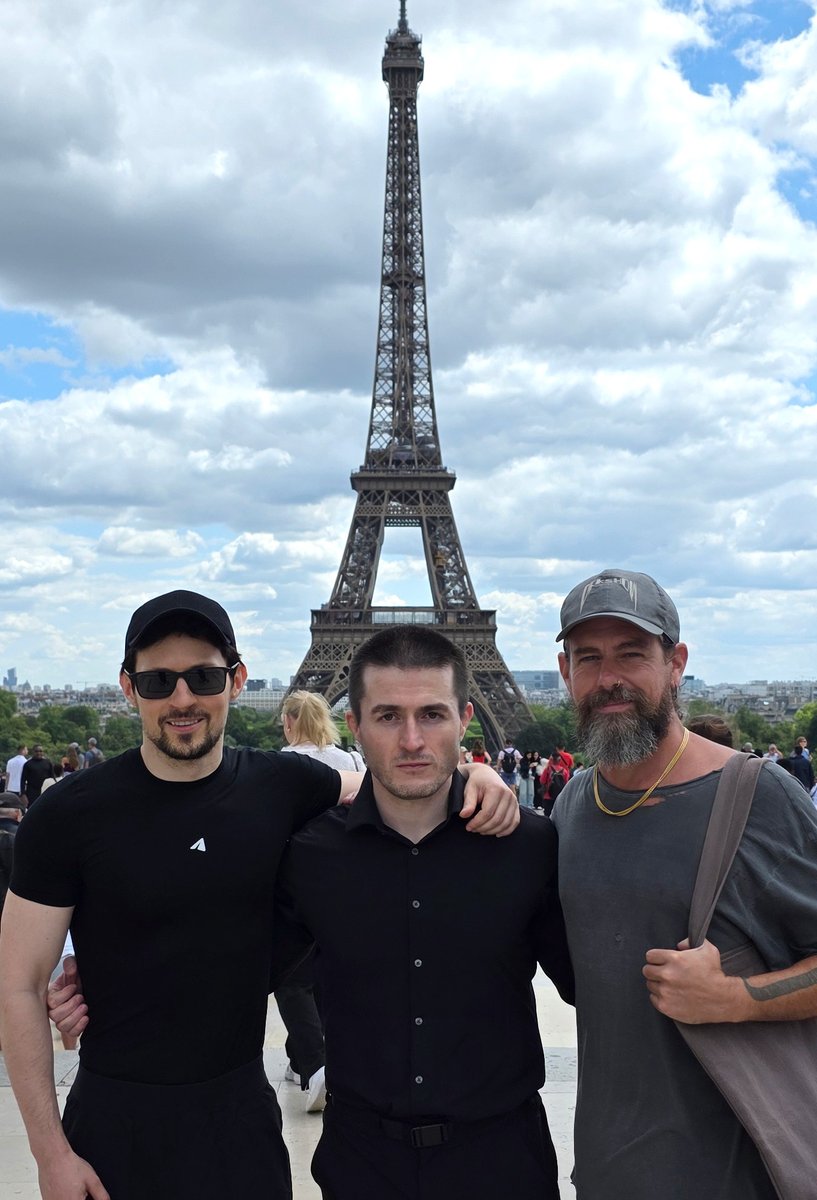
Life is full of interesting surprises. I stopped by Paris and ran into these two (@durov and @jack) separately, and we had an amazing conversation about life and freedom. The experience definitely felt like part of a simulation. I'm pretty sure the pic is AI generated.
I'm grateful for this life, whatever it is, and for all of you 🙏❤️
Life is full of interesting surprises. I stopped by Paris and ran into these two (@durov and @jack) separately, and we had an amazing conversation about life and freedom. The experience definitely felt like part of a simulation. I'm pretty sure the pic is AI generated.
I'm grateful for this life, whatever it is, and for all of you 🙏❤️









![balajis's tweet photo. FROM ONE TO ZERO
There is a scenario in which Silicon Valley could literally go to zero in the next ten years. The successors would be China and the Internet: namely Chinese tech companies and Internet-based crypto protocols, because those have embedded political protection in a way Silicon Valley simply doesn’t.
Here’s why this is possible.
(1) The first and most obvious factor is that wealth seizures are now on the ballot in the most literal sense. The 2026 “Billionaire Act” referendum[1] directly targets the founders of billion dollar tech companies, which is to say that it directly targets the power law, which is to say that it targets the very economic logic of venture capital itself. No prospect of billionaires means no angel funding means no Silicon Valley. And if the first ballot doesn’t land, more referenda are likely to follow, till the ballots hit the target.
(2) The second factor is that while some individuals have realized the threat, and have exited California for places like Texas and Miami (or Dubai and Singapore), many companies still have not. Unless the CEO makes it a priority to rebalance the entire team out of CA to another office, unless they viscerally realize that everything they’re building will be seized if they remain in California, they won’t prioritize it. The very smartest like Elon made this move years ago, but political normies won’t.
(3) That brings me to my third point: the Bay Area tech scene is increasingly selected for political normies. They seem not to understand that companies incorporated in Delaware, listed in New York, and headquartered in California are embedded at three levels of the stack in enemy (which is to say blue) territory. They are still executing an obsolete 2000s-era playbook, which assumes the political platform under their feet will remain stable.
(4) What’s the political platform? It’s a platform just like iOS or Android. In this case, it means the rules tech takes for granted in Washington, California, Delaware, and NYC that enable things like property rights, meritocratic hiring, visas, wire transfers, IPOs, and general rule of law.
Those rules have been eroded over the last decade thanks to the Second American Civil War. A brief list includes: wealth seizures, DEI, remittance taxes, visa bans, abolition of police, tariffs, recission of stock awards (eg in Elon’s case), and punitive anti-tech regulation (especially for AI and crypto under Biden).
(5) Unfortunately, this erosion of propitious conditions for tech now comes from both left and right. For much of the left, tech is white/male/capitalist. For much of the right, it is nonwhite/immigrant/globalist. Tech is now a class enemy for the US left and (to a lesser but real extent) a racial enemy for the right. This is a bad place to be.
(6) This brings me to my next factor: the rise of extreme anti-tech sentiment. Especially for the Democrats, their rage at the Internet for taking away their control over media, money, and speech knows no bounds. Outside X, they hiss and spit daily over AI and crypto. And they are already burning self-driving cars, lighting up Tesla dealerships, and shooting CEOs. It is only a matter of time before more Luigi leftists and Kirk killer types engage in stochastic anti-tech terrorism. Needless to say, this is not something Silicon Valley has budgeted for.
(7) The good news is tech has already largely decentralized. Hardware is in China. Elon is in Texas. Crypto is global. 400+ cities have unicorns. And once we have open AI models that can do what Claude Code does, it’ll be feasible to replicate much of what SV once did. So, progress will continue.
(8) You can already see inklings of this future. Apple couldn’t ship a car, but Xiaomi could, and yet it’s <1/10 the valuation. Similarly, top crypto projects are roughly where tech was in 2010: near $100B, not yet the main event.
So: the anti-tech meteor may not yet have hit the Silicon Valley dinosaurs. But we can see the mammals.](https://pbs.twimg.com/media/G_uajy0X0AA7XbM.jpg)