Strategic partnerships deliver their greatest value when they evolve beyond project implementation into long-term platforms for innovation, knowledge exchange and shared economic transformation.
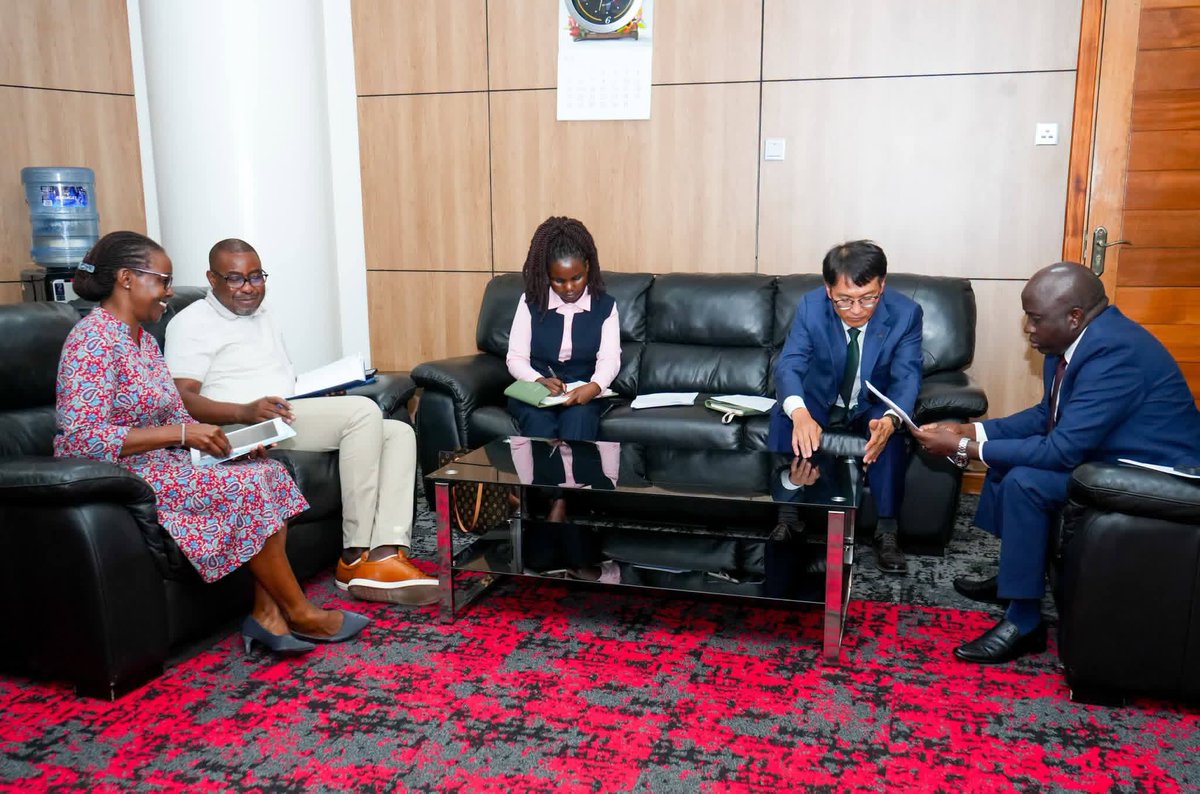
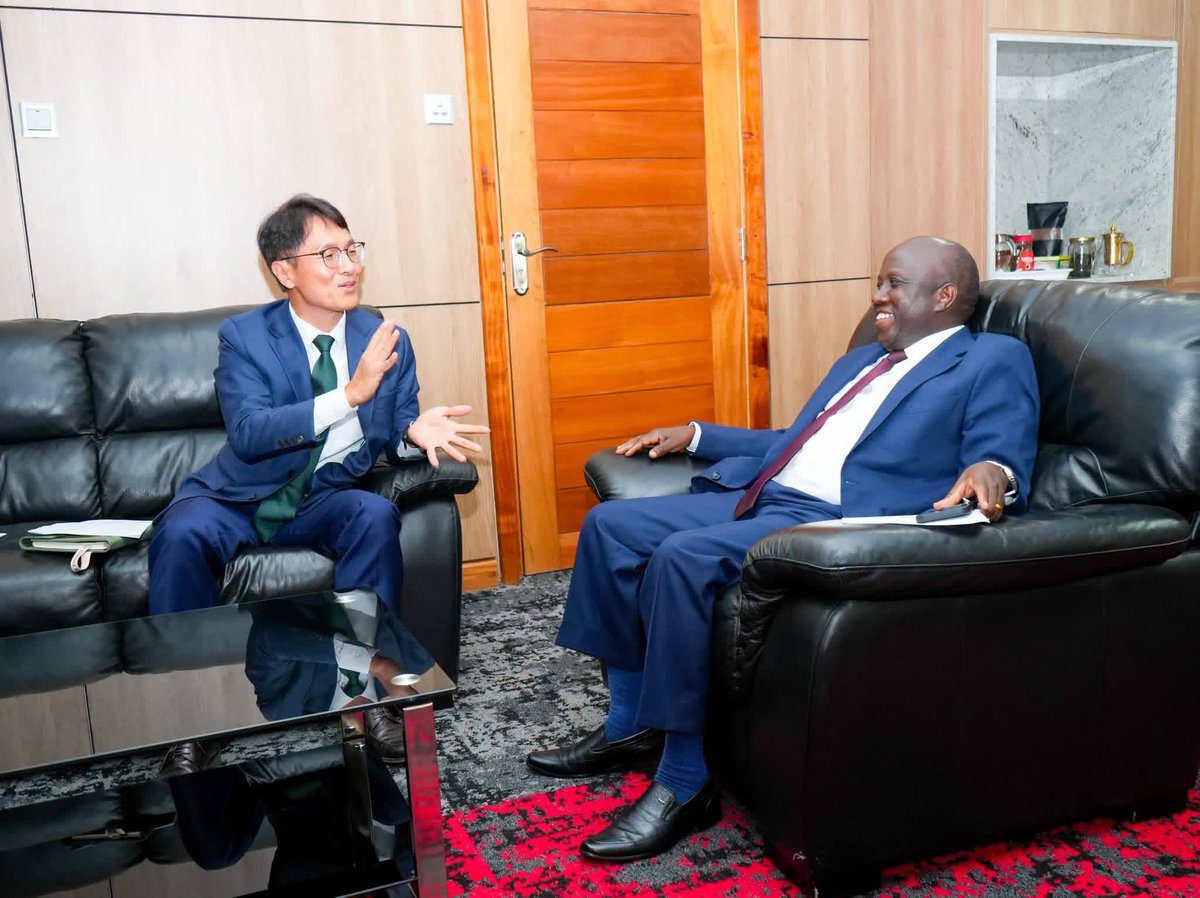
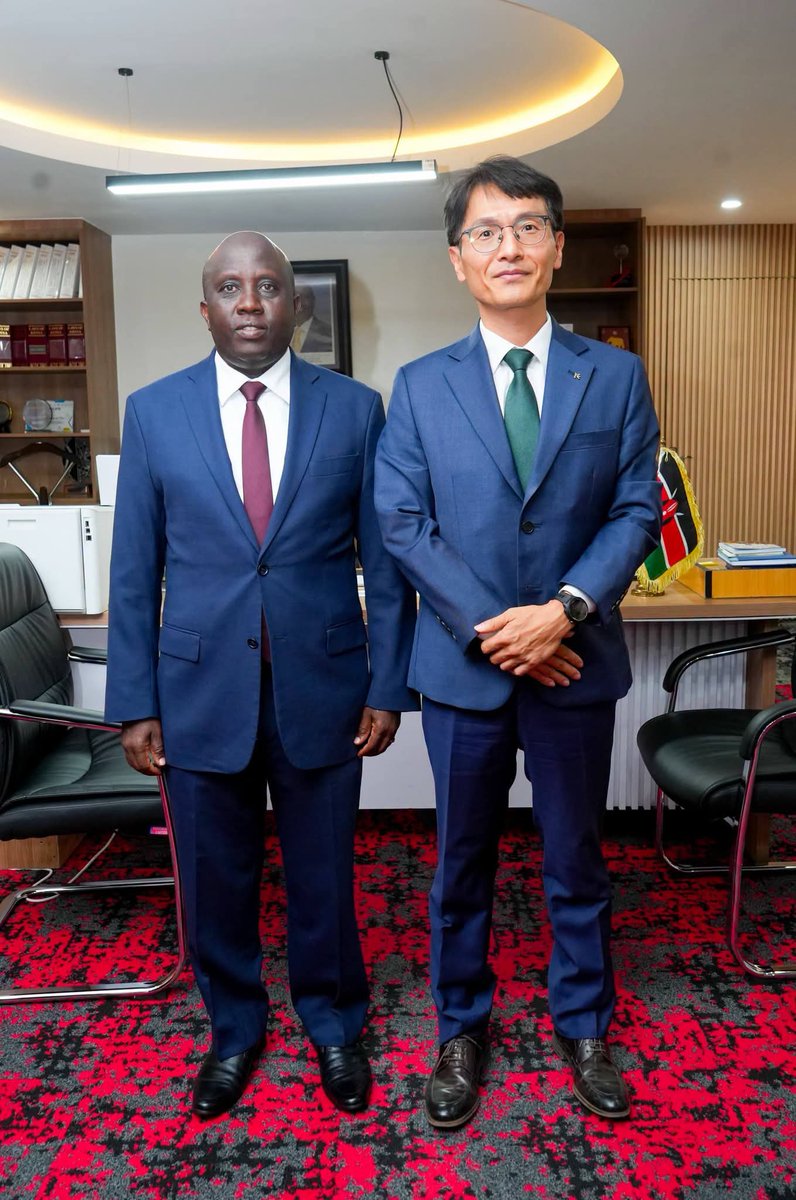
Today, I met with the Korea Exim Bank (KEXIM) Country Director, Mr. Byunghyun Hwang, to take stock of the progress of the Kenya Advanced Institute of Science and Technology (Kenya-AIST) as we advance towards its operationalization. As Kenya strengthens its national innovation ecosystem, institutions such as Kenya-AIST will play a pivotal role in developing the research capacity, scientific talent and technological capabilities needed to power a knowledge-driven economy.
Our discussions also focused on the next phase of collaboration at Konza Technopolis, including ongoing engagements around the proposed Digital Media City (DMC) and AI data centre initiatives. These strategic investments have the potential to strengthen Kenya's digital infrastructure, expand opportunities for innovation and position the country as a regional destination for emerging technologies.
We further looked ahead to the upcoming visit by a Korean delegation in August, which will provide an opportunity to broaden cooperation across ICT, cultural exchange and policy dialogue while identifying new areas for mutually beneficial collaboration.
Kenya's digital transformation journey is increasingly being shaped by partnerships that combine investment with knowledge, technology transfer and institutional development. As we continue implementing the Digital Superhighway agenda, sustained collaboration with trusted global partners will be essential in building the ecosystems, capabilities and infrastructure that will define the next chapter of Kenya's digital economy.
Uzalendo Half-Marathon:
Gideon Kiprotich and Zehna Yego are the winners
Kiprotich timed 1 hour, 5.59 minutes to win men’s race
Race aims to raise funds to educate children from poor families
#CitizenWeekend
The best is yet to come. 🇰🇪🚀
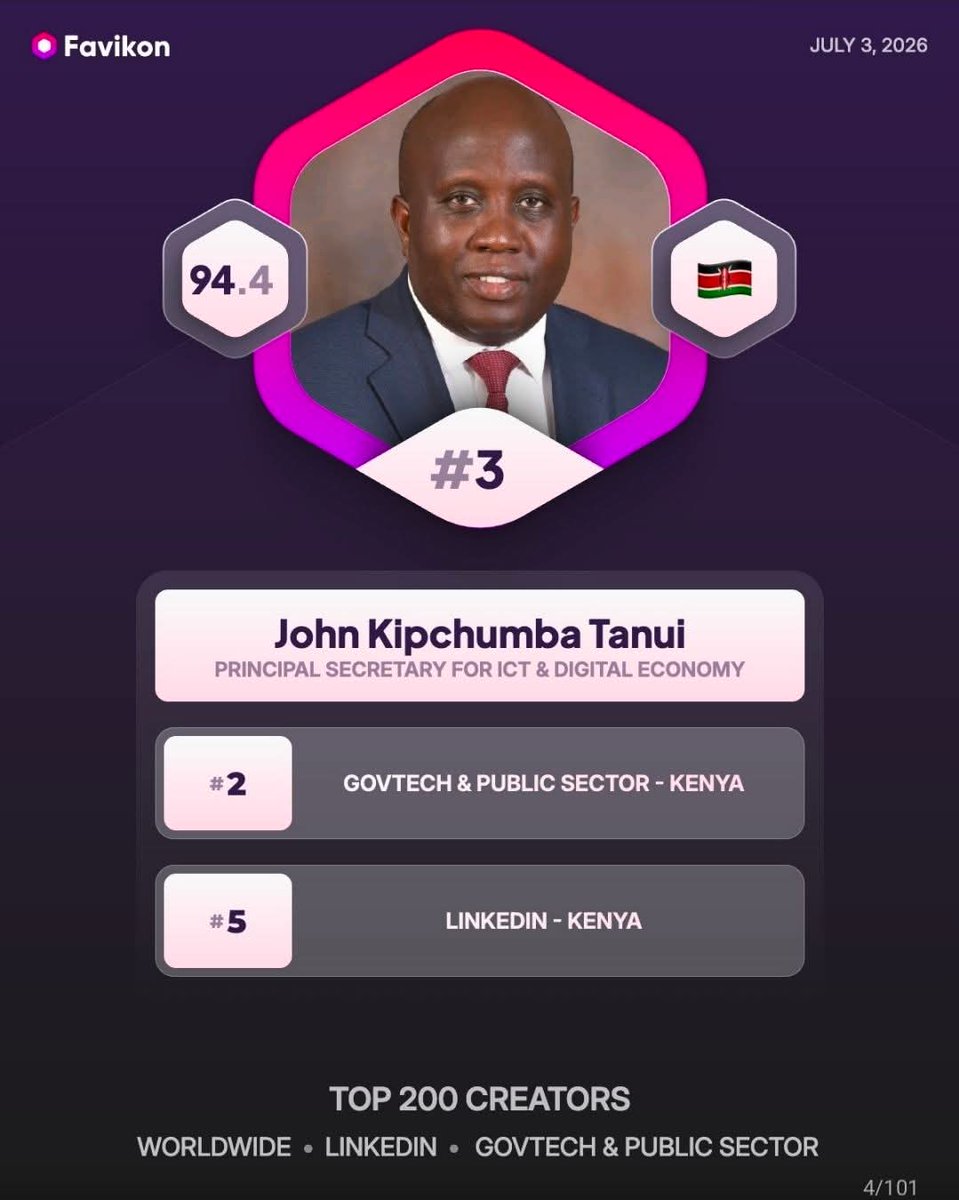
I am deeply honoured to be recognised among the world's leading GovTech voices, ranked #3 globally, #2 in Kenya's GovTech & Public Sector, and #5 on LinkedIn Kenya.
#NextGen.Ke is now LIVE! 🚀
If you're a Kenyan graduate (18–35), register today for a chance to access stipend-supported internships with leading employers.
Build your skills. Expand your network. Launch your career.
Deadline: 8 July, 2026
https://t.co/vbwUNyltCD
Great institutions do not merely produce graduates; they shape character, nurture purpose, and prepare young people to lead the future.
Today, I was honored to join the Gender & Culture CS @hannawcheptumo ,during the Kapropita Girls' High School the Rehoboth Class of 2025 Thanksgiving Service under the theme "A Heart of Gratitude" drawn from Psalm 100.
Also present was Baringo Central Mp Hon Hon Joshua Kandie , & CEC Agriculture Hon. Risper Chepkong'a.
Founded on 16th March 1957 by the African Inland Mission, Kapropita Girls High School remains one of the oldest and most distinguished institutions in Baringo County. Built on a strong Christian foundation, the school has nurtured over 9,400 young women since inception and continues to be a beacon of academic excellence, leadership, and moral formation.
The institution's growth has been guided by visionary leadership over the decades, including the late President H.E. Daniel Toroitich Arap Moi, who served as Chairman from 1981 to 2007 and contributed immensely to the school's development. Today, the Board of Management under the leadership of Eng. Paul Limo continues to steer the school toward even greater heights.
The Rehoboth Class of 2025 has every reason to celebrate. Out of 305 KCSE candidates, the school attained a commendable mean score of 7.144 (C+) and achieved a 68.9% university transition rate. More importantly, the school has set an ambitious target of attaining a mean score of 8.5 (B-) in 2026, reflecting a culture that refuses to settle and continuously strives for excellence.
Drawing from Psalm 100, Rev. Peter Ng'ok delivered a powerful reminder that gratitude is never an accident; it is a deliberate acknowledgment of God's sovereignty.
One illustration particularly stood out. Like the tiny mouse crossing a bridge alongside a giant elephant and later claiming, "Look how we shook the bridge," we are often tempted to attribute success solely to ourselves. Yet the truth is that behind every achievement, every promotion, every leadership opportunity, and every academic milestone is the hand of God making circumstances align in our favor.
As I reflected on the remarkable achievements of these young women, I encouraged them to remain grounded in faith, integrity, and gratitude. The excellent results achieved today are not merely a reflection of academic ability, but of resilience, discipline, dedicated teachers, supportive parents, and God's faithfulness.
As these students prepare to join institutions of higher learning, enter the workforce and participate in shaping our democracy, they are stepping into a Kenya that is undergoing unprecedented transformation.
Through the Government's Bottom-Up Economic Transformation Agenda (BETA), we are laying the foundation for their future through investments in the Digital Superhighway, Artificial Intelligence, digital skills, innovation ecosystems, affordable housing, digital public infrastructure, and job creation opportunities for young people.
We are expanding connectivity across the country, strengthening Kenya's position as Africa's digital innovation hub, and creating pathways for young people to participate meaningfully in the digital economy.
The Government can build the digital superhighway, but it is this generation of young that must drive the vehicles of innovation on it.
As we embrace emerging technologies such as Artificial Intelligence, may we never forget the values that sustain lasting success. Let us pair Artificial Intelligence with Authentic Integrity, innovation with character, and ambition with gratitude.
Congratulations to the Rehoboth Class of 2025 and the Principal, teachers, parents, alumni, the Board of Management and the entire Kapropita Girls High School fraternity.
Equally all the best to the Class of 2026 Mary's of Bethany.
May today's gratitude inspire tomorrow's excellence.
Building Africa’s Digital Future: Is It Time for Device as a Service?
Africa’s digital transformation is accelerating. Governments are investing in connectivity, digital skills, digital public infrastructure, devices, and local electronics manufacturing. Yet an important question remains:
What happens to devices after they leave the factory?
Yesterday, I visited the world-class facilities of @CloseTheGapInt and Cycle IT in Belgium, where I witnessed a fully certified operation covering secure data destruction, device refurbishment, asset recovery, and responsible recycling.
The visit reinforced a conviction that the future of Africa’s digital economy is not only about manufacturing devices—it is about managing them throughout their entire lifecycle.
Kenya’s electronics manufacturing sector now has capacity exceeding 7 million devices annually. At the same time, the rollout of 1,450 Digital Hubs will require more than 150,000 devices to support digital skills, innovation, AI training, online work, and entrepreneurship.
In addition, through the Kenya Digital Economy Acceleration Project (KDEAP), Government is rolling out 10,000 smart boards and laptops to Junior Secondary Schools, building on the foundation laid by the Digital Literacy Programme.
Across Africa, there are now over 700 million mobile subscribers and more than 1 billion connected devices in circulation. Kenya alone has over 70 million mobile subscriptions.
This presents a significant opportunity.
Imagine a future where devices are not simply manufactured, sold, used, and discarded. Instead, they are deployed, maintained, upgraded, recovered, refurbished, remanufactured, and ultimately recycled within a circular ecosystem.
This is the essence of Device as a Service (DaaS).
Globally, manufacturers are increasingly embracing lifecycle management models that combine deployment, maintenance, upgrades, refurbishment, recovery, and recycling. The result is lower lifecycle costs, reduced e-waste, improved sustainability, and stronger local service ecosystems.
For Kenya, this could unlock a new phase of industrial growth. Beyond assembly, manufacturers could generate value through maintenance, repair, refurbishment, remanufacturing, recovery, and recycling services—creating jobs, strengthening supply chains, and enhancing competitiveness.
This thinking informed our decision to incorporate e-waste management and device lifecycle spaces within the Digital Hubs Programme, enabling hubs to evolve into centres for repair, refurbishment, digital skills, and circular economy innovation.
This raises an important question:
Could Kenya’s electronics manufacturers partner more closely with Government to develop Device as a Service models for schools, Digital Hubs, public institutions, and citizens?
Could partnerships involving manufacturers, Close the Gap International, and the WEEE Centre help establish a national framework for device lifecycle management and responsible e-waste handling?
As Kenya expands device deployment across the economy, embedding sustainability into programme design may prove just as important as the devices themselves.
My sincere appreciation to Olivier Vanden Eynde, Founder of Close the Gap International, for championing a vision that demonstrates how technology, sustainability, and inclusion can advance together.
As a symbolic reminder of this opportunity, I was gifted a professionally refurbished device during the visit. Rather than keep it, I intend to donate it to a deserving young Kenyan entrepreneur working in clean energy, circular economy, sustainability, or green technology, particularly among recent NYOTA Programme beneficiaries.
“The next frontier in electronics manufacturing is ensuring every device is repaired, upgraded, reused, refurbished, and recycled throughout its lifecycle.”
Driving Kenya’s Digital Superhighway Straight into the Classroom
For years, we have spoken about bridging the digital divide. Today, we are putting the physical infrastructure directly into the ecosystem where it can spark the most profound change: our classrooms, our laboratories and our teacher training hubs.
I am incredibly thrilled to celebrate the official launch and flag-off of the Digital Literacy Programme (DLP) devices at the [Centre for Mathematics, Science and Technology Education in Africa (CEMASTEA)] today.
This crucial intervention is a milestone under the [Kenya Digital EconomyAccelerationProject ], funded by the World Bank and spearheaded by the Ministry of Information, Communications and the Digital Economy through the ICT Authority. With the rollout of 10,382 interactive smartboards and laptops to public Junior Schools across the country, we are directly expanding high-tech capabilities into thousands of institutions nationwide during this first phase.
Why This Launch Matters
Technology is not an elective; it is a fundamental pillar of modern literacy. We are executing a highly strategic, three-pronged transformation:
* Empowering the Educators: We cannot build tech-savvy students without digitally empowered teachers. Centering this deployment at CEMASTEA ensures our trainers and teachers master digital pedagogy, AI integration, and virtual lab modeling.
* Democratizing STEM Learning: Whether a child sits in an urban center or a remote rural school, these devices ensure uniform, high-quality, and curriculum-aligned digital science and mathematics content.
* Accelerating our Digital Economy: This rollout directly feeds into Sub-component 3.1 of KDEAP, purposefully scaling digital skills, innovation, and collaboration to build the workforce of tomorrow.
*Beyond Hardware: Building a Legacy
A device is only as powerful as the infrastructure and capacity backing it.
Through KDEAP, this launch is intertwined with ongoing efforts in expanding last-mile fiber connectivity, developing immersive digital repositories, and fostering localized digital skills. We aren't just handing out tools; we are constructing a self-sustaining digital learning ecosystem.
We were honored to have key leadership steering this transition at the flag-off ceremony today, including:
Mr. Stephen Isaboke, PS for Broadcasting and Telecommunications
Prof. Julius Bittok, PS for Tourism (immediate former PS Education)
Hon. John Kiarie, Chair of the Parliamentary Committee on Communication, Innovation, and Information
Mr.Jessy Maruti, leadership at the ICT Authority
Aneliya Muller
The World Bank Task Team Lead
Mrs. Gladys Masai, CEO of CEMASTEA
I want to extend my deepest appreciation to the teams at the ICT Authority, the Ministry of Education and our partners at the World Bank. Your collaborative execution is turning Kenya’s Digital Masterplan into a reality.
From Charter to Action: Charting the Operational Future of @Kenya_aist. 🇰🇪
Following the historic award of the Presidential Charter to Kenya Advanced Institute of Science and Technology - Kenya-AIST, I today held a strategic engagement with the institution’s executive management team, led by Ag. Principal Prof. Jennifer Khamasi, to align on the next phase of operationalization and long-term institutional vision.
Our engagement focused on positioning Kenya-AIST as a globally competitive center of excellence in advanced science, technology, research, and innovation — an institution envisioned to play a transformative role in shaping Kenya’s future economy.
As Kenya advances its digital and industrial transformation agenda, Kenya-AIST will serve as a critical national platform for nurturing world-class talent, deepening scientific capability, accelerating research commercialization, and strengthening linkages between academia, industry, and innovation ecosystems.
Beyond education and research, the institution is expected to contribute significantly to economic transformation by catalyzing high-value industries, supporting advanced manufacturing and emerging technologies, driving innovation-led enterprise, attracting investment, and creating globally competitive jobs for the next generation of Kenyan talent.
Situated at Konza Technopolis, Kenya-AIST represents a bold national investment in a future powered by knowledge, innovation, and technology — reinforcing Kenya’s ambition to emerge as Africa’s leading knowledge economy and innovation hub.
The foundation has been laid, and the journey toward a globally competitive institution of excellence is firmly underway.
@MoICTKenya@ictdigitalke
#DigitalEconomy #KenyaAIST #KonzaTechnopolis #STEM #Innovation #Research #DigitalTransformation #KnowledgeEconomy #LeadershipInAction
𝗱𝗲𝘃𝗲𝗹𝗼𝗣𝗣𝗣 𝗣𝗿𝗼𝗷𝗲𝗰𝘁 𝗟𝗮𝘂𝗻𝗰𝗵
Today, I delivered the keynote address during the launch of the develoPPP Project: “Digital Outsourcing Jobs for Kenya’s Youth” at the @cci Building, @Tatu_City, Kiambu County.
The initiative, supported through partnerships between @giz_gmbh, CCI Global (Kenya ), Global Careers Africa, Heinlein Group, Netspice GmbH and other European private sector partners, marks an important step in positioning Kenya as a leading regional and global hub for BPO, IT-enabled Services (ITES), software engineering and digital talent exports.
The launch comes shortly after Kenya approved the National Policy on Business Process Outsourcing, providing a strong framework to accelerate digital jobs, skills development, service exports, investment attraction and growth of the digital economy.
The global BPO industry is valued at over USD 300 billion and continues to grow rapidly due to AI, cloud computing, cybersecurity and remote work. Kenya is well positioned to benefit through:
- Expanding digital infrastructure
- Investments in digital skills and hubs
- Growth of AI and software engineering ecosystems
- A youthful, innovative and globally connected workforce
Kenya has already created over 300,000 digital jobs and online work opportunities through initiatives such as Ajira and Jitume Digital Hubs. I commend Mr. Rishi Jatania, EBS, and the CCI team for attracting over 5,000 jobs to their Tatu City facility. I also recognize Joel Onditi of Pathways Technologies Limited and Humphrey Muchuma of INUA AI Group for contributing to this growing ecosystem.
I was encouraged that this initiative focuses not only on training but also on connecting Kenyan youth to international opportunities through practical skills, employer linkages and global market access. The project will train 3,000 young people and support pathways into digital employment targeting European and global markets.
I also highlighted opportunities for private sector partnerships in operationalizing Kenya’s Digital Hubs and proposed Centers of Excellence across the country to drive:
- Digital jobs
- AI and cloud training
- Software engineering
- Startup incubation
- Online freelancing
- Export of digital services
The event brought together leaders from Government, development partners and industry, including Friederike Hemker (German Embassy Nairobi), Christoph Zipfel (GIZ Kenya), Peter Ganten (Open Source Business Alliance), Ross Stewart and Hinesh Patel (Global Careers Africa), Peer Heinlein (Heinlein Group), alongside local technology companies, training institutions and young Kenyan digital talent.
As Africa becomes home to the world’s youngest workforce, Kenya has a unique opportunity to emerge as a trusted global supplier of digital talent, AI operations and software engineering services.
Kenya is ready.
@MoICTKenya , @ictdigitalke
The next incredible chapter of this football club is written ❤️
We’ll be in Europe for the first time in our 127-year history next season 🌎
On to Sunday for one final push to find out which competition 💪
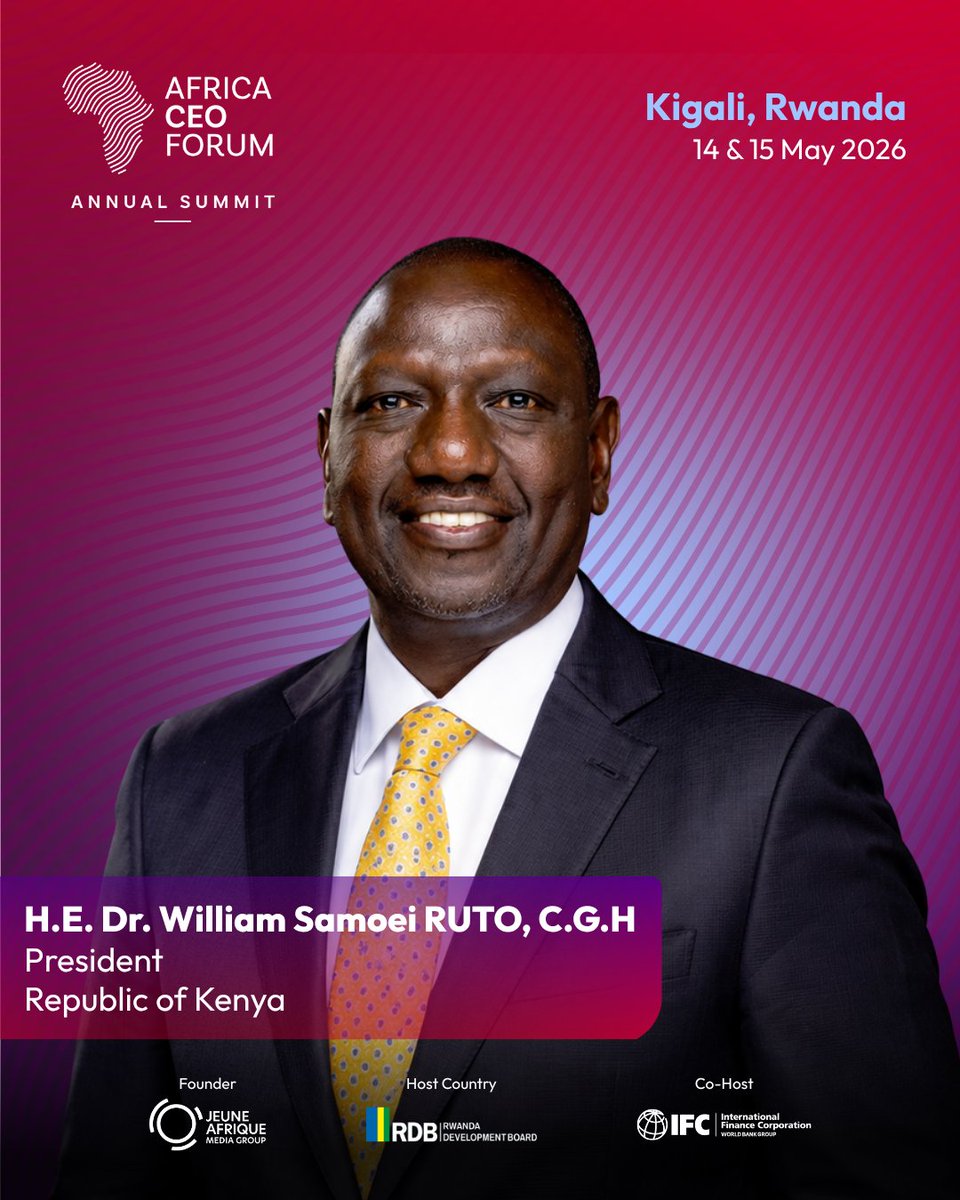
🇰🇪 H.E. Dr. William Samoei Ruto arrives in Kigali with a message the continent has been waiting for.
🔙 Just days ago in Nairobi, co-hosting the Africa Forward Summit alongside President Emmanuel Macron, Kenya's Head of State drew a line under decades of donor logic and called for something far more ambitious: an Africa that finances Africa. He pointed to over 4 trillion dollars in long-term domestic savings already sitting on the continent, including more than 1 trillion in pension and insurance assets and over 500 billion dollars in central bank reserves, and asked the only question that matters. Why are these resources still waiting for someone else's permission to build the continent?
💡 His answer is structural. Through Kenya's National Infrastructure Fund, already capitalised at around 1 billion dollars, he is testing a model designed to crowd private capital into the corridors, ports, energy systems and digital backbones that will turn the AfCFTA from protocol into market. The thesis is unambiguous: "Africa cannot trade effectively with itself while its economies remain disconnected."
🌍 In Kigali, that same conviction lands at the heart of the Africa CEO Forum 2026 conversation, where pan-African ownership, green industrialisation and the mobilisation of domestic capital are no longer side debates but the main stage. From the Silicon Savannah he has helped engineer to the climate finance reform he has pushed through every multilateral forum that will listen, President Ruto embodies a generation of African leadership that has stopped asking and started building.
🎯 His presence on the presidential panel sets the tone for two days that will define how the continent moves from 4 trillion dollars in potential to 4 trillion dollars in motion.
📍 Kigali, 14-15 May 2026.
👉 Discover the full programme: https://t.co/ZBLLHsNBaT
#ACF2026 #AfricaCEOForum
📢 Public Notice: Stakeholder Validation Forum
The Ministry of Information, Communications & The Digital Economy KE @MoICTKenya is holding a virtual public validation exercise on the proposed Kenya Information and Communication Regulations 2026.
Key Details:
Date: Thursday, May 21st, 2026
Time: 10:00 AM EAT
Format: Virtual public session
Prerequisite: Mandatory registration required before joining
Review Documents:
Ministry official responses to earlier stakeholder submissions are available online.
Access documents via https://t.co/6GqQejcdeZ
Join the validation exercise using the link:
https://t.co/d3UJ71vX0G




![tanuijohn's tweet photo. Driving Kenya’s Digital Superhighway Straight into the Classroom
For years, we have spoken about bridging the digital divide. Today, we are putting the physical infrastructure directly into the ecosystem where it can spark the most profound change: our classrooms, our laboratories and our teacher training hubs.
I am incredibly thrilled to celebrate the official launch and flag-off of the Digital Literacy Programme (DLP) devices at the [Centre for Mathematics, Science and Technology Education in Africa (CEMASTEA)] today.
This crucial intervention is a milestone under the [Kenya Digital EconomyAccelerationProject ], funded by the World Bank and spearheaded by the Ministry of Information, Communications and the Digital Economy through the ICT Authority. With the rollout of 10,382 interactive smartboards and laptops to public Junior Schools across the country, we are directly expanding high-tech capabilities into thousands of institutions nationwide during this first phase.
Why This Launch Matters
Technology is not an elective; it is a fundamental pillar of modern literacy. We are executing a highly strategic, three-pronged transformation:
* Empowering the Educators: We cannot build tech-savvy students without digitally empowered teachers. Centering this deployment at CEMASTEA ensures our trainers and teachers master digital pedagogy, AI integration, and virtual lab modeling.
* Democratizing STEM Learning: Whether a child sits in an urban center or a remote rural school, these devices ensure uniform, high-quality, and curriculum-aligned digital science and mathematics content.
* Accelerating our Digital Economy: This rollout directly feeds into Sub-component 3.1 of KDEAP, purposefully scaling digital skills, innovation, and collaboration to build the workforce of tomorrow.
*Beyond Hardware: Building a Legacy
A device is only as powerful as the infrastructure and capacity backing it.
Through KDEAP, this launch is intertwined with ongoing efforts in expanding last-mile fiber connectivity, developing immersive digital repositories, and fostering localized digital skills. We aren't just handing out tools; we are constructing a self-sustaining digital learning ecosystem.
We were honored to have key leadership steering this transition at the flag-off ceremony today, including:
Mr. Stephen Isaboke, PS for Broadcasting and Telecommunications
Prof. Julius Bittok, PS for Tourism (immediate former PS Education)
Hon. John Kiarie, Chair of the Parliamentary Committee on Communication, Innovation, and Information
Mr.Jessy Maruti, leadership at the ICT Authority
Aneliya Muller
The World Bank Task Team Lead
Mrs. Gladys Masai, CEO of CEMASTEA
I want to extend my deepest appreciation to the teams at the ICT Authority, the Ministry of Education and our partners at the World Bank. Your collaborative execution is turning Kenya’s Digital Masterplan into a reality.](https://pbs.twimg.com/media/HKYqQ4fXAAAaBEQ.jpg)
![tanuijohn's tweet photo. Driving Kenya’s Digital Superhighway Straight into the Classroom
For years, we have spoken about bridging the digital divide. Today, we are putting the physical infrastructure directly into the ecosystem where it can spark the most profound change: our classrooms, our laboratories and our teacher training hubs.
I am incredibly thrilled to celebrate the official launch and flag-off of the Digital Literacy Programme (DLP) devices at the [Centre for Mathematics, Science and Technology Education in Africa (CEMASTEA)] today.
This crucial intervention is a milestone under the [Kenya Digital EconomyAccelerationProject ], funded by the World Bank and spearheaded by the Ministry of Information, Communications and the Digital Economy through the ICT Authority. With the rollout of 10,382 interactive smartboards and laptops to public Junior Schools across the country, we are directly expanding high-tech capabilities into thousands of institutions nationwide during this first phase.
Why This Launch Matters
Technology is not an elective; it is a fundamental pillar of modern literacy. We are executing a highly strategic, three-pronged transformation:
* Empowering the Educators: We cannot build tech-savvy students without digitally empowered teachers. Centering this deployment at CEMASTEA ensures our trainers and teachers master digital pedagogy, AI integration, and virtual lab modeling.
* Democratizing STEM Learning: Whether a child sits in an urban center or a remote rural school, these devices ensure uniform, high-quality, and curriculum-aligned digital science and mathematics content.
* Accelerating our Digital Economy: This rollout directly feeds into Sub-component 3.1 of KDEAP, purposefully scaling digital skills, innovation, and collaboration to build the workforce of tomorrow.
*Beyond Hardware: Building a Legacy
A device is only as powerful as the infrastructure and capacity backing it.
Through KDEAP, this launch is intertwined with ongoing efforts in expanding last-mile fiber connectivity, developing immersive digital repositories, and fostering localized digital skills. We aren't just handing out tools; we are constructing a self-sustaining digital learning ecosystem.
We were honored to have key leadership steering this transition at the flag-off ceremony today, including:
Mr. Stephen Isaboke, PS for Broadcasting and Telecommunications
Prof. Julius Bittok, PS for Tourism (immediate former PS Education)
Hon. John Kiarie, Chair of the Parliamentary Committee on Communication, Innovation, and Information
Mr.Jessy Maruti, leadership at the ICT Authority
Aneliya Muller
The World Bank Task Team Lead
Mrs. Gladys Masai, CEO of CEMASTEA
I want to extend my deepest appreciation to the teams at the ICT Authority, the Ministry of Education and our partners at the World Bank. Your collaborative execution is turning Kenya’s Digital Masterplan into a reality.](https://pbs.twimg.com/media/HKYqQxpWMAIwn29.jpg)
![tanuijohn's tweet photo. Driving Kenya’s Digital Superhighway Straight into the Classroom
For years, we have spoken about bridging the digital divide. Today, we are putting the physical infrastructure directly into the ecosystem where it can spark the most profound change: our classrooms, our laboratories and our teacher training hubs.
I am incredibly thrilled to celebrate the official launch and flag-off of the Digital Literacy Programme (DLP) devices at the [Centre for Mathematics, Science and Technology Education in Africa (CEMASTEA)] today.
This crucial intervention is a milestone under the [Kenya Digital EconomyAccelerationProject ], funded by the World Bank and spearheaded by the Ministry of Information, Communications and the Digital Economy through the ICT Authority. With the rollout of 10,382 interactive smartboards and laptops to public Junior Schools across the country, we are directly expanding high-tech capabilities into thousands of institutions nationwide during this first phase.
Why This Launch Matters
Technology is not an elective; it is a fundamental pillar of modern literacy. We are executing a highly strategic, three-pronged transformation:
* Empowering the Educators: We cannot build tech-savvy students without digitally empowered teachers. Centering this deployment at CEMASTEA ensures our trainers and teachers master digital pedagogy, AI integration, and virtual lab modeling.
* Democratizing STEM Learning: Whether a child sits in an urban center or a remote rural school, these devices ensure uniform, high-quality, and curriculum-aligned digital science and mathematics content.
* Accelerating our Digital Economy: This rollout directly feeds into Sub-component 3.1 of KDEAP, purposefully scaling digital skills, innovation, and collaboration to build the workforce of tomorrow.
*Beyond Hardware: Building a Legacy
A device is only as powerful as the infrastructure and capacity backing it.
Through KDEAP, this launch is intertwined with ongoing efforts in expanding last-mile fiber connectivity, developing immersive digital repositories, and fostering localized digital skills. We aren't just handing out tools; we are constructing a self-sustaining digital learning ecosystem.
We were honored to have key leadership steering this transition at the flag-off ceremony today, including:
Mr. Stephen Isaboke, PS for Broadcasting and Telecommunications
Prof. Julius Bittok, PS for Tourism (immediate former PS Education)
Hon. John Kiarie, Chair of the Parliamentary Committee on Communication, Innovation, and Information
Mr.Jessy Maruti, leadership at the ICT Authority
Aneliya Muller
The World Bank Task Team Lead
Mrs. Gladys Masai, CEO of CEMASTEA
I want to extend my deepest appreciation to the teams at the ICT Authority, the Ministry of Education and our partners at the World Bank. Your collaborative execution is turning Kenya’s Digital Masterplan into a reality.](https://pbs.twimg.com/media/HKYqQvCWcAAGDZk.jpg)






![tanuijohn's tweet photo. Driving Kenya’s Digital Superhighway Straight into the Classroom
For years, we have spoken about bridging the digital divide. Today, we are putting the physical infrastructure directly into the ecosystem where it can spark the most profound change: our classrooms, our laboratories and our teacher training hubs.
I am incredibly thrilled to celebrate the official launch and flag-off of the Digital Literacy Programme (DLP) devices at the [Centre for Mathematics, Science and Technology Education in Africa (CEMASTEA)] today.
This crucial intervention is a milestone under the [Kenya Digital EconomyAccelerationProject ], funded by the World Bank and spearheaded by the Ministry of Information, Communications and the Digital Economy through the ICT Authority. With the rollout of 10,382 interactive smartboards and laptops to public Junior Schools across the country, we are directly expanding high-tech capabilities into thousands of institutions nationwide during this first phase.
Why This Launch Matters
Technology is not an elective; it is a fundamental pillar of modern literacy. We are executing a highly strategic, three-pronged transformation:
* Empowering the Educators: We cannot build tech-savvy students without digitally empowered teachers. Centering this deployment at CEMASTEA ensures our trainers and teachers master digital pedagogy, AI integration, and virtual lab modeling.
* Democratizing STEM Learning: Whether a child sits in an urban center or a remote rural school, these devices ensure uniform, high-quality, and curriculum-aligned digital science and mathematics content.
* Accelerating our Digital Economy: This rollout directly feeds into Sub-component 3.1 of KDEAP, purposefully scaling digital skills, innovation, and collaboration to build the workforce of tomorrow.
*Beyond Hardware: Building a Legacy
A device is only as powerful as the infrastructure and capacity backing it.
Through KDEAP, this launch is intertwined with ongoing efforts in expanding last-mile fiber connectivity, developing immersive digital repositories, and fostering localized digital skills. We aren't just handing out tools; we are constructing a self-sustaining digital learning ecosystem.
We were honored to have key leadership steering this transition at the flag-off ceremony today, including:
Mr. Stephen Isaboke, PS for Broadcasting and Telecommunications
Prof. Julius Bittok, PS for Tourism (immediate former PS Education)
Hon. John Kiarie, Chair of the Parliamentary Committee on Communication, Innovation, and Information
Mr.Jessy Maruti, leadership at the ICT Authority
Aneliya Muller
The World Bank Task Team Lead
Mrs. Gladys Masai, CEO of CEMASTEA
I want to extend my deepest appreciation to the teams at the ICT Authority, the Ministry of Education and our partners at the World Bank. Your collaborative execution is turning Kenya’s Digital Masterplan into a reality.](https://pbs.twimg.com/media/HKYqQ6PWMAEWkO-.jpg)