The future of Internet Capital Markets starts here.
R3 is proud to back @Solana_SRI on their comprehensive institutional guide to @Solana
Proud to back this work as a Founding Member.
@mdudas@pbrody There’s a difference between a validator and super validator. I won’t claim to know what it is but that could explain how they threaded the needle on this statement
Bringing institutions and flows to a public network accrues way more value for every participant long term. And is also much easier short term. Eventually the coordination costs are too high to make multiple semi synchronized private networks align. Believe me, I tried!
Better to bring it to @solana and https://t.co/DREH47XzjJ
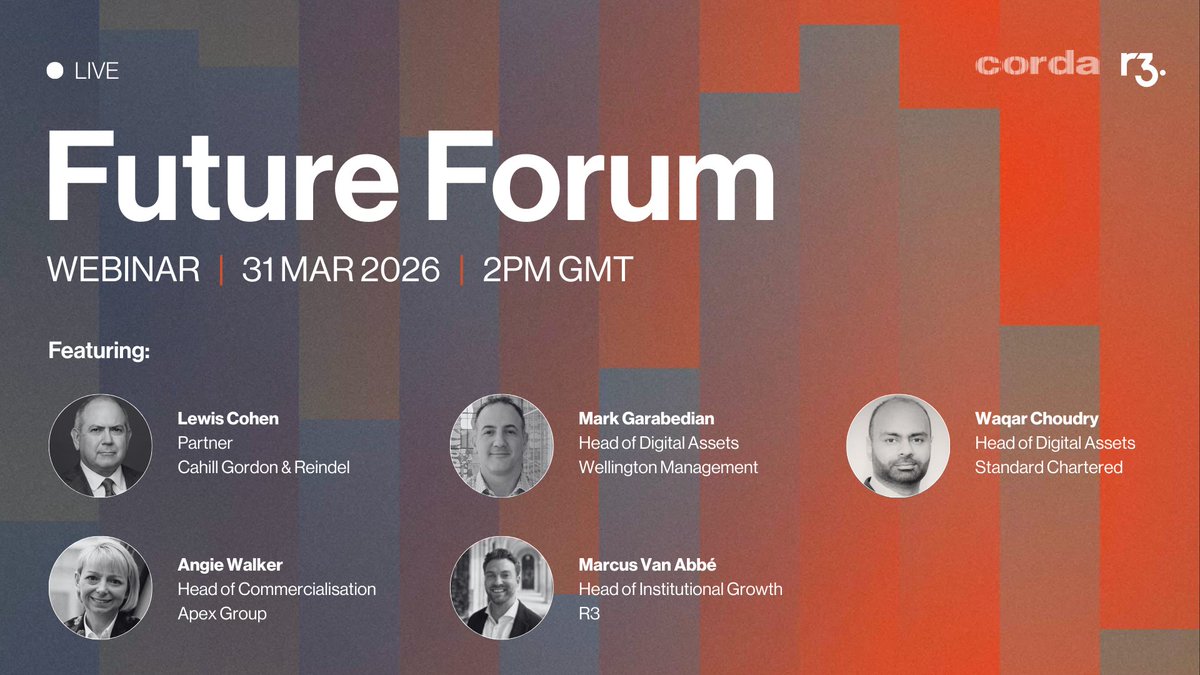
In 3 weeks we’re hosting our next Future Forum webinar: Asset Managers as Market Architects
Tokenised MMFs, ETFs and private market funds are now launching on-chain.
But what happens to capital markets infrastructure when funds are natively on-chain?
In this webinar, we’ll discuss:
• New fund structures
• On-chain operating models
• The evolving role of asset managers
Speakers from:
• Wellington Management
• Standard Chartered
• Apex Group
• Cahill Gordon & Reindel LLP
Register:
https://t.co/ZXoNAkWTHt
The first wave of RWAs focused on one thing:
Tokenization.
→ Take a real-world asset.
→ Put it on a blockchain.
→ Wrap it in a token.
But tokenization alone doesn’t create demand.
Crypto markets don’t just want assets.
They want assets that fit into on-chain financial systems.
That means:
• Liquidity
• Transparent yield
• Composability
• Programmatic settlement
Traditional asset structures weren’t built for this.
That’s why many RWAs struggle to gain traction in DeFi.
It’s not the asset that’s the problem.
It’s the structure around the asset.
In traditional finance, the most successful products aren’t raw assets.
They’re structured financial products.
- Asset pools
- Tranching
- Yield engineering
- Liquidity design
This is how entire markets are built.
Crypto is rediscovering the same principle.
The next generation of RWAs won’t just be tokenized assets.
They’ll be structured yield products built for on-chain capital markets.
That means new infrastructure.
Systems that can:
• pool assets
• structure yield
• distribute risk
• integrate with DeFi
Do you know where things get interesting?
There are projects already building this.
Projects like @inside_r3 are exploring this model through high-quality yield vaults.
Instead of simply tokenizing assets, Corda shifts focus to how these assets are structured and packaged to meet the demands of on-chain investors.
Offering diversification from pure crypto assets without sacrificing returns.
That shift is very crucial.
It turns RWAs from static assets into financial building blocks inside crypto markets.
This is where real-world assets actually become part of DeFi.
• instant liquidity
• composable
• integrated with DeFi
The first phase of RWAs was tokenization.
The next phase is structure.
And the infrastructure enabling that shift is Corda.
@inside_r3
1/ Web3 bond protocol, Xitadel's first LTT partner is @FlashTrade, first collateral is sFLP.1.
Who are they, what do they do, and why are they the perfect launch partner for Xitadel?
Let's break it down.