At a stadium, the seats are in rows facing the field so people can pay attention to the game. At a concert, they’re in rows facing the stage so people can pay attention to the show. At a movie theater, they’re in rows facing the screen so people can pay attention to the movie. At a church, they’re in rows facing the pulpit so people can pay attention to the service.
Teachers,
Why are you putting kids in pods with seats that don’t face you? Don't you want them paying attention to you?
In response to the clip going around with the African lady saying 'WHAT WHITE CULTURE!?!'
Because I can explain it in more detail than anyone else... here are the main things that create western civilisation.
The principle, the law of nature that is an adaptation to and what operation it creates in our civilisation.
THE WESTERN CIVILISATION STACK
Western civilisation can be understood as a set of adaptations to the laws of nature that allow millions of people to cooperate, solve problems and innovate together.
1. SOVEREIGNTY — Let people act.
Law of nature: Knowledge and ability are distributed among individuals.
No ruler or institution can know everything everyone knows. Sovereignty gives people freedom to choose, experiment and solve problems for themselves. That creates millions of independent problem-solvers instead of waiting for one authority to find the answer.
2. RECIPROCITY — Don’t impose your costs on others.
Law of nature: Cooperation survives when it benefits both sides.
Freedom cannot mean freedom to steal, defraud, injure or force others to carry your costs. Reciprocity means pursuing your interests while respecting the same right in others. It turns conflict into cooperation and makes peaceful life among strangers possible.
3. RESPONSIBILITY — Make people accountable for consequences.
Law of nature: Every action produces consequences.
Freedom works when the person making a decision also bears responsibility for its results. When people can keep the benefits of their choices while forcing the costs onto others, cooperation breaks down. Responsibility reconnects choice with consequence.
4. PROPERTY — Make control and consequences clear.
Law of nature: Resources are scarce and cannot satisfy every competing use at once.
Property establishes who controls something, who may use or exchange it, and who bears the consequences of those decisions. That reduces conflict, encourages people to improve what they possess, and makes investment and long-term planning possible.
5. TRUTH — Correct error faster than reality punishes you for it.
Law of nature: Reality does not change because we believe something false.
Truthful testimony, open criticism and evidence allow people to discover mistakes before those mistakes become catastrophes. A civilisation that can criticize and correct itself can learn faster than one that protects comforting falsehoods.
6. CONTRACT — Make cooperation possible across time.
Law of nature: Cooperation requires predictable future behaviour.
Promises backed by reputation and law allow strangers to trust one another enough to cooperate. Contract lets one person invest today because another can credibly promise performance tomorrow. That makes enormous networks of specialization, trade and investment possible.
7. RULE OF LAW — Replace arbitrary power with predictable rules.
Law of nature: People have conflicting interests, and power creates opportunities for predation.
Law provides a common procedure for resolving disputes without violence or personal rule. When rulers and citizens are both constrained by known rules, people can cooperate, invest and experiment without constantly fearing arbitrary interference.
8. DUE PROCESS — Test accusations instead of trusting authority.
Law of nature: Human beings are biased, mistaken and sometimes dishonest.
An accusation is not proof. Evidence, defense, confrontation, impartial judgment and appeal create an adversarial process for discovering error. Due process protects both society from wrongdoing and individuals from arbitrary punishment.
9. DECENTRALISATION — Let many solutions compete.
Law of nature: No one knows in advance which adaptation will work best.
Families, firms, towns, institutions and governments can try different solutions to different problems. Failures can remain local while successful solutions spread. Decentralisation therefore turns society itself into a continuous experiment.
10. MARKETS — Let reality select among competing solutions.
Law of nature: Evolution advances through variation, selection and retention.
Markets allow people to try different products, services and ways of organising resources. People select among them through voluntary choice. Successful solutions attract resources; unsuccessful ones disappear or improve. Markets turn millions of choices into continuous social learning.
11. SPECIALISATION — Let differences become advantages.
Law of nature: People differ in knowledge, ability, resources and circumstances.
Instead of everyone doing everything badly, specialization lets people become exceptionally good at different things and exchange the results. Cooperation converts human differences from a source of conflict into a source of increasing productivity.
12. SCIENCE — Institutionalise error correction.
Law of nature: A false model eventually fails when tested against reality.
Science turns doubt into a productive institution: observe, propose, test, criticize, replicate and correct. Knowledge therefore does not have to depend upon authority or tradition. Every generation can discover where the previous generation was wrong and build upon what it got right.
13. CAPITAL — Preserve successful adaptations.
Law of nature: Progress compounds only when successful adaptations survive.
Tools, businesses, infrastructure, institutions and knowledge allow yesterday’s successful experiments to become tomorrow’s starting point. Each generation does not begin again from zero. It inherits accumulated solutions and adds another layer.
14. EDUCATION — Transfer accumulated knowledge between generations.
Law of nature: Individuals die; knowledge does not have to.
Writing, schools, apprenticeships and universities allow discoveries to survive their discoverers. Instead of every generation rediscovering mathematics, engineering, medicine and law, it begins with thousands of years of accumulated learning.
15. COMMONS — Build things that make everyone more capable.
Law of nature: Cooperation can produce benefits no individual could produce alone.
Courts, roads, standards, security, scientific knowledge, infrastructure and trustworthy institutions multiply everyone's ability to act. A successful civilisation does more than protect private interests: it continually creates shared capital that makes future cooperation cheaper and more productive.
THE RESULT
These principles form a system:
Sovereignty creates experimentation.
Reciprocity makes it peaceful.
Responsibility makes it sustainable.
Property makes interests clear.
Truth corrects error.
Contract creates trust across time.
Law suppresses predation.
Decentralisation preserves alternatives.
Markets select successful solutions.
Specialisation multiplies productivity.
Science accelerates discovery.
Capital preserves what works.
Education transmits it.
Commons multiply everyone's capabilities.
That is the deeper logic of the Western stack:
Stable rules + distributed freedom + relentless error correction = cooperation at scale and accelerating innovation.
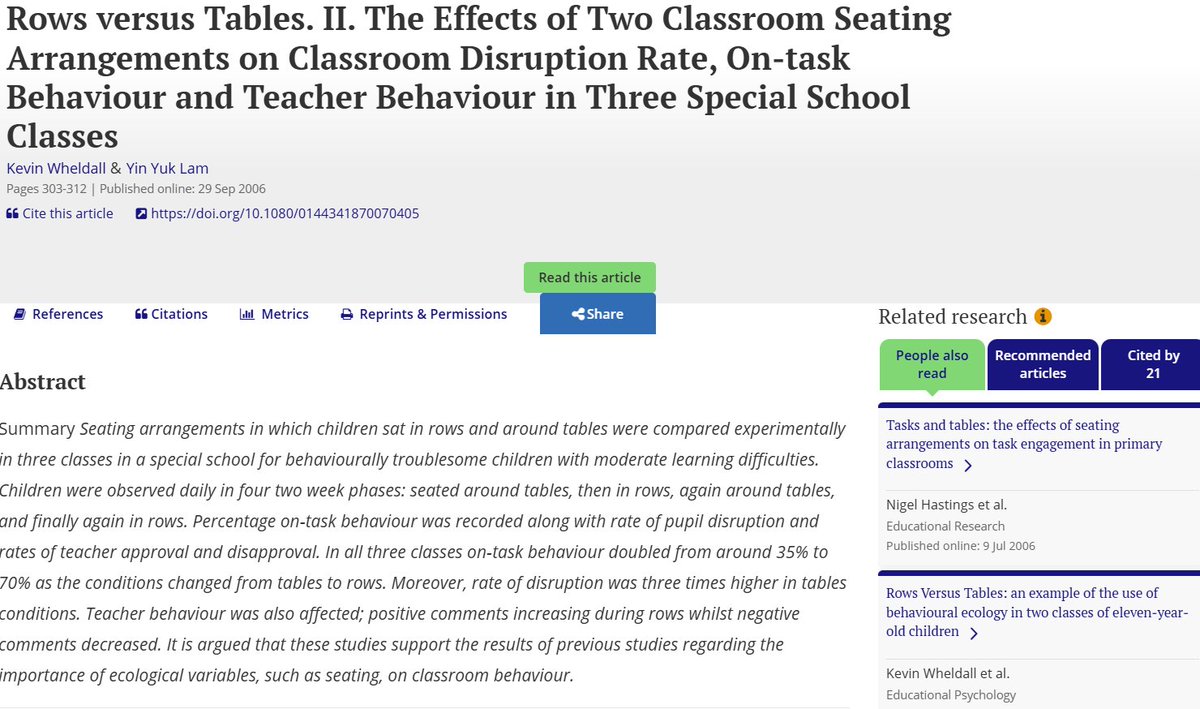
I cannot get enough of the research on classroom seating arrangements
It's just a prime example of how progressive, "student-centered" education promises much but ultimately fails
When desks move from groups to rows, on task behavior DOUBLED
Conversely, rates of disrupted TRIPLED when desks were placed in groups
Moms and dads, your child can still read the greats. Even if she's 14, she can start with Charlotte's Web or Mrs. Frisby and the Rats of NIMH. Your boy can read The Lonesome Gods or Where the Red Fern Grows or Johnny Tremain or The Red Badge of Courage. The evidence is piling up that children need training to read well and widely, but also in the reading choices they make. The algos (and AI) will train them if you don't.
Here's help: https://t.co/V1qSWTkafj
School improvement starts with calm classrooms, clear expectations, and leadership that backs teachers. But too often, we’re instead give PD which skips over the basics in favor of the latest trendy strategy.
We need less novelty and more grounding.
We need to revisit the desks in rows facing the teacher at the front (or Pastore's Perch, teacher at upper right or left corner for optimal viewing of all students).
I personally think this is the number one drag on student academic outcomes. Behavior and learning takes a massive hit in elem classes with desks in groups, NO ONE facing the teacher and learning material on the board directly. I wish parents could see real videos of what this is like.
Fordham Institute (@educationgadfly) research reveals that adding 30 extra minutes of social studies daily boosts 5th‑grade reading scores. Not ELA. Students gain stronger comprehension through knowledge-rich history lessons.
Learn more: https://t.co/A0yFw2enQ5
#HistoryMatters
What separates good teaching from great teaching?
Effective feedback.
Hattie’s research tells us that feedback has an effect size of 0.70—almost double the average. But not all feedback is equal. According to Hattie, “The most powerful single influence on achievement is feedback…but it must be timely, specific, and help the learner know where to go next.”
Dylan Wiliam expands on this with his five strategies for formative assessment. He reminds us that feedback should cause thinking, not compliance. If students are not using feedback to move their learning forward, it’s just noise.
Susan Brookhart emphasizes that feedback must be clear, purposeful, and aligned with the learning target. Vague praise or criticism does little. Students need to understand what they’re doing well, where they need to improve, and exactly how to do it.
Grant Wiggins said, “Feedback is not advice, evaluation, or judgment. It’s information about how we’re doing in our efforts to reach a goal.” In short—feedback should not end the learning—it should ignite it.
And let’s not forget Carol Dweck, who teaches us that how we frame feedback impacts whether students develop a fixed or growth mindset. If we want students to persist through challenges, our feedback must reinforce the process, not just the person.
So in your classroom:
•Make learning goals clear
•Give feedback during the learning, not after
•Use student work and peer feedback to promote ownership
•Keep the focus on progress and next steps
Great classrooms are built on a culture of feedback—where students don’t just hear it, they act on it. @VisibleLearning@dylanwiliam@SusanBrookhart@CarolDweckDSU
Four studies (among MANY) that find that tailoring instruction to “learning styles” has precisely ZERO effect on learning
They’re not real. This is one of the most conclusive topics of study in education yet it remains heresy to point out the pseudoscience that are “learning styles”
You know those elementary school classrooms that look like a unicorn sneezed neon colors all over the walls?
Turns out, they're pretty detrimental to student focus and learning
Can't focus on spelling and a lame motivational poster at the same time
Oracy is yet another educational fad/distraction that doesn’t work.
Focus on Oracy forces a school to organise itself around a mistaken concept, making it harder to succeed - not impossible, but harder.
We do NOT do Oracy at Michaela.
1/15
I’d wager substantially that 44 kids in a well-run class with high behavioral expectations, rich curriculum, and explicit teacher-led instruction would show greater learning gains than a “student-centered” class of 18.
Whenever this topic of teacher autonomy vs. scripted lessons come up, I see 2 main objections. (Aside: this dichotomy is rarely as stark as it's made out. There are different levels of scripting and types of autonomy. But for now, let's grant that you have to "take a side.") 1/x