Warm greetings to all working people of Bangladesh on the great occasion of May Day.
The Bangladesh Awami League is a party of the masses. The Father of the Nation, Bangabandhu Sheikh Mujibur Rahman, and the daughter of democracy, Prime Minister Sheikh Hasina, have always worked for the welfare of working people and remained committed to protecting their rights.
After forming the government in 1972, two groundbreaking decisions were taken for farmers. First, land tax was waived for holdings up to 25 bighas, and farmers were granted loan waivers amounting to 700 million taka. To ensure fair wages for workers, a new 10-tier pay commission was introduced, along with the formation of a wage commission. It was the Awami League government that declared May Day a national holiday. In 1972, under Bangabandhu’s leadership, Bangladesh became a member of the International Labour Organization (ILO), and through his efforts, an ILO office was established in the country. Bangabandhu also incorporated workers’ rights into the Constitution. The importance he placed on labor rights is evident in the inclusion of socialism as a fundamental state principle—aimed at building a society free from exploitation, which the Constitution defines as a core responsibility of the state. Bangabandhu once said, “This independence will only be meaningful to me when the suffering of the farmers, workers, and the poor people of Bengal comes to an end.” However, due to foreign conspiracies and the greed of traitorous military personnel, he was assassinated prematurely. With his loss, the country fell into disarray, and the suffering of the poor deepened under anti-liberation forces and military rule.
In 2009, Sheikh Hasina, the worthy successor of Bangabandhu and one of Bangladesh’s most successful prime ministers, began working to realize his vision. Up until 2024, her government worked tirelessly to protect workers’ rights, ensuring fair wages, workplace safety, occupational health, and maintaining industrial peace and stability while keeping the economy running. During the Awami League’s tenure, the minimum wage for garment workers increased from 8,000 taka to 12,500 taka. In collaboration with the ILO, a tripartite national action plan on fire safety in the garment sector was adopted, involving workers, owners, and the Ministry of Labour and Employment. This led to improved building safety and better working conditions. Through the Workers Welfare Foundation, Sheikh Hasina also introduced support programs for workers’ children’s education.
During its 15 years in power, the Awami League government ensured the implementation of the Bangladesh Labour Rules 2015, amendments to the Bangladesh Labour Act 2006, an increase in the retirement age for workers, initiatives on fire and building safety, the National Labour Policy 2012, the National Child Labour Elimination Policy 2010, the National Occupational Health and Safety Policy 2012, the National Skills Development Policy 2011, and the establishment of the Bangladesh Workers Welfare Foundation Fund. These initiatives strengthened worker protection and contributed to the country’s economic stability.
Since August 2024, however, Bangladesh’s labor market has again faced a severe downturn, and the lives of working people have become extremely difficult. Due to mob attacks and illegal occupations under the Yunus government, hundreds of factories have shut down, leaving over 200,000 people newly unemployed. Despite a change in government, the situation has not improved. Programs that previously helped over 10 million low-income families access essential goods at subsidized prices—such as allowances and family cards—have been discontinued. The poverty rate has increased from 20 percent to 27.93 percent, and unemployment has risen to 4.63 percent. The current government has no clear plan to address this crisis. Instead, it is accused of diverting project funds and preparing to leave the country, while introducing systems that primarily benefit ministers and bureaucrats. There is no visible roadmap from the BNP-Jamaat alliance to improve the lives of the people.
Only the Awami League truly prioritizes the protection of workers’ rights in this country.
There is no alternative to the Awami League in ensuring the liberation and welfare of workers.
#MayDay #Bangladesh
#মে_দিবস_অমর_হোক!!!
"আপনি চাকরি করেন। আপনার মাইনে দেয় ওই গরীব কৃষক। আপনার মাইনে দেয় ওই গরীব শ্রমিক। আপনার সংসার চলে ওই টাকায়। আমি গাড়ি চড়ি ওই টাকায়। ওদের সম্মান করে কথা বলেন। ওদের ইজ্জৎ করে কথা বলে���। ওরাই মালিক।”
— জাতির পিতা বঙ্গবন্ধু শেখ মুজিবুর রহমান।
Remembrance and Tribute by Sheikh Hasina, President of Bangladesh Awami League and daughter of Bangabandhu, on the occasion of 25 March ‘Genocide Day'.
----
March 25 is the most horrific night in the life of the Bengali people. On this night in 1971, the Pakistani military launched a campaign named Operation Searchlight, initiating the systematic extermination of the Bengali nation. Within nine months, the death toll of this brutal genocide rose to over 3 million. Since such extreme brutality had no precedent in Bengali history, an exact Bengali term for “genocide” has never truly emerged; the commonly used word “genocide” (গণহত্যা) is applied to convey its meaning.
On this dark night, I remember the great leader of the Bengali liberation struggle, the Father of the Nation, Sheikh Mujibur Rahman, who was arrested that very night by the occupying Pakistani forces. I pay my respects to the countless martyrs whose sacred blood has stained this soil.
To ensure that the atrocities and barbarity of the occupying Pakistani forces are recognized both nationally and internationally, our government took the historic decision on March 11, 2017, in the National Parliament to observe March 25 as ‘Genocide Day.’ We have sought to inform the world about the heavy price of our independence and to strengthen the global demand for justice for this genocide. Ignoring all domestic and international conspiracies and pressure, we ensured exemplary punishment for several identified perpetrators of crimes against humanity through due legal process. This was not an act of vengeance, but a necessary step toward justice, the rule of law, and ending the culture of impunity.
During the tenure of the Yunus government, this trail process was halted, and convicted war criminals were released. A death-row war criminal was even made a member of the National Parliament, thereby dishonoring the sacrifice of millions of martyrs. In continuation of this trend, there are ongoing efforts to deliberately undermine the sacred memory of the martyrs and to rehabilitate collaborators of the perpetrators and defeated forces in various ways. This is not only a distortion of history but also an attack on the spirit of the freedom fight.
The Bangladesh Awami League has never betrayed, and will never betray, the blood of the martyrs who were victims of genocide. Those who are attempting to rehabilitate the killers and reintroduce Pakistani ideology in the country must be resisted through unity, just as the Bengali nation stood united in 1971.
Joy Bangla, Joy Bangabandhu.
The blood of the martyrs cannot go in vain.
May Bangladesh live forever.
#25thMarch #GenocideDay #SheikhHasina
Greetings from Bangladesh Awami League President and daughter of Bangabandhu, Sheikh Hasina, on the occasion of the holy Eid-ul-Fitr
—
Eid Mubarak
Dear fellow citizens,
Assalamu Alaikum. My greetings to all of you on the holy Eid-ul-Fitr. After a month of fasting and spiritual discipline during the sacred month of Ramadan, the joyous Eid has arrived. This month of restraint teaches us humanity and tolerance. It teaches us to share our happiness with others. We all aspire to build a humane world based on mutual harmony and dignity.
Dear fellow citizens,
Even while staying away from my homeland, on this blessed day of Eid, I pray that every person in the country remains well. May Eid become a true festival for every hardworking and laboring individual. I have always tried to ensure that the basic needs of my country’s people are fulfilled, so that they do not succumb to poverty, nor fall victim to conspiracies at home and abroad. But today, it is clear to everyone how a terrible conspiracy has played with the fate of the poor people of Bangladesh. Since August 5, 2024, the entire country has become like a prison. Prisons are filled with free-thinking writers, journalists, and political activists at both national and local levels. I express my sympathy and sorrow to these innocent people and their families. Though I may not be physically present beside you, rest assured that, by the grace of the Almighty, the daughter of Sheikh Mujibur Rahman will not hesitate to sacrifice her life for your freedom and for the people of this country. True Eid joy will come at the moment of our victory.
Dear fellow citizens,
Due to the flawed policies of the previous occupying Nazi-like Yunus government and the impact of wars in the Middle East and other regions, the global economy is facing multiple crises. Bangladesh is also experiencing the effects of this downturn. As a result, it has become difficult for the poor to maintain a normal standard of living. In this situation, I call upon the affluent and well-off members of society to stand beside the underprivileged, so that every person’s life may be filled with happiness and the pure joy of Eid.
May the days ahead be filled with truth and beauty.
Once again, Eid Mubarak!
Joy Bangla, Joy Bangabandhu.
Let darkness fade and dawn arise.
May Bangladesh live forever.
#Bangladesh #EidMubarak #SheikhHasina
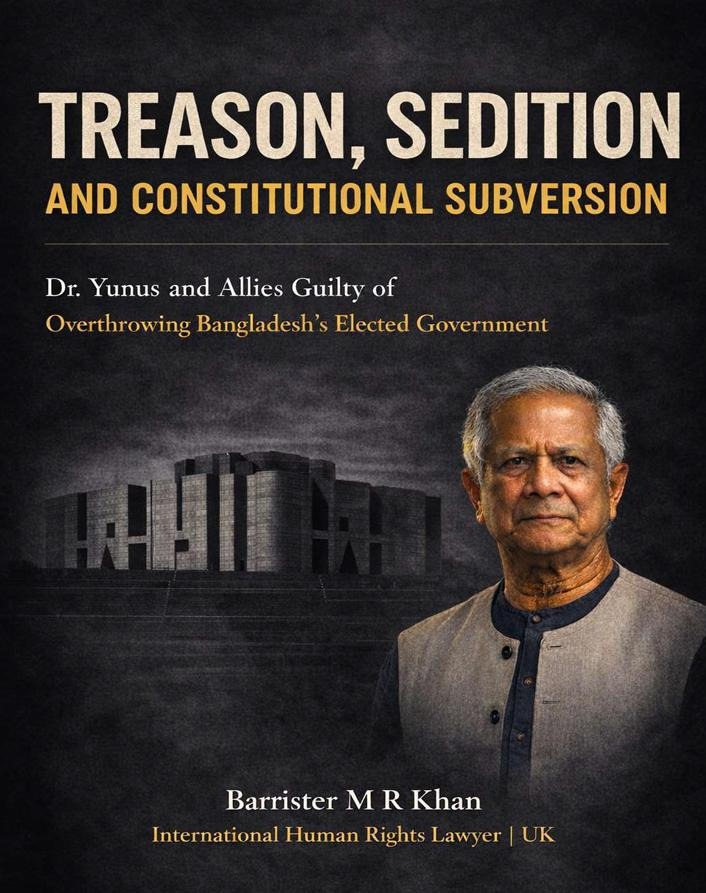
TREASON, SEDITION AND CONSTITUTIONAL SUBVERSION
The constitutional and criminal framework of Bangladesh provides a clear basis for judicial scrutiny, prosecution, and punishment of Dr. Yunus and all participants involved in this subversive and violent conspiracy against the state. A detailed critical Legal analysis follows on the report below.
➡️https://t.co/C4qaUzoDxJ
Researched and Prepared By -
Barrister M R Khan
International Human Rights Lawyer | UK
#Bangladesh #Treason #DrYunus #YunusRegime
The Narrative of So-Called “Indian Hegemony” by the Pro-Pakistani Razakar Group vs. the Actual Reality
In my previous writing, I mentioned that during the Liberation War, the Pro-Pakistani Razakar group constructed a narrative of so-called “Indian hegemony,” and even today they continue to promote that same narrative. They label the friendship between pro-Liberation forces of Bangladesh under the leadership of Sheikh Hasina and India—built on the basis of equality—as “Indian hegemony.”
This is because their mentality is still trapped in subservience to pro-Pakistani ideals. To those who are mentally subservient to Pakistan, even a friendship with India based on equality appears to be “Indian hegemony.” This is nothing new; it has been their habit for a long time. If one examines history, evidence of this can easily be found.
They spread countless stories about Indian hegemony during Sheikh Hasina’s tenure in power. Yet in reality, they have never been able to show a single agreement made with India during her time that went against Bangladesh’s interests.
On the contrary, during Sheikh Hasina’s tenure Bangladesh secured many important benefits from its neighboring country India. Through relations with India based on equality and friendship, she implemented many initiatives beneficial to the people of both countries. But the Razakars’ “Pakistani mindset” could not view those initiatives positively.
At a time when the entire world is facing an energy crisis, let me give one example. Prime Minister Sheikh Hasina arranged for Bangladesh to import diesel from India through a pipeline at a lower cost and with lower carbon emissions. This initiative will play a significant role in the progress of Bangladesh’s agriculture and industry. On the day of the inauguration, nearly 9 million liters of diesel arrived at Bangladesh’s Parbatipur depot through the pipeline from Numaligarh in India.
You can see the news at the link below:
https://t.co/dd4cMWLTPR
The pipeline shown in the attached image is that very pipeline. It starts from the Numaligarh refinery near Siliguri in India and extends to the Parbatipur railhead depot in Dinajpur, Bangladesh. Even during the construction of this pipeline, Sheikh Hasina was falsely accused by BNP-Jamaat of selling the country to India. They claimed that the project was part of selling out national interests. She had to endure countless criticisms and accusations.
And now, diesel is being imported from India through that very pipeline, which has helped make the country’s fuel supply somewhat easier and more stable.
During her time in power, Sheikh Hasina undertook numerous projects, most of which were aimed at strengthening the country’s infrastructure and economy. This pipeline is just one small example among them.
The more the country faces crises, the more clearly people will recognize the importance of the work Sheikh Hasina carried out. Ultimately, those initiatives will benefit ordinary people. Sadly, many of the very beneficiaries of those initiatives have often criticized her work by mixing truth with falsehood.
—Mohammad Ali Arafat
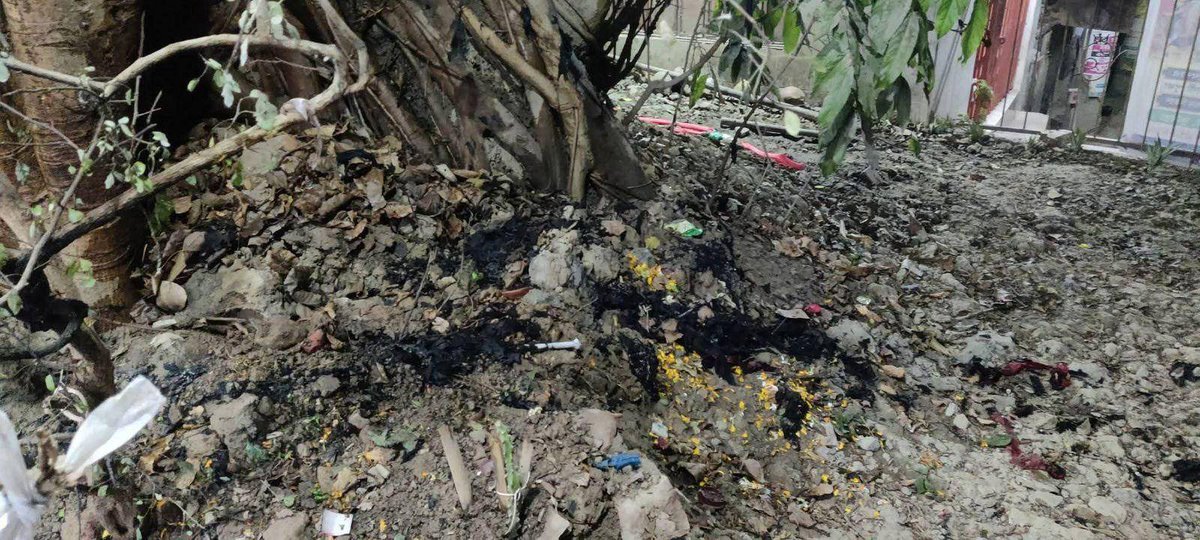
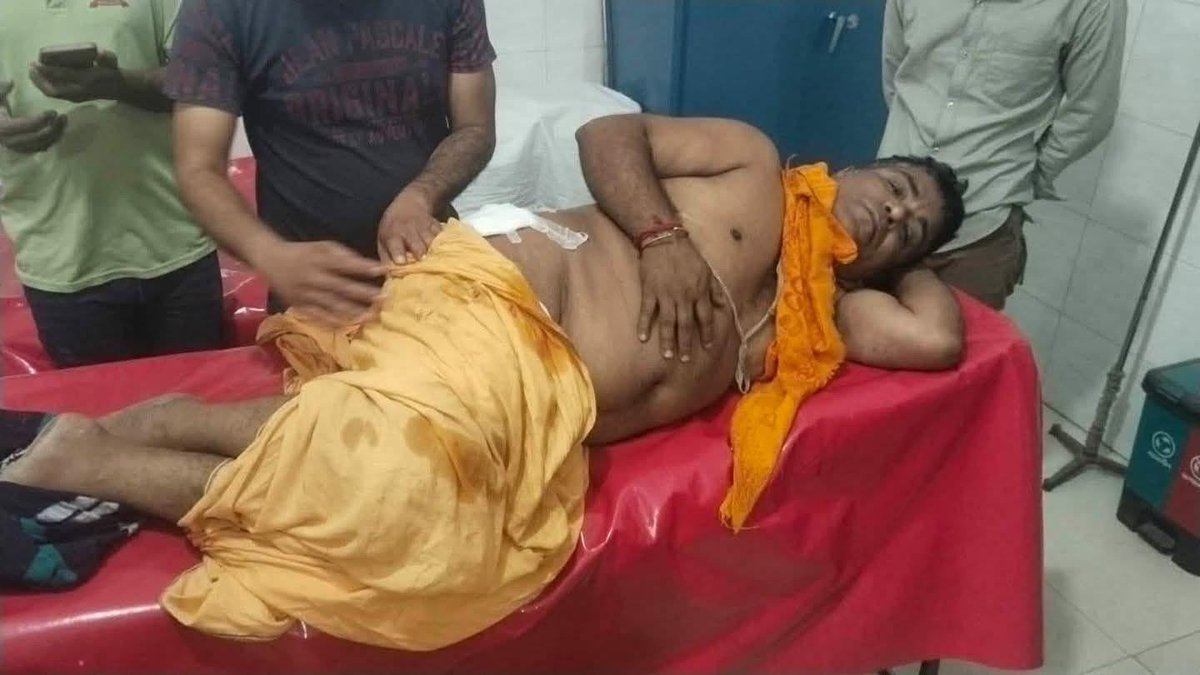
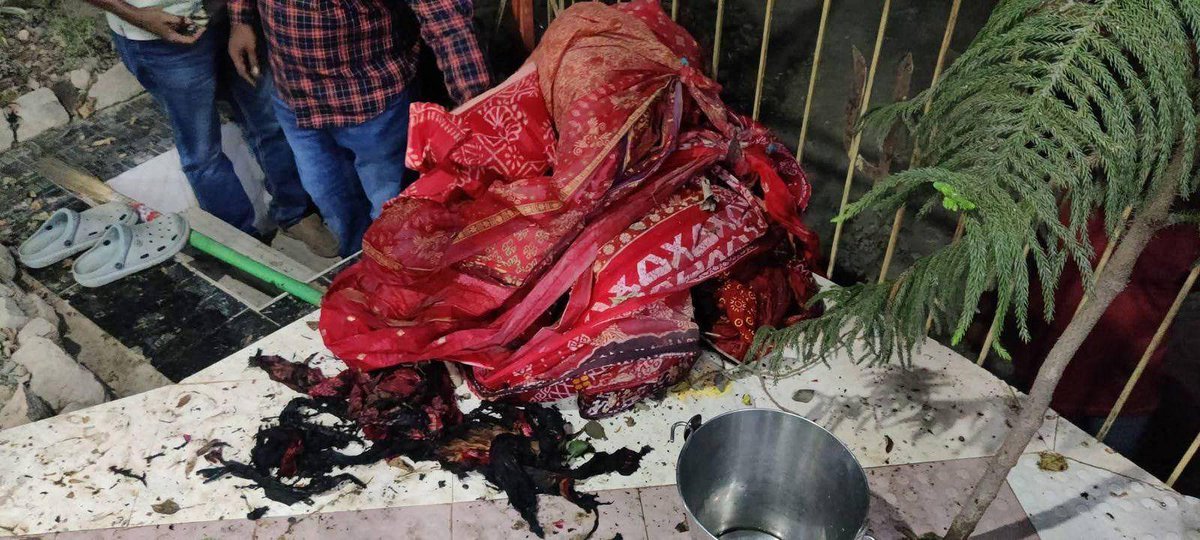
Bomb blast on temple during evening prayer, hindu devotees critically wounded
- No right to life for minorities in Bangladesh
To offer evening prayer, #Hindu worshipers gathered at a temple in Cumilla on March 7, 2026. But their right to exercise freedom of religion has been trampled on as attackers sized on the moment and threw bombs targeting all the devotees.
Media reports indicate the blast left at least four worshipers critically wounded. The gruesome blast left the entire community in shock, brining to light the sheer absence of safety for minorities. Since the start of Yunus regime, minorities have been branded as agents of Awami League alongside extremist outfits were empowered.
Read➡️https://t.co/oygrnEVPvP
#Bangladesh #BangladeshCrisis #MinorityRights
Throughout world history, there have been many wars of independence.
In some places, they emerged through revolutions, in others through civil wars, and elsewhere through long and bloody conflicts. But the story of the Bengali people’s independence is different.
This war did not begin suddenly. Behind it lay the long-term vision of a leader, a carefully planned step-by-step strategy, and an extraordinary ability to prepare an entire nation psychologically for freedom.
That leader was Sheikh Mujibur Rahman, widely known as Bangabandhu.
He understood that a nation does not achieve independence overnight. The first task is to awaken a people’s sense of identity. That is why he began with the struggle for language rights, gradually transforming that consciousness into a movement for autonomy.
In 1966 he announced the historic Six-Point Movement, which effectively served as the blueprint for an independent Bangladesh.
Then came the 1970 Pakistani general election.
The Bengali people gave him overwhelming support. That victory was not merely the result of an election—it was a powerful expression of national unity.
By March 1971, the country was effectively running under his direction. Every instruction, every movement, and every programme formed part of a broader strategy.
Then came the historic moment.
On 7 March Speech of Sheikh Mujibur Rahman, Bangabandhu, with his thunderous voice, delivered the immortal words:
“This time the struggle is for our freedom. This time the struggle is for our independence.”
It was a single speech, yet within it were the instructions for resistance, strategic guidance, courage, and a vision for the future. After that speech, nearly 75 million Bengalis seemed to stand together as one.
Finally, when the massacre began on Operation Searchlight on 25 March, Bangabandhu declared independence. The Bangladesh Liberation War began.
History has seen many leaders wage wars and many revolutions take place. But only a few leaders have managed to prepare an entire nation step by step, secure a democratic mandate, unite their people, and ultimately lead them to independence.
Bangabandhu was not just a leader—he was the architect of a successful history.
And that is why whenever the story of Bengali independence is told, history ultimately arrives at one name: "Sheikh Mujibur Rahman".
#Bangabandhu #7thMarch #MonthOfIndependence #SheikhMujiburRahman
The struggle of the Bengali nation - and of the people of all of Bangladesh that began in 1971 has not yet truly ended.
We achieved our map, our sovereign territory, but we have yet to secure full economic freedom. The journey toward that freedom was begun by Bangabandhu Sheikh Mujibur Rahman - who started building the nation after independence. Following his path, his daughter Sheikh Hasina led the country toward becoming a middle-income developing state.
But today Bangladesh faces a crisis marked by hunger and poverty. Freedom of expression is under strain, and political rights remain deeply contested.
On this historic and fiery day of 7 March Speech of Sheikh Mujibur Rahman, let us renew our pledge: to build Bangladesh, to free its people from hunger and poverty, and to restore the democratic rights of its citizens.
Joy Bangla.
Joy Bangabandhu.
১৯৭১ সালে বাঙালি জাতির তথা সমগ্র বাংলাদেশের মানুষের যে সংগ্রাম শুরু হয়েছিল তা এখনও শেষ হয়নি।
আমরা আমাদের মানচিত্র পেয়েছি, এখনও পায়নি অর্থনৈতিক মুক্তি। সেই মুক্তির পথে দেশ গঠন শুরু করেছিলেন বঙ্গবন্ধু, তার পথ অনুসরণ করেই দেশকে মধ্যম আয়ের উন্নয়নশীল রাষ্ট্রে পরিণত করেছিলেন তারই কন্যা।
কিন্তু আজ বাংলাদেশে ক্ষুধা আর দারিদ্র্যের মহামারি, নেই কোন বাকস্বাধীনতা, নেই রাজনৈতিক অধিকার।
আসুন ৭ই মার্চের সেই অগ্নিঝরা দিনের শপথ নেই, বাংলাদেশ গড়ার। বাংলাদেশের মানুষকে ক্ষুধা, দারিদ্র্য থেকে মুক্ত করার, বাংলাদেশের মানুষের গণতান্ত্রিক অধিকার ফিরিয়ে আনার।
জয় বাংলা,
জয় বঙ্গবন্ধু।
#Banabandhu #7March #March1971 #Bangladesh #JoyBangla
In the voter-less election of February 12, seizing polling stations and stuffing ballots—marking party symbols in favor of their own candidates—was reportedly one of the key strategies for casting fake votes and securing victory.
A similar scene was allegedly observed in the Noakhali-6 (Hatia) constituency. A leaked video from inside a polling center shows numerous ballot papers stamped with the BNP’s “Sheaf of Paddy” symbol. According to the footage, @bdbnp78 activists occupied the polling station and stamped ballots in this manner to cast fraudulent votes in the February 12 election, which critics have described as undemocratic and illegal.
An election where voters are absent, where ballots are allegedly snatched and stamped even in the presence of law enforcement, and where polling station security is compromised—such an election, by any standard, cannot be called free and fair.
#BangladeshElections2026 #RiggedElection
Why is the @NCP_bd25 alleging that the election results were manipulated? Wasn’t there supposed to be a historic election under Yunus in what’s being called the “New Bangladesh”?
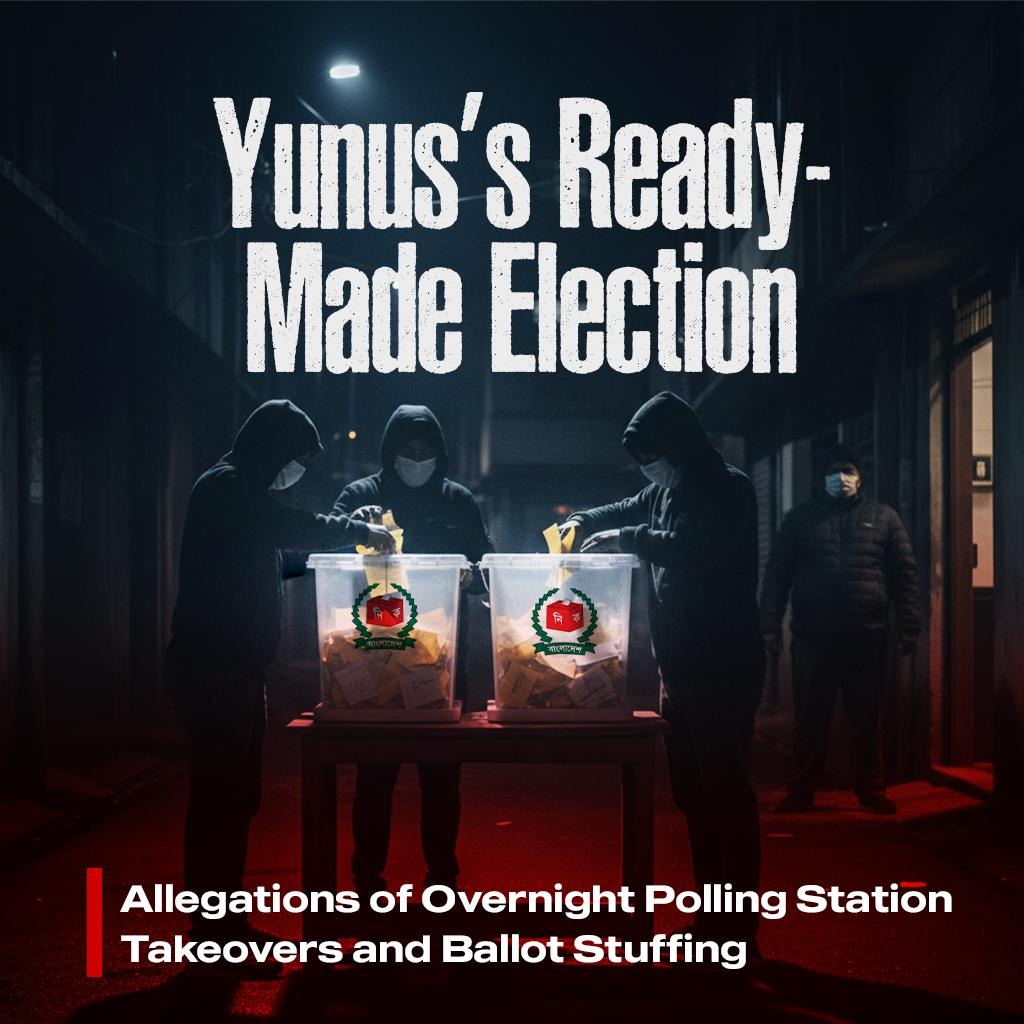
“Yunus’s Ready-Made Election”: Allegations of Overnight Polling Station Takeovers and Ballot Stuffing
--
Although authorities have stated that voting is being conducted nationwide with enthusiasm and with the assistance of the army, allegations have emerged from various areas of polling station takeovers and ballot stuffing. There are also claims that votes meant to be cast during the day are being recorded at night.
According to local sources, in some centres BNP supporters are allegedly leading such activities, while in others Jamaat activists are said to be dominant. Traditionally, ballot papers and boxes were delivered to polling stations on the morning of election day. However, in this election, ballot papers and boxes were reportedly sent to centres the day before.
While the Election Commission announced that voting would officially begin on the morning of 12 February, allegations suggest that from the evening of 11 February, ballot papers were being stamped and boxes filled in several locations. The issue has sparked discussion and criticism in different areas.
There are also accusations that in some cases police, Ansar members, or even army personnel have provided assistance. It is alleged that where the BNP holds influence, BNP supporters are involved in ballot marking, while in areas dominated by Jamaat or NCP, similar activities are taking place.
No official statement has yet been issued by the relevant authorities. Observers warn of the risk of further deterioration, with the practice of filling ballot boxes on the eve of polling increasingly described by many as an “open secret.”
#Bangladesh #BangladeshElections2026 #BangladeshElections
Not Voting Is Also a Democratic Right — Allegations of Intimidation in Netrokona-3
----
As Bangladesh heads to the polls, questions are being raised not only about how people vote — but whether they are free not to vote.
In the Netrokona-3 constituency, a local Jubo Dal leader has been accused of attempting to assault a woman with a stick after she reportedly refused to cast her ballot. The allegation centres on an incident in Teligati Union of Atpara upazila, where Zainal, a Jubo Dal figure, is said to have threatened and tried to coerce an independent voter into supporting the BNP’s electoral symbol, the sheaf of paddy.
Critics argue that the current election — organised under the administration of Muhammad Yunus — has already been marked by controversy, particularly following the exclusion of the Awami League from participation. They say the absence of major opposition forces has left many voters disengaged or unwilling to take part.
At the heart of the debate is a fundamental democratic principle: participation in an election includes the right to abstain. Any attempt to pressure, threaten, or intimidate voters — whether to secure support or compel turnout — risks undermining public confidence in the process.
There has been no official response from authorities regarding the specific allegation.
As polling unfolds, the broader question remains: can an election be considered credible if citizens do not feel free to choose — or to decline — without fear?
#BangladeshElections2026 #Bangladesh #BangladeshElections
Attention -
@Ashoke_Raj@mayankgajwani@janusmyth@sanjaypugalia @rishhikesh @ShubhajitRoy@DanStrumpf @lamyikfei @HannahEP@ashwanindtv@VishnuNDTV@_pallavighosh@yogital@AakritiThapar@zohrabai@clementperruche@MickyGupta84@DevirupaM@AbdEarally@bijendrasingh@joship2812 @Rnailasaleem @KiraHuju@AP@AFP@bbcworldservice@BBCWorld@bbcbangla@ReutersAsia@Reuters@France24_en@FRANCE24