Most stadiums still treat connectivity as a cost line.
The useful shift is pairing it with on-site edge compute so AI analytics, navigation and multi-angle streams can actually run in the venue. Good to see Weaver Labs and Stadium MK putting that on show at MK Tech Week.
Most stadiums still view connectivity as an operational cost or a "nice-to-have" fan perk. The reality is completely different.
Real-time innovation -from AI analytics and 3D navigation to immersive multi-angle camera streams- doesn't just need basic internet coverage. It requires Connectivity and Edge Compute working together on-site.
As part of our partnership with @Stadium_MK, we’re thrilled to announce that we’ll be showcasing at Milton Keynes Tech Week this coming Monday! 🚀
We’ll be sharing how our Cell-Stack software platform serves as the digital foundation for stadiums, integrating edge compute directly with venue connectivity to launch high-demand fan and operational applications in weeks, not months.
If you're attending MK Tech Week, come meet the Weaver Labs team to discuss how we turn infrastructure into a strategic, value-generating asset for venues, smart cities, and enterprise environments.
See you on Monday! 📍
@Weaver_Labs Great work guys. Coverage alone doesn’t deliver AI analytics or immersive streams — you need connectivity and edge compute working together on site. Good to see that being showcased with Stadium MK at MK Tech Week, wish I could make it.
@sir4K_zen Yeah being open-source likely helps remove infrastructure toil. The toolchain stitches teleop → synthetic data → Isaac training → sim validation → edge deploy, so teams can stop rebuilding that handoff which should speed up sim-to-edge.
Amazon just open-sourced the factory that builds robot brains.
This is not a reboot of RoboMaker, which AWS shut in 2025. It is the pipeline Amazon says that it learned from running more than a million warehouse robots, packaged so other companies can train humanoids, cobots, and mobile robots without stitching the stack themselves.
The AWS Physical AI Toolchain: reference architectures, infrastructure-as-code, and deployment automation that runs the whole loop — synthetic data, training, simulation, edge deploy, then data back from the robot. It sits on AWS (SageMaker, EC2 GPUs, IoT Greengrass, Bedrock AgentCore) and NVIDIA’s stack (Isaac Sim, Isaac Lab, GR00T, Cosmos).
The bet: the bottleneck is no longer the demo. It is getting a model from teleop data onto a machine that does not fall over. @amazon
Anthropic is giving open-source projects free security scans from its strongest models.
The Cyber Mission launched October 8. OSS Scanner is opt-in. Enrolled projects get periodic reports with a proof of concept, an explanation, and a suggested fix where one exists. Anthropic says it expects a true-positive rate above 90 percent. Reports are model-generated and sent without human review, so some severity ratings will be wrong.
The same program puts Claude and on-site engineers with the firms that defend power grids, water systems and plants. Founding partners include CrowdStrike, Palo Alto Networks, Dragos, Nozomi Networks, Hitachi and Rockwell Automation, plus Accenture, Booz Allen, Deloitte and PwC.
Enrollment is a pull request. Projects need enough staff to triage the findings.
An astrophysicist just filled in the sky that no ultraviolet telescope has fully mapped.
Brice Ménard, at Johns Hopkins and Anthropic, used Claude Science to merge public surveys from GALEX, Swift, FIMS/SPEAR and TD-1, then estimate the third of the sky those missions never observed.
NASA’s GALEX mission imaged about two-thirds of the sky and skipped bright fields, including much of the Milky Way plane, to protect its detectors. On regions where real UV data were hidden, he says the estimate came within about 10 percent of the measurements. The map also adds UV estimates for more than 100 million stars inferred from ESA’s Gaia.
It is a teaching map, not a peer-reviewed catalog. About a third of it is predicted, and those pixels are labeled. The work he says would have taken weeks of calibration took days.
The State of Anyone is live.
Team on the mic. Next-level vision for the protocol. Privacy for any app, powered by DePIN.
Jump in before you miss the announcements.
$HPE has booked its first AMD Helios order: $1.2B from Vultr.
72 MI455X GPUs per rack. HPE Juniper switches in every rack. EPYC “Venice” CPUs.
Same day, networking growth went from 5–7% to a high-teens CAGR through FY29.
Stock is already up ~39% in a month and ~47% in 3 months, around $72.
The AI trade is not only the chip. It is whoever owns the rack and the network.
Is that rerate done, or is the networking story still early?
Inference just got an order book.
Architect launched Liquid Inference: every AI prompt is auctioned, and the lowest quote that meets the buyer’s rules wins. OpenAI and Anthropic SDKs still work. One API key. Live prices instead of a static list.
AkashML is a launch partner. Decentralized GPUs are now competing inside the router, not sitting on a side marketplace.
Same code. Cheaper marginal token. DePIN compute, finally in the request path.
SpaceX is in talks to borrow $40 billion to buy Nvidia chips.
Bloomberg: about $10B in bank loans and $30B in investment-grade debt. Apollo and PIMCO are looking. Nothing is signed.
Musk already said Colossus was at 230K Nvidia chips and Colossus 2 at 550K. This would be one of the biggest debt deals of the AI buildout.
Same week, Dalio called AI a classic bubble.
Buildout, or the credit cycle catching up to the capex?
GPT-6 just stopped returning a wall of text.
OpenAI is putting Luna on Free and Go today. Answers can now ship with buttons, forms, charts, and small tools. Paid plans get Sol. Web-search answers start about 44% sooner than GPT-5.6 Instant.
The model is no longer the product. The screen that sits on top of it is.
Whoever owns that screen owns the click, the form, and the next action. The lab supplies the answer. The interface collects the user.
Would you rather keep a chat box, or let the answer become the tool?
GPT-6 and Intelligent UI, now rolling out in ChatGPT for everyone.
Intelligent UI in ChatGPT delivers fast, interactive answers that make everyday questions more visual, complex topics easier to grasp, and interactive tools for your task available on the spot.
FieldAI is reportedly raising $700M at a $10B valuation.
That is about 5x the $2B mark from last year, when it raised ~$405M from backers including Nvidia’s NVentures, Intel Capital, Bezos’s family office, Emerson Collective, and Khosla.
The product is not a humanoid. It is a robot-agnostic “brain” (Field Foundation Models) meant to run humanoids, dogs, drones, and rovers in places that do not stay still. Construction, data centers, defense. Reported contracts since June push cumulative revenue and bookings above $135M. Term sheet, single-source so far (Business Insider, Oct 2); not closed.
This puts it in the ballpark of Physical Intelligence (~$11B) and Skild AI (>$14B). Investors are paying up for the software layer, not another chassis. @fieldai_
Grok Bot just stopped pretending one model can do everything.
Elon says SpaceX will route each task to whichever backend is most likely to win: Claude Opus 5.5 for hard reasoning, Midjourney for images, Suno for music, plus other leading APIs.
Not “our model or nothing.” Best outcome, even if the model isn’t ours.
That’s the product shift. The agent keeps the computer, the tools, and the memory. The model underneath becomes a supplier.
Would you rather your agent stay loyal to one lab, or switch mid-task when a rival is clearly better? @grok@bot@elonmusk
The tell is duration. A 20-year power purchase agreement and multi-year GPU contracts are not pilot projects. They are customers reserving capacity that does not fully exist yet. That is why power and infrastructure names are re-rating faster than the model labs.
Sources:
Constellation and Google, 6 October 2026: 20-year PPA for 890 MW of new nuclear capacity on the PJM grid from upgrades at 11 units, plus a separate 15-year supply deal for 2,700 MW. Constellation says the upgrades are more than $4.3 billion of investment. https://t.co/vpaH7VJp6r
Power Magazine, 7 October 2026: same terms, first uprate expected online by 2028, all 890 MW before the end of 2032. https://t.co/kA3t3uCOvT
HPE, 30 September 2026: $1.2 billion Vultr order, first AMD Helios AI Rack by HPE, 72 AMD Instinct MI455X GPUs per rack. https://t.co/Zfoxrg4EjJ
Boost Run, 6 October 2026: five-year, $525.6 million AI cloud agreement on NVIDIA GB300 NVL72 systems; initial acceptance expected early Q2 2027; company says total contract value is now over $2.6 billion. The release does not name the customer. https://t.co/IGJWOYoya1
Google just locked a 20-year nuclear deal with Constellation. HPE booked a $1.2B AI rack order from Vultr. Boost Run signed a $526M, 5-year compute contract and pushed total contract value above $2.6B.
The AI trade is no longer “who has the best model.” It is who already has the power, the racks, and the signed backlog.
Models get the headlines. Contracts move the stocks. @Google@ConstellationEG
Most humanoid companies want a warehouse worker.
@mnv_humanoids wants a body you can send into a blast radius.
The startup came out of stealth this week with about $10 million, led by General Catalyst. Its robot, Roger, is built so a specialist stays outside the hazard while the machine does oil-and-gas work, bomb disposal and hazmat.
CEO Sandor Felber worked on Tesla’s Optimus. CTO Maurice Rahme spent years at Boston Dynamics. They say Roger went from a clean sheet to a walking prototype in about five months. First paid energy pilot is this fall. Operational contracts are a 2027 target.
It is still a prototype. That is the point.
Meet Roger, the humanoid purpose-built to protect human life in the most dangerous jobs across energy and public safety.
The experts stay safe and in control. Roger goes in.
No full autonomy needed.
Roger takes the risk. They get the job done.
Idea to walking in 5 months.
Your takeaway is about to roll up on four wheels.
@Deliveroo is launching sidewalk robots with Coco Robotics in the UK.
First stop: Canary Wharf this month, with Patty & Bun and a handful of local spots. Then Milton Keynes, Leeds, Stockton-on-Tees and Nottingham.
Coco’s bots top out around 21 km/h and can carry four 18-inch pizzas. Starship has owned UK pavement delivery. That just got a DoorDash-backed rival. @CocoRobotics
The man who built Alexa just took Atlas.
@BostonDynamics named Rohit Prasad CEO today. He ran Alexa and Amazon’s AGI effort. He replaces Robert Playter, who stepped down in February. The seat has been interim since then.
Hyundai, which owns the company, wants a factory that can build 30,000 robots a year by 2028, and Atlas on its own lines.
Physical AI just got a product person.
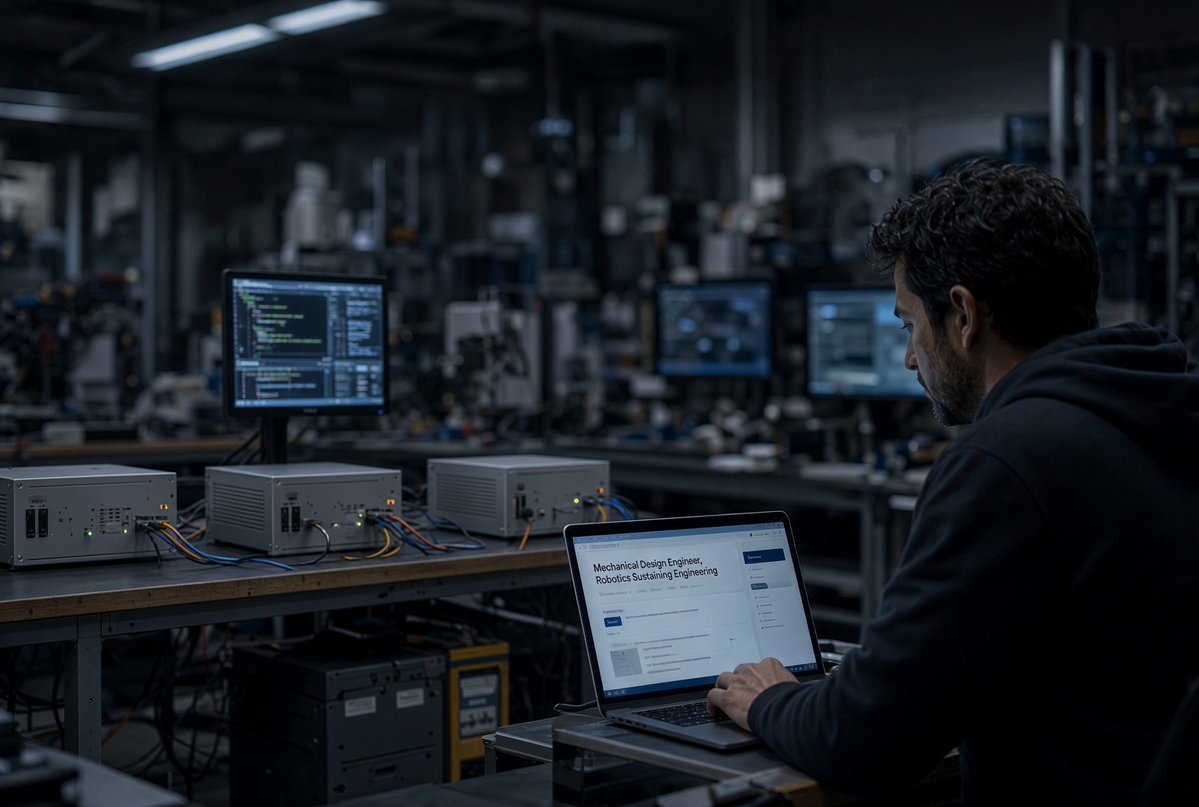
@Meta is hiring a mechanical engineer in Redmond to keep “our humanoid robot hardware” alive after “initial release.”
The role sits on the Meta Robotics Hardware team. It covers fractured parts, fatigue cracks, loose fasteners, and the jump from small prototype runs toward medium volumes. Motors, actuators, gearboxes.
The listing covers prototypes and research hardware, and Meta has not shown a robot or a volume target.
Still: the job post talks like the hardware already exists.
If Meta is collecting data on its own humanoids, the physical-AI race just got a fifth horse.
Agility Robotics is on the clock today. @agilityrobotics
Analyst & Investor Day runs 12:30–3:00 p.m. ET in New York. Livestream is public. Digit 5, the factory plan, and the operating model are the agenda. Schaeffler and Foxconn are in the room.
The numbers they are walking in with: more than $300 million in multi-year Digit 5 orders, 65,000-plus hours already logged on earlier Digits at sites including GXO, Schaeffler, and Toyota Canada.
The listing path is Churchill Capital Corp XI ($CCXI). Close is targeted for Q4. The ticker they want is AGLT.
This is the humanoid company that already has paying warehouse work, not a demo reel. The question for the call is whether those orders turn into a public-company ramp.
Watch: https://t.co/rOa0xEqPGw