A new study by Hamada et al. showed: MED13L expression is relevant to corticogenesis (formation of cerebral cortex) and influences the dendritic branching of cortical excitatory neurons. MED13L variants may directly cause defects in cortical neurons.
https://t.co/hgJmnA0NlI
Good news is: Rarebase’s first phase of research analysis has discovered 15 promising drug candidates... “Validation Phase” is planned to analyze this short list of promising medicines on MED13L patient cells neurons...
https://t.co/lsZlfTKYgC
Initial investigations of Rarebase @rarebasepbc shows that MED13L is a strong responder in terms of the number of drugs that seem to upregulate the gene and in terms of how significantly these drugs upregulate MED13L. More will follow in early future...
https://t.co/wGgZ4VwV7G
MED13L protein reduction is likely one of the main reasons #MED13L_syndrome occurs (https://t.co/BfQdlnig4x).
Rarebase @rarebasepbc will test 4000 compounds (FDA-approved and promising clinical trial drugs) on neurons to see which ones can safely increase MED13L expression.
@Unique_charity has done a great job in developing information guides for rare genetic disorders, here is the guide for #MED13L_syndrome :
https://t.co/RRsicMsw2a
To create scientific breakthroughs for rare #genetic#neurodevelopmental disorders, families and #scientists must come together. This is why you have to represent yourself in research! Learn more about research participation in #SimonsSearchlight: https://t.co/gfNez3k7xZ
MED13L community had a goal of '$10k in May' to kick off their $1 Million for MED13L Fundraising Campaign.
At the end of May, the total amount of incoming funds to the MED13L Foundation is $121,156!!!!!!!
https://t.co/BnMcRD6R1R
The MED13L Foundation along with the CURE MED13L research initiatives, today announced May 13th as World MED13L Day and launched a fundraising campaign to raise $1 million towards the development of therapies for the single-gene disorder.
https://t.co/tN9cGcvdSX
Today we celebrate #MED13LAwarenessDay w/ @MED13L_UPDATE and @Med13lA! We currently have over 100 MED13L families enrolled in #SimonsSearchlight w/more joining weekly. Find a summary of the #MED13L gene, resources, research, and more on the MED13L webpage: https://t.co/iQmfF2OdRy
Leiden Open Variation Database (LOVD) is a free web-based platform containing the largest network of
curated gene variant databases in the world. It also includes MED13L gene variant database. Detected and curated MED13L variants are availabe here: https://t.co/ZCL9qHQnOx
Study of skin fibroblast cells from a #MED13L patient shows abnormal mitochondrial structure & function (Chang 2022). Mitochondria produce energy in cells. If these findings are replicated in more patients and cell types, it will be a big step in understanding #MED13L_syndrome.
MED13L protein reduction is likely one of the main reasons #MED13L_syndrome occurs (https://t.co/BfQdlnig4x).
Rarebase @rarebasepbc will test 4000 compounds (FDA-approved and promising clinical trial drugs) on neurons to see which ones can safely increase MED13L expression.
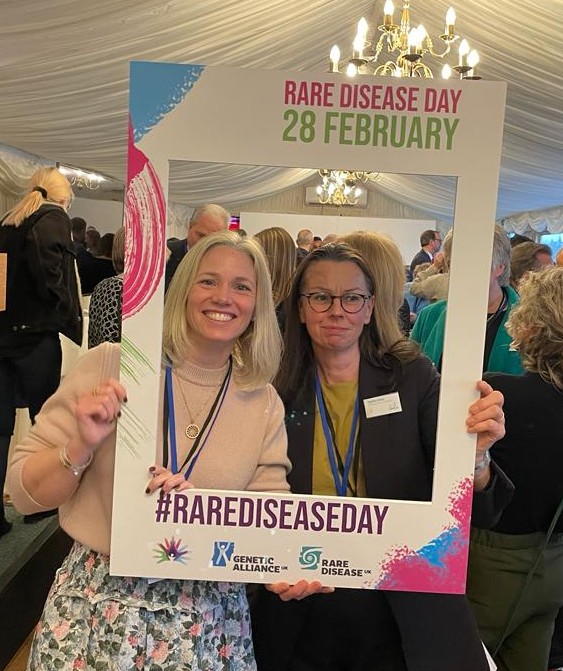
28 February 2022 is #RareDiseaseDay#MED13L_syndrome is a rare neuro-developmental disorder mainly caused by newly occurring (de novo) mutations in #MED13L gene. It has an estimated incidence of ~6 in 100,000 births (López-Rivera 2020).
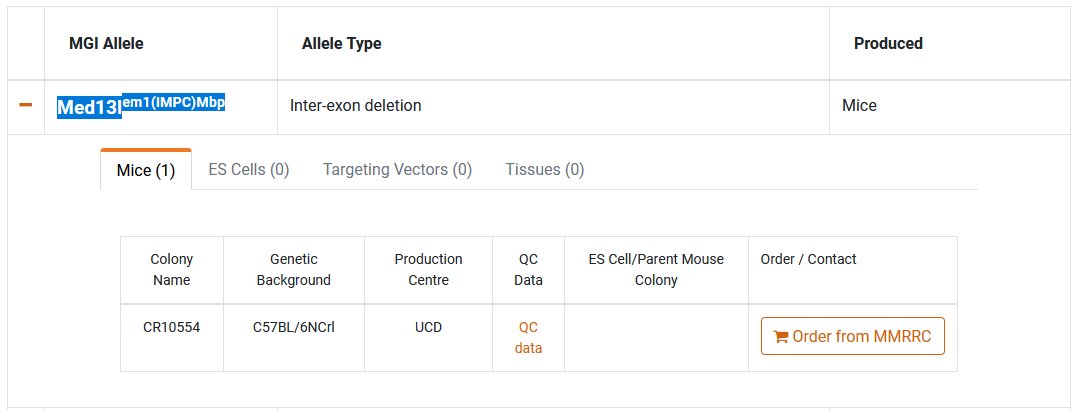
Having a Med13l mutant mouse model is a key step towards a better understanding of #MED13L syndrome. Hopefully in collaboration with Jackson Laboratory @jacksonlab and Mouse Phenotyping Consortium @impc , mouse models such as the Med13lem1(IMPC)Mbp 👇 are characterized.
@impc systematically switches off (knocks out) each of the roughly 20,000 genes of the mouse genome. The knockout mice are very valuable to study human disorders and develop treatment options. We are looking forward to the characterization of #MED13L knockout mouse: 👇