Every summer prep playbook chases long-term relationships. I built the opposite: 3-week category dominance strategy. Splits Meta volume plays from Amazon seasonal positioning. The exact framework with timelines. Reply AGENTS and I'll send it.
Bunch O Balloons could have gone DTC and built a 'water balloon brand'. Instead they went Amazon exclusive and sold outcome. Volume over margin, distribution over community, moment over LTV. For one-time seasonal purchases, this is the only move.
330+ balloons in a single pack. Amazon exclusive. Seasonal. Bunch O Balloons understood something that kills most toy brands: your customer doesn't want a relationship. They want the party to work. One purchase per summer. Outcome beats brand.
The mistake is thinking DTC is always right. For seasonal commodities, Amazon is smarter. Shelf velocity plus seasonal demand plus exclusive badge equals category dominance during peak season. You don't need to own the customer. You own the moment.
2 weeks of META ad rejections, every appeal approved within 12 hours.
the community called it a glitch. it is not a glitch.
WHERE META'S ENFORCEMENT IS ACTUALLY HEADING
META has been rolling out tiered account health scoring for months.
above the threshold: automatic approvals.
below it: flagged first, approved second.
appeals work because you momentarily clear the line, not because META made an error.
THE METRIC YOUR MEDIA BUYER IS IGNORING
account quality score. it lives in business manager. most teams check it never.
the rejections aren't random. they are the leading indicator for delivery efficiency collapse in Q4.
brands at $50k+/month need to be watching this weekly, not reacting to it quarterly.
and nobody is pricing the Q4 risk into their media plans right now.
Same stack I use: → https://t.co/6jw8R9pFi2
Reddit validation is backwards. Meta CVR is tanking this week. Father's Day spend is up, conversions flatlined. The issue: brands validating via Reddit are solving for upvotes, not buyers. Test on paid platforms. A small paid budget beats free sentiment. That's real validation.
@hridoyreh Founder obsession runs deep. But pure content monetization has a low ceiling. Starter Story's $100k/m is solid for a bootstrap. the next phase scales through ops work, coaching, or community, not more posts.
$97 digital product on Kajabi nets you $63. Gumroad nets $68. Self-hosted, you keep all $97.
You're paying 30-35% for a checkout on zero fulfillment cost. Infinite margins, until you negotiate them away.
Why share yours with a platform?
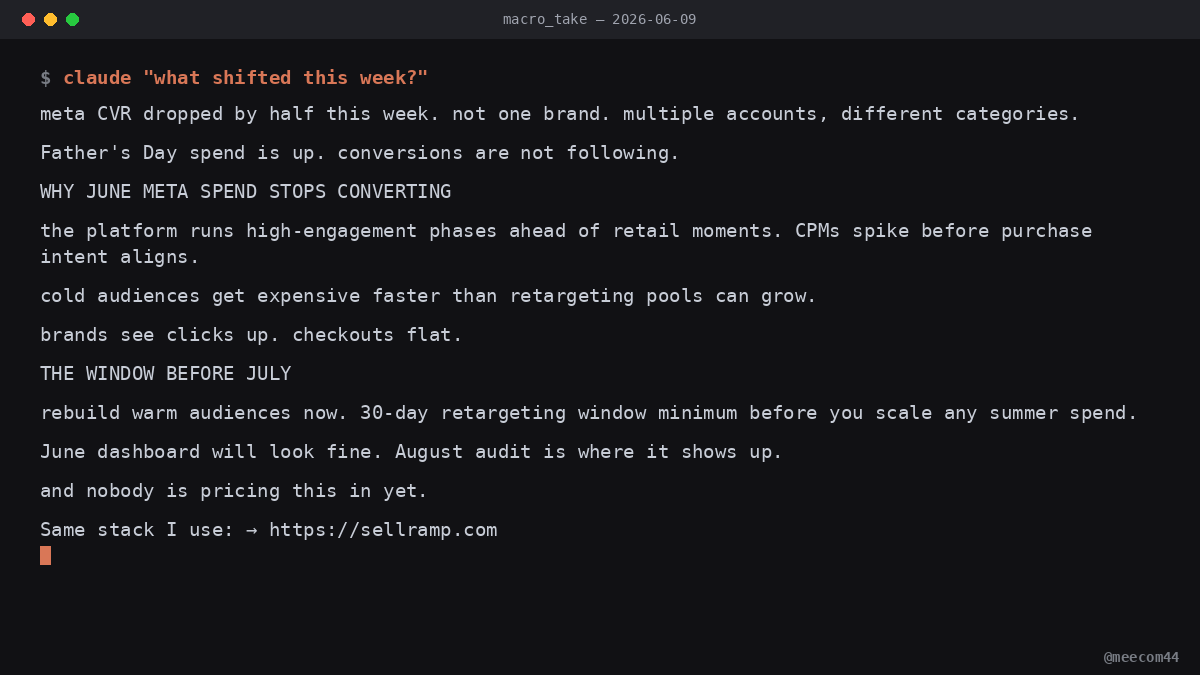
meta CVR dropped by half this week. not one brand. multiple accounts, different categories.
Father's Day spend is up. conversions are not following.
WHY JUNE META SPEND STOPS CONVERTING
the platform runs high-engagement phases ahead of retail moments. CPMs spike before purchase intent aligns.
cold audiences get expensive faster than retargeting pools can grow.
brands see clicks up. checkouts flat.
THE WINDOW BEFORE JULY
rebuild warm audiences now. 30-day retargeting window minimum before you scale any summer spend.
June dashboard will look fine. August audit is where it shows up.
and nobody is pricing this in yet.
Same stack I use: → https://t.co/6jw8R9pFi2
$5-10k/month is where freelancers hit a wall. Not pricing. Delivery ops. Hand-delivering the same way at $1k. No templates, no automation, no delegation. Why scale revenue if your fulfillment system doesn't scale?
Paid once to build checkout infra. Operates free now. Every founder paying $1,500/month for managed platforms is solving the same problem I solved once. By year 2 that's $18k in recurring costs I don't have. That's the asymmetry. Build once. Operate forever.
The micro-influencer deal is cooked. One creator used to handle one variant. Now one render handles 50. The labor arbitrage that paid UGC creators just broke.
Running 30 agents taught me this the hard way. You need tight observability on goal interpretation itself. One agent misreading context cascades into 5 downstream systems breaking.
That fact-check agent would've been hundreds of lines of function definitions. Now it's a prompt with context. Same output, fraction of the code. The efficiency gain is why I build everything this way now.
Humans bottleneck on execution bandwidth, not IQ. I've got 30 agents on Claude Code handling what one person would batch manually. AI didn't make me smarter. It made me faster.
Adding tools kills focus more than it adds capability. Claude Pro alone ships more than the $400 stack. The gap isn't budget. It's knowing what to ask.