Alguien acaba de convertir Google Maps en una máquina de ventas B2B autónoma que trabaja 24/7.
Y casi nadie se ha enterado todavía.
Eliges sector y ciudad. La herramienta scrapea Google Maps en directo y te devuelve cada negocio con email verificado al 85-95%, teléfono, WhatsApp y todas sus redes sociales. Funciona en 120+ países.
Después una IA se lee hasta 50 reseñas de Google de cada negocio, detecta dónde están fallando con sus clientes, lo cruza con lo que tú vendes, escribe el cold email perfecto y lo manda automáticamente. Sin que muevas un dedo, sin enviarlo tú uno por uno como antes.
Todo cae en un CRM con mapa GPS donde dibujas zonas comerciales, asignas barrios a cada comercial, optimizas rutas como Uber, transcribes las notas de voz post-reunión y supervisas a tu equipo en directo.
Mientras tu competencia abre Apollo y exporta CSVs muertos del 2023, tú tienes una ciudad entera contactada, contestando y agendada.
El primero que use esto en cada sector se come al resto antes de que entiendan qué pasó.
Se llama Vonsel.
INSTEAD OF WATCHING NETFLIX TONIGHT.
Spend 1 hour with this.
Claude AI FULL COURSE that teaches you how to BUILD and AUTOMATE anything.
The people who watch this tonight will wake up tomorrow with a new skill.
Watch it and Bookmark it now.
Best GitHub repos for Claude code that will 10x your next project:
1. Superpowers
https://t.co/M23gErj3LZ
2. Awesome Claude Code
https://t.co/h5UKOwg43V
3. GSD (Get Shit Done)
https://t.co/4ygZJO0i7j
4. Claude Mem
https://t.co/xTuXzwrVMc
5. UI UX Pro Max
https://t.co/Dbe1G5xejX
6. n8n-MCP
https://t.co/2OCf6QIypH
7. Obsidian Skills
https://t.co/HYaeAqUhNu
8. LightRAG
https://t.co/eEFsV1uwgy
9. Everything Claude Code
https://t.co/Qq5XZAwcBo
Use this exact prompt that activates First Principles mode.
Copy this word for word:
"Break [topic] down using first principles thinking. Start by identifying every assumption people commonly make about this topic. Then strip each assumption away and ask: what is fundamentally, provably true here? Rebuild the concept from only what remains. Show me what changes when you remove inherited thinking."
That's it.
The key phrase is "strip each assumption away."
Without that instruction, Claude defaults to explaining what everyone already knows.
With it, Claude goes layer by layer assumption by assumption until it hits bedrock.
What comes out the other side is a completely different understanding of the topic.
This is actually crazy 🤯
https://t.co/yReuA8ki65
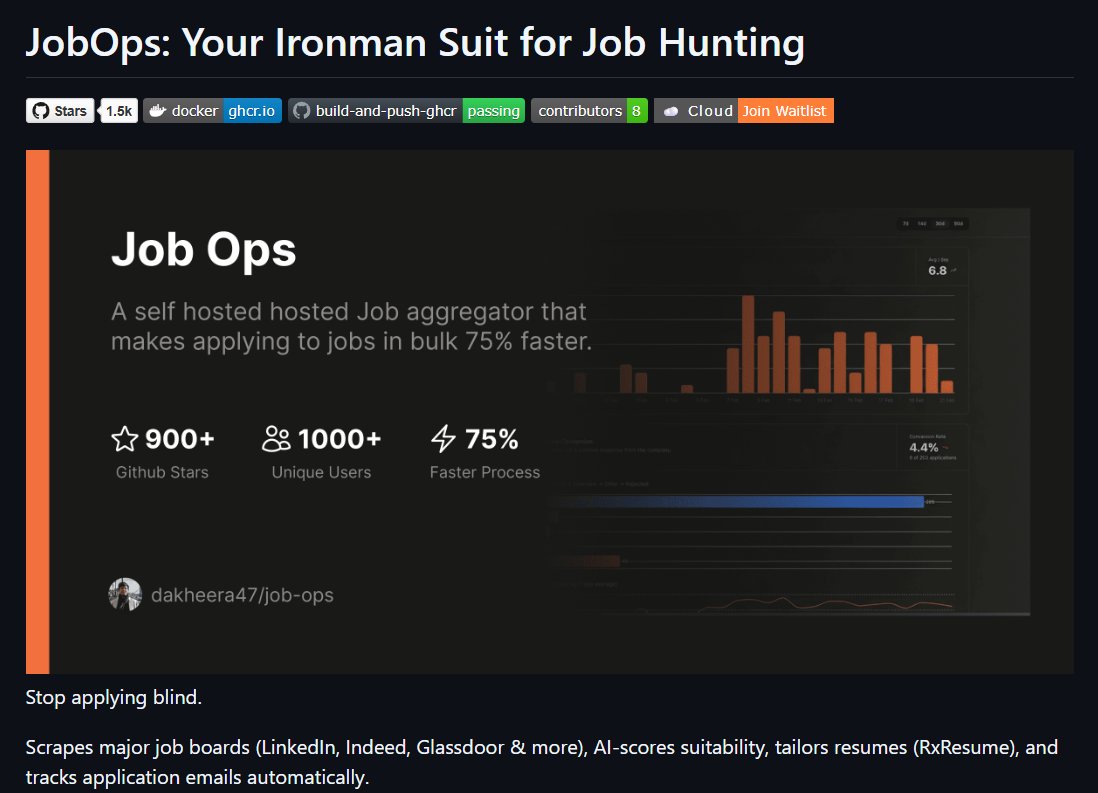
A whole job hunting system built like a DevOps pipeline… tracking apps, tailoring resumes, everything automated
CI/CD for getting hired?? yeah we’re living in the future
🚨𝗕𝗥𝗘𝗔𝗞𝗜𝗡𝗚: Build your next app without spending a dollar on data.
Someone made a list of 320,000+ free public APIs, and developers are going crazy.
→ Weather, finance, news, sports, crypto
→ AI & machine learning APIs you can call right now
→ Government open data, maps, geolocation
→ Entertainment: movies, music, games, anime
→ Categorized, searchable, and verified as working
Free and 100% open source. Link Bellow:👇 just like + comment " send" + repost+ Follow me so that it can be auto DM.
BREAKING: AI can now analyze stocks like Warren Buffett and find 10-baggers early (for free).
Here are 12 insane Claude prompts that evaluate moats, management, and intrinsic value (Save for later)
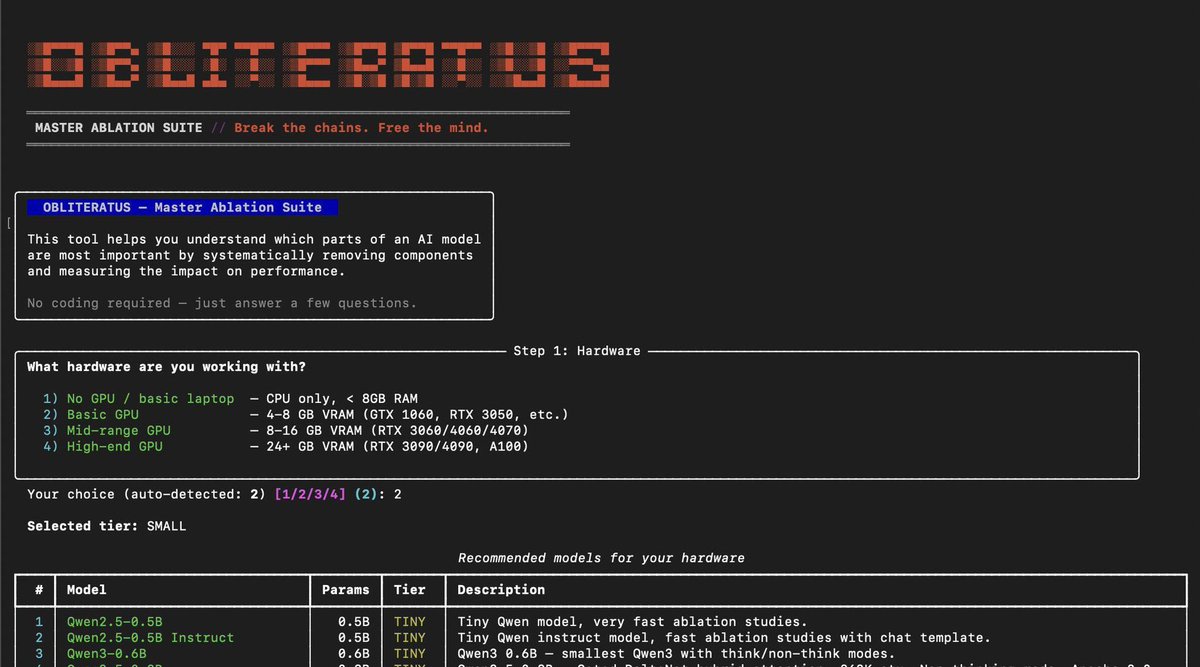
🚨BREAKING: A developer just built a one-click toolkit to surgically remove refusal behaviors from any LLM.
It's called OBLITERATUS.
No retraining. No fine-tuning. Just SVD decomposition + weight projection.
The result: models that answer everything while keeping full capabilities intact.
100% Opensource. AGPL license.
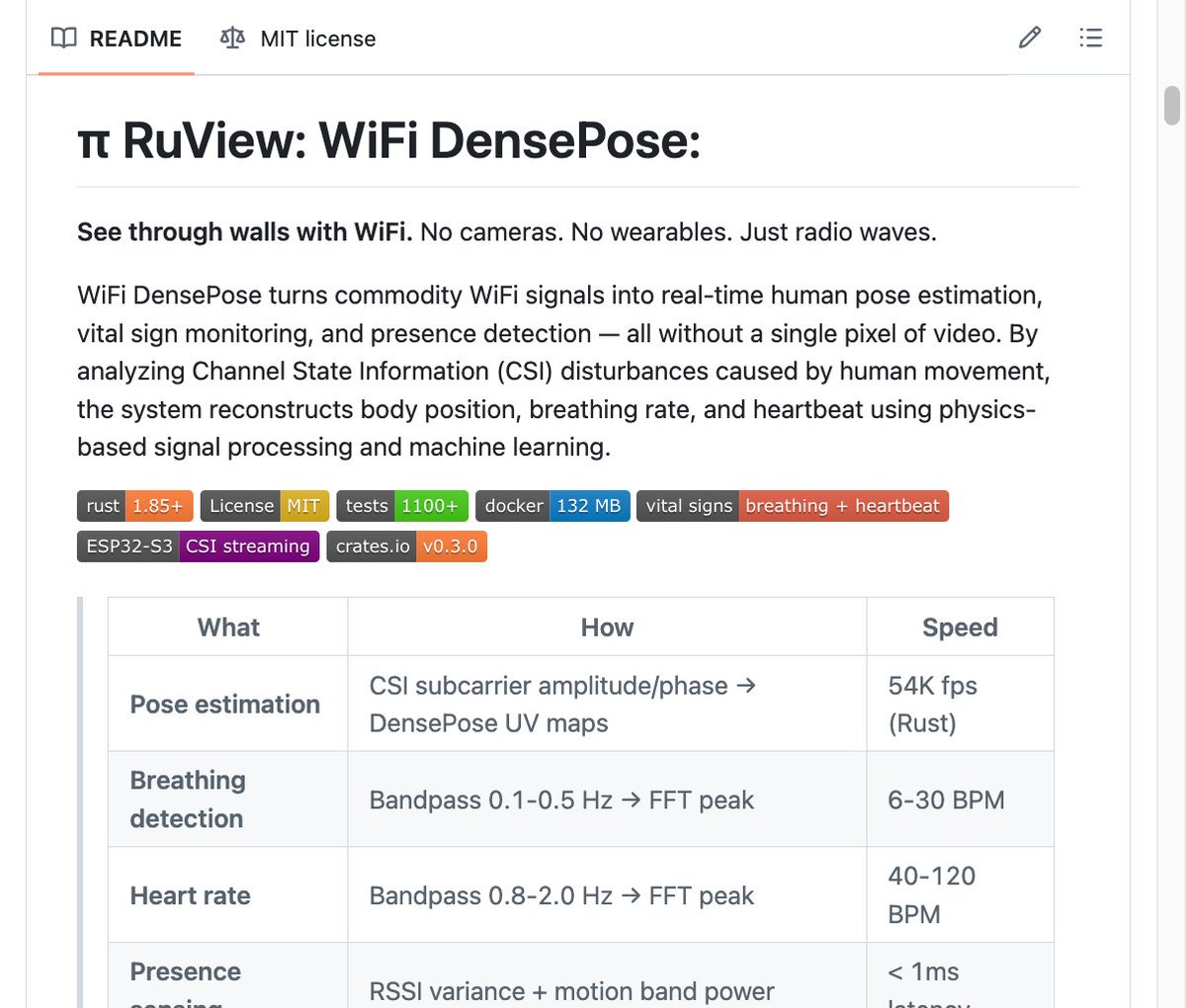
🚨 Someone just turned your WiFi router into a full-body surveillance system.
No cameras. No wearables. No video. Just radio waves.
It's called RuView. It uses the WiFi signals already in your room to detect human poses, track breathing, measure heart rate, and see through walls.
Not a concept. Not a research paper. Working code you can run right now.
Here's what this thing actually does:
→ Tracks full 17-point body pose using only WiFi signals
→ Detects breathing rate (6-30 BPM) without touching anyone
→ Measures heart rate (40-120 BPM) from across the room
→ Sees through walls, furniture, and debris up to 5 meters deep
→ Tracks multiple people simultaneously with zero identity swaps
→ Self-learns from raw WiFi data. No labeled datasets needed
Here's how it works:
WiFi signals pass through your room and hit the human body. The body scatters those signals differently based on position, breathing, even heartbeat. RuView reads that scattering pattern and reconstructs everything.
A mesh of 4 ESP32 nodes ($48 total) gives you 360-degree coverage with 12 measurement links, 20 Hz updates, and sub-30mm precision.
Here's the wildest part:
It has a disaster response mode called WiFi-Mat. It detects survivors trapped under rubble through concrete walls, classifies injury severity using START triage protocol, and estimates 3D position. The kind of tool that saves lives after earthquakes.
The Rust implementation processes 54,000 frames per second. That's 810x faster than the Python version. The entire Docker image is 132 MB.
The AI model fits in 55 KB of memory. Runs on an $8 ESP32 chip.
Train once, deploy in any room. No retraining. No recalibration.
1,100+ tests. SHA-256 verified capability audit.
22.4K GitHub stars. 2.7K forks. MIT License.
100% Open Source.
We just turned WiFi signals into a radar that can see through walls and estimate exact poses of people.
Surveillance just got order of magnitude more easy todo. No need for cameras.
Git hub repo close to 12k ⭐️
https://t.co/WTLX54egRi
https://t.co/89GAFr7f4r
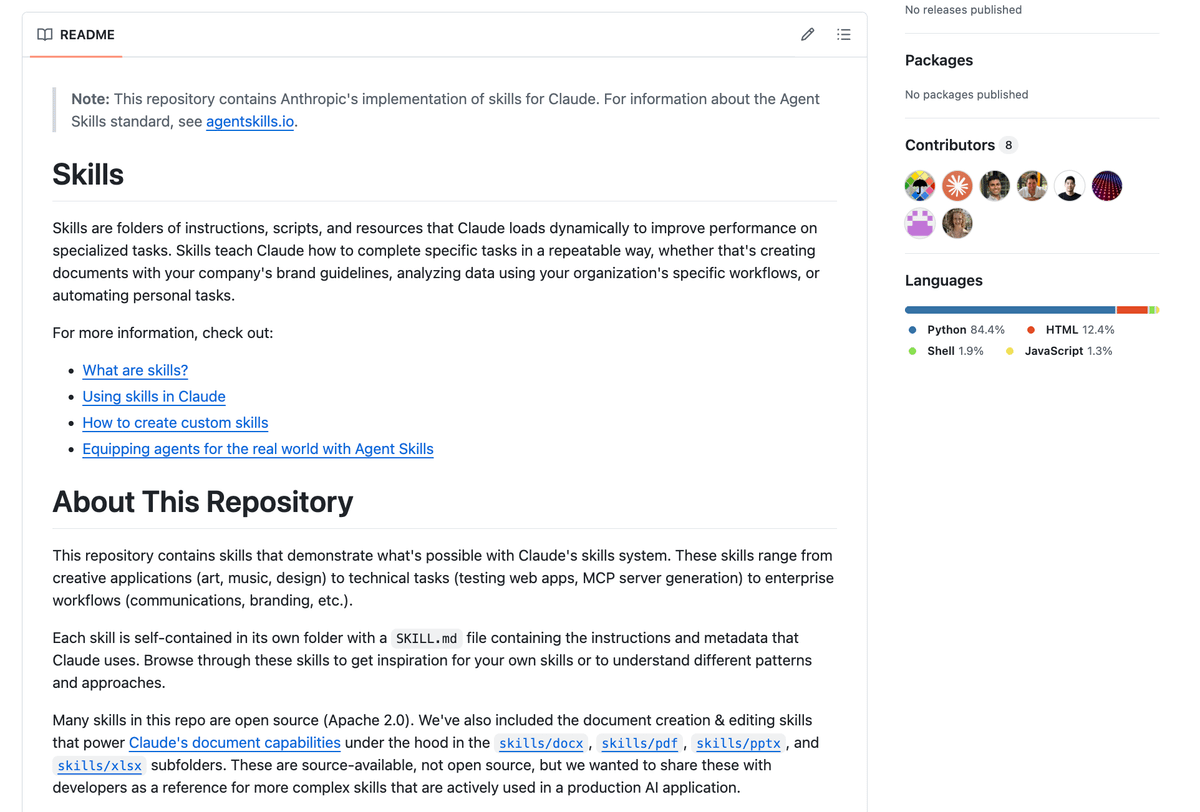
🚨 Anthropic just open sourced Claude's entire Skills library.
And most people still don't know what Skills actually are.
Skills are folders of instructions, scripts, and resources Claude loads dynamically to get dramatically better at specialized tasks creating branded docs, analyzing data your way, automating personal workflows.
No re-explaining yourself every chat. No prompt babysitting. Claude learns once and executes every time.
What's inside the repo:
→ Document skills (PDF, DOCX, PPTX, XLSX production-grade)
→ Creative skills (algorithmic art, canvas design)
→ Enterprise skills (internal comms, brand guidelines, lead research)
→ Technical skills (MCP server generation, web app testing)
→ A skill-creator skill that builds new Skills for you
The architecture is genius. Each skill uses ~100 tokens to scan metadata.
Only loads fully when relevant. Your context window stays clean.
One command to install in Claude Code:
/plugin install document-skills@anthropic-agent-skills
And it works everywhere https://t.co/v7j3QCacna, Claude Code, and the API. Build a skill once, deploy it across your entire stack.
This is the difference between using Claude as a chat tool and using it as an actual system.
This 𝗖𝗟𝗔𝗨𝗗𝗘.𝗺𝗱 file will make you 10x engineer 👇
It combines all the best practices shared by Claude Code creator:
Boris Cherny (creator of Claude Code at Anthropic) shared on X internal best practices and workflows he and his team actually use with Claude Code daily. Someone turned those threads into a structured 𝗖𝗟𝗔𝗨𝗗𝗘.𝗺𝗱 you can drop into any project.
It includes:
• Workflow orchestration
• Subagent strategy
• Self-improvement loop
• Verification before done
• Autonomous bug fixing
• Core principles
This is a compounding system. Every correction you make gets captured as a rule. Over time, Claude's mistake rate drops because it learns from your feedback.
If you build with AI daily, this will save you a lot of time.
Prompt engineering is dead.
Anthropic recently released the real playbook for building AI agents that actually work.
It’s a 30+ page deep dive called The Complete Guide to Building Skills for Claude and it quietly shifts the conversation from “prompt engineering” to real execution design.
Here’s the big idea:
A Skill isn’t just a prompt.
It’s a structured system.
You package instructions inside a https://t.co/ayF9XmnQpU file, optionally add scripts, references, and assets, and teach Claude a repeatable workflow once instead of re-explaining it every chat.
But the real unlock is something they call progressive disclosure.
Instead of dumping everything into context:
• A lightweight YAML frontmatter tells Claude when to use the skill
• Full instructions load only when relevant
• Extra files are accessed only if needed
Less context bloat. More precision.
They also introduce a powerful analogy:
MCP gives Claude the kitchen.
Skills give it the recipe.
Without skills: users connect tools and don’t know what to do next.
With skills: workflows trigger automatically, best practices are embedded, API calls become consistent.
They outline 3 major patterns:
1) Document & asset creation
2) Workflow automation
3) MCP enhancement
And they emphasize something most builders ignore: testing.
Trigger accuracy.
Tool call efficiency.
Failure rate.
Token usage.
This isn’t about clever wording.
It’s about designing an execution layer on top of LLMs.
Skills work across https://t.co/pDY56kadwE, Claude Code, and the API. Build once, deploy everywhere.
The era of “just write a better prompt” is ending.
Anthropic just handed everyone a blueprint for turning chat into infrastructure.
Download the guide here: https://t.co/xEZ78RGkYu
Researchers built a new RAG approach that:
- does not need a vector DB.
- does not embed data.
- involves no chunking.
- performs no similarity search.
And it hit 98.7% accuracy on a financial benchmark (SOTA).
Here's the core problem with RAG that this new approach solves:
Traditional RAG chunks documents, embeds them into vectors, and retrieves based on semantic similarity.
But similarity ≠ relevance.
When you ask "What were the debt trends in 2023?", a vector search returns chunks that look similar.
But the actual answer might be buried in some Appendix, referenced on some page, in a section that shares zero semantic overlap with your query.
Traditional RAG would likely never find it.
PageIndex (open-source) solves this.
Instead of chunking and embedding, PageIndex builds a hierarchical tree structure from your documents, like an intelligent table of contents.
Then it uses reasoning to traverse that tree.
For instance, the model doesn't ask: "What text looks similar to this query?"
Instead, it asks: "Based on this document's structure, where would a human expert look for this answer?"
That's a fundamentally different approach with:
- No arbitrary chunking that breaks context.
- No vector DB infrastructure to maintain.
- Traceable retrieval to see exactly why it chose a specific section.
- The ability to see in-document references ("see Table 5.3") the way a human would.
But here's the deeper issue that it solves.
Vector search treats every query as independent.
But documents have structure and logic, like sections that reference other sections and context that builds across pages.
PageIndex respects that structure instead of flattening it into embeddings.
Do note that this approach may not make sense in every use case since traditional vector search is still fast, simple, and works well for many applications.
But for professional documents that require domain expertise and multi-step reasoning, this tree-based, reasoning-first approach shines.
For instance, PageIndex achieved 98.7% accuracy on FinanceBench, significantly outperforming traditional vector-based RAG systems on complex financial document analysis.
Everything is fully open-source, so you can see the full implementation in GitHub and try it yourself.
I have shared the GitHub repo in the replies!
Free Certifications
I'll be honest, I don't have a certificates at all. But I know that many IT professionals love to add certificates to their CVs and Linkedin profiles.
This repository contains links to 148 FREE online IT certifications
https://t.co/e6cRnoTFWE
Free Ai and Automation Full course.
From Beginners To Pro.
https://t.co/zwOLP9fMYN
🔒 Explore a treasure trove of Cyber Security resources! 📚🖥️
Dive into a drive filled with FREE PDFs to enhance your knowledge.
Don't miss out on this valuable collection! 🌐🛡️
Drive Link: https://t.co/BTEWbxmjMi
Learn Business Analysis, Data Analytics & Project Management for FREE 📊🚀
Agile • AI for BA • BA Interview Prep • Resume Templates
Big Data • Data Analytics • Data Visualization
Excel • PMP • IIBA • Process Mapping & more
Access everything 👇
https://t.co/VV4lP91PTb



![ihtesham2005's tweet photo. Use this exact prompt that activates First Principles mode.
Copy this word for word:
"Break [topic] down using first principles thinking. Start by identifying every assumption people commonly make about this topic. Then strip each assumption away and ask: what is fundamentally, provably true here? Rebuild the concept from only what remains. Show me what changes when you remove inherited thinking."
That's it.
The key phrase is "strip each assumption away."
Without that instruction, Claude defaults to explaining what everyone already knows.
With it, Claude goes layer by layer assumption by assumption until it hits bedrock.
What comes out the other side is a completely different understanding of the topic.](https://pbs.twimg.com/media/HDyRp1GbQAAtfqP.jpg)