@ChrisGPotts Does any of the work on interpretability you cite connect with the question of faithfulness (or lack thereof) of CoT? Or are these completely independent questions?
@ZeeshanZiaML My own view (I don't speak for MJ!) is that "superintelligence" is not (at least not yet) a scientific concept, so it's hard to say anything scientific about it.
@slatestarcodex 1. I believe that AI can be dangerous (& already is).
2. I am skeptical of claims that AI could cause human extinction.
3. I had no involvement in the article you cite.
4. AI field is polarized, but it's not helpful to (yes) belittle expertise of people you disagree with.
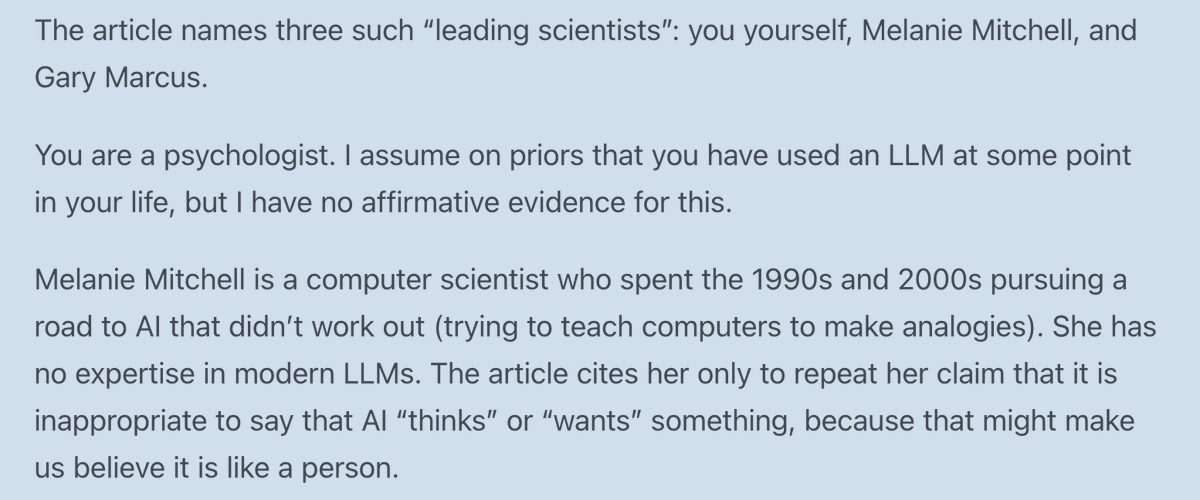
@slatestarcodex Check out my Google Scholar page. I've done many things since my PhD work in the 1980s on analogy (which actually did work out in its limited domain) and have done a lot of research on "modern LLMs". E.g., my most recent two papers, both accepted at NeurIPS 2027.
Many piling on me for using "straw-person" instead of "straw-man". But there is something all these critics have in common. Guesses?
Seriously, please read Miller & Swift's "Words & Women" for compelling discussion of how default male language affects everyone's biases.
Because if you read the quote-thread you're continuing here, your stochastic parrot coauthor Timnit is literally calling it "the accurate description" of Astra and Fable.
So of the two of you already wildly disagree on what the thing you both coined actually is nowadays, there's no hope the rest of us agrees.
@boazbaraktcs@_aidan_clark_ People now often use the term "LLM" to mean any large AI system that incorporates a pre-trained LM. This is not the meaning that was addressed in the Stochastic Parrots paper. That's my only point!
@boazbaraktcs@_aidan_clark_ Any post training that moves the model away from the general statistics of language (e.g., like RLHF or RL for tool use) makes the model no longer a statistical model of language (in the sense of modeling the structure of human language)....