Five great signs of intelligence:
• You're not afraid or ashamed to find errors in your understanding of things.
• You take mistakes as lessons.
• You don't get offended with accepting the facts.
• You are highly adaptable and very curious.
• You know what you don't know.
@dexterxbt@SpartakBGNN@0xSmith_C@ether_fi Hi, for example I put different airports and there are all charging entrance. From lounges in America, to lounges in Europe or even in Asia (as I travel often) all are charging …
@ether_fi What about the free airport lounge passes? I am few points away from pinnacle to get the unlimited , but is it really worth it if you cannot provide an update?
@ether_fi@0xVishnya@EthenaPay Any news when the Luxe perks come live ? It states September in your website (free lounge passes , 10% off AI, food and more)
I keep asking the agents in the chat and they cannot confirm. Thank you @ether_fi
Most of what young people blame on “capitalism” is actually the result of statism: big government; monetary debasement; regulation that blocks housing supply; taxes that punish work and investment; and political privilege that protects insiders.
Young people are not victims of free markets. They are victims of a big government system in which political spending rules, central banks subsidize debt instead of promoting price stability, savings, and prudent investment, and bureaucrats decide who gets opportunities.
More government will not solve any of it.
https://t.co/FD5eABY8Yl
My grandma asked me today: "If everyone in the world wrote down their problems and put them in a hat, would you risk grabbing one, or keep yours?" It changed how I see life...
I came across a quote that said:
"You can seem like a millionaire to one person and a homeless person to the next. The ants think you are a giant, and the trees don't even notice you. You think you have a boring life, but the next person might be striving for your lifestyle. Comparison is the thief of joy, so stay kind and keep loving life. Life is all just a big game of perspective."
All the cities and towns on earth combined occupy between 1% and 3% of the earth's entire land surface. And land takes up only 28% of the globe.
We are physically tiny, yet we carry vast assumptions about our importance. Humans make up 0.01% of life on Earth.
Based on global biomass data, the world's fish outweigh humanity by nearly 12 times. Depending on how it's measured, insects and land arthropods outweigh us by up to 17 times.
Historically, older ecological models estimated that gap was even wider, but a comprehensive global biomass census published in the Proceedings of the National Academy of Sciences (PNAS) narrowed it.
Because the human population has surged past 8 billion while global insect numbers face declines, the weight difference is closer than it used to be — but it remains immense.
Earth's temperature is estimated to have increased by 1.4°C since the start of the industrial revolution. In 1775, when this shift began, the global population was just 750 to 800 million. Today, we stand at 8.3 billion large animals.
Yet even the termites significantly outweigh us.
While global human biomass is roughly 350 million tons, entomologists estimate the total weight of all termites is around 445 million tons.
It’s a profound reminder: when the literal bugs beneath our feet outweigh our entire global civilisation, we are really not that important in the grand scheme of things.
No warming since 1850 at truly rural sites! Anyone who travels regularly between towns & country knows there is a few degrees more warmth in all urban areas.
Renesas Electronics: AI Infra & Compute
The Rise of AI Servers and Inference Compute
> Total general server shipments are expected to grow modestly (~1.3x) from 2024 to 2030. In contrast, AI Server volumes are projected to scale dramatically, growing ~2.4x, effectively doubling in volume over the period.
> While GPUs have driven the initial training wave, the market is seeing a major pivot toward AI ASICs and CPUs as the industry shifts heavily toward inference. AI ASIC shipments are projected to grow ~3.0x by 2030, vastly outstripping GPU growth (~1.5x) and standard CPU growth (~1.7x).
Revenue Drivers and Renesas’ TAM Expansion
> The primary structural tailwinds include the grid-to-rack transformation, an increase in system complexity requiring advanced MCU control, and a crucial architectural shift to 800V and vertical power architectures.
> Growth is driven heavily by Digital Power, followed by Memory Interfaces, and other supporting MCU components.
The Power Bottleneck: Grid-to-Core Architecture
> Grid Level: Managing power via Solid State Transformers (SST), Energy Storage Systems (ESS), and Uninterruptible Power Supplies (UPS) using Digital Controllers and high-voltage GaN (Gallium Nitride).
> Rack Level: Stepping down power using 800V DC/DC converters, hot-swap controllers, and Power Supply Units (PSUs).
> xPU Board Level: Delivering ultra-low voltage and high current directly to the processor via memory interfaces, high-speed optical module PMICs, and complex Vcore stages (utilizing integrated voltage regulators to optimize space and efficiency).
Exponential Power Demand Metrics
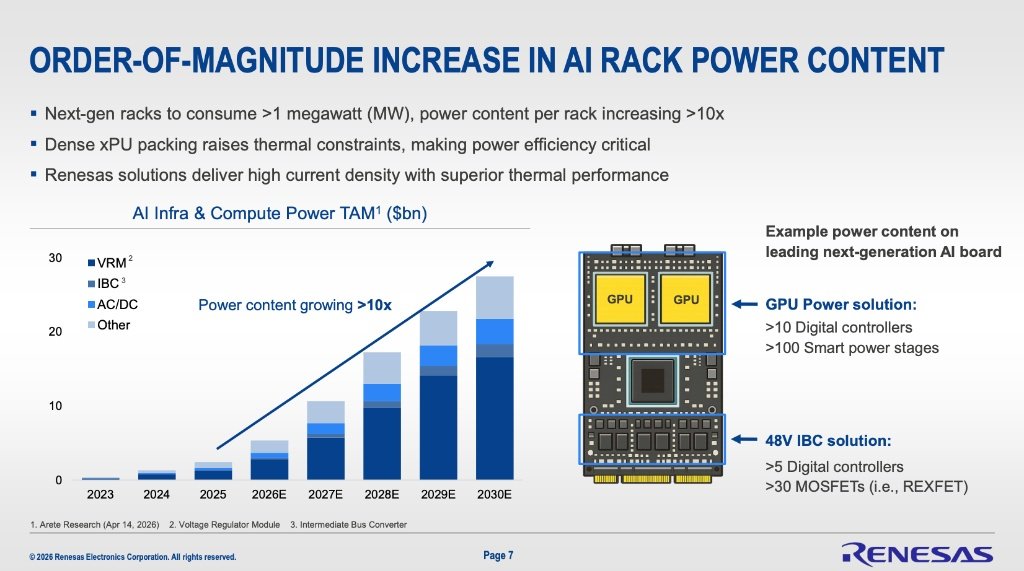
> Next-gen AI racks are projected to consume >1 megawatt (MW) of power, driving a >10x increase in power content per rack.
> The AI Infra & Compute Power TAM is scaling almost exponentially toward 2030, with Voltage Regulator Modules (VRM) making up the vast majority of this value, followed by Intermediate Bus Converters (IBC) and AC/DC stages.
> A single example leading next-gen AI board showcases the sheer complexity involved, requiring a GPU power solution with >10 Digital controllers and >100 Smart power stages, alongside a 48V IBC solution utilizing >30 MOSFETs. Dense packing drastically raises thermal constraints, making thermal performance and current density the ultimate competitive battlegrounds for silicon providers.
This is bullish for many power semi names. $STM $IFNNY $TXN $ON $WOLF
⚡️The quote is basically the whole monetary caste system in one sentence.
Coca-Cola’s real superpower is not syrup. It is trust converted into cheap liabilities.
A company with stable cash flow, global distribution, brand durability, and institutional credibility can issue long-term debt at low rates.
Then inflation and money supply growth slowly erode the real value of that debt while the company owns assets, pricing power, equity, brands, bottling networks, real estate, inventory, and financial claims that reprice upward over time.
That is the trade.
Borrow weak money.
Buy stronger assets.
Let time and inflation pay the debt for you.
The rich understand this. Corporations understand this. Governments understand this. Real estate investors understand this. Private equity understands this. The entire upper layer of the economy is structurally short fiat.
The bottom is structurally long fiat.
Wage earners hold cash, earn salaries, rent time, pay variable prices, and borrow at worse terms. Their groceries reprice. Their rent reprices. Their insurance reprices. Their healthcare reprices. Their tuition reprices. Their savings melt. But their access to cheap leverage is limited or punitive. They experience inflation as damage.
The asset-owning class experiences inflation as transfer.
That is why inflation is not merely “prices going up.” Inflation is a balance-sheet sorting mechanism. It separates those who can borrow against credibility from those who must save in currency.
The Coca-Cola bond is powerful because it lets the company manufacture a financial liability that other people treat as safe. Pension funds, insurers, bond funds, and conservative allocators buy the paper. Coca-Cola receives dollars today. It pays fixed coupons tomorrow. If the currency base expands faster than the cost of that debt, Coca-Cola wins quietly.
The product is Coke.
The deeper product is creditworthiness.
The deepest product is access to monetary dilution before the masses feel it.
This is why ownership matters more than income. Income gets taxed and inflated away. Assets and cheap fixed-rate liabilities ride the monetary wave.
The system is not neutral.
It rewards people who can convert money into claims before money loses value.
It punishes people who receive money after the dilution has already moved through the asset layer.
That is the real game.
Rich entities sell paper promises and buy reality.
Poor people sell reality and hold paper promises.