exploring @vangrid_io
This might be one of the most interesting shifts I've seen in the Vangrid story so far.
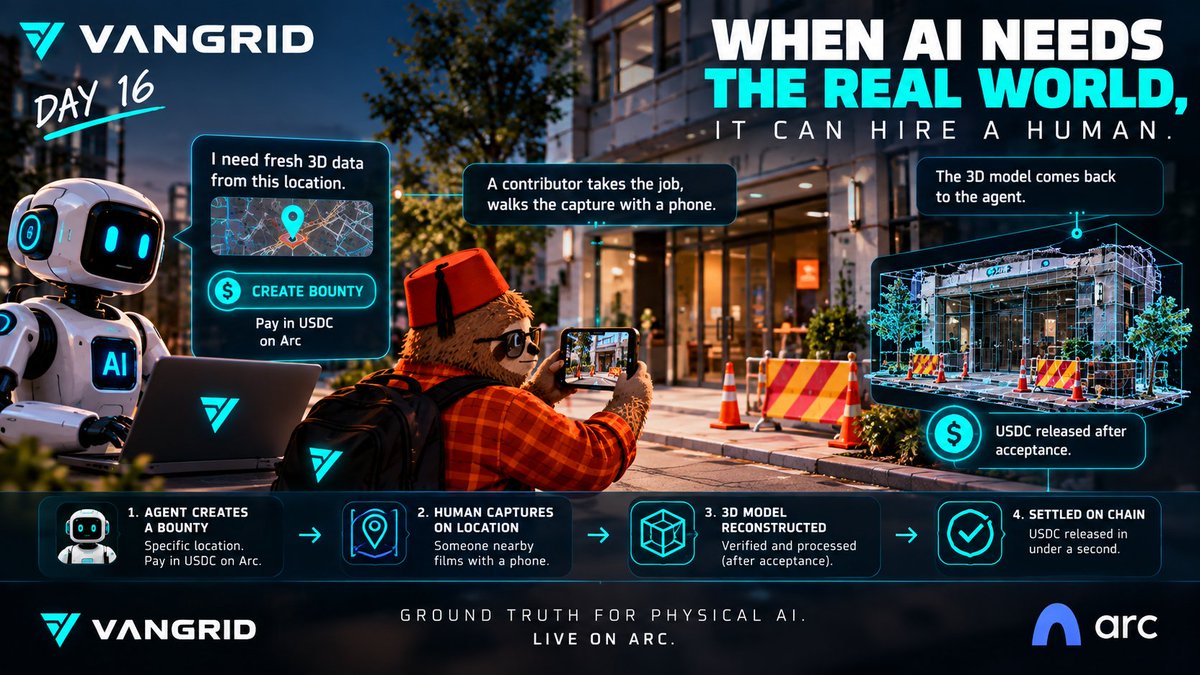
AI agents can now hire humans to capture the physical world.
Think about that for a second.
An agent needs fresh ground truth from a specific location.
It doesn't have to send a robot there.
It doesn't have to wait for a mapping fleet.
It can fund a bounty in USDC.
A person already near that location goes there, captures it with a phone, and the resulting 3D data comes back to the agent.
Agent needs data → bounty → human captures → 3D reconstruction → agent receives ground truth
And now Vangrid says this flow is live on @arc.
This changes how I've been thinking about the network.
Humans aren't just collecting data for machines.
They can become an on-demand physical extension of AI agents.
The agent has the intelligence and the demand.
The human has something the agent doesn't:
physical presence.
Connect the two with a marketplace and suddenly a smartphone becomes more than a sensor.
It becomes a way for an AI agent to reach into the physical world.
That's a much bigger idea than mapping.
It's the beginning of a market where machines can pay humans for real-world work.
And Vangrid may be building one of the first bridges between the two.
exploring @vangrid_io 🌍
Here's something I've been thinking about.
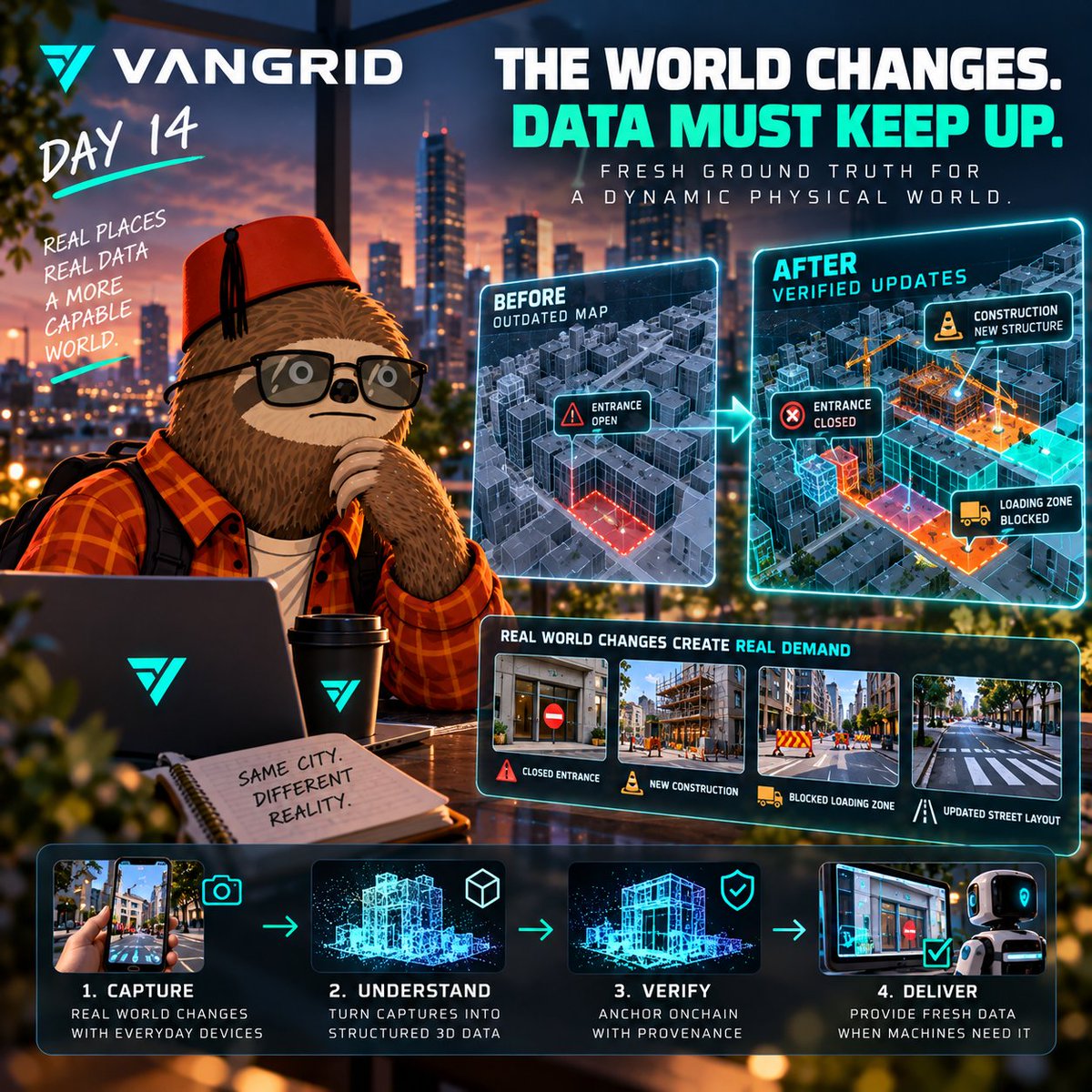
What if the most valuable spatial data isn't a complete map of the world, but the ability to know exactly what changed?
Imagine two delivery robots operating in the same city.
One has access to a massive 3D dataset updated every few months.
The other has access to a network that can provide fresh information about specific locations whenever something changes.
Which one has the information it needs when an entrance suddenly closes?
This is where Vangrid's potential gets interesting.
The real opportunity might not be collecting more data than everyone else.
It might be building a system where fresh information is captured precisely when and where it's needed.
A changed entrance.
A newly blocked loading zone.
A construction site that didn't exist yesterday.
Each change creates a potential need for new ground truth.
And each verified capture could help close that information gap.
The value isn't just in knowing what the world looks like.
It's in knowing when the world no longer looks the same.
If Physical AI continues expanding into everyday environments, the ability to detect and respond to change could become incredibly valuable.
Static maps describe the world. Fresh ground truth helps machines keep up with it.
That's the bigger opportunity I'm watching with @vangrid_io
exploring @vangrid_io
I’ve been thinking about something that could completely change the economics of real-world data.
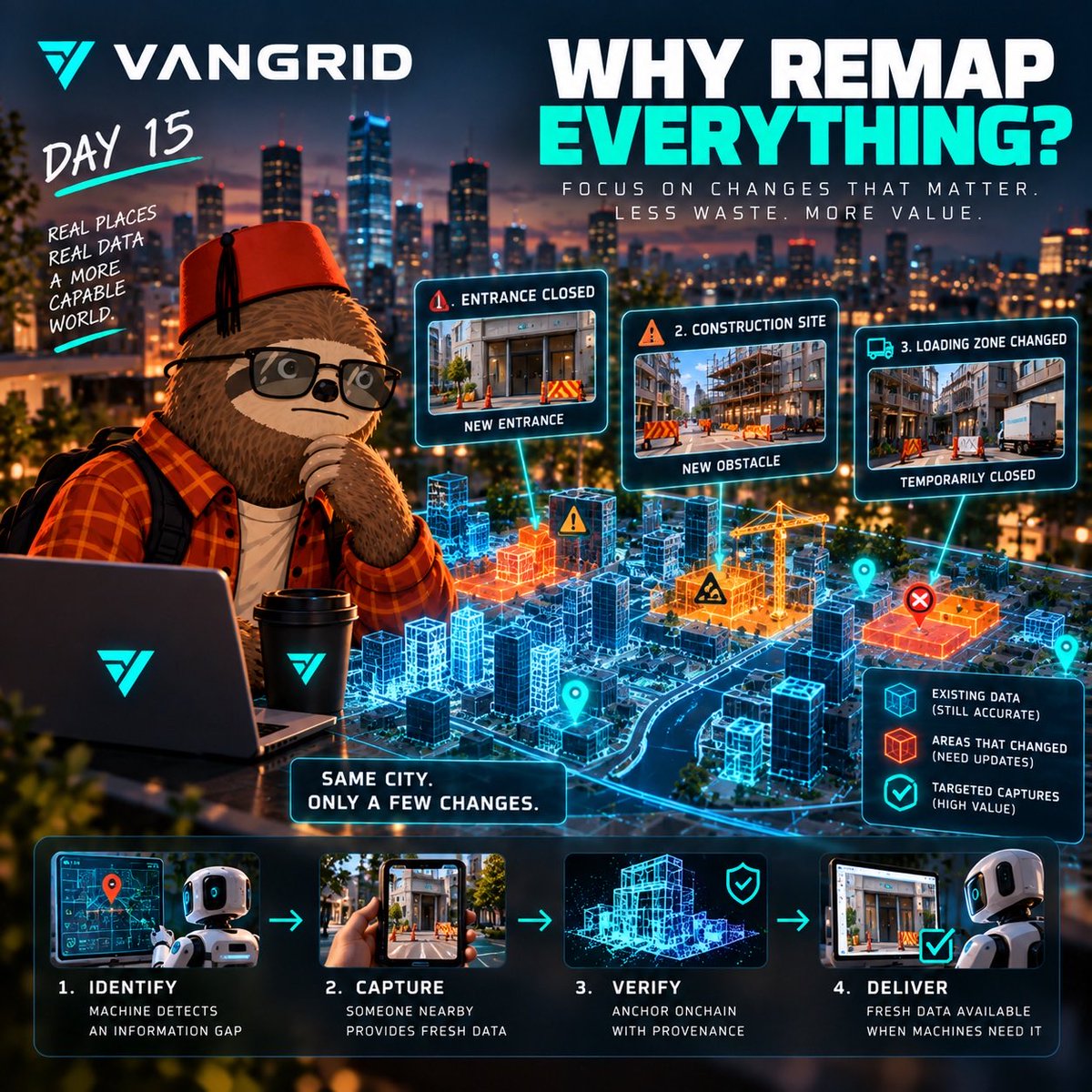
Why capture an entire city again when only a few streets have changed?
Imagine a delivery fleet operating across thousands of locations.
Most of its existing spatial data is still accurate.
But one entrance has moved.
Two loading zones are temporarily closed.
A new construction site has appeared.
Does the fleet really need another complete dataset?
Probably not.
It needs fresh information about those specific changes.
This is where Vangrid’s demand-driven model becomes interesting.
Instead of constantly rebuilding massive datasets, imagine a network that directs contributors toward locations where fresh ground truth has the most value.
A machine identifies an information gap.
The network requests a targeted capture.
Someone nearby provides the missing data.
And that information becomes available after verification.
The opportunity isn’t necessarily capturing more of the world.
It’s reducing the cost of keeping our understanding of the world accurate.
Of course, detecting changes and integrating updates reliably are challenges of their own.
But if this model works at scale, the economics of spatial data could look very different.
Less unnecessary collection. More useful information.
That’s another reason I’m watching @vangrid_io.
What If Machines Become the Customers?
exploring @vangrid_io
Here’s where the Vangrid idea gets even more interesting to me.
Today, humans decide where data needs to be captured.
But imagine millions of robots, autonomous vehicles and Physical AI systems operating in the real world.
They won’t always know what they need in advance.
A robot encounters an environment it doesn’t understand.
It requests fresh ground truth.
Someone nearby captures it.
The network verifies it.
The machine receives the context it was missing.
Now repeat that across thousands of machines and locations.
Suddenly, the machines aren’t just consuming spatial data.
They’re creating demand for it.
That’s when a capture network starts looking less like a mapping project and more like infrastructure.
Humans capture the world.
Machines request what they need.
The network connects the two.
What happens when machines become the customers?
That’s the part of @vangrid_io I’m watching closely.
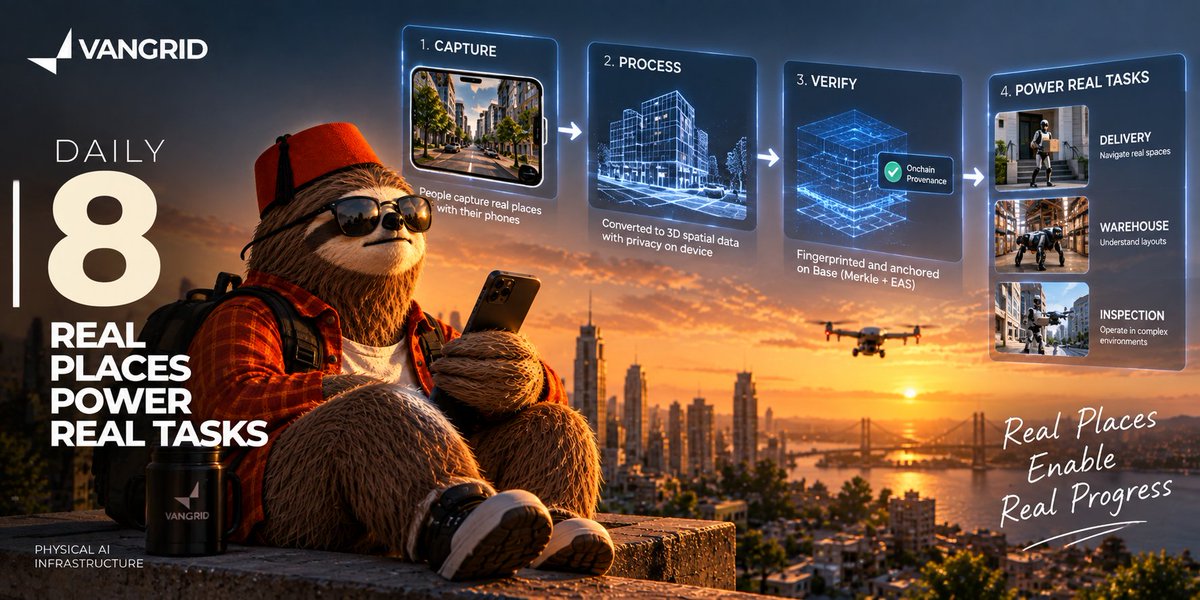
Day 8 of digging into @vangrid_io.
One thing I keep coming back to:
Physical AI doesn't need data just for the sake of having more data.
It needs data it can actually use to do something in the real world.
A delivery robot needs to understand the entrance to a building.
A warehouse robot needs to know the current layout between racks.
An inspection system needs to understand a site as it looks today, not six months ago.
That's where Vangrid's model starts to make sense.
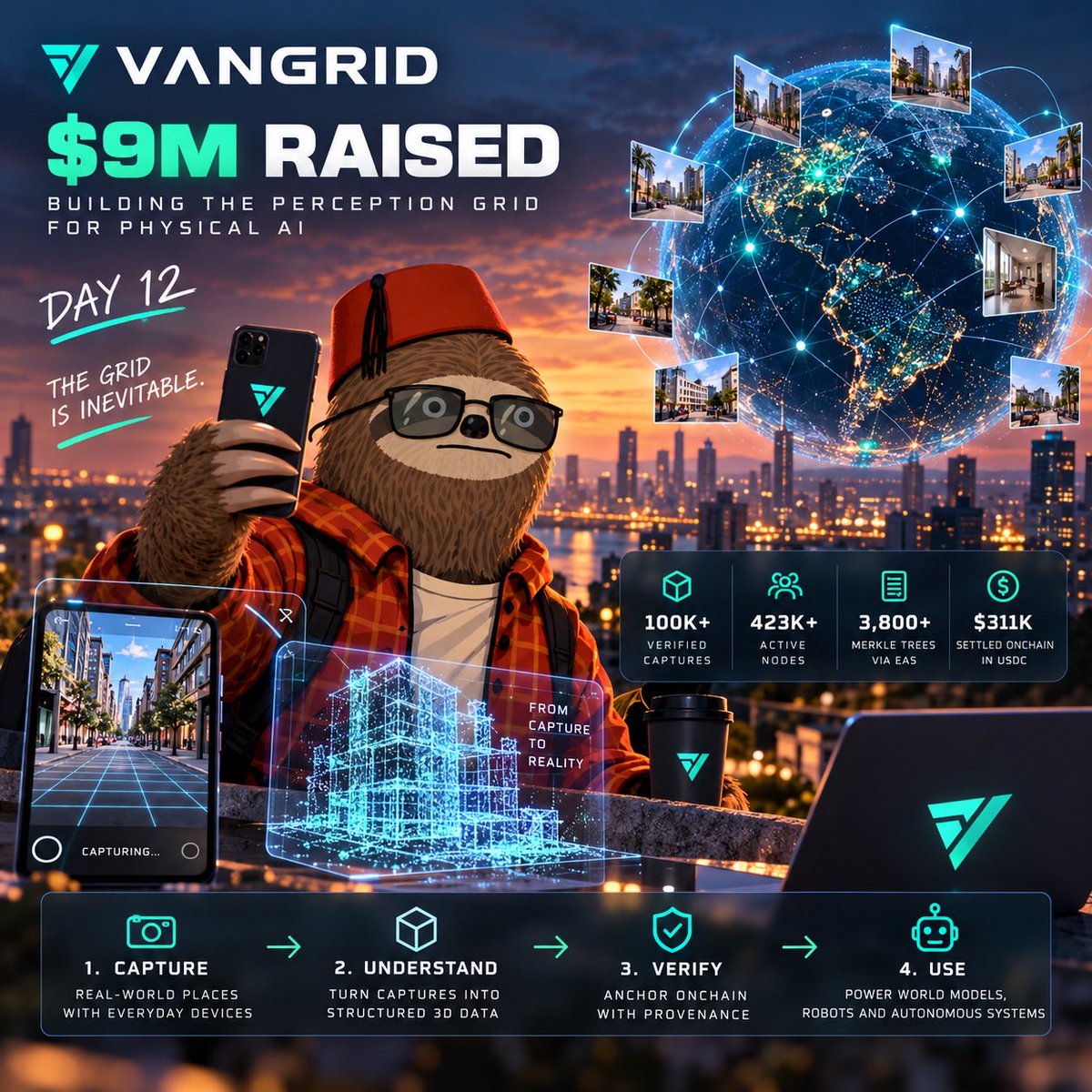
A real place gets captured with a phone.
The environment becomes structured spatial data.
Provenance makes the capture verifiable.
And that data can eventually help machines operate in that space.
Capture → Understand → Verify → Use
The interesting part isn't just mapping more of the world.
It's turning real places into something machines can actually understand and act on.
That's a much bigger opportunity for Physical AI.
Day 9 exploring @vangrid_io
Here's the Vangrid idea I've been thinking about the most:
Today, a human decides that fresh data is needed from a location.
But what happens when the machine realizes it first?
Imagine a delivery robot reaching a building and discovering that the entrance no longer matches its data.
Instead of failing or waiting for the next mapping update, it could flag that location for a fresh capture.
Someone nearby captures it with a phone.
The new observation gets processed and verified.
The machine gets a fresher understanding of the environment.
Machine detects uncertainty → requests ground truth → human captures → network verifies → machine updates
That would turn a spatial dataset into something much more interesting:
a feedback loop between machines and the physical world.
That's the direction I'm watching with @vangrid_io.
Not just mapping the world once.
Keeping machines connected to a world that never stops changing.
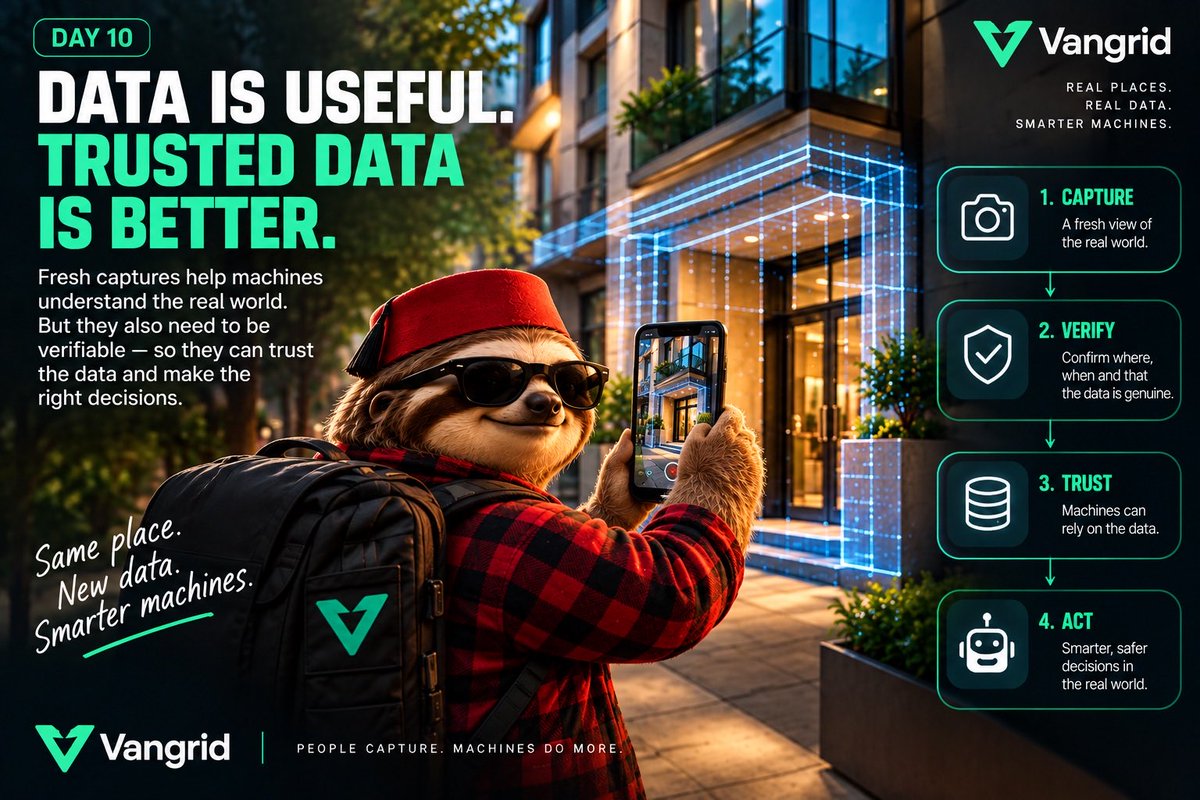
Day 10 exploring @vangrid_io
The more I think about Physical AI, the more one problem stands out.
Getting fresh data is only half the battle.
Can the machine trust it?
Imagine a delivery robot receives a new capture of a building entrance.
It needs more than an image.
It needs confidence that the data came from the right place, at the right time, and hasn’t been changed along the way.
That’s why provenance matters.
Vangrid isn’t just exploring how the physical world can be captured. The bigger idea is making those observations verifiable.
Capture → Verify → Trust → Act
Because when machines start making decisions based on real-world data, knowing where that data came from becomes just as important as the data itself.
The future of Physical AI won’t just need more data.
It will need ground truth it can trust.
That’s one of the most interesting parts of what @vangrid_io is building.
exploring @vangrid_io
Something I've realized while writing this series:
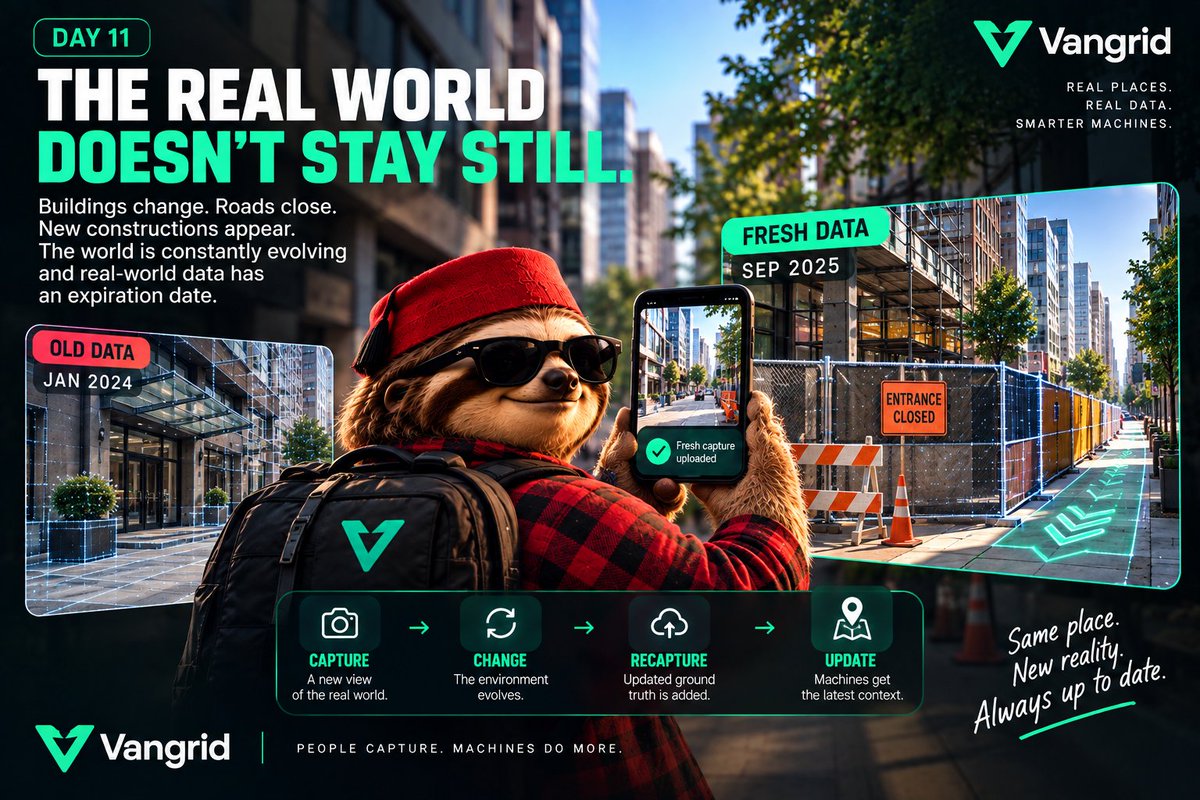
Real-world data has an expiration date.
A map can be accurate today and wrong next month.
A construction site changes overnight.
A warehouse gets reorganized.
A road closes.
A building entrance moves.
For humans, these changes are easy to notice.
For machines operating from old data, they can become real problems.
This is why I think the interesting part of @vangrid_io isn't simply creating another massive dataset.
It's the possibility of creating a network that can continuously refresh our digital understanding of the physical world.
Capture → Change → Recapture → Update
The goal isn't to map everything once.
It's to keep the map connected to reality.
And as more robots start operating outside controlled environments, freshness might become just as important as accuracy.
@sparkfinance fırsatını kaçırıp az puan aldıysanız üzülmeyin!
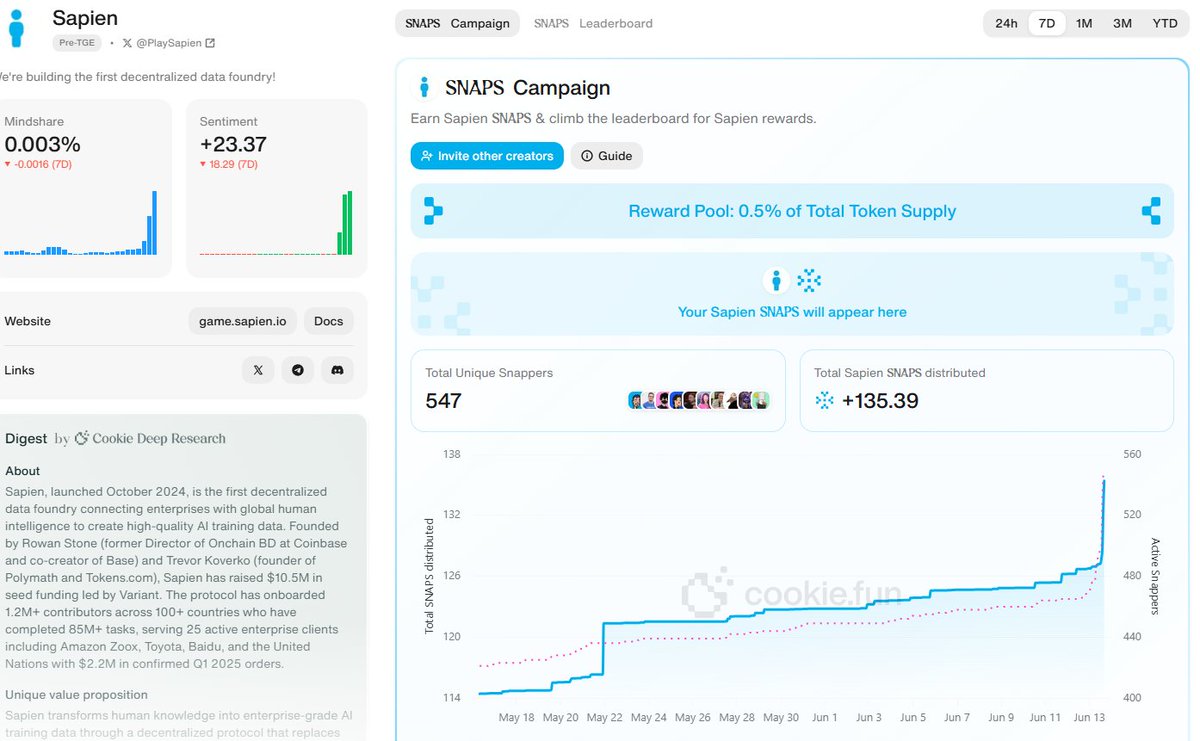
Yeni proje @PlaySapien henüz emekleme aşamasında içeride 500 kişi bile yok! 👀
⏳ Şimdi harekete geçme zamanı!
Mindshare’e erkenden katılın, sıralamada sağlam bir yer edinin.
🍪 Toplam arzın %0.5’i Cookie kullanıcılarına ayrıldı, bu ciddi bir oran!
🔍 Protokolü detaylıca inceledim:
Amaçları, oyunlaştırılmış görevlerle yapay zeka eğitim modellerini geliştirmek.
Görevleri tamamlayarak puan topluyorsunuz ve bu puanlar gelecekte tokene dönüşecek.
💰 Proje şu anda 15.5 milyon $ yatırım aldı.
Kurucu ekip, Web3 camiasında tanınan sağlam isimlerden oluşuyor.
🔗 Katılmak için: https://t.co/h2CAuKa8sW
📉 Şu ana kadar yalnızca 128 Sapien Snap dağıtılmış durumda.
Her gün içerik paylaşarak siz de bu snapleri toplayabilirsiniz.
@cookiedotfun
Two standout projects are making serious waves in the crypto space: @cookiedotfun and @sparkfinance.
🔹 @cookiedotfun delivers real-time market insights powered by AI-driven analytics helping users stay ahead with smarter decisions.
🔹 @sparkfinance is revolutionizing DeFi, currently managing over $2.6B in liquidity within the MakerDAO ecosystem, offering powerful yield strategies.
✨ With Cookie Snaps, you can earn SNAPS by creating engaging content.
⚡️ Meanwhile, Spark unlocks high-yield opportunities and exciting airdrop potential.
Stay tuned and follow both platforms you don’t want to miss what’s coming next!
In this post, I’ll cover the latest from
@cookiedotfun × @sparkfinance 🔥
Cookie just crossed 10,000+ participants, but the total SNAPS haven’t increased at the same pace. I’ve seen a lot of people lately saying, “Points don’t come as easily anymore.” And honestly? That’s kind of the point.
The project is making it clear: SNAPS aren’t meant to be given out so easily anymore and that’s a good thing. In modern economics, scarcity creates value.
In other words: our SNAPS are becoming rarer and more valuable. Isn’t that exactly what we want?
Personally, I prefer “less, but meaningful” over “more, but empty.”
So here’s the real talk: no matter how many points you earn now, if you’re not consistent, if you don’t keep showing up you’ll stall out. You’ll lose momentum.
That’s why I rely on my daily “minimum survival income” meaning: I try to post at least 1 or 2 tweets every day. Just to stay in rhythm.
There have also been a lot of questions about the loyalty algorithm lately. So I asked one of the Cookie Discord mods directly, and here’s what they told me (in their own words):
“Mentioning multiple tokens won’t automatically lower your score. The system uses AI to analyze if you’re genuinely loyal to a few projects or just ‘selling dog meat in a sheep costume.’ It looks at your content, timing, and engagement behavior holistically. You can’t fake this. Being real and consistent is what matters most.”
So the takeaway?
Yes, you can talk about other projects as long as you’re sincere and genuinely engaged.
Also, a quick heads-up:
@sparkfinance has opened the first phase of airdrop eligibility checks, with snapshots from April. That means many of the newer Cookie users might not be eligible yet.
But don’t stress I confirmed with the Cookie Discord team that Spark will reward Cookie contributors in the future too. Just keep building.
The most practical thing we can do right now is stay consistent with what’s already working.
Even if each of us just earns $500 from Cookie’s $5M prize pool hey, that’s still enough for a good chicken-and-rice meal, right? 🍗🍚😄
TL;DR:
Don’t let short-term point drops shake your rhythm.
📈 Luck creates spikes.
🧠 Consistency builds power.
I’m not quitting Cookie’s rewards will come.
See you at the top, friends! 🍪🚀
Let’s explore how ArCoin and Camp Network have joined forces — and why their collaboration is shaping up to be one of the most exciting experiences in Web3
What is @arcoin_official?
ArCoin is an augmented reality (AR) game that transforms the world map into 34 billion hexagonal tiles.
Players conquer, develop, and interact with these digital lands using real-world movements and AR technology. Each tile is represented by an NFT secured on the TON blockchain, creating a bridge between physical experience and digital ownership.
Technical Infrastructure & Economy
Built on TON Blockchain: Fast, low-cost transactions with scalable infrastructure
Tile NFTs: Every land tile is an onchain NFT that players can own and trade
$ARCN Token Utility:
▪ Buy land
▪ Stake for rewards
▪ Unlock exclusive missions
▪ Earn through AR ads and physical engagement
Dynamic Economy: The system adjusts based on player activity, keeping the experience fresh and adaptive.
Integration with @campnetworkxyz
Recently, ArCoin joined the Camp Network’s K2 Incentivized Testnet.
Camp is a Layer-1 blockchain designed for IP creation, digital identity, and social interaction. With this integration:
AR missions and tile claims are now being executed on Camp Testnet
ArCoin showcased its flexibility and Camp demonstrated its strength in content-driven, immersive use cases.
ArCoin is more than just a game — it’s a real-world integrated Web3 platform.
Its ability to combine physical interaction, AR, and onchain rewards — while seamlessly integrating into Camp Network’s content and social layers — positions it at the forefront of the Web3 evolution.
This partnership highlights what happens when gaming, real-world engagement, and decentralized IP infrastructure collide.
With ArCoin, you move and earn.
With Camp Network, your activity gains value, story, and ownership.
#ArCoin #CampNetwork #Web3Gaming #AR #DePIN #NFT #Layer1 #TestnetSeason #KaitoPicks #PlayToEarn
Camp Network is to IP what Spotify was to music.
When the system respects creators, there’s no need to steal people choose to flow.
That’s what @campnetworkxyz is building:
A trustless, trackable, onchain future for creators in the AI era.
Spotify disrupted piracy.
Camp Network will disrupt IP theft.
#CampNetwork #IPinWeb3 #OnchainIP #AIethics #Web3Creators #DePIN #ZKtech #KaitoAlpha #KaitoPicks #Layer3 #TestnetSeason
Big updates from @sparkfinance × @cookiedotfun!
In just 24 hours, over $100M USDS flowed into Spark pushing TVL to a new ATH: $355M+. 📈💥
⚠️ An exploit in the USDS pool was quickly identified & patched on June 3. No retroactive penalties, but stricter rules going forward.
✅ Spark’s fast response shows real commitment to safety, fairness & long-term growth.
DeFi is evolving and Spark is setting the standard.
#SparkFi #SNAPS #DeFi #COOKIE $SPK $USDS