Our researcher, PhD candidate Thomas Wilschut's study, shows that verbal responses eliminate disadvantages in vocabulary learning for dyslexic learners.
Read the blog to learn how these findings could reshape the way we teach dyslexic students: https://t.co/wY1kZCCZJN
We're enhancing our mastery system to boost long-term retention, improve study habits, and deepen learning insights. This update benefits long-term learning by encouraging well-timed study intervals, sustaining motivation, and supporting mastery.
Our research shows that some problems are forgotten faster, highlighting the need for adaptive learning. Partnering with @noordhoff , we tested Tafeltrainer with 500+ students, finding it effectively improves times table mastery.
Read more: https://t.co/OJXec0MQtj
We will participate in the @OEBconference on November 27-29, 2024, and we are also thrilled to join @Eduvation_DE at the @didactaDIGITAL on February 20-24, 2025. We are excited to showcase MemoryLab's latest solutions and to work together to shape the future of learning.
At #CogSci2024, Jori Blankestijn, a developer and UX researcher, presented a poster on using a data-driven approach to enhance learning. He collaborated with @univgroningen and @noordhoff to improve education through innovative, data-driven methods.
Last week we had another fun team activity! We hit the courts to play some Padel at Peakz Padel. It was exiting to see everyone bringing their A-game and cheering each other on! After all the action, we had some well deserved dinner. Here's to more memorable moments!
The testing effect—the phenomenon where retrieving information from memory enhances its later recall—has been extensively studied in both fundamental and applied research. This weeks research commentary by our researcher @thomas_wilschut.
The full paper: https://t.co/BDhXtqxoqI
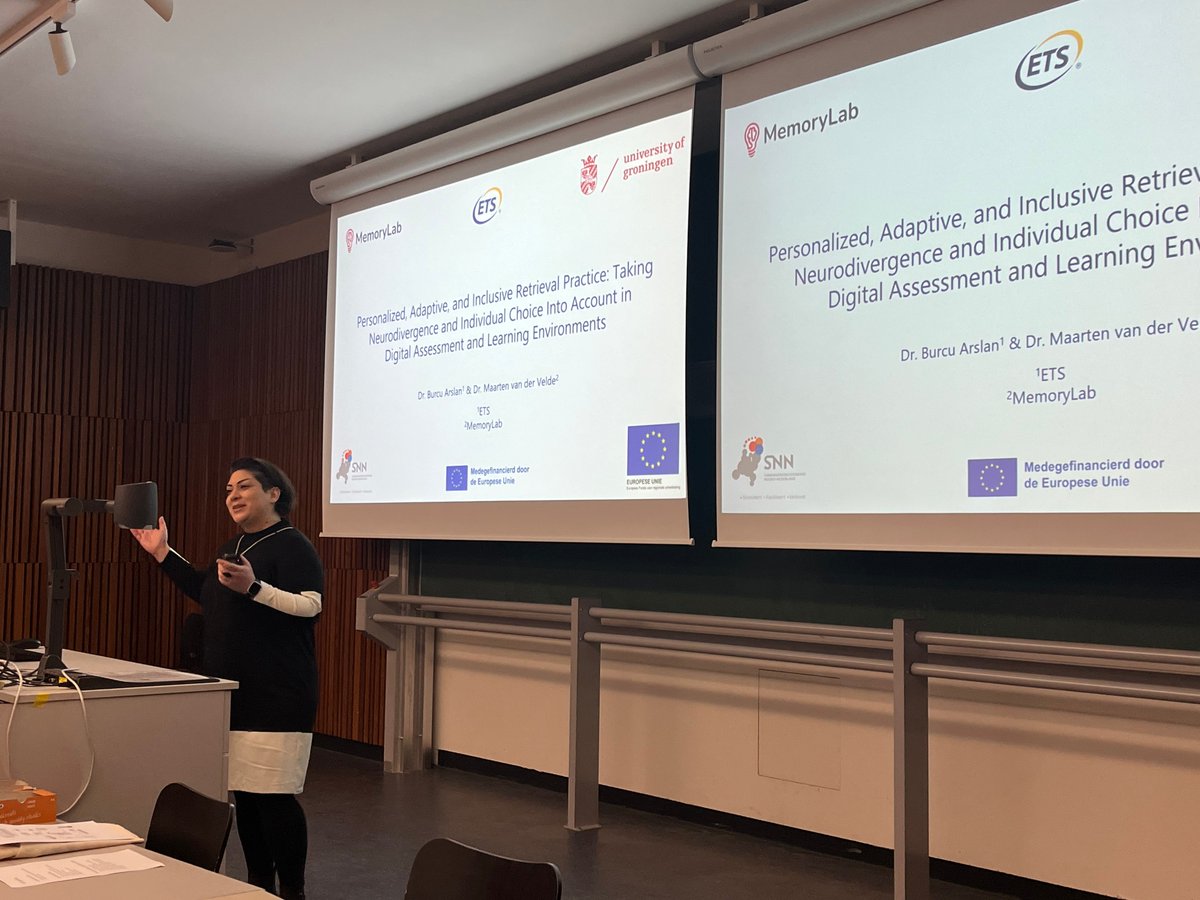
@BArslan_CogSci (ETS EMEA) gave a great presentation at last month's #TeaP conference in Regensburg, Germany, in the context of the new Samenwerkingsverband Noord-Nederland (SNN)-funded collaboration between MemoryLab, ETS EMEA, and the @univgroningen
In this blog post Myrthe Braam will delve into our comparative analysis of the Model Based Mastery (MBM) algorithm versus our traditional Optimal Spacing (OS) algorithm, showing that the MBM algorithm helps students master lessons faster.
https://t.co/8hxkD7y8Jj
"Despite more than a century of research, there is still debate about the shape of the forgetting curve". Our new research commentary by our senior researcher @mavdvelde
The full paper is available at: https://t.co/k2kCdR5qxy
In this white paper, we give an insight in the process of developing the Multiplication Trainer: an application for learning multiplication problems with an adaptive algorithm that is based on a computer model of the learner's memory.
Download here: https://t.co/Rrdek015QW
Last Friday we attended the ‘Nationaal Congres Engels’ in Ede. Together with team #SteppingStones@noordhoff we had a great day with lots of interesting conversations about the use of ‘SlimStampen’ and the added value of adaptive learning in education.
We are delighted to announce the launch of our adaptive learning solution, specifically designed for UPSC Civil Services Exams in India.
full press release: https://t.co/QqvWBnOy8m
Part 4 ‘Evaluating learner performance in the Multiplication Trainer’ in our Building TafelTrainer series by @thomas_wilschut is now live.
https://t.co/wtKR0mzmWn
"In order to learn optimally one should strive to spend as much of their learning time in the zone of proximal development. That is, making memory retrieval difficult, but not too difficult. https://t.co/V5cmhfVdfH
The prospect of a high-stakes test can reduce the positive effects of retrieval practice on long-term retention. This weeks research commentary by our senior researcher @mavdvelde.
In addition to the symposium, @thomas_wilschut will give a talk at TeaP on The Sound of Recall: Cognitive and Meta-cognitive Markers of Memory Retrieval Performance in Speech, and Maarten will give a talk on Alleviating 4 Million Cold Starts in Adaptive Fact Learning. (4/4)
Burcu Arslan (Educational Testing Service Global), Florian Sense (Air Force Research Laboratory), Holly Hake (University of Washington), and Corinna Börner-Schröder and Johanna Wagner (Ludwig Maximilian University of Munich). (3/4)