Highest rates of prostitution in the World :
1.Thailand (Buddhist)
2.Denmark (Christian)
3.Italy (Christian)
4.Germany (Christian)
5.France (Christian)
6.Norway (Christian)
7.Belgium (Christian)
8.Spain (Christian)
9.United Kingdom (Christian)
10.Finland (Christian)
Highest rates of theft in the world:
1.Denmark and Finland (Christian)
2.Zimbabwe (Christian)
3.Australia (Christian)
4.Canada (Christian)
5. New Zealand (Christian)
6.India (Hindu)
7.England and Wales (Christian)
8.United States (Christian)
9.Sweden (Christian)
10.South Africa (Christian)
Highest rates of alcohol addiction in the world:
1.Moldova (Christian)
2.Belarus (Christian)
3.Lithuania (Christian)
4.Russia (Christian)
5.Czech Republic (Christian)
6.Ukraine (Christian)
7.Andorra (Christian)
8.Romania (Christian)
9.Serbia (Christian)
10.Australia (Christian)
Highest homicide rates in the world:
1.Honduras (Christian)
2.Venezuela (Christian)
3.Belize (Christian)
4.El Salvador (Christian)
5.Guatemala (Christian)
6.South Africa (Christian)
7.Saint Kitts and Nevis (Christian)
8.The Bahamas (Christian)
9.Lesotho (Christian)
10.Jamaica (Christian)
Most dangerous gangs in the world:
1.Yakuza (non-religious)
2.Agberos (Christian)
3.Wah Sing (Christian)
4.Jamaica Posse (Christian)
5.Primeiro (Christian)
6.Aryan Brotherhood (Christian)
Largest drug cartels in the world:
1.Pablo Escobar – Colombia (Christian)
2.Amado Carrillo – Colombia (Christian)
3.Carlos Lehder – Germany (Christian)
4.Griselda Blanco – Colombia (Christian)
5.Joaquín Guzmán – Mexico (Christian)
6.Rafael Caro – Mexico (Christian)
And then they say that #Islam is the cause of violence and terrorism in the world and want us to believe that.
Who started World War I?
Not Muslims.
Who started World War II?
Not Muslims.
Who killed about 20 million of Australia’s indigenous people?
Not Muslims.
Who dropped the nuclear bombs on Nagasaki and Hiroshima in Japan?
Not Muslims.
Who killed more than 100 million Native Americans in South America?
Not Muslims.
Who killed about 50 million Native Americans in North America?
Not Muslims.
Who kidnapped more than 180 million Africans as slaves from Africa, of whom about 88% died and were thrown into the oceans?
Not Muslims.
First, we must define terrorism or understand how terrorism is viewed by non-Muslims.
If a non-Muslim commits a terrorist act, it is called a crime; but if a Muslim commits it, it is called terrorism.
We must stop dealing with double standards.
The Saudi Arabia–Iran deal brokered by China might quietly reshape the Middle East… weaken the United States dollar… and force Israel to rethink its future in the region.
Most people still don’t realize how big this is.
Here’s what’s really happening—and why it matters. 🧵👇
Source Vid: https://t.co/Gyv9tYRhO7
@ShahidkBolsen@MiddleNation_
People criticize Erdogan for not doing enough, which is fair to some extent.
But how many other leaders of major Muslim-majority countries do as much as Erdogan for the cause of Islam?
How many others are willing to speak so openly against Israel, criticize sectarianism, and call for transnational Muslim cooperation against Israel?
Erdogan does this even though he knows this means the US and Israel will target him for removal (e.g., 2016 coup attempt, support for his rival Imamoglu).
He knows he will be targeted in the same way as Imran Khan.
Private sector elites always telegraph their preferred leaders.
They just don't use words.
The TPS does not endorse leaders.
It prices them.
For example.
The preferred leader's country starts getting favorable credit treatment before any deal is public. Bond yields ease. IMF or World Bank language softens. Sanctions get selectively carved out in ways that benefit specific sectors tied to the preferred leader's power base.
This happens months before any handshake. If you watch sovereign debt spreads and credit default swap pricing, you can see who the financial system has decided to work with before a single diplomat boards a plane.
Then, the media starts to reframe. The language shifts from "strongman" or "hardliner" to "pragmatist" or "reformer" or "someone the West can work with."
Like Jolani for example.
This is preparation of the Western public to accept the deal when it arrives.
The opponent starts to gets degraded. The leader NOT chosen starts receiving negative coverage, corruption investigations surface, domestic opposition suddenly gets amplified, and their international invitations dry up.
Just like Netanyahu.
And lastly.
Before any deal is signed, look at who is already being positioned for the reconstruction contracts, the energy concessions, the infrastructure projects that will follow the settlement.
The money does not wait for peace. It pre-positions for it. Whoever holds the post-conflict economic architecture was selected before the conflict ended, because you cannot assemble that architecture in real time.
It takes months of quiet negotiation. If you can identify who holds the reconstruction portfolio, you have identified who the TPS chose, and you can often identify it while the bombs are still falling.
And thanks for acknowledging.
So, on the Israeli side,
Netanyahu has not appeared at a security cabinet meeting since early this month. But the question is not whether all these videos are real or not.
The question is why the Prime Minister of Israel, in the middle of a military operation, is proving he is alive through coffee videos instead of chairing war cabinet meetings.
Yariv Levin has 'reportedly' been named interim Prime Minister. If confirmed, this is the most significant political development in Israel since the war began, and it has generated almost no mainstream coverage.
On the Iranian side,
Old Khamenei was killed on Day 1 of the war. His son Mojtaba was named successor on March 9. As of today, Mojtaba Khamenei has not appeared on video or audio.
Ali Larijani, the Secretary of the Supreme National Security Council and the man who was effectively running Iran since Khamenei's death, was reportedly struck by an Israeli airstrike overnight. Israel's defense minister announced the kill.
Iran has not confirmed it. This is a major surprise. I expect major escalation and retaliation.
But so far.
Nothing. Silence.
So what we have is;
Israel's prime minister absent and possibly replaced.
Iran's supreme leader has never been seen.
Iran's de facto wartime leader may or may not be alive.
And no one really seems to care.
The markets are calm. The VIX, which measures market fear, has dropped from 27, three days ago to ~22 today.
The financial markets, while leaders are going MIA, are pricing in resolution, not escalation.
This means one of two things: either global financial markets are collectively delusional about the severity of a war that threatens, or they see something that the headline coverage does not.
A negotiated settlement requires both sides to prefer the deal over continued conflict. The problem in this "war" has been managing the leaders within the calibrated conflict, on both sides, that have personal incentives disconnected from their nations' strategic interests.
Netanyahu's incentive structure was transparent. He faces corruption charges that carry potential prison time. As long as the war continues, the political and legal pressure pauses.
On the Iranian side, Mojtaba Khamenei inherited leadership during a war, which means his legitimacy is entirely tied to how the war ends. A Supreme Leader who accepts a ceasefire in his second week looks like he surrendered before he started. His consolidation window, the period during which he needs to establish authority and credibility before making any concessions, created an unavoidable delay in negotiations regardless of what the broader Iranian strategic calculus demanded.
So this means, the specific leaders in place on both sides could not be the ones to make it. Netanyahu's personal legal exposure made him a spoiler. Mojtaba's political immaturity made him incapable of delivering a settlement this early in his tenure.
The rational outcome, a negotiated ceasefire, is being blocked by the irrational incentive structures of the two people who would have to sign it.
What appears to be happening now is the removal of both obstructions simultaneously.
If Netanyahu has been sidelined, whether through injury, incapacitation, or a quiet political decision that his leadership is no longer sustainable, the Israeli security establishment gains the ability to negotiate without his veto.
Katz has been running the war cabinet.
Levin has reportedly assumed interim authority.
Neither man carries Netanyahu's personal legal baggage or his specific incentive to prolong the conflict.
On the Iranian side, if Larijani has been relocated or killed, and if Mojtaba is being kept out of public view for his own protection rather than because of incapacity, then Iran's actual decision-making apparatus may be intact and functional behind a deliberate veil of ambiguity.
The objective appears to be; remove or sideline the leaders who cannot make a deal, install or empower actors who can, and use the fog of war to obscure the transition so that neither side's public feels like their leader was taken out to force a settlement. The war provides cover for a political restructuring on both sides that would be impossible to achieve through normal domestic politics.
The real challenge is that propaganda saturation on both sides makes verification nearly impossible in real time. Israel claims it killed Larijani. Netanyahu's office says he is fine. He is absent from meetings. Mojtaba issued a statement. No one has seen him.
Every factual claim about leadership status is coming through channels that have strong incentives to lie.
The behavioral pattern though, shows that both sides are experiencing simultaneous leadership disruption, and the market response to that disruption is calm.
As I called it.
This "war" is the instrument being used to execute a transition that was already underway.
This transition of TPS capital flight.
The restructuring of Gulf contracts and investments away from the US is the financial transition that the multipolar world has been building toward for a decade.
This is what this Iran "war" really is about.
A toast to a new partnership in a new era,
between the TPS and the Middle East.
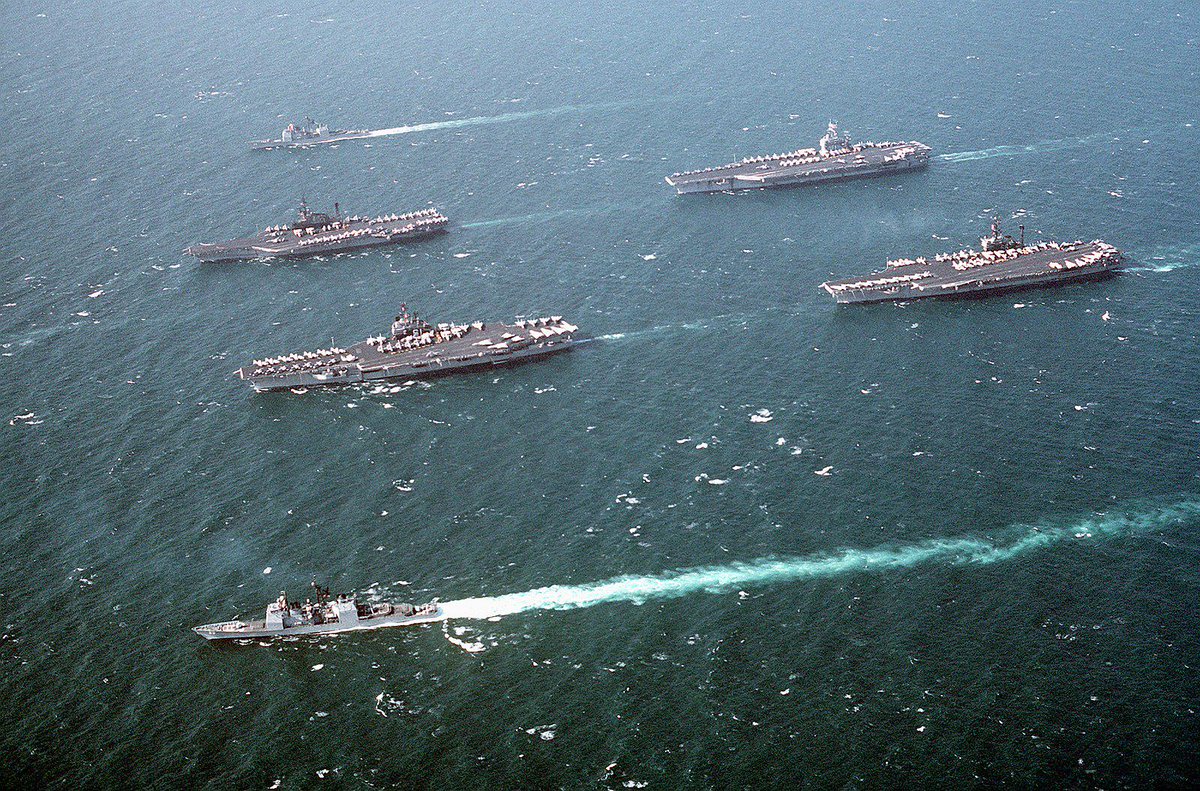
In the first Iraq War in 1990, the US had 1900+ aircrafts, 6 aircraft carriers, and 38 allies;
In the Second Iraq War in 2003, the US had 863 aircrafts, 5 aircraft carriers, and 16 allies;
In the 2026 Iran War, the US had 300+ aircrafts, 2 aircraft carriers, and only 1 ally;
From these numbers, you can see the decline of the empire.
With regards to Iran and the US; in my opinion, there is a maybe 5-10% chance of large scale military conflict.
A 60-75% chance of a deal (with no military strikes at all), and maybe a 20% chance of limited strikes followed by a deal, and 100% chance that whatever happens will happen with full coordination between the US and Iran