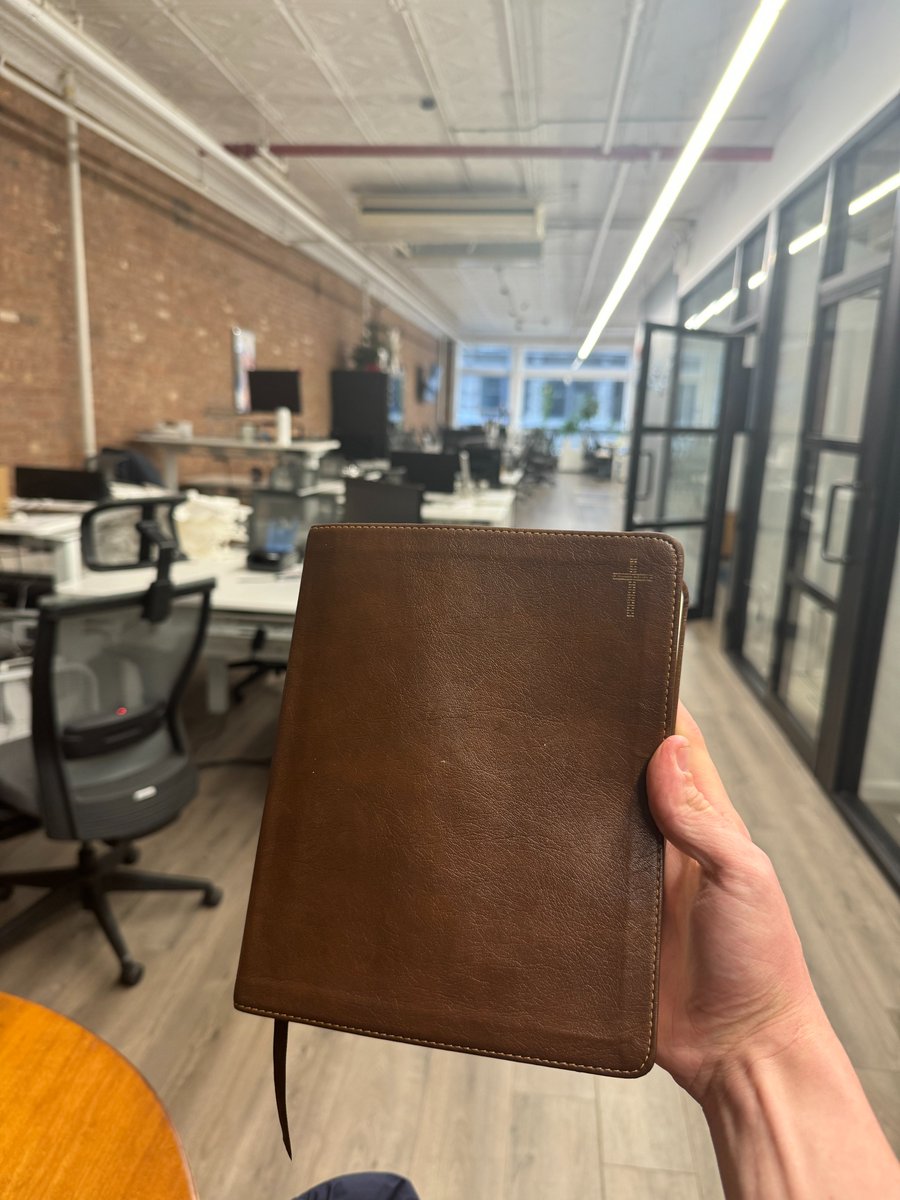
Standing on the promises of God helps us walk out the plans of God.
Keep showing up in His Word, sweet friend. Keep believing that His promises are for you and not just other people. And keep tucking those promises deep in your heart.
I went from thinking the Bible was the most boring book ever to seeing the magic in it.
Years ago, I realized that the Bible is the foundational book of Western civilization. If I was going to be an educated person, I needed to know what it said. Though I was motivated to learn about it, I didn't have the patience to read it or the knowledge to understand it.
Generally, I try to follow my 4th-grade English teacher's advice to read things first-hand. But the Bible seemed too hard, too boring, and too confusing to read on my own. It was a snooze fest. The stories felt outdated in a world of smartphones and fast Internet. Living in the modern world, shouldn’t I be rooting my life in modern books, modern studies, and modern authors?
At the time, I was living in New York when a friend introduced me to the work of Tim Keller. I reluctantly found time to put down the self-help and picked up two of his books instead: The Reason for God and Making Sense of God. It was around that time when I discovered Keller's Questioning Christianity lecture series.
Instead of focusing on the Bible directly, Keller focused on Christianity's relationship with culture and the modern world. He spoke to career-driven Gordon Gekkos who were driven by the glories of the material world, but sensed the emptiness at the heart of such a single-minded pursuit. Instead of referencing scripture directly, he spoke about big-picture themes like identity and purpose, morality and meaning.
This was back when I thought all Christians had the intelligence of sidewalk pigeons. I would scoff at church-goers because I didn’t understand why anyone would worship a sky fairy or follow rules from thousands of years ago. Keller was the guide I needed.
For the first few years, I looked at faith through a cultural lens instead of reading the Bible directly. I literally knew nothing about Jesus or Christianity — and I came to realize how little I knew about my own atheism too. In school, while studying the Declaration of Independence, I’d learned that it’s “self-evident” that “all men are created equal.” Turns out, this defining American ideal is only self-evident if you assume that every person has inherent worth because they’re made in the image of God. I was stumped. Where did my moral compass come from? Do people have inherent value? And if so, is it because every human is a child of God?
In addition to advocating for the life of Jesus and the truth of his message, Keller revealed the many assumptions underlying my own atheistic worldview. He taught me that every worldview requires a leap of faith. Sure, Christianity couldn’t perfectly explain everything in the universe, but then again, neither can any worldview. Astrophysicists say that much of the universe is made up of “dark matter,” which is a scientific-sounding way to talk about a leap of faith
Though I did some Bible studies, I never enjoyed them. They felt more like reading tedious academic papers than drinking directly from the fountain of God’s wisdom. Instead of reading Scripture directly, I joined a small Christian reading group where I was the only non-believer. By showing me coherent ways to interpret reality besides my science-based materialism, books like The Story of Reality and I Don't Have Enough Faith to Be an Atheist loosened the screws on my atheism.
My palate was beginning to change. Like a fine wine, the same flavors that were once repulsive to me started to appeal to my intellectual taste buds. I surrounded myself with wise Christians who were orthodox about scripture and eager to answer my hardest questions about faith. I asked them to dinner and invited myself to Church with them.
This marked a new era. Once again, I found some guides: books, Internet sources, and an in-person leader to show me the way. On the Internet, I'd turn to The Bible Project to answer my big-picture thematic questions. I picked up the ESV Study Bible, which I still read every day on the white boucle couch in my living room (if you like reading on the computer, I recommend The Bible Study App by Olive Tree).
For years, I’d stiff-armed the Bible. Now, I was skipping to a 7am Bible Study led by a devout believer who'd been reading God's word every day for almost a quarter-century, and wasn’t afraid to rebuke my theology.
What surprised me most was how carefully we read. I admired the integrity of our study. We live in a culture of binge-reading where people boast about how many books they can complete in a given year. We did the opposite. We never read more than ~20 verses in a single session and dissected every word, every verse, and every story. (I once spent two hours studying John 1:1-4 — just four verses at a strip mall Schlotzsky's in the Texas Hill Country.)
Never in my life had I read so deliberately. I spent months in the books of Ephesians, Romans, John, and 2 Corinthians, and there's no way I would've known how to read the Bible so diligently on my own. I learned to look beyond English translations, and I use the BibleHub to look up the original Greek and Hebrew whenever possible.
For a translation, I recommend the English Standard Version (ESV) (no, you don’t need to read the King James Version). And If you're going to pick two books, I recommend the Gospel of John and the Book of Romans. Either find a guide to read them carefully with you or follow along with The Bible Project and The ESV Study Bible. Whatever you do, read slowly.
I used to be a serial consumer who’d brag about how many books I read every year. I’d pick up anything and everything. The more, the merry. But the more I study the Bible, the more careful I’ve become about who I read and listen to. Gone are my days as a serial consumer. Frauds, charlatans, and false teachers abound, so be skeptical and vet your sources. In all this time, I’ve had no more than ten serious teachers. Fortunately, that’s all you need.
I became a believer on March 20th of this year, four years after attending my first Tim Keller lecture, and the Bible is alive for me now like no book I've ever read.
These days, I read the Bible and basically nothing else.
Opening it up is the best part of my daily routine. The words twinkle. The stories are supernatural. It's a living, breathing document, and I wholeheartedly believe it's the Word of God, which makes every other book feel dim by comparison.
More Time Than Money: The problem with the traditional view of retirement
It was a hot and humid September day in 2011, and I was stuck in a windowless conference room in downtown Atlanta. I had joined Deloitte as a consultant just a few weeks prior, right after earning a finance degree from the University of Tennessee.
It was my first real job, working for the biggest of the “Big Four” accounting and consulting firms, one of the bluest of corporate America’s blue chip companies. A fantastic career launching pad.
Several decades of professional “company man” life laid ahead of me. Or so I thought.
Even though it's been more than 12 years, I could still take you to the exact spot in that stuffy, windowless room where I asked a question that would change the trajectory of my life.
Pondering existential questions certainly wasn’t on the agenda that day. They don't let new hires do much serious work in the first few months – and for good reason, I had no clue what I was doing – so instead of client work, I was getting caught up on the impossibly long list of new hire tasks.
This included signing up for a 401(k) retirement plan.
No biggie for a finance major, right? But surprisingly, the concept of retirement wasn’t included in my business school education. So I found myself many pages deep in a Google search learning the difference between a traditional 401(k) and a Roth 401(k), since Deloitte offered both.
This was when I came across a curious statement. It was something like "if you expect your income to be less in retirement than while you're working, go with the traditional option over the Roth." And that's when I asked myself the life-altering question:
"Why would I want to make less money when I’m retired?"
The whole idea sounded absurd to me. I assumed I was missing something or just didn't understand the intricacies of grown-up life. The prize for decades of hard work was cutting back on your lifestyle and pinching pennies?
I wanted no part of that.
I also didn��t have the time to sort all of this out since I needed to choose a retirement plan by the end of the week. But the question stayed with me over the next few years.
And in 2018, two seemingly unrelated events in my life helped things finally make sense:
1. I watched my own grandmother outlive her retirement money
2. I read the book Rich Dad Poor Dad
That’s when I realized the entire traditional view of retirement is horribly misguided.
The premise is simple: work a job you love, save a bit, let the stock market do its thing, then start spending down your nest egg once you’re 65. If you’re conservative with your spending, they say, it’s unlikely that you’ll run out of money.
But real life usually ends up much more messy.
You’re underpaid at your job. You get laid off. Massive inflation reduces how much you can save each month. An unexpected medical crisis makes you dip into your retirement savings. You retire at the beginning of a recession and a stock market crash decimates your nest egg.
The list goes on and on.
For the traditional view of retirement to actually fulfill its promises, you have to live 40 perfect years, never once seeing the ugly side of life. And the chances of that happening are more or less zero.
The more common outcome is a life in retirement characterized by extreme frugality and fear. A recent report by Cerulli Associates found 58% of people in or near retirement say their top fear is running out of money. This makes sense given that the traditional view of retirement is to draw down a nest egg of savings. It’s terrifying to watch your account balance get smaller each month. And a horrible way to live the final few decades of your life.
In 2018, I watched my mom and her siblings forced into decisions about my grandmother’s care and quality of life based solely on what my grandmother’s dwindling retirement savings account could support.
This was the final straw for me, solidifying that the traditional retirement path is a terrible one, so I set out searching for an alternative. And what I found surprised me with its simplicity.
Instead of “saving for retirement,” the better path is acquiring real, tangible, cash-flowing assets that appreciate in value over time.
And the best example of this is rental real estate.
• It’s tangible – you can reach out and touch it
• It produces cash flow – tenants pay rent each month
• It appreciates in value – properties in strong markets become worth more and more
In Rich Dad Poor Dad, Robert Kiyosaki says that wealth isn’t measured in money, it’s measured in time:
"Wealth is a person’s ability to survive so many number of days forward—or, if I stopped working today, how long could I survive?"
Using this definition, you technically reach retirement when the cash flow from the assets you own covers all of your living expenses. And the best part is that you don’t have to sell the assets for income, like in a traditional retirement portfolio. This virtually eliminates the possibility of outliving your money.
I realize this is contrarian advice. Sadly, Wall Street has invested billions over decades to convince everyone that buying stocks and mutual funds in a 401(k) or IRA is the only path to retirement. And many people I talk to bristle at the idea of not following this conventional path. I hear comments like “it’s worked for millions of other people, what’s the problem?”
The problem is that it hasn’t worked as well as they think. They haven’t seen the sleepless nights of those who worry if they’re spending too much, or those who go into a panic at the smallest drop of the stock market. They haven’t seriously contemplated what life looks like when medical decisions are made based on what little they can afford and not what they actually need.
But true, lasting wealth is very much within reach for those who can tune out Wall Street’s self-serving advice and overcome their fear of being different. Dave Zook, known as “the real asset investor” has a saying that sums this up well:
"You can be conventional or you can be wealthy. Pick one."
Personally, I’ve decided that I want to be wealthy. Not necessarily private jet wealth (although I would be ok with that), but the Robert Kiyosaki definition, and I’m diligently working to acquire enough cash-flowing assets to cover my family’s living expenses both now and decades into the future.
Admittedly, this path isn’t easy. It’s filled with strange looks, questions, and the occasional jeer from those comfortable following conventional advice and adhering to the traditional view of retirement. But I’ve seen firsthand that conventional advice doesn’t guarantee an easy journey or comfortable outcome.
Kiyosaki says that “the fear of being different keeps most people from seeking new ways to solve their problems.” On that day in September 2011, I had no idea I was asking a question that would make me different. But sure I’m glad that I did.
Looking for some good ways to use those Amazon gift cards you got for Christmas?
Here are the 4 best sub-$100 purchases I made this year (+ an extra bonus)
👇
I can’t stand songs that call God’s love “reckless.” That is false. God’s love is far from reckless. His love is incredibly intentional for all of us. Don’t listen to Christian songs that misrepresent who God is.
If you do nothing today, watch Tennessee Point Guard Zakai Ziegler and his family move into their home in Knoxville, Tennessee.
This family has been through a lot, and it is so awesome to see VolNation do just a little bit to help out.
Just an awesome story all the way around.
LSU and Ed Orgeron have mutually agreed to part ways after the 2021 season, sources tell @ClowESPN and @Mark_Schlabach. (First reported by Sports Illustrated)
Let’s walk and chew gum here
- What #Vols fans did tonight was not cool. Anyone throwing stuff on field during a game should be banned for life.
- It was 15 years’ worth of frustration vented by an unfortunately large number of people.
- Anger was justified. Reaction was NOT.