La respuesta es casi seguro 49... pero... ¿cuál es la pregunta? Amante de la libertad de camino al One Piece... A veces me da por escribir a veces por preguntar
Yo creo que lo más extraordinario del caso es que la Fiscalía pida la absolución de una persona que ha reconocido en juicio que cobraba un sueldo público, sin tan siquiera saber dónde estaba la oficina en la que supuestamente trabajaba o a qué se dedicaba su empleador.
O que Hacienda, por primera vez en la historia, aceptara como justificante de no residencia en España la mera compra de una casa en otro país, sin más indagaciones.
A eso sí que se podría llamar “doctrina Sánchez Pérez-Castejón”
El Gobierno habilita 90.000M€ en créditos extraordinarios para gobernar sin Presupuestos.
Desde 2024, se han modificado partidas presupuestarias por valor de ¡¡€161.000M!!
Unas reflexiones históricas al hilo de la noticia.
El moderno parlamentarismo nació en Inglaterra.
Sus orígenes se remontan a la Carta Magna de 1215, pero el momento decisivo fue la Revolución Gloriosa — que acabó con el derrocamiento de Jacobo II — y la Bill of Rights de 1689, que consagró la supremacía del Parlamento sobre el Rey.
La idea era muy sencilla: el ejecutivo no toca un penique sin que el Parlamento lo autorice.
Se llamó el “power of the purse” —el poder de la cartera—.
Tardaron siglos en conquistarlo.
La lógica era brutal en su simplicidad: si controlas el dinero, controlas al Gobierno. Sin presupuesto votado, el rey no gobierna.
En parte, los ingleses derrocaron a Jacobo II por saltarse al Parlamento.
En España, el principio lo recogió la Constitución de 1812: los presupuestos los aprueban las Cortes. Cada euro, autorizado para un fin concreto.
Al rey Fernando VII no le gustó que el Parlamento le controlara, así que con la ayuda de los Cien Mil Hijos de San Luis —que ni eran 100.000, ni eran hijos de Luis IX— derogó la Constitución de Cádiz y el pueblo volvió a las “cadenas”.
Sin embargo, una vez muerto el “rey felón”, y liberales del s. XIX mediante — que combatieron a los carlistones involucionistas durante más de 40 años — el principio acabó grabado en la piedra del moderno Estado de derecho.
Tres siglos después, 161.000 millones en modificaciones de crédito desde 2024, sin presupuestos aprobados, y el Parlamento mirando.
Los parlamentarios ingleses de 1689 liaron una revolución por menos.
Distintas épocas, distintas ambiciones.
El documento de la vergüenza.
El DAO de la Guardia Civil ordenó a sus agentes “no actuar” en los casos de corrupción de Pedro Sánchez.
Son una mafia. Que lo sepa toda España.
-Un youtuber que no cobra un euro público español y decide libremente irse a vivir a Andorra: "Es un jeta. Es un insolidario"
-David Sánchez, que cobra de los impuestos de todos los españoles y no paga un euro de impuestos en España: "Es legal y ético. No tenemos nada que decir"
País de pobres como ratas y cargas fiscales medias sobre salarios de miseria de más del 30%.
[Sí, es cierto que el SMI no paga IRPF –como
bien se encargan de cacarear ministros y periodistas serviles–. Pero ni el salario más mísero de este país se libra de pagar cotizaciones a la SS que, en la práctica, suponen que el Gobierno se lleve c. 30% del dinero que sale del bolsillo del empresario para pagar ese salario].
Y si nos vamos a salarios –que en absoluto te hacen en “rico”– de €50.000, la carga fiscal se eleva a más del 45%.
Entre un Gobierno depredador de la riqueza del sector privado y el hedor insoportable a corrupción que lo envuelve, el “cohete” empieza a parecerse al transbordador espacial Columbia en el año 2003.
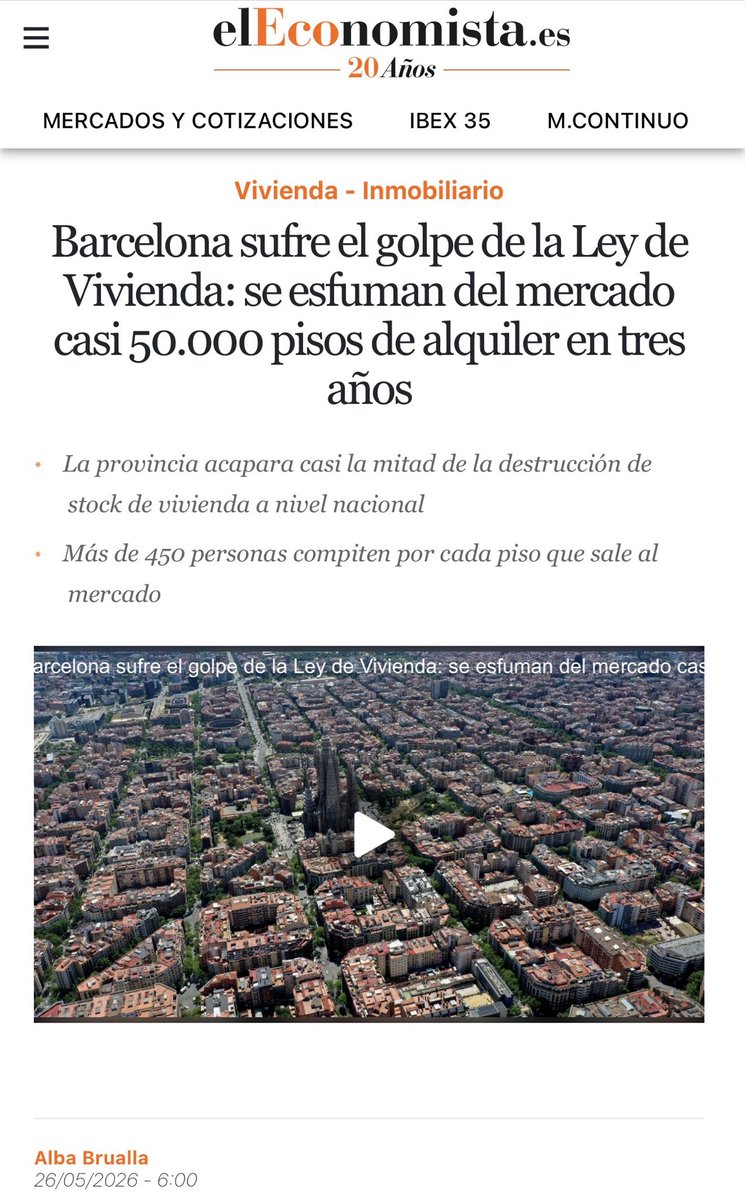
El estropicio que han provocado las leyes nacionales y catalanas en el mercado de alquiler de vivienda en Barcelona se estudiará en los libros de historia:
• Desaparición de 50.000 viviendas del mercado en 3 años.
• Los escasos caseros que se mantienen en el mercado tienen a 450+ potenciales
Inquilinos donde elegir, expulsando del mercado a todo inquilino que no ofrezca garantías de que va a cumplir su parte del contrato.
Y los políticos demagogos siguen sin reconocer su responsabilidad en el fracaso, buscando chivos expiatorios.
No hay nada como el populismo para aleccionar a un rebaño de votantes, absolutamente idiotizados por un sistema educativo público que prioriza la dependencia sobre el pensamiento crítico.
Desde hace un tiempo, las democracias son pasto de demagogos.
O creamos poderosos contrapesos (checks & balances) contra esa lacra de la política; o nos planteamos el “extremo” del sufragio censitario (votan los que contribuyen); o acabamos dando la razón a Aristóteles cuando reconocía que las democracias tienden a convertirse en el gobierno de las masas ignorantes, en manos de demagogos
Mi reflexión libertaria del día.
Jesús Vázquez reivindica “la España de los derechos”.
Bien.
Pero conviene preguntarse: ¿qué derechos?
Todo ser humano tiene, por el hecho de existir, una serie de derechos inherentes a su persona.
Los que seguimos la tradición liberal de John Locke los resumimos en tres: vida, libertad y propiedad privada.
Son derechos negativos: no exigen nada de nadie, sólo que no se interfiera en ellos.
El problema es que el llamado “Estado del bienestar” tiende a convertir toda necesidad en un derecho.
Y como señala la tradición liberal desde Nozick, las necesidades son infinitas: si las convertimos en derechos, estamos obligando a terceros a satisfacerlas.
Lo cual entra en directa contradicción con la libertad que el contrato social debiera proteger.
España puede ser orgullosamente “la España de los derechos”.
Pero quizás vale la pena debatir si esos derechos nos liberan… o nos encadenan mutuamente.
La inflación de derechos acaba erosionando la libertad que el contrato social debería preservar.
Spain 🇪🇸 is a cheap country. There, I said it
People who live there think it's expensive. And tourists tend to think it's extremely affordable
I think they're both right... and both kinda missing the point
Spain is genuinely affordable in ways that surprise foreigners. Mercadona groceries, a €12 menú del día, €2 beers, €1.20 coffees, €4 bottles of wine...
Man, since I'm back, I'm VERY surprised by some of these prices
By Western European standards, day-to-day life is remarkably cheap
In fact, if you're earning remotely in dollars or euros, Spain feels almost cheap
A LOT of things are priced similarly to, say, Brazil or Argentina
BUT...
Two things will destroy that equation: housing and taxes
Rent in Madrid or Barcelona now rivals Amsterdam or Berlin. And if you become a Spanish tax resident, income tax runs 19–47%, plus social security... meaning a self-employed person earning €60k hands over 35–45% to the state
So here's the real picture:
✅ Tourist? Feels like a bargain (if you discount hotels)
✅ Remote worker without tax residency? Can work out well.
❌ Full tax resident renting in a major city? Oooh boy
You're paying Nordic taxes for Mediterranean infrastructure
The food is cheap. The lifestyle is cheap. The price of belonging to the system is not
This is why so many Spaniards are leaving: living here with a Spanish salary is impossible unless you've inherited a house
A Norwegian neuroscientist spent 20 years proving that the act of writing by hand changes the human brain in ways typing physically cannot, and almost nobody outside her field has read the paper.
Her name is Audrey van der Meer.
She runs a brain research lab in Trondheim, and the paper that closed the argument was published in 2024 in a journal called Frontiers in Psychology. The finding is brutal enough that it should have changed every classroom on Earth.
The experiment was simple. She recruited 36 university students and put each one in a cap with 256 sensors pressed against their scalp to record brain activity. Words flashed on a screen one at a time.
Sometimes the students wrote the word by hand on a touchscreen using a digital pen, and sometimes they typed the same word on a keyboard. Every neural response was recorded for the full five seconds the word stayed on screen.
Then her team looked at the part of the data most researchers had ignored for years, which is how different parts of the brain were communicating with each other during the task.
When the students wrote by hand, the brain lit up everywhere at once.
The regions responsible for memory, sensory integration, and the encoding of new information were all firing together in a coordinated pattern that spread across the entire cortex. The whole network was awake and connected.
When the same students typed the same word, that pattern collapsed almost completely.
Most of the brain went quiet, and the connections between regions that had been alive seconds earlier were nowhere to be found on the EEG.
Same word, same brain, same person, and two completely different neurological events.
The reason turned out to be something nobody had really paid attention to before her work. Writing by hand is not one motion but a sequence of thousands of tiny micro-movements coordinated with your eyes in real time, where each letter is a different shape that requires the brain to solve a slightly different spatial problem.
Your fingers, wrist, vision, and the parts of your brain that track position in space are all working together to produce one letter, then the next, then the next.
Typing throws all of that away. Every key on a keyboard requires the exact same finger motion regardless of which letter you are pressing, which means the brain has almost nothing to integrate and almost no problem to solve.
Van der Meer said it plainly in her interviews.
Pressing the same key with the same finger over and over does not stimulate the brain in any meaningful way, and she pointed out something that should scare every parent who handed their kid an iPad.
Children who learn to read and write on tablets often cannot tell letters like b and d apart, because they have never physically felt with their bodies what it takes to actually produce those letters on a page.
A decade before her, two researchers at Princeton ran the same fight using a completely different method and ended up at the same answer. Pam Mueller and Daniel Oppenheimer tested 327 students across three experiments, where half took notes on laptops with the internet disabled and half took notes by hand, before testing everyone on what they actually understood from the lectures they had watched.
The handwriting group won by a wide margin on every question that required real understanding rather than surface recall.
The reason was hiding in the transcripts of what the two groups had actually written down.
The laptop students typed almost word for word, capturing more total content but processing almost none of it as they went, while the handwriting students physically could not write fast enough to transcribe a lecture in real time, which forced them to listen carefully, decide what actually mattered, and put it in their own words on the page.
That single act of choosing what to keep was the learning itself, and the keyboard had quietly skipped the choosing and skipped the learning along with it.
Two studies. Two countries. Same answer.
Handwriting makes the brain work. Typing lets it coast.
Every note you have ever typed instead of written went into your brain through a thinner pipe. Every meeting, every book highlight, every idea you captured on your phone instead of on paper was processed at half depth.
You did not forget those things because your memory is bad. You forgot them because typing never woke the part of the brain that would have made them stick.
The fix is the thing your grandmother already knew.
Pick up a pen. Write the thing down. The slower road is the faster one.
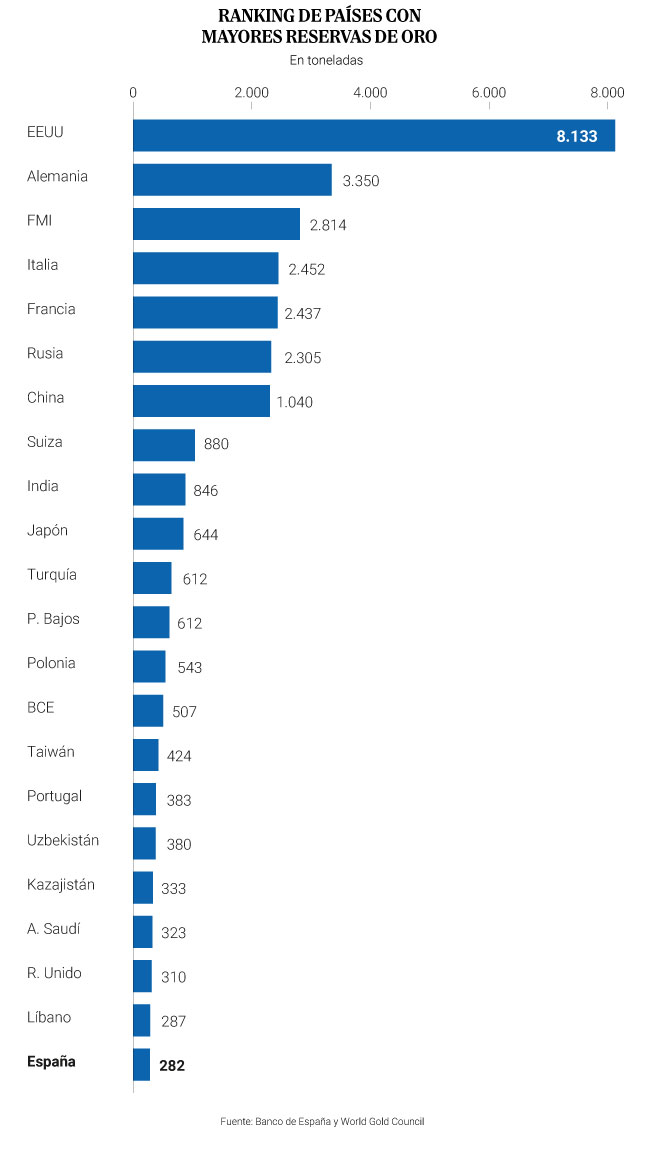
Os recuerdo que Zapatero vendió casi la mitad de las reservas DE ORO del Banco de España entre los años 2004 y 2007, 241 toneladas.
https://t.co/xeuAnsFjXj
Norway and the UK drilled the same North Sea.
🇳🇴Norway got $2 trillion.
🇬🇧The UK got tax cuts.
Same basin,Same era.... Completely different outcomes.
Norway captured $30 per barrel in government revenue. The UK captured $11.
That gap, compounded over 50 years of production, is the entire difference.
Norway's model was simple: tax heavily (78% marginal rate), take direct equity stakes in fields via the SDFI, own part of Equinor, and put everything surplus into a fund invested abroad.
The Government Pension Fund Global now holds over $2 trillion in assets.
That's $390,000 per Norwegian citizen about 1.5% of all listed equities on earth.
The fiscal rule: only spend the 3% annual real return. Never touch the principal.
The UK started producing earlier, at lower prices, with a lower tax rate (40%) and no saving mechanism.
North Sea revenues flowed straight into the general budget.
Economists estimate the UK missed out on roughly £400 billion compared to a Norwegian style regime.
The windfall largely financed tax cuts in the 1980s rather than a fund.
Where things stand in 2026?
Norway's petroleum sector will generate $63 bn in net cash flow this year alone feeding a fund already large enough to cover 10-15% of the national budget from returns alone.
The UK is a net energy importer.
Since 2021 it has paid countries like Norway more than £100 billion for gas.
One country treated oil as a finite resource to convert into permanent financial wealth.
The other treated it as income.
image source:eia
Ojo. La propia Audiencia Nacional ha tomado una medida excepcional en el caso Shakira: condenar en costas a la AEAT, una penalización que la justicia aplica únicamente cuando se aprecia temeridad y absoluta falta de fundamento.
No quiero ni imaginar cuánto dinero habrán llegado a sacar a ciudadanos inocentes que no tenían recursos suficientes para defenderse frente a la Administración.