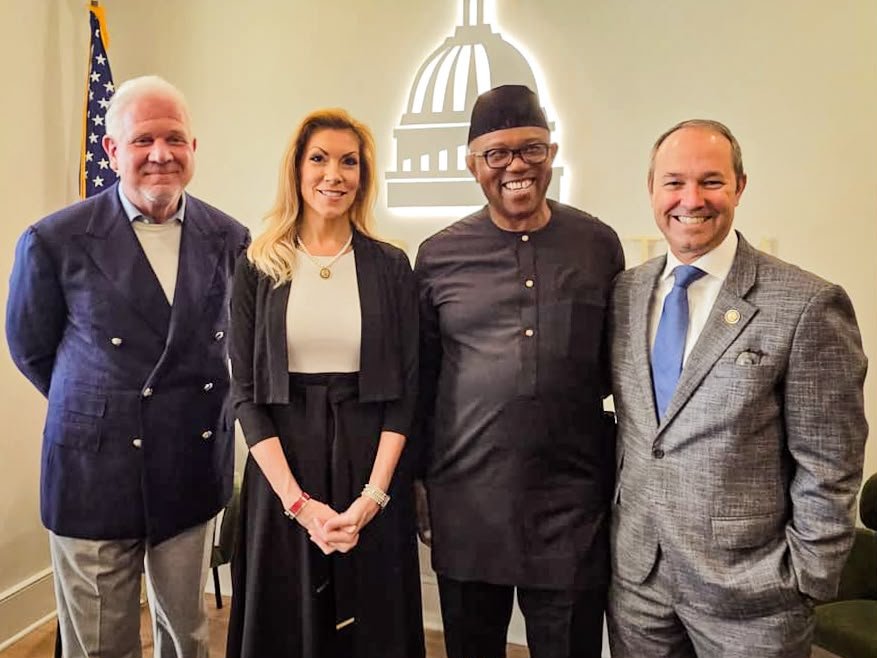
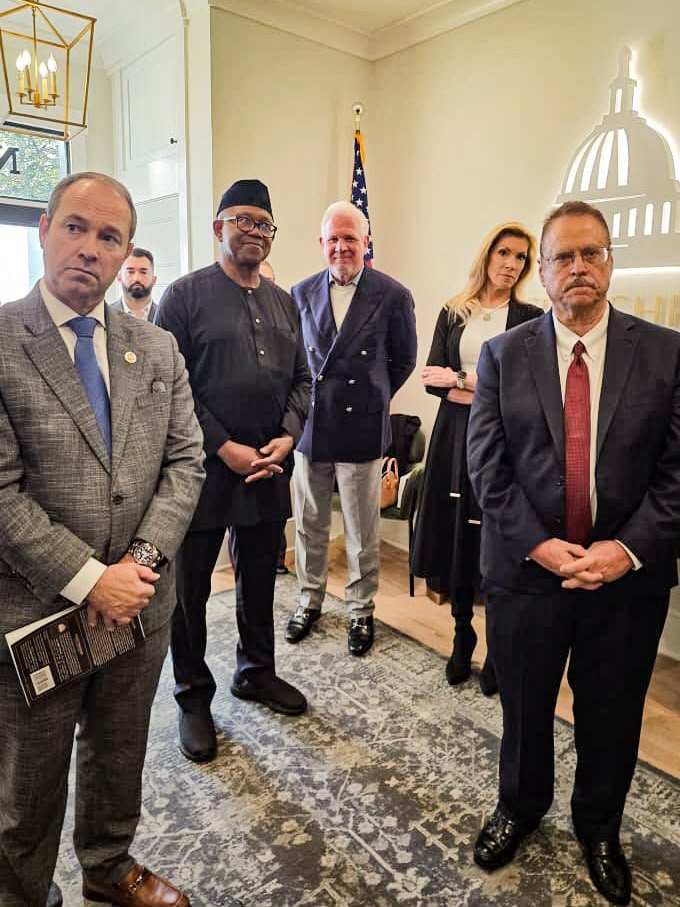
WASHINGTON, DC : PRESENTING NIGERIA’S DEVELOPMENT AND DEMOCRATIC FUTURE ON THE GLOBAL STAGE.
Yesterday, Monday, November 16, I arrived in Washington, DC, for a series of significant meetings and engagements with congressional leaders from both the U.S. House of Representatives and the Senate, as well as other influential American figures. These discussions focused on vital matters affecting Nigeria’s development, the well-being of our people, and the future of our democracy.
I began the day with a substantive interview with renowned American television commentator Glenn Beck. Our conversation addressed Nigeria’s challenges, the pressing need for accountable leadership, the responsible management of our vast human and natural resources, and the opportunities to establish Nigeria among the world’s leading nations.
I also met with prominent American leaders, including Congressman Marlin Stutzman, Congresswoman Beth Van Duyne, Congressman Todd Tiahrt, Suzanne Bock Grisham, retired U.S. Army Colonel Albert V. Short, and other esteemed stakeholders.
One of the day’s principal highlights was my address on Capitol Hill, during which I underscored the urgent importance of international cooperation and support for Nigeria’s advancement, particularly in the areas of national unity, security, economic prosperity, and the welfare of our citizens.
Our conversations also addressed the protection of Nigeria’s emerging democracy and the strengthening of democratic institutions to ensure elections are free, fair, transparent, and credible, accurately reflecting the will of the Nigerian people.
Nigeria has immense potential to emerge as a leading nation within the global community. What is urgently required is accountable leadership, responsible stewardship of our resources, resilient institutions, and an authentic commitment to the security, unity, and well-being of every Nigerian.
Throughout these engagements, my message remained unequivocal: Nigerians must determine Nigeria’s future. Every vote must be counted, the rights of every citizen must be safeguarded, and the people’s will must consistently prevail.
I remain encouraged by these engagements and firmly committed to working with Nigerians at home and in the diaspora, alongside our international partners, to build a peaceful, secure, united, and prosperous Nigeria.
Our journey continues. Our determination remains steadfast.
A New Nigeria is POssible! -PO
NIGERIANS, GO AND VERIFY (2)
Building the Institutions of the State
Peter Obi
In Series 1, I explained the philosophy that guided our administration in Anambra State: governance as a public trust, anchored on character, competence, capacity, and compassion. I also introduced the Anambra Integrated Development Strategy (ANIDS), our comprehensive framework for achieving balanced and sustainable development across all sectors.
But a development vision, however noble, cannot succeed without strong institutions to drive it. Before the government could effectively deliver on its promises in education, healthcare, infrastructure, security, and other sectors, we had to first restore the machinery of government itself. We could not build a prosperous state on a cracked and unstable foundation.
This was why one of our foremost priorities under ANIDS was to rebuild, strengthen, and reposition the institutions of government. When I assumed office, the physical and administrative architecture of governance was in a deplorable condition. Our task was not simply to construct buildings but to restore the institutions, systems, and structures through which government could function effectively.
We therefore began systematically rebuilding the infrastructure of governance across the executive, legislature, judiciary, civil service, and local government system.
Restoring the Seat of Government
The Government House in Awka, the state capital, had been vandalised and burnt by reactionary forces in 2004. We therefore had to rebuild, re-equip, and furnish it, restoring its dignity and functionality as the seat of executive government.
In the same vein, we rehabilitated the Governor’s Lodge in Amawbia and constructed a new Governor’s Lodge in Onitsha. These investments were intended not merely to provide accommodation but to strengthen executive presence and facilitate effective governance across the state’s major administrative and commercial centres.
Strengthening the Legislature and Judiciary
We rehabilitated the Anambra State House of Assembly Complex in Awka, providing our lawmakers with a more conducive and decorous environment in which to discharge their constitutional responsibilities. We also provided legislators with vehicles to facilitate the effective performance of their legislative duties.
We recognised that a functioning democracy requires strong institutions, including an effective legislature and an independent judiciary, each operating within its constitutional mandate.
In strengthening the judiciary, we provided brand-new vehicles to High Court judges. This was the first time such provision had been made for them in the history of the state. We also provided vehicles to magistrates for the first time since the creation of Anambra State.
These interventions were intended to strengthen the administration of justice, improve mobility, and enable judicial officers to discharge their responsibilities more effectively.
Rebuilding the Civil Service: The Chief Jerome Udoji State Secretariat Complex
Before our administration, many Ministries, Departments, and Agencies (MDAs) operated from scattered rented apartments, while civil servants lacked a centralised and decent working environment. This untidy arrangement undermined coordination, efficiency, and the dignity of public service.
We addressed this situation by constructing the two-phase, ultra-modern Chief Jerome Udoji State Secretariat Complex, comprising Blocks 1 and 2. The project brought the MDAs together under one roof, improved administrative coordination, and provided civil servants with a more suitable environment in which to serve the people.
The complex was named after Chief Jerome Udoji, the first indigenous Chief Secretary (the equivalent of today’s Secretary to the State Government) of the Eastern Region during the First Republic. This was also a recognition of his contribution to public administration and the civil service tradition.
Peter Obi takes Washington, DC, USA by storm! 24 hours. Capitol Hill. The White House. U.S. congressional leaders. One powerful message: Nigeria deserves free, fair and credible elections!
“Peter Obi is a true leader. He succeeded where others have failed. When he was governor, he spoke directly to the people. He is a man who puts public interest first before even considering his personal interests.”
- U.S. Congressmen in Washington, D.C. yesterday sings praises of Peter Obi
@AjeboDanny Also I have noticed by listening that elements in the sound of songs in her albums are repetitive. Showing hat this is a body of work, just as there's a general theme to her albums, there also a theme element. Renny as an example.
@ItodeWisdom@AWAH185557@AjeboDanny You'd understand what he meant by all her Grammys were worth it when you look at the categories she won it. It was well deserved and she didn't have an actual competition. When she did have a serious competition, she lost, twice.
@EvernoisBrewtha@AjeboDanny@Wizarab10 If you are implying the Beyonce has been buying her awards. You are wrong. If you look back at the categories which she won her awards you'd understand that she didn't exactly have a competition.
When A Court Grants You Bail Of ₦8 Million, You Are Not Expected To Pay ₦8 Million!
I was in court recently when bail was granted to my client under the following conditions:
✅ Bail in the sum of ₦8 million.
✅ Two sureties, one of whom must be a relative of the defendant.
✅ The second surety must be a civil servant not below Grade Level 12.
✅ Both sureties must depose to affidavits of means.
After the proceedings, my client approached me almost in tears. She asked, “Counsel, where am I going to get ₦8 million to pay the court?”
I laughed and explained that bail is free! You are not expected to pay ₦8 million to the court.
So, what does bail of ₦8 million mean?
It simply means that the sureties must demonstrate that they have sufficient financial worth to stand as security for that amount.
For instance:
✅ A surety who owns a car may present evidence of ownership and its value.
✅ A surety who owns landed property may present the relevant documents.
✅ Other assets and evidence of financial means may also be considered by the court.
The ₦8 million is the amount stated in the bail bond. It is not money that must be deposited with the court.
If the defendant jumps bail and the sureties fail to produce the defendant when required, the court may order forfeiture of the bail bond and require the sureties to pay the amount.
So, the next time a court grants you bail of ₦8 million or any amount, don’t start looking for ₦cash to pay the court, understand what the court actually requires from you!
Credit: Law Parlour on FB
@Kabiyesi_09@Rushe_C Is a genre on its own.
I would never see anything African in a derogatory way, I'm only cautious when it comes off as racism from the Grammys.
@Kabiyesi_09@Rushe_C Ohh, I get your point even clearer now. For me the only reason I hate when the word African come out Inna category is because I fee the Grammys in a racist way just place every African song there. Why not "Best Afrobeat song" like there is "Best Rnb song" because Afrobeat..
@Kabiyesi_09@Rushe_C So in this case celebrating Tems being nominated outside the African category is only right becuase the song what you need is Rnb. The rhythm, the percussion and all proves that.
@Kabiyesi_09@Rushe_C Let's take Rnb for example or Pop though dominated by Americans, when a non-American artist released a song that fits into such category, it follows that they should be placed in that category other than placing that song based on region.