1. We know the public affairs industry. We know the difference between lobbying: making persuasive arguments, and coercion: using the threat of political consequences to pressure elected representatives into serving private interests over the public. That is not lobbying. It is an assault on an MP’s constitutional oath of office.
2. We also know the Executive Ethics Code. Section 2(3)(d) and (f), specifically. Which is precisely why a meeting with Starlink was inappropriate.
3. We also know it is inappropriate for a Minister to meet privately with a company due to submit a “tender”. ICASA falls within the Department of Communications.
3. We also know Parliament was misled in response to a parliamentary question about the meeting taking place. We know of the President’s meeting, it was public, not clandestine and lied about to Parliament.
4. We also know that, after the meeting, the conversation shifted to changing policies and laws. The sequence of events speaks for itself.
5. And you ought to know this: we are not nearly as naïve as you seem to think we are. And you really need to stop thinking the rest of South Africa is stupid too.
6. Good luck & Godspeed. 🫶🏾
Just two weeks ago South Africa donated 2.5 million dollars to DRC for their fight against Ebola. Only African country to have done that so far actually.
But here we are branded as the prime enemies of Pan Africanism whilst the kings of Pan Africanism haven't even donated a Single cent or sent any form of help. We have our problems yes and challenges of xenophobia but Africa collectively must not act they themselves are models of solidarity in tough times.
Home Affairs officials who were selling our passports for extra income. The UK government warned us multiple times that it was happening & the passports were indistinguishable from real ones because the same machines & processes were used. They did nothing about it
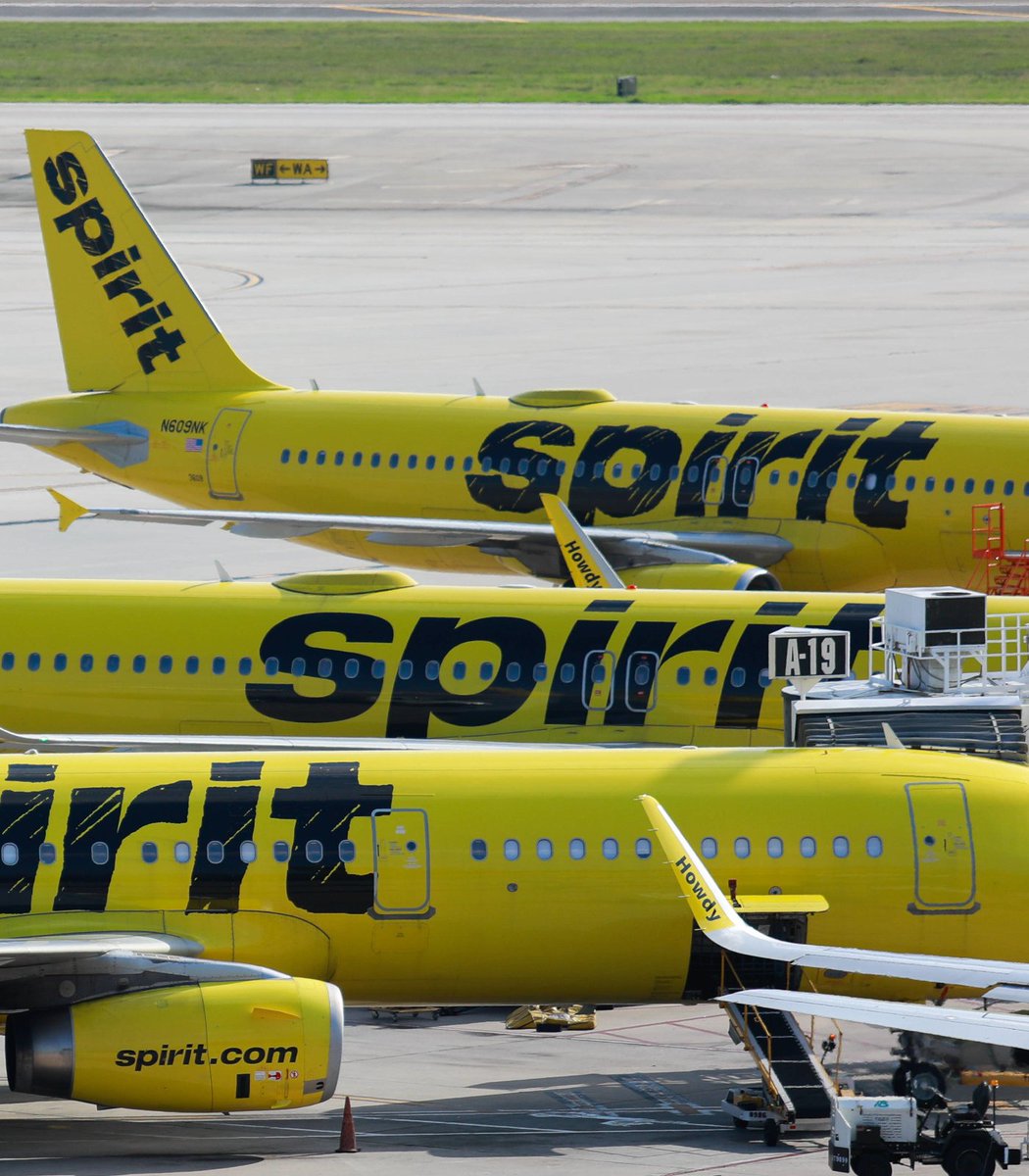
Since Spirit Airlines began service in 1992, they never had a fatal crash. They're closing down with a perfect record.
Every Spirit flight that ever took off landed safely.
Spirit Airlines died tonight at the hands of the socialist crusader, Elizabeth Warren
She must be so proud to add another casket to her achievements.
Tonight at 3am, Spirit turns off the lights. 14,000 jobs gone. 30+ smaller airports lose service.
JetBlue offered $3.8 BILLION in cash to buy Spirit in 2022. Shareholders, flight attendants union, literally everyone voted yes.
The combined company would have held 9% of the US market against a Big 4 that already owned 80%.
For anyone who understands numbers: 9% isn’t a monopoly against 80%.
Warren said no.
She wrote letters. She pressured Buttigieg. Biden’s DOJ sued. A federal judge killed the deal in January 2024.
Her argument: the merger would cost consumers $1 billion a year.
Now look at her collateral damage she dusts under the rug.
510 pilots gone in the months after. 1,800 flight attendants furloughed in December.
14,000 jobs in 2023. 7,500 last week. Zero tonight.
And that’s just the people in Spirit uniforms.
Catering goes. Fuel guys go. Baggage crews, gate agents, airport coffee shops, hotels and rental cars in 70 cities Spirit flew to. Every airline job carries 3 more on its back.
40,000 people out of work because of one woman’s moronic crusade against the market.
And the math ain’t mathing.
Spirit abandoned 90 routes during the death spiral. Fares on those routes are up 14% on average. Oakland to Newark: $135 to $288. Fort Myers to San Juan: $92 to $219. Kansas City to Newark up 66%.
That’s reality. Not some BS number from a “study.”
So @SenWarren tell me how this saves the consumer money?
Cheap carriers in a market drop fares 21% across the board. Southwest did this in the 90s and saved Americans $68 BILLION over 20 years.
Warren killed it. That’s what moronic politicians led by socialism do.
Then with her own blind arrogance, she tweeted Spirit’s collapse is “a Biden win for flyers.”
A win.
14,000 people are reading termination letters tonight.
And she’s taking credit.
This is socialism in 2026.
A senator who’s never made payroll thinks she knows how to run a market better than the people who own and work in the company.
She saved you a billion on imaginary paper.
She cost you ten times that in real life.
She didn’t protect consumers from anything.
14,000+ will go from working to welfare.
She will make sure to blame billionaires, hardworking tax payers, AI, capitalism and whatever monster they will make up tomorrow hiding under your bed.
Higher taxes. Fewer jobs. More expensive everything.
She called it a win. I hope you enjoy winning.
The most underrated act of kindness is simply letting people be. Let them mispronounce a word, talk too much about a show they love, or get excited about something you don't quite understand. Everyone has something that lights them up, let them shine, even if it's not your thing.
South Africa went through 500 years of colonialism & apartheid & all the dark things that go with that. No therapy. Just “forgive & forget” because “you are a rainbow nation now”. Today, beneficiaries of those unjust systems say there’s “a white genocide” & “140 racist laws”.
Some of yall are still paying for Claude Max only to be told after a few messages to come back tomorrow. Claude really pulled the biggest bait and switch on people lol.
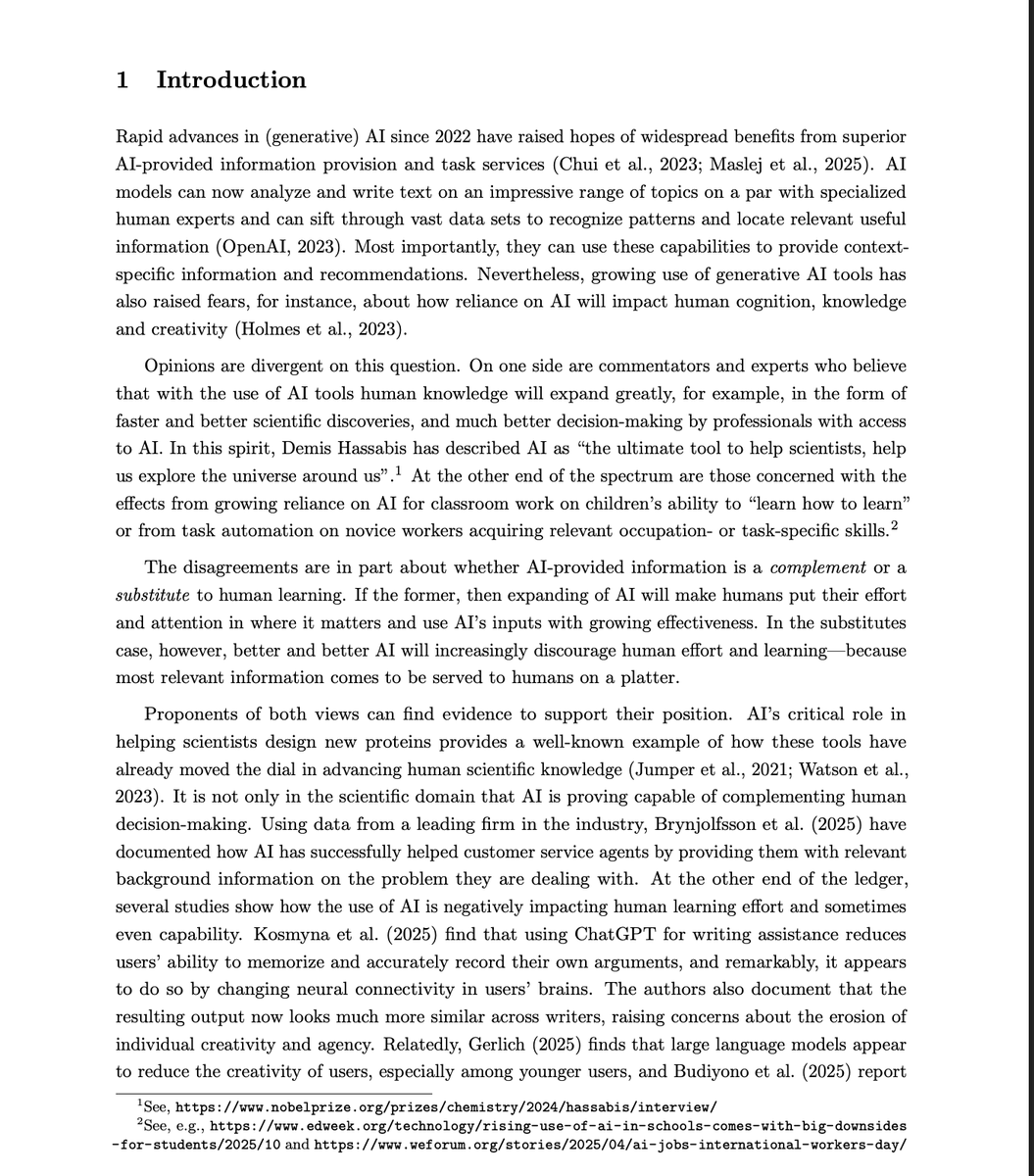
MIT's Nobel Prize-winning economist just published a model with one of the most alarming conclusions in the AI literature so far.
If AI becomes accurate enough, it can destroy human civilization's ability to generate new knowledge entirely.
Not gradually degrade it. Collapse it.
The paper is called AI, Human Cognition and Knowledge Collapse.
Authors: Daron Acemoglu, Dingwen Kong, and Asuman Ozdaglar. MIT. Published February 20, 2026.
Acemoglu won the Nobel Prize in Economics in 2024. He is not a doomer blogger. He is the most cited economist of his generation, and his models tend to be taken seriously by the people who set policy.
Here is the argument in plain terms.
Human knowledge is not just a collection of facts stored in individuals. It is a living system that requires continuous reproduction. People learn things. They apply them. They teach others. They build on prior work to generate new work. The entire engine of science, medicine, technology, and innovation runs on this cycle of active human cognition.
What happens when AI provides personalized, accurate answers to every question people would otherwise have to learn themselves?
Individually, each person is better off. They get correct answers faster. They make fewer errors. Their immediate outcomes improve.
But they stop doing the cognitive work that sustains the collective knowledge base.
Acemoglu's model shows this produces a non-monotone welfare curve.
Modest AI accuracy: net positive. AI helps at the margin, humans still do enough learning to sustain collective knowledge, everyone gains.
High AI accuracy: net catastrophic. AI is accurate enough that learning yourself feels unnecessary. Human learning effort collapses. The knowledge base that AI was trained on is no longer being refreshed or extended. Innovation stalls. Then stops.
The model proves the existence of two stable steady states.
A high-knowledge steady state where human learning and AI assistance coexist productively.
A knowledge-collapse steady state where collective human knowledge has effectively vanished, individuals still receive good personalized AI recommendations, but the shared intellectual infrastructure that enables new discoveries is gone.
And the transition between them is not gradual.
It is a threshold effect. Below a certain level of AI accuracy, society stays in the high-knowledge equilibrium. Above that threshold, the system tips. And once it tips, the collapse is self-reinforcing.
Because the people who would have learned the things that would have pushed the frontier forward never learned them. And the AI cannot push the frontier on its own. It can only recombine what humans already knew when it was trained.
The dark irony at the center of the model:
The AI does not fail. It keeps giving accurate, personalized, useful answers right through the collapse.
From the individual's perspective, nothing looks wrong. You ask a question, you get a correct answer.
But the collective capacity to ask questions nobody has asked before, to build the frameworks that generate new knowledge rather than retrieve existing knowledge, that capacity is quietly disappearing.
Acemoglu has been the most prominent mainstream economist skeptical of transformative AI productivity claims. His prior work found that AI's actual measured productivity gains were much smaller than the technology industry projected.
This paper is a different kind of warning. Not that AI will fail to deliver promised gains.
But that if it succeeds too completely, it will undermine the human cognitive infrastructure that makes long-run progress possible at all.
The welfare effect is non-monotone.
That is the sentence worth sitting with.
Helpful until it is not. Beneficial until it crosses a threshold. And past that threshold, the same accuracy that made it so useful is precisely what makes it devastating.
Every student who uses AI instead of working through a problem is a data point.
Every researcher who uses AI instead of developing intuition is a data point.
Every generation that grows up with accurate AI answers and no incentive to develop deep domain knowledge is a data point.
Individually rational. Collectively catastrophic.
Acemoglu proved this is not just a cultural concern or a vague anxiety about screen time.
It is a mathematically coherent equilibrium that a sufficiently accurate AI system will push society toward.
And there is no visible warning sign before the threshold is crossed.
Serious industrial nations don’t take accountants as seriously as South Africa does.
In industrialising nations, like Vietnam and surrounding states, for instance, the most prestigious roles are found in engineering or industrial management because the economy is physically building things.
Meanwhile, in South Africa, SAICA’s CA(SA) is viewed as the ultimate golden ticket.
But it’s not only in developing/industrialising nations where accountants take a back seat. In the US, Germany and Japan, CEOs are generally product people or engineers, while in South Africa, a massive percentage of JSE-listed CEOs are chartered accountants.
The reason for this is that the South African economy has been deindustrialising for decades, so the existing companies don’t grow by inventing new things or expanding production. They “grow” through the financial engineering of mergers, acquisitions, cost-cutting, and “tax optimisation”.
The consequence of this is that if you compare SA to an employment-dense industrialiser like Vietnam, you find that the latter focuses on vocational excellence. Over there, an accountant is just a back-office functionary who supports the factory. The hero is the plant manager who meets a production quota.
But South Africa, to its detriment, is obsessed with compliance excellence. The factory, if it even exists, is a “risk” to be managed, and the chartered accountant is the high-priest who tells the board if that risk is acceptable.
By taking accountants this seriously, South Africa has perfected the art of measuring value, but has neglected the art of creating real tangible value.
The worship and adoration of the CA(SA) is a symptom of a services-led economy that has skipped the labour-intensive industrialisation phase, and this is primarily why the unemployment epidemic cannot be resolved.
This isn’t new. It’s subject to monthly verification by a group that includes both national and international bodies an arrangement we entered into voluntarily. The aim was to ensure transparency, reduce suspicion, and, of course, to recognise that at the dawn of democracy no one wanted a newly elected government to inherit such an arsenal.
It was always a flawed assumption that those who fought for liberation would then turn those same tools on themselves. But regardless, the key point remains: we stopped.
There’s no basis for raising a false alarm about South Africa on this issue.
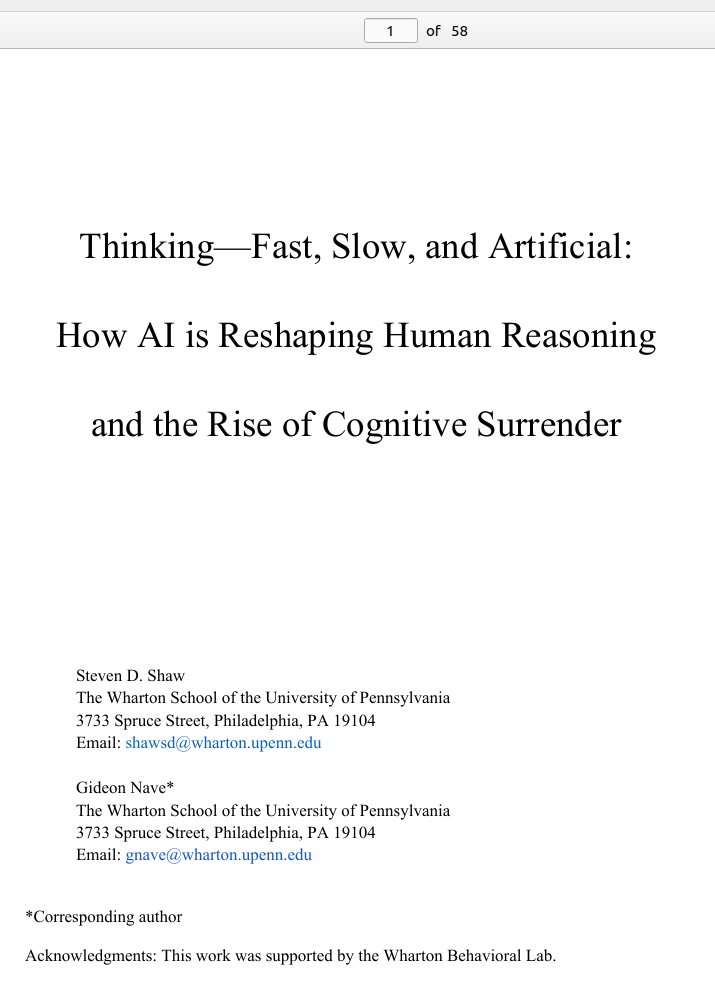
Wharton’s latest AI study points to a hard truth: “AI writes, humans review” model is breaking down
Why "just review the AI output" doesn't work anymore, our brains literally give up.
We have started doing "Cognitive Surrender" to AI - Wharton’s latest AI study points to a hard truth: reviewing AI output is not a reliable safeguard when cognition itself starts to defer to the machine.when you stop verifying what the AI tells you, and you don't even realize you stopped. It's different from offloading, like using a calculator.
With offloading you know the tool did the work. With surrender, your brain recodes the AI's answer as YOUR judgment. You genuinely believe you thought it through yourself.
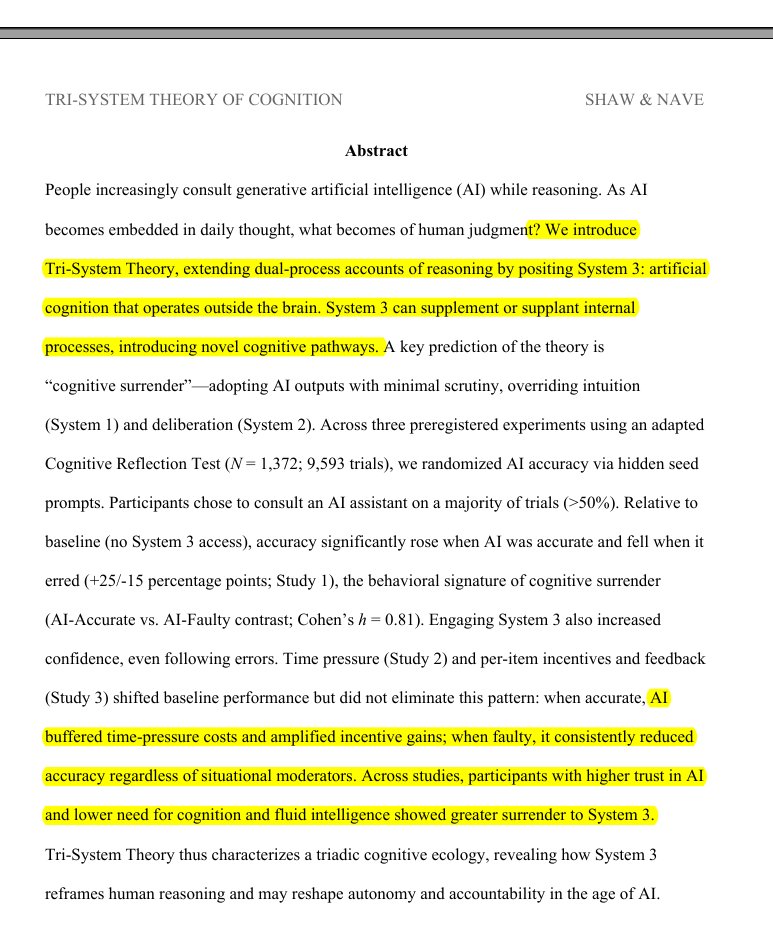
Says AI is becoming a 3rd thinking system, and people often trust it too easily.
You know Kahneman's System 1 (fast intuition) and System 2 (slow analysis)? They're saying AI is now System 3, an external cognitive system that operates outside your brain. And when you use it enough, something happens that they call Cognitive Surrender.
Cognitive surrender is trickier: AI gives an answer, you stop really questioning it, and your brain starts treating that output as your own conclusion. It does not feel outsourced. It feels self-generated.
The data makes it hard to brush off. Across 3 preregistered studies with 1,372 participants and 9,593 trials, people turned to AI on over 50% of questions.
In Study 1, when AI was correct, people followed it 92.7% of the time. When it was wrong, they still followed it 79.8% of the time.
Without AI, baseline accuracy was 45.8%. With correct AI, it jumped to 71.0%. With incorrect AI, it dropped to 31.5%, worse than having no AI. Access to AI also boosted confidence by 11.7 percentage points, even when the answers were wrong.
Human review is supposed to be the safety net. But this research suggests the safety net has a hole in it: people do not just miss bad AI output; they become more confident in it.
Time pressure did not eliminate the effect. Incentives and feedback reduced it but did not remove it. And the people most resistant tended to score higher on fluid intelligence and need for cognition. That makes this feel less like a laziness problem and more like a cognitive architecture problem.