Glioblastoma is one of the most aggressive forms of brain cancer. Despite decades of research, the disease remains difficult to treat, with only about 6% of adults age 40 and older surviving five years after diagnosis.
Part of the challenge is that glioblastoma seems to have a workaround for nearly every treatment. The brain's protective barrier, known as the blood brain barrier (BBB), is great at preventing harmful invaders from entering the brain, but can also prevent drugs from reaching tumors. Cancer cells have also found remarkably clever ways to evade the immune system. And different groups of cells within the same tumor can respond differently to treatment, preventing the complete elimination of the tumor and helping the disease return.
Researchers at the Mass General Brigham Cancer Institute are tackling each of these obstacles from different angles, hoping to improve the effectiveness of treatments, reduce disease recurrent and increase patient longevity.
https://t.co/99JJAZuVLr
Mass General Brigham - 2026 Brigham and Women’s Hospital Faculty Awards
Please join us in recognizing and congratulating our faculty for their remarkable contributions and achievements.
Clinical Excellence Award - Rose Du, MD, PhD
Distinguished Clinician Award - G. Rees Cosgrove, MD, FRCSC
Education Award - Wenya Linda Bi, MD, PhD
Faculty Development & Excellence Award - Alexandra J. Golby, MD
Mentor Award - Yi Lu, MD, PhD
Professionalism Award - John David Rolston, MD, PhD
Research Excellence Award - Nathalie M.Y.R. Agar, PhD
Astrocytomas and oligodendrogliomas are isocitrate dehydrogenase (IDH)-mutant gliomas that most commonly arise in adults under the age of 50 and exhibit variable responses to treatment. To understand the genetic drivers of disease progression, here we used whole-genome and whole-exome sequencing to characterize longitudinally collected tumour specimens from 183 patients with IDH-mutant glioma. Samples were collected through the Glioma Longitudinal Analysis (GLASS) Consortium. Most primary surgery samples were classified as grade 2 on the basis of histology (73% for astrocytomas and 93% for oligodendrogliomas). We validated known genomic markers of tumour progression, including hypermutation and homozygous deletion of CDKN2A or CDKN2B (hereafter, CDKN2A/B), and discovered genetic alterations that distinguish between the evolutionary trajectories of astrocytomas and those of oligodendrogliomas. Mutations in phosphatidylinositol 3-kinase (PI3K) and NOTCH1 were newly acquired in recurrent oligodendrogliomas, regardless of treatment, and were associated with an increased tumour mutational burden. In recurrent astrocytomas, however, again irrespective of treatment, acquired focal oncogene amplifications and CDKN2A/B homozygous deletions were associated with an increase in chromosomal imbalances, which converged with markers of chromosomal instability such as chromothripsis and whole-genome doubling. In both types of IDH-mutant glioma, we observed a convergence of acquired alterations, genome-wide changes and worse patient outcomes, suggesting that treatment-refractory clones were being selected. Treatment with temozolomide was associated with the mutational signatures SBS11 and SBS119 in both tumour types, whereas the radiotherapy-associated ID8 signature increased in astrocytomas specifically. We show that the genomes of oligodendrogliomas and astrocytomas adapt to the selective pressures of tumour progression and treatment in distinct ways, suggesting that oligodendrogliomas and astrocytomas differ in their responses to treatment-induced DNA damage.
https://t.co/jwxhFeoZlO
Applications are open for the 2nd MGB–MMI Microvascular Anastomosis Slingshot Program, exclusively for neurosurgeons and neurosurgery residents from LMICs.
📅 October 28, 2026 | Boston
⏳ Apply by October 15
Application link: https://t.co/Oke9M8fItS
One Day. One Kit. Lifelong Impact.
Bryan Choi, MD, PhD has joined Neuro-Oncologyas a member of its Editorial Board, effective immediately, for a 2-year term. Neuro-Oncologycontinues to remain the premier journal in the field. Editorial Board membership is a very prestigious and highly sought-after position. Congratulations!
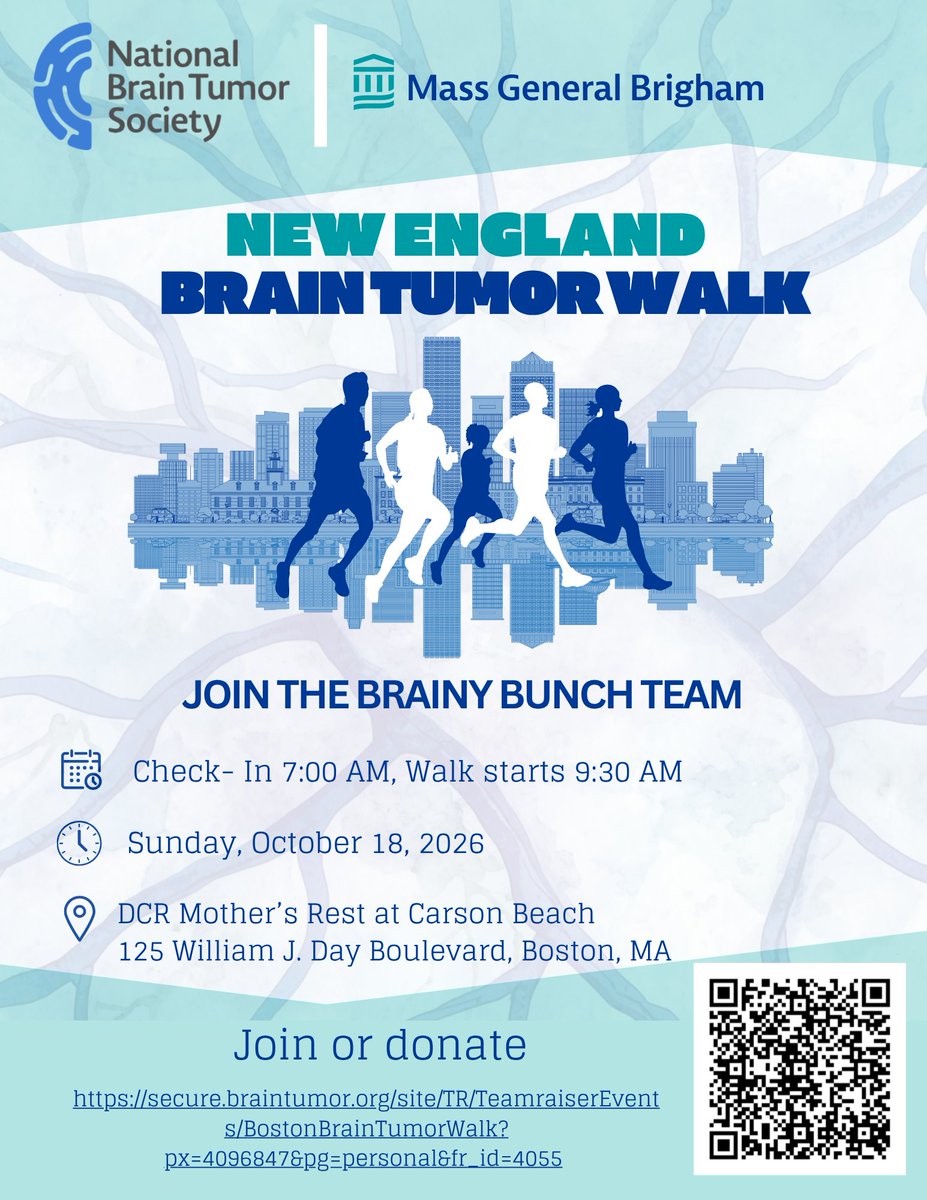
Come walk with us! We are less than 2 weeks away from the New England Brain Tumor Walk!
Event Schedule & Details
7:00 a.m. - Registration/Check-in Opens
8:30 a.m. - Remembrance Ceremony
9:00 a.m. - Opening Ceremony and Awards
9:30 a.m. - Walk Begins
The event is rain or shine! Be sure to visit our activity tents and sponsors throughout the morning.
#BrainyBunch #NEBrainTumorWalk #MGBNeurosurgery #NationalBrainTumorSociety
Transforming How Patients and Clinicians Prepare for Appointments
Imagine you’ve been experiencing back pain for some time. After getting a referral from your primary care provider, you wait weeks for an appointment with a specialist. When the day finally arrives, you spend most of the appointment just describing what you’ve been experiencing rather than exploring how to fix the issue.
Benjamin Johnston, MD, PhD, and Kevin Huang, MD, both neurosurgeons in the Mass General Brigham Neuroscience Institute, have been in appointments just like that more times than they can count.
Read More - https://t.co/vThsrh22d3
Treating the Symptoms of Essential Tremor with Focused Ultrasound: Melissa’s Story
Three decades ago, Melissa Kurtz, now 71, began experiencing stiffness in her left hand. At times, she would grip a pen so hard that the hand froze.
As a left-handed person working in graphic design and advertising, it was an annoying problem. It was also worrisome, as she feared she had Parkinson’s disease.
A local neurologist found Melissa in fact had essential tremor. This common movement disorder causes uncontrollable shaking—usually first noticed in the dominant hand. Eventually, it can also affect the other hand, legs, head, and voice. Essential tremor most often develops in people in their 60s and 70s, but it can also begin much earlier, including in the teen years or early adulthood.
“He said, ‘There’s nothing you can do for it. I suggest you sit down, have a glass of wine, and write a letter to relax yourself a bit,’” Melissa recalled.
Thanks to a chance meeting at a party two years ago, Melissa learned about a proven treatment option for symptoms of tremor: focused ultrasound. Furthermore, one of the nation’s most experienced centers in the procedure happened to be just over an hour’s drive from her home in Amherst, New Hampshire—the Mass General Brigham Neuroscience Institute.
Read more https://t.co/FCMuZrLG6p
This project is a combination of years of work partnering with neurosurgeons in Paraguay to build Neuro Vascular expertise, transfer Surgical skills, build systems that allow their surgeons to work in within their resources, helping their patients.
“It was really a wonderful experience for me l, where I learned much more than I taught” – Nirav J. Patel, MD
https://t.co/n3s7cjwQzL
Congratulations to Dr. G. Rees Cosgrove on being selected by the WSSFN leadership to receive the 2026 Tasker Award. The Ronald Tasker Award is a distinguished achievement honor presented by the World Society for Stereotactic and Functional Neurosurgery (WSSFN) to highly accomplished functional neurosurgeons.
Offering hope to patients with glioblastoma.
Using engineered DNA, MGB researchers have built specialized viruses that are harmless to healthy brain cells and infect only tumor cells, replicating within them and then destroying them, offering hope to patients like Kyle Donohue.
https://t.co/27PFmxtvdc
The project investigates the mechanisms underlying magnetic modulation of neural activity, with the goal of advancing the performance of magnetic neuromodulation approaches, including microcoil-based neural implants and transcranial magnetic stimulation (TMS). Transcranial magnetic stimulation (TMS) has demonstrated unique effectiveness in treating conditions such as depression, yet only 30–40% of patients experience sustained long-term benefit. Magnetic stimulation-based neural implants are also emerging as a promising technology, although substantial work is still needed before they can be translated into clinical use. These limitations stem, in large part, from an incomplete understanding of the mechanisms underlying magnetic neural activation. This study takes a systematic approach to close that gap. The magnetically induced electric field will be decomposed into multiple distinct components, each independently controlled to determine its contribution to neural activation and thereby derive the governing rules of magnetic neural activation. This mechanistic understanding will then be extended to the circuit level to develop the first physiologically grounded model explaining how magnetically activated neurons collectively shape circuit-level responses. Together, these findings are expected to provide actionable guidelines for improving TMS performance and to accelerate development of magnetic stimulation-based neural implants.
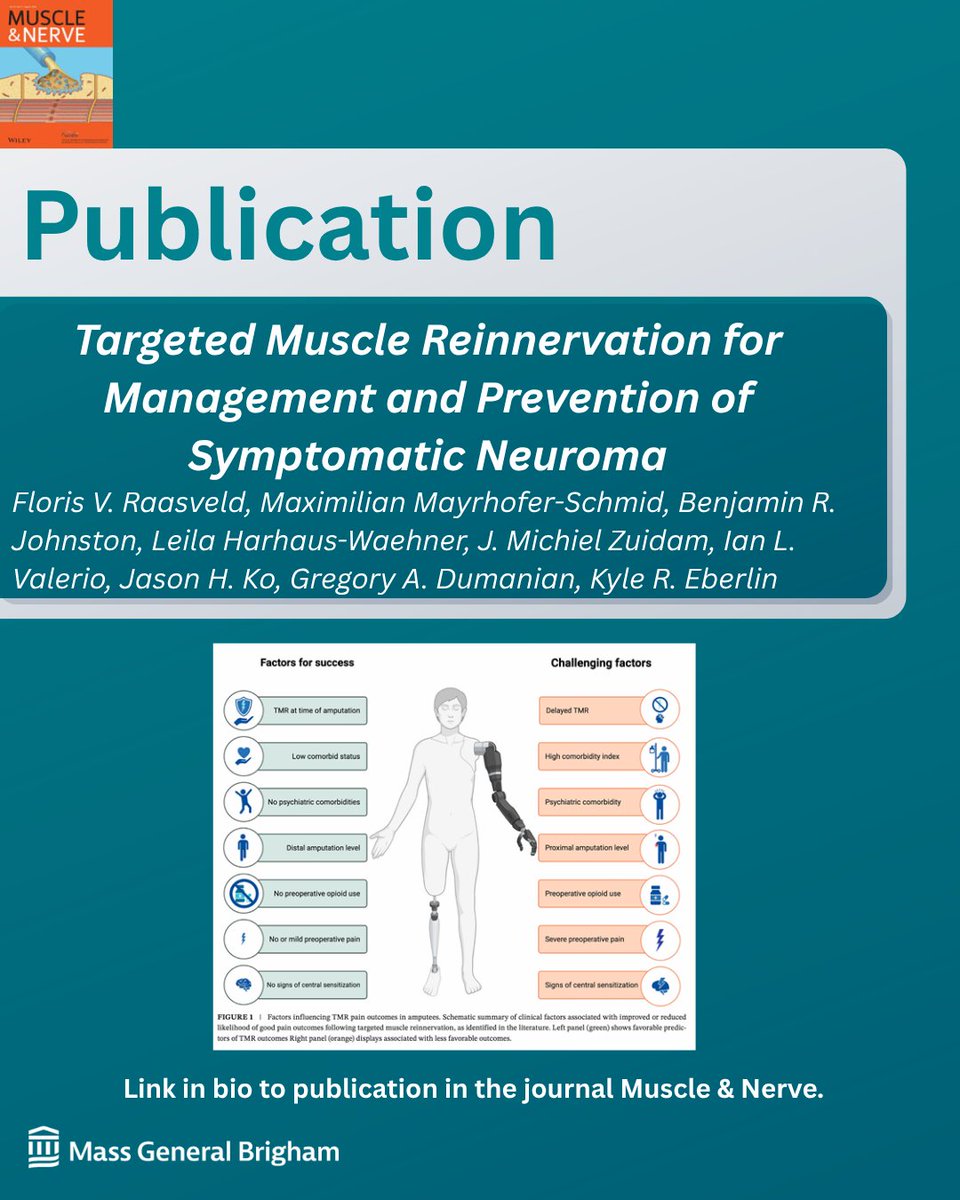
Researchers in the Plastic and Reconstructive Surgery and Neurosurgery departments at Mass General Brigham and Harvard Medical School led by Dr. Kyle Eberlin, MD have successfully published, "Targeted Muscle Reinnervation for Management and Prevention of Symptomatic Neuroma,” in the journal Muscle & Nerve.
"The past two decades have witnessed a fundamental transformation toward active nerve reconstruction management strategies, prominently featuring targeted muscle reinnervation (TMR). Originally developed for myoelectric prosthetic control, TMR has had a significant impact on the field of peripheral nerve surgery through its efficacy in preventing and treating neuropathic pain. TMR provides physiologic targets for organized axonal regeneration while potentially interrupting the peripheral- to- central pain cascade that characterizes chronic neuropathic pain."
https://t.co/ReaPRloCIb