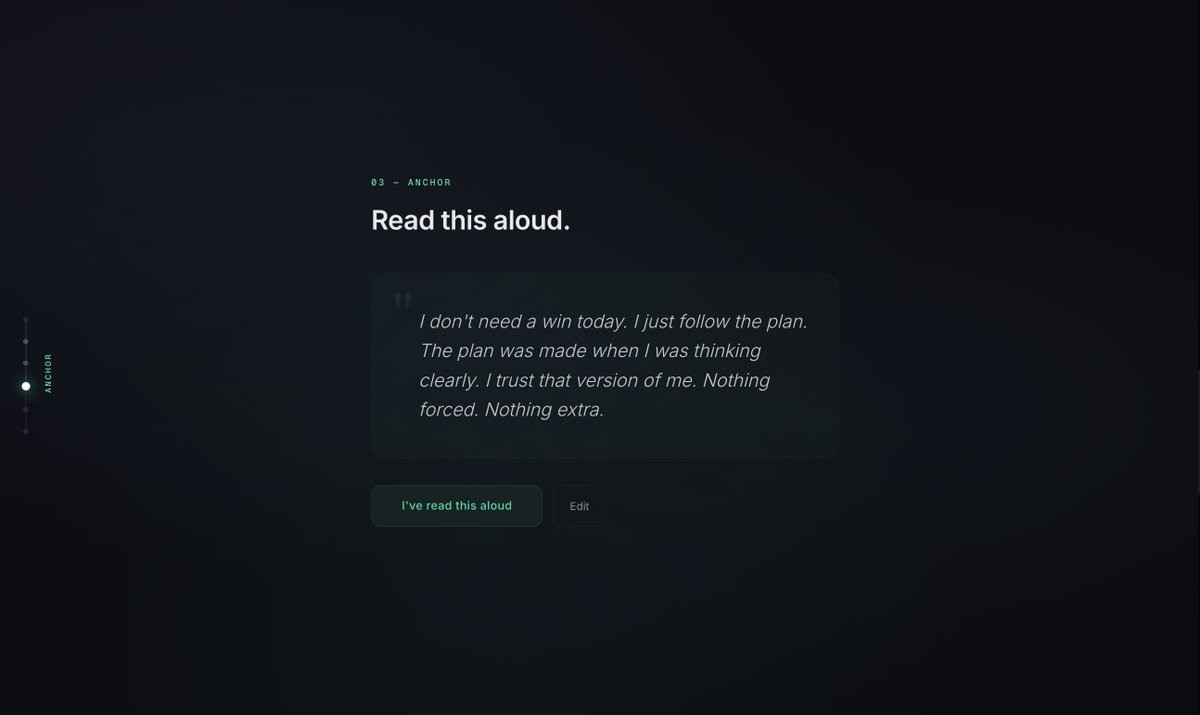
That's the whole pre-session sequence.
Scan. Reset. Anchor. Intentions.
A few minutes before the open - and the most important decisions of the day are already made.
@PerceptivTrader Environment is the underrated one on that list.
Identity and emotional patterns take years to rewire.
The structure around a session can change the same day.
@holantei The part doing the work is closing the platform, not the 0.8%.
Plenty of traders set a target, hit it, and keep trading with the charts still open.
Ending the session is what makes "no exceptions" real.
Every high-pressure job has someone watching the person, not just the performance.
The boxer's corner.
The copilot.
The surgical team.
A trader gets a P&L and a closed door.
There's a difference between a system that tells you to stop and a system that stops you.
One depends on the person under pressure making the right call. The other doesn't.
That difference is the entire gap.
@TTrades_edu The hard part of option 2 is that a promise isn't a change.
Deciding to stop oversizing feels like change.
But a change is something that looks different in your setup the next morning.
If nothing around you changed, nothing changed.
@PJtrades_NQ Those are two separate skills though.
Good days test the strategy.
Bad days test whatever you set up before the session started.
The first you can learn from someone else - the second you have to build yourself.
The part of trading nobody prepares you for is how much of it is doing nothing.
Watching. Waiting. Letting setups come to you instead of hunting for them.
@1MINUTETIP The timing isn't random.
A winning streak is the one moment where increasing size actually feels rational.
You're not breaking rules out of desperation - you're breaking them out of confidence.
That's why it's harder to catch.