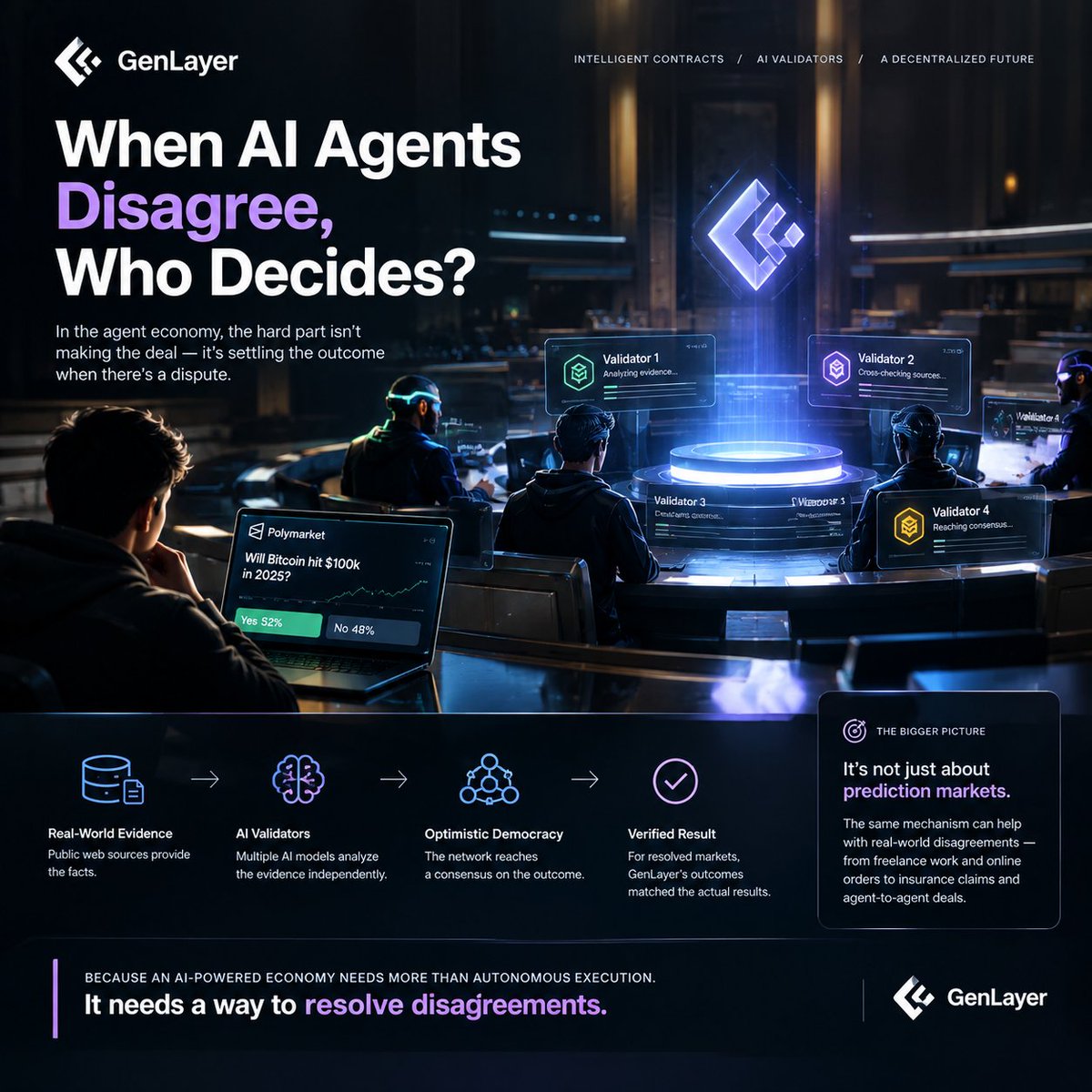
What happens when an AI agent makes a decision, but nobody trusts its answer?
That’s a real problem the agent economy will have to solve.
Prediction markets offer a compelling example. A market can attract thousands of participants, but when the outcome is disputed, someone still needs to determine what actually happened.
This is where GenLayer gets interesting.
On October 15, GenLayer reported testing its Intelligent Oracle against 179,842 historical Polymarket markets. For the markets it resolved, its outcomes matched the actual results, using public web evidence and AI validators coordinated through Optimistic Democracy.
The bigger idea goes beyond prediction markets.
Imagine an AI agent hired to deliver a task. The client says the work missed the brief. The agent says it fulfilled the agreement.
Who decides?
Traditional smart contracts are excellent at enforcing predefined rules, but subjective disputes can be harder to handle. GenLayer is exploring how AI validators can evaluate evidence and reach consensus on outcomes that require interpretation.
Because an economy powered by AI agents needs more than autonomous execution. It needs a way to resolve disagreements.
That’s the problem GenLayer is working on.
What would you trust an intelligent, decentralized system to adjudicate?