Power & infrastructure is key for the AI build out and $AIPO etf holds the stocks doing that
$CCJ – Mines uranium; fuels nuclear reactors that power AI data centers.
$GEV – Makes gas turbines and grid equipment; keeps power flowing at scale.
$ETN – Builds electrical components (switchgear, transformers); manages power distribution infrastructure.
$VRT – Designs liquid cooling and power systems specifically for data center density.
$CEG – Operates nuclear plants; sells clean baseload electricity to hyperscalers directly.
The best companies usually sit in the middle of something unavoidable.
$ASML sits in the middle of advanced chip manufacturing.
$TSM sits in the middle of global semiconductor production.
$SNPS and $CDNS sit in the middle of chip design.
$AMAT and $LRCX sit in the middle of semiconductor equipment.
$VRT sits in the middle of data center power and cooling.
Everyone wants to talk about the end product.
But some of the best businesses are the ones every winner needs to use.
If you are not watching $SHAZ right now, you are completely missing the most explosive infrastructure asymmetry of 2026.
The bears are panicking over a temporary post-IPO pullback down to $67.41, completely ignoring a textbook wealth-transfer setup.
Sharon AI isn't just another spec play. They are a pure-play accelerated compute powerhouse that just pulled off the ultimate validation:
A staggering $950 MILLION cloud GPU infrastructure deal with a global tech giant.
Compass Point just stepped in and aggressively slapped a massive $90 price target on the stock.
Sitting on over $172 MILLION in fresh cash from their Nasdaq debut, they have the ultimate runway to scale their high-performance computing tier.
This is a structural bear trap. Institutional front-running is happening in broad daylight while retail scrolls past.
Argue with me in the comments, or thank me when Compass Point’s $90 target hits the tape.
Are you buying the $SHAZ cloud-infrastructure dip or staying on the sidelines? 👇
$AIRJ just published a white paper that reframes the entire thesis. This isn't a water story. It's a permitting story.
Here's the problem they're actually solving.
A 100 MW hyperscale data center generates $3–5M in revenue per day once operational. In the U.S. Southwest, Australia, Singapore, and the Middle East, water permits at that scale now take months to years. Every quarter of delay is hundreds of millions in deferred capacity revenue.
The conventional fix is switching to air-cooled chillers. Problem solved, right? Except it isn't.
Air-cooled systems consume 1.5–2.5× more electricity than water-cooled. At 100 MW IT, that's $5–13M per year in additional electricity costs. Permanent. Paid every hour for the life of the facility. Operators are trading a permitting problem for an energy problem they can't recover from.
AirJoule is the third option. Keep the water-cooled architecture. Generate the water on-site from waste heat the facility already produces. No permit required. No architectural compromise.
The white paper models this across five climate zones using PUE figures sourced directly to Microsoft, Google, AWS, and Meta sustainability reports. The methodology is rigorous.
The Midland, TX case study is where it gets specific.
Two scenarios:
Case A - 75% permit secured, AirJoule closes the gap. 695 Prime units, ~$105M capex. Adds only +0.06 to PUE vs. the +0.15 permanent penalty of going air-cooled - worth $4.7M/yr in electricity savings for the life of the facility.
Case B - full water independence, no permit at all. 287 units, ~$45M capex, +0.03 PUE impact. No GCD approval, no public hearings.
Here's the number that reframes the investment case.
At $3M/day hyperscale revenue, the entire AirJoule fleet capex is recovered in 15–35 days of permit acceleration.
If AirJoule pulls a schedule forward by even 100 days, captured revenue of $300–500M exceeds the entire investment several times over.
This isn't a sustainability argument. It's an IRR argument. Different conversation. Different decision-makers.
Unit pricing disclosed for the first time: $100,000–$200,000 per Prime unit.
At the $150K midpoint, a 287-unit fleet is ~$43M to the customer. A 695-unit fleet is ~$104M.
Real contract sizes. Real revenue events for AIRJ when they convert. The first large commercial contract would be a material catalyst.
One detail the market hasn't priced: the 18–30 month lead time disclosure.
"We engage with operators and EPC partners 18 to 30 months before commercial operation date."
If the unnamed hyperscaler in active technical engagement places an order in 2026, revenue materializes in 2027–2028 - exactly consistent with management's guidance. The pipeline is further along than it looks.
The white paper is written for technical buyers and EPC engineers, not retail investors. PUE figures anchored to hyperscaler sustainability disclosures. Climate methodology referenced to ASHRAE standards. Construction benchmarks from JLL and Turner & Townsend.
That's a signal about where the commercial conversation actually is.
AIRJ isn't selling water. It's selling permit independence and schedule certainty to operators for whom a single quarter of acceleration is worth $270–450M in captured revenue.
$45–105M contract sizes. Active hyperscaler engagement. Prime built and operational. Runway through 2027. The white paper is the commercial document. The contracts are the catalyst.
NFA. DYOR. Long $AIRJ.
Money is rotating back into SaaS & Healthcare $DRUP
$PLTR — AI-powered data analytics for government intelligence and enterprise decision-making.
$MSFT — Cloud (Azure), Office, and Copilot AI suite; dominant enterprise software incumbent.
$LLY — Pharma giant; Mounjaro/Zepbound GLP-1 drugs are the primary growth engine now.
$ISRG — Makes da Vinci surgical robots; monopoly-like grip on robotic-assisted surgery.
$ADBE — Creative software (Photoshop, Illustrator, Premiere); AI integration via Firefly under pressure from generative competitors.
$CRM — Enterprise CRM and Agentforce AI platform; Salesforce monetizing AI agents across sales workflows.
A look into $AAPL supply chain for WWDC ;
$MU — Makes DRAM/NAND memory chips used in iPhones, Macs, and iPads.
$QCOM — Supplies cellular modems for iPhone
$AVGO — Provides RF chips, Wi-Fi/Bluetooth combos, and custom ASIC co-development with Apple.
$SONY — Manufactures the CMOS image sensors behind iPhone cameras.
$SWKS — Makes RF front-end chips enabling cellular connectivity; also losing share to Apple’s internalization.
$AAOI is one of the only U.S.-based optical players that designs AND fabs its own laser chips in-house (DFB/EML via a proprietary MBE + MOCVD process).
That vertical integration = margin control + supply security for Western hyperscalers.
The setup:
→ 800G ramping hard. First volume shipment to a major hyperscaler landed in Q1’26.
→ 1.6T on deck. Mgmt has guided 2026 revenue to potentially top $1B - more than doubling the business.
→ New 210k sq ft Texas facility = largest AI-transceiver capacity in the U.S.
But the sleeper catalyst is CPO.
As the industry shifts to co-packaged optics, the laser moves OUT of the module and becomes an external light source (ELSFP).
$AAOI just rolled out a 400mW ultra-narrow-linewidth pump laser purpose-built for this and they make the laser in-house.
The kicker here is that they’re targeting ~400K ELSFP units/month by 2027.
In a CPO world, $AAOI stops being “just a transceiver vendor” and becomes a foundational light-source supplier to the entire AI datacenter buildout.
Picks and shovels guys ⛏️
I am adding $AAOI throughout 2026-2027 for the CPO ramp up, I think this is a $1000 stock in the making.
What are your thoughts on $AAOI?
The AI supercycle is in year 3 of 15. You didn't miss it.
You'd make millions by knowing whats coming and buying dips until 2030+
Pay attention, we just finished Phase 1 2023-2025
chips · memory · connectivity
$NVDA → Designs the GPUs every AI model trains and runs on.
$MU → Makes high-bandwidth memory inside every AI server.
$COHR → Moves data at light speed between GPUs optically.
$MRVL → Custom silicon connecting every chip in a hyperscaler's cluster.
$AVGO → Builds Google's, Meta's, and Apple's custom AI chips quietly.
$AMD → Only credible GPU rival to NVDA for AI training.
PHASE 2 — The grid gets built (2026–2027)
power · cooling · networking
$IREN → AI-native data centers built to scale compute and power.
$WULF → Energy-efficient infrastructure hosting the world's most power-hungry AI workloads.
$VRT → Cooling and power systems keeping AI data centers running.
$ETN → Electrical gear powering every hyperscale AI facility being built.
$CEG → Nuclear energy feeding AI's insatiable around-the-clock power demands.
$ANET → High-speed switches moving massive AI workloads across GPU networks.
$GEV → Gas turbines physically delivering power to data centers.
$SMCI → Liquid-cooled GPU server racks — pick-and-shovel for AI density.
PHASE 3 — The massive bottleneck (2027–2029)
materials · space · autonomy
$MP → Mines rare earth materials used in AI hardware and defense.
$USAR → Domestic minerals securing U.S. AI manufacturing independence.
$ASTS → Satellites delivering AI connectivity to every corner of Earth.
$RKLB → Low-cost rockets launching satellites powering AI communication networks.
$KTOS → AI-driven autonomous weapons systems entering mass military deployment now.
$TSLA → Leads real-world AI through robotics, autonomy, and manufacturing.
$SYM → AI-powered warehouse robots automating global logistics at scale.
$ALAB → Chip packaging bottleneck — critical past 100K GPU nodes.
$PLTR → Software turning AI compute into defense and enterprise decisions.
PHASE 4 — Full automation (2030+)
platforms · agents · quantum
$MSFT → Deploys AI agents across every enterprise software product it sells.
$GOOGL → Controls AI search, cloud, and consumer distribution globally.
$META → AI assistants across 3 billion users in social and commerce.
$CRM → AI agents inside enterprise sales — 150K customer moat.
$NOW → AI workflow OS for Fortune 500 enterprises.
Quantum
$IONQ $RGTI $QUBT — next-gen compute unlocking exponential AI breakthroughs.
♻️ RESHARE this post and make 1 comment, I'll share when to add these stocks in June.
Top Industrial Stocks that should be on your watchlist🧵
$STRL - Dominant data center site development play with 60%+ revenue from E-Infrastructure, $2.6B backlog, and 25% operating margins riding the AI buildout wave.
$MOD - Data center cooling juggernaut expecting 60%+ growth in FY2026 with $2B+ revenue target by 2028, serving all major hyperscalers in the AI infrastructure boom.
$POWL - Electrification specialist with 79% YTD gains driven by surging demand for power control systems in data centers, utilities, and industrial applications.
$VRT - Data center infrastructure leader with 20% organic order growth, strategic NVIDIA partnership, and aggressive 2026 guidance beating Wall Street expectations by wide margins.
$GNRC - Expanding beyond residential generators into high-growth data center backup power market with hyperscaler relationships expected to drive meaningful backlog growth.
How Liquid Cooling Works in AI Data Centers?
1. Direct-to-Chip (D2C) Cooling
Cold plates bolted directly onto GPUs/CPUs for instant heat removal.
Tickers: $VRT · $ETN · $MOD · $NVT
2. Immersion Cooling
Servers fully submerged in non-conductive fluid for total heat transfer.
Tickers: $VRT · $TT · $MOD · $SMCI
3. Coolant Distribution Units (CDUs)
Precision pumps, manifolds, and loops feeding coolant to every rack.
Tickers: $VRT · $ETN · $TT · $NVT
4. Facility Chillers & Heat Rejection
Massive chillers and heat exchangers dumping heat outside the building.
Tickers: $TT · $CARR · $JCI · $VRT
5. Integrated Thermal Management
AI-powered sensors, controls, and full-system monitoring platforms.
Tickers: $VRT · $ETN · $JCI · $PH
Liquid cooling is the must-have upgrade for AI data centers — unlocking 100kW+ racks, slashing energy use, and keeping hyperscalers ahead of the heat wave.
That’s why leaders like $VRT, $ETN, $TT, and $MOD are exploding as the next big AI infrastructure winners.
One of the biggest bottlenecks in AI is not $XFAB or $SIVE. It is cooling.
So I mapped the entire liquid cooling supply chain in one thread, every listed name from $VRT and $MOD to $AVC, $CC and $SOLS, across single phase, two phase and immersion. 👇
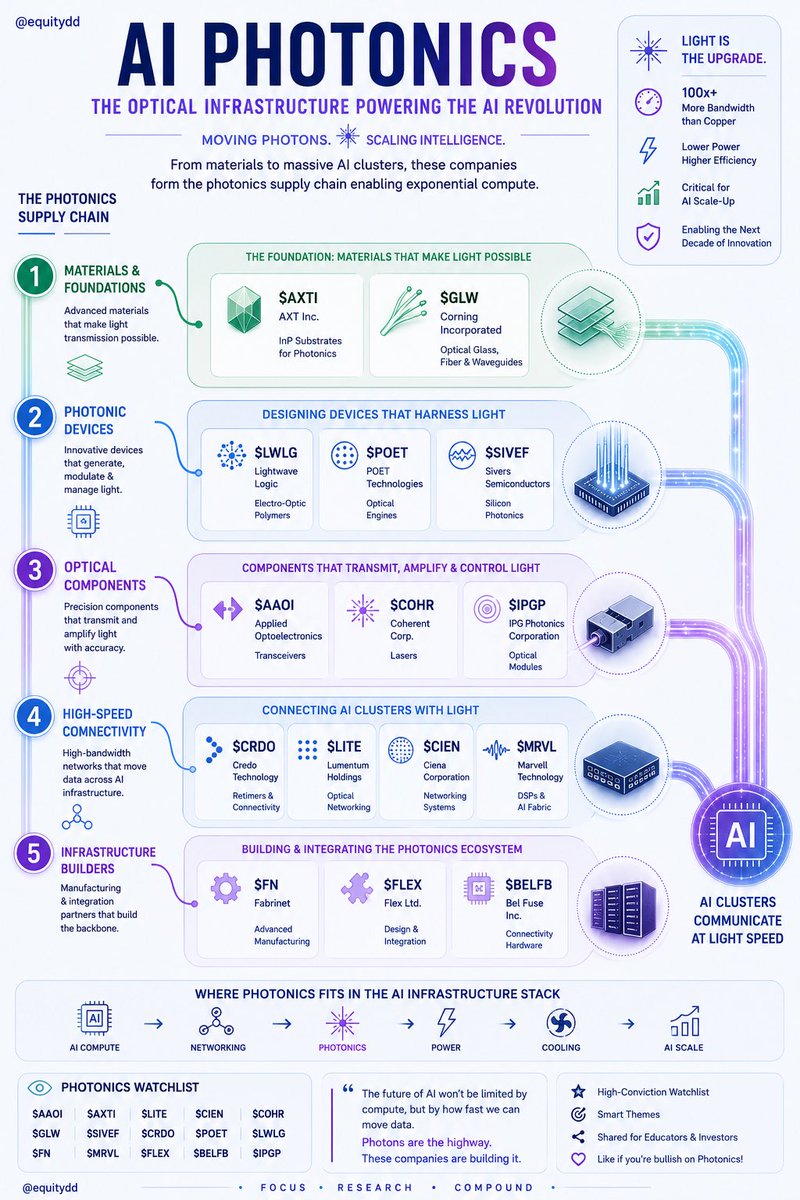
Photonics offer high bandwidth connectivity compared to copper. From materials and optical components to infrastructure buildout, below infographic goes through each layer of optical ecosystem.
$AAOI $LITE $GLW $AXTI $POET $SIVEF $COHR $CIEN $COHR $IPGP $MRVL $FLEX $FN
Which stocks are you bullish on?
If we see a market pullback then this is definitely one of my top themes to watch very closely.
AI infrastructure is becoming a power trade, not only a chip trade
The Defiance AI & Power Infrastructure ETF, $AIPO, focuses on companies building the physical backbone required for AI data centers: power generation, grid equipment, cooling systems, construction, utilities, nuclear fuel, and AI hardware.
The fund has around $780M in AUM and holds 78 companies. Its structure is different from many AI ETFs because it is not dominated only by software or semiconductor names. Industrials account for about 56% of the portfolio, followed by technology at 19% and utilities at 16%. U.S. companies represent roughly 88% of holdings.
The top holdings show the theme clearly.
$PWR, $ETN, $GEV, and $VRT are the largest positions. Their roles are tied to transmission lines, power management, turbines, cooling, backup systems, and electrical equipment. In other words, they support the infrastructure layer behind AI compute.
$BE adds exposure to on-site fuel cells, which can help data centers bypass grid bottlenecks. $CCJ and $CEG add nuclear exposure, which is becoming more relevant as hyperscalers look for reliable, carbon-free baseload power.
The ETF also includes AI hardware and connectivity names such as $AVGO, $NVDA, $AMD, and $MRVL. These companies support GPUs, custom accelerators, networking, and data movement inside large AI clusters.
Smaller holdings like $STRL, $MTZ, $NVT, $HUBB, $VST, and $GNRC broaden the portfolio into site development, transmission construction, rack enclosures, power distribution, merchant power, and backup generation.
AI demand is creating pressure across the entire physical stack. More models require more data centers. More data centers require more electricity, cooling, transmission, and backup power.
$AIPO offers a concentrated way to track this infrastructure theme. The main risk is that many holdings already reflect strong AI-related expectations, so valuation discipline still matters.
I can't believe this 1-hour talk is free
Ray Dalio, Jamie Dimon, and Larry Fink on one stage
Between them - more capital under management than most countries have GDP
They laid out exactly where the money is going for the next decade
Watch it
Then read the article on how quant funds use AI
Did you know the Red Cross was owned by the Rothchilds
Did you know the Red Cross was Child Trafficking
Organ Trafficking
Adrenochrome &
Money Laundering
Organised Crime Network
🔗 THE WHITE RABBIT
Everytime there is massive crash in June, $SPY recovers at 30% 1 year later.
Here's 12 stocks under $20 that can easily 10x-20x:
1. $TE — T1 Energy
Aschenbrenner's AI infrastructure bet. Revenue beat by 61%.
2. $POET — POET Technologies
AI photonics optical interposer. Next-gen data center chip architecture.
3. $KEEL — Keel Infrastructure
Ex-Bitcoin miners pivoting hard to AI compute demand.
4. $CLSK — CleanSpark
Verified Aschenbrenner long. Bitcoin miner scaling into AI HPC.
5. $ONDS — Ondas Holdings
Building wireless connectivity for autonomous defense drones. (Trump call)
6. $CIFR — Cipher Mining
Power + data center assets perfectly positioned for AI workloads.
7. $WULF — TeraWulf
Nuclear-powered data centers. Cleanest energy costs in AI compute.
8. $HIVE — HIVE Digital
Revenue up 219% YoY. Pivoting from crypto mining to AI HPC.
9. $SATL — Satellogic
Sub-$10 satellite imaging play. Defense + geospatial AI data boom.
10. $NOK — Nokia
Nvidia invested $1B. AI-RAN + T-Mobile deal. Up 140% YTD still cheap.
11. $BTDR — Bitdeer
Self-mining + AI cloud. Building proprietary ASIC chips in-house.
12. $LAES — SEALSQ
Post-quantum cryptography chips. Every connected device needs this.
Remember, you're getting 1 more chance to add dips again to hold. HOLDING is the best way to make money in this market not scalping.
��️ RESHARE this post and write 1 comment, I'll DM you my favorite stock to buy under $10 (and its strong too)