Social needs may be an important part of the acute-to-chronic pain story.
In first-year findings from our PREVENT cohort, ED patients reporting multiple social needs had substantially higher adjusted anxiety and depressive symptoms, pain catastrophizing, and disability compared with patients reporting no social needs.
Importantly, these estimates were adjusted for age, gender, race, ethnicity, and current pain intensity.
These findings reinforce the importance of considering the broader biopsychosocial context when trying to understand recovery after acute musculoskeletal pain—and may help inform how we identify and support patients at risk for persistent pain after ED discharge.
Our first-year PREVENT manuscript has been published open access by the @CambridgeCore Journal of Clinical & Translational Science.
https://t.co/nyuJa3V5eh
#pain #research #recovery
@GWHospital@GW_OVPR@GW_RRIEM@GWtweets@GWSMHS
Just finished Parable of the Sower by Octavia Butler.
A sower is someone who spreads seeds, allowing them to take root and grow. But growth requires more than simply planting seeds. The environment must be prepared, and what takes root must be cultivated over time.
This was my first time reading Butler. The book was recommended to me by Dr. Shanna Katz Kattari, PhD, MEd, CSE after I shared that I’d read Brave New World and 1984.
The story is captivating, and the carnage of Butler’s dystopian world is devastating to read at times. Yet, despite the brutality, my interpretation is that this is fundamentally a story of hope, championed by its young protagonist, Lauren.
Lauren is determined to spread the teachings of Earthseed, a belief system she develops around a central idea: “God is Change.”
But God isn’t a supernatural entity or mythical being. Change itself is the fundamental reality of existence. And although change is inevitable, we have the capacity to shape it.
Throughout the book, I kept thinking of the familiar aphorism: Be the change you want to see in the world.
I’m a fan of this message.
Although much about today’s world seems different from years past, I remain hopeful that better days are ahead. But hope alone is insufficient. We must be willing to champion the changes we wish to see.
That seemed to be Lauren’s perspective as well.
She’s not a naive optimist, but a realist who recognizes and accepts that the change her world desperately needs will not simply happen. It must be ushered in, forged through community, and cultivated over time.
Much like a seed, a better future requires someone willing to plant it, an environment in which it can take root, and people committed to nurturing its growth.
Change is inevitable. Progress is not.
And perhaps that is what I take away most from Butler’s novel. We cannot always choose the circumstances in which we find ourselves, but we can choose how we respond and what we work to create.
So, be the change. Plant the seeds. Cultivate something better.
And perhaps, as Earthseed envisions, one day we’ll “take root among the stars.”
#book #reading #culture #academic
Update: I've now completed the multivariable analyses examining associations between chronic pain and kratom use using the 2025 NSDUH data.
After adjusting for demographic, socioeconomic, and behavioral health characteristics, chronic pain remained significantly associated with:
🔹 Lifetime kratom use: aOR 2.00 (95% CI: 1.59–2.53)
🔹 Past-year kratom use: aOR 2.07 (95% CI: 1.42–3.02)
🔹 Past-month kratom use: aOR 3.31 (95% CI: 1.72–6.35)
These survey-weighted analyses included 40,566 U.S. adults.
Interestingly, the association was numerically strongest for past-month use, although the estimate was less precise and differences between outcomes have not been formally tested.
While these cross-sectional findings cannot establish causation or explain motivations for kratom use, they suggest that the relationship between chronic pain and kratom use persists even after accounting for several important potential confounders.
Next step: manuscript development.
#kratom #pain #research #clinician #academic #scientist
I spent some time today exploring the recently released 2025 National Survey on Drug Use and Health (NSDUH) public-use data.
I was particularly interested in two things: estimating the prevalence of chronic pain (CP) and high-impact chronic pain (HICP) among U.S. adults, and examining how kratom use differs among individuals reporting these conditions.
A few preliminary findings from my survey-weighted analyses:
🔍19.8% of U.S. adults reported chronic pain, while 8.7% reported high-impact chronic pain.
🔍Approximately 2.0% reported lifetime kratom use, 0.72% reported past-year use, and 0.37% reported past-month use.
🔍Adults reporting chronic pain had approximately 2.5 times the prevalence of past-year kratom use compared with those without chronic pain (1.40% vs. 0.56%).
🔍Among adults reporting high-impact chronic pain, past-year kratom use was 1.27%, compared with 0.67% among those without high-impact chronic pain.
These findings are particularly timely given the recent 60 Minutes coverage of kratom and the growing public health discussion surrounding these products.
An important limitation: Although NSDUH asks about kratom use, it does not distinguish between traditional plant-based kratom products, derivatives such as 7-hydroxymitragynine (7-OH), or semisynthetic analogs such as MGM-15 and MGM-16. These distinctions matter given their differing pharmacological profiles. We therefore cannot determine which specific products respondents used from these data.
These are preliminary, unadjusted findings. I still need to run multivariable models to examine potential confounding. As with any cross-sectional analysis, these findings cannot establish causation or explain why individuals are using kratom.
Nevertheless, I think these data offer an interesting opportunity to better understand kratom use among people experiencing chronic pain, particularly as the landscape of kratom-related products continues to evolve.
2025 NSDUH data: https://t.co/2M8aYTC1wp
#ChronicPain #Kratom #PainResearch #Epidemiology #PublicHealth
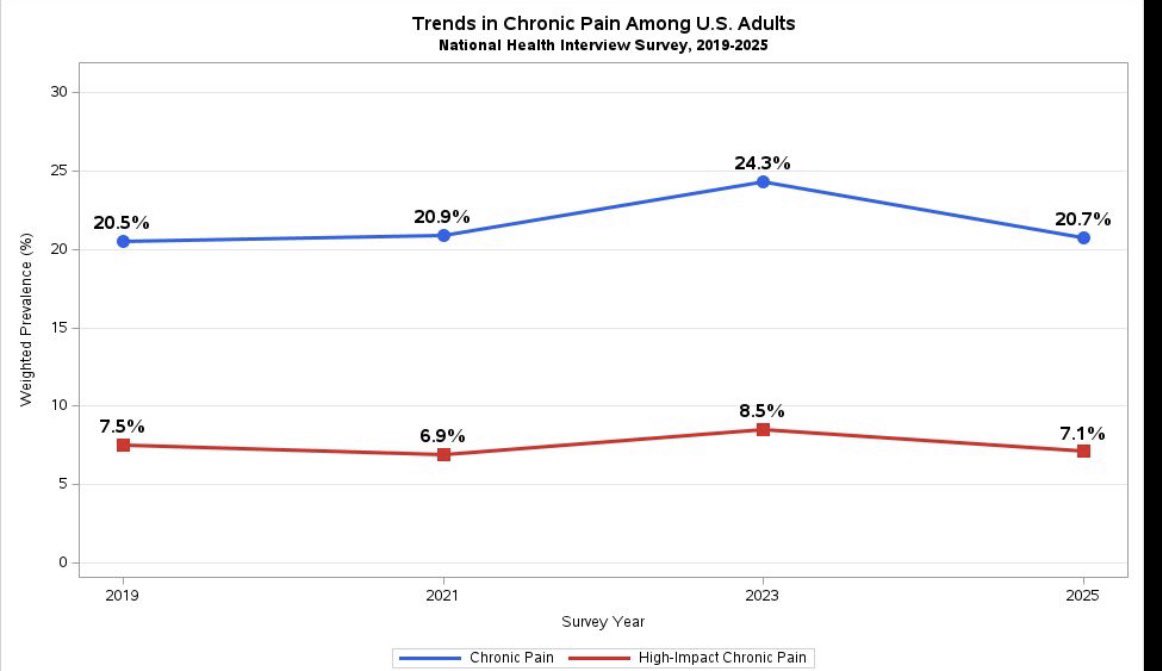
I recently published an investigation in The Journal of Pain examining national trends in chronic pain (CP) and high-impact chronic pain (HICP) using National Health Interview Survey (NHIS) data from 2019, 2021, and 2023.
One notable finding was the increase in chronic pain prevalence from 20.5% in 2019 to 24.3% in 2023. High-impact chronic pain followed a similar trajectory, increasing from 7.5% to 8.5%.
Today, I spent some time conducting preliminary analyses of the newly released 2025 NHIS data, and the findings were interesting.
Chronic pain: 20.7% (95% CI: 20.0–21.4%)
High-impact chronic pain: 7.1% (95% CI: 6.7–7.5%)
Compared with 2023, these estimates represent relative reductions of approximately 15% and 16%, respectively.
Interestingly, the 2025 chronic pain estimate closely aligns with findings from another nationally representative survey. The Substance Abuse and Mental Health Services Administration (SAMHSA) incorporated the NHIS chronic pain question into its 2025 National Survey on Drug Use and Health (NSDUH), reporting a prevalence of 19.8%.
(see: https://t.co/8RPksTMq7y)
What has changed between 2023 and 2025?
Both chronic pain and high-impact chronic pain appear to have returned to levels similar to those observed in 2019.
These findings are preliminary, and additional analyses are needed to formally evaluate the differences and examine potential explanations. Nevertheless, it's an interesting development in national chronic pain surveillance.
I'm particularly curious whether these changes are consistent across demographic and socioeconomic groups or concentrated within specific populations.
Original publication: https://t.co/rG5YM8F64d
#ChronicPain #PainResearch #Epidemiology #PopulationHealth
Recently picked up From Acute to Chronic Back Pain: Risk Factors, Mechanisms, and Clinical Implications.
I recognize quite a few familiar names among the contributors and am looking forward to digging into their work.
Published in 2012, the book brings together perspectives on the transition from acute to chronic low back pain. Given how much our understanding of pain mechanisms, prognostic factors, and clinical management has evolved over the past 14 years, I can’t help but wonder whether it’s time for an updated edition.
Excited to read through it!
#PainResearch #LowBackPain #ChronicPain
I'm excited to share that our latest research is now in press in @TheJournal_Pain !
In this secondary analysis of a prospective cohort, we examined factors associated with new-onset chronic pain six months after an emergency department (ED) visit among opioid-naïve adults discharged with a new opioid prescription.
Among 483 participants without chronic pain at baseline who completed six-month follow-up, the observed cumulative incidence of new-onset chronic pain was 26.7%.
A few 🔑 findings:
🔑Early pain persistence mattered. Pain frequency at 48 hours was associated with new-onset chronic pain, while pain frequency and intensity at two weeks demonstrated particularly important associations in adjusted analyses.
🔑Baseline pain characteristics mattered. Neck/back pain and longer pain duration before the ED visit were consistently associated with higher odds of new-onset chronic pain.
🔑Early opioid use was not associated with new-onset chronic pain. Neither opioid use at 48 hours nor at two weeks was associated with new-onset chronic pain in adjusted analyses.
These findings highlight the first two weeks following ED discharge as a potentially important window for identifying patients at elevated risk of transitioning from acute to chronic pain.
They also underscore the potential value of assessing pain beyond the initial ED encounter and developing targeted interventions to support recovery and potentially prevent chronic pain.
I'm grateful to Dr. Benjamin Friedman and our colleagues at Albert Einstein College of Medicine for the opportunity to collaborate on this work!
Read the article:
https://t.co/2kuoMd1jFr
Explore our interactive visualization of chronic pain trajectories from baseline to six months, illustrating the development, persistence, and resolution of chronic pain:
https://t.co/Ajj23uUvwj
#PainResearch #ChronicPain #EmergencyMedicine #AcutePain #PainManagement
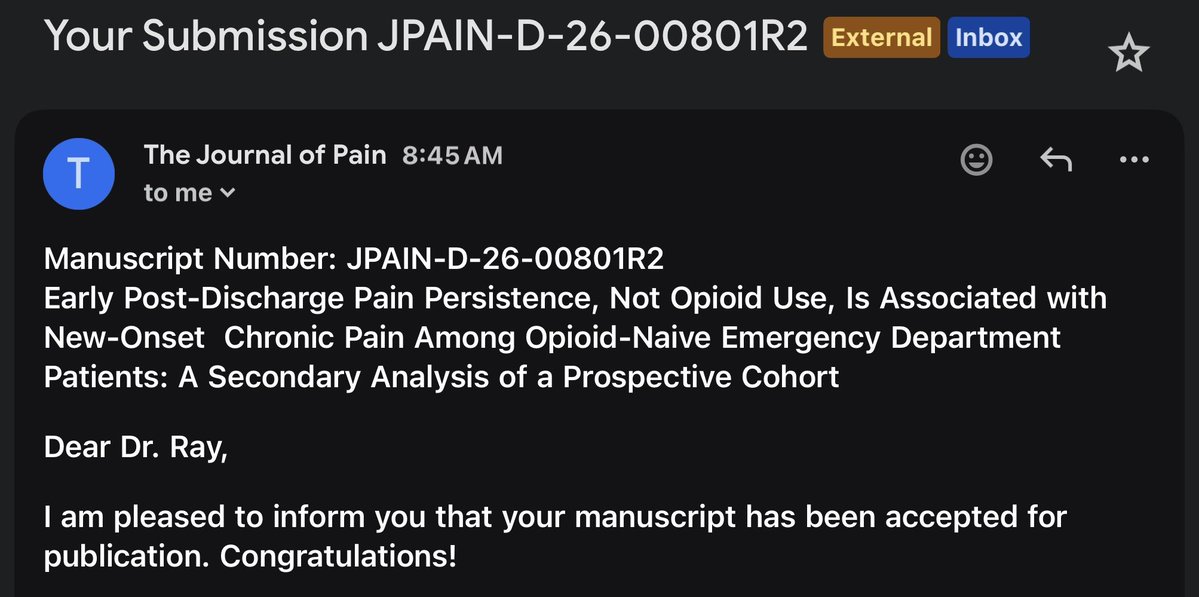
I’m excited to share that our manuscript has been accepted for publication in @TheJournal_Pain !
Special thanks to Dr. Benjamin Friedman and colleagues at Albert Einstein College of Medicine for the invitation to collaborate on this study.
In this secondary analysis of a prospective cohort, we examined factors associated with new-onset chronic pain at six months among opioid-naïve patients who presented to the emergency department with acute pain and received a new opioid prescription at discharge.
One of our key findings was the importance of early post-discharge pain persistence, rather than opioid use, in identifying patients at risk for developing chronic pain. Pain-related markers assessed at 48 hours and two weeks highlight the early recovery period as a potentially important window for identifying patients at risk and investigating interventions to prevent the transition from acute to chronic pain.
Looking forward to sharing more once the manuscript is available online!
#PainResearch #ChronicPain #EmergencyMedicine #PainManagement
I’ve been working on this book chapter for the past several months, and I’m happy to report that it is now complete and off to the editors.
This is the first book chapter I’ve written, and I’m grateful for the opportunity to contribute to an educational text focused on pain management in emergency medicine. As both a clinician and a pain researcher, it was an interesting exercise in translating what I know about pain science and assessment into something practical and clinically useful in the emergency department.
I especially enjoyed writing the section on pain assessment when self-report is limited or unavailable.
Thinking carefully about how we assess pain when we cannot rely on a patient’s direct report-using potential sources of pain, adapted communication, behavioral observation, caregiver or proxy information, and response to intervention-was a learning experience for me as well. It also reinforced an important distinction: these approaches can help us infer the likelihood that pain is contributing to a patient’s presentation, but they are not an objective substitute for the patient’s subjective experience.
As I often used to tell my students: we learn by doing.
Writing this chapter certainly reinforced that for me.
I hope clinicians and learners find it useful. I’ll share more when Practical Pain Management in Emergency Medicine is published. #academic #clinician #scientist #bookchapter #pain #emergency
If you’ve recently tried to email me at my GW address, your message may not have been delivered.
For the time being, please reach me at [email protected] instead.
Thanks!
New NIH data show that the average age at first R01-equivalent award has remained stable since FY 2021. Read about the trends and NIH's continued commitment to supporting the next generation of biomedical researchers.
🔗 https://t.co/skSPr2prsH
Original: Dr. @MichaelRayDC examined temporal trends, a complementary prevalence-burden framework, and multilevel correlates of chronic pain and high-impact chronic pain.
FULL: https://t.co/hOvQmZ6R19
Happy to see this work published in the August issue of @TheJournal_Pain
https://t.co/8UMsEbpcSW
Using nationally representative data from 91,001 U.S. adults, I found that:
✒️Chronic pain prevalence increased from 20.5% in 2019 to 24.3% in 2023—nearly 1 in 4 adults.
✒️High-impact chronic pain increased from 7.5% to 8.5%.
✒️Chronic pain and high-impact chronic pain were strongly patterned by socioeconomic disadvantage, poor overall health, rheumatic conditions, anxiety and depressive symptoms, health care utilization, and cost-related barriers to care.
One of the most striking findings was that people with chronic pain were not necessarily disconnected from the health care system:
92.5% had health insurance.
91.0% had a usual source of care.
90.7% had seen a physician within the past year.
At the same time, chronic pain prevalence rose substantially with greater health care utilization-from 18.7% among adults with no emergency department visits to 56.5% among those with four or more visits.
Why is this important?
Having insurance and interacting with the health care system do not necessarily translate into timely, affordable, coordinated, or effective pain care. High utilization may be a marker of unresolved needs rather than adequate treatment. These findings suggest that the opportunity to improve pain care is already present within routine clinical encounters-but realizing it will require greater attention to affordability, continuity, coordination, and access to multidisciplinary, evidence-based care.
A special shoutout to Alison McGuire with the GW iMPACT team for creating this compelling artwork embodying that central finding: many Americans living with chronic pain are insured and actively engaging with the health care system, yet substantial unmet needs remain.
I'm grateful to everyone who contributed to this work and hopeful that these findings can support more equitable screening, care planning, and pain-management strategies.
#ChronicPain #PainResearch #PublicHealth