One of my extended family members had a heart attack last week, despite being fit, eating a healthy diet, and occasionally going on 70-mile bike rides. Fortunately, he underwent an intervention to open a fully occluded vessel and is scheduled for treatment on two more. It was a direct, personal reminder of why we do what we do.
We built Cleerly Plaque Analysis to provide clear visibility into cardiovascular health for patients. Clinical evidence showing that plaque can quantify disease and predict adverse events, such as heart attacks, continues to mount. For instance, a recent CONFIRM2 paper in the American Journal of Preventive Cardiology highlighted two key points: 1) adverse events with higher total plaque volume, and 2) risk increases sharply once plaque volume crosses specific thresholds.
Developing an AI-powered plaque analysis solution is one thing but proving it improves patient outcomes is another. That is why we need robust clinical evidence.
That evidence is on the way: the PARAMOUNT trial for symptomatic patients compares personalized medical and interventional management based on coronary atherosclerotic plaque against standard of care. The primary results will be presented at the AHA Scientific Sessions on November 7.
AI-supported mammography screening outperforms standard double reading:
○ consistently favorable outcomes compared with standard double reading
○ non-inferior interval cancer rate
○ fewer interval cancers with unfavorable characteristics
○ higher sensitivity, and the same specificity
○ reducing screen reading workload
New ARPA-H ADVOCATE program targets the leading cause of death in the U.S. with agentic AI for cardiovascular care.
A patient-facing, mobile clinical agent that provides 24/7 specialist-level CVD management using integrated EHR and wearable data. A disease-agnostic supervisory AI that ensures continuous post-deployment safety and control.
The program also delivers scalable deployment, regulatory, and reimbursement blueprints for chronic disease care.
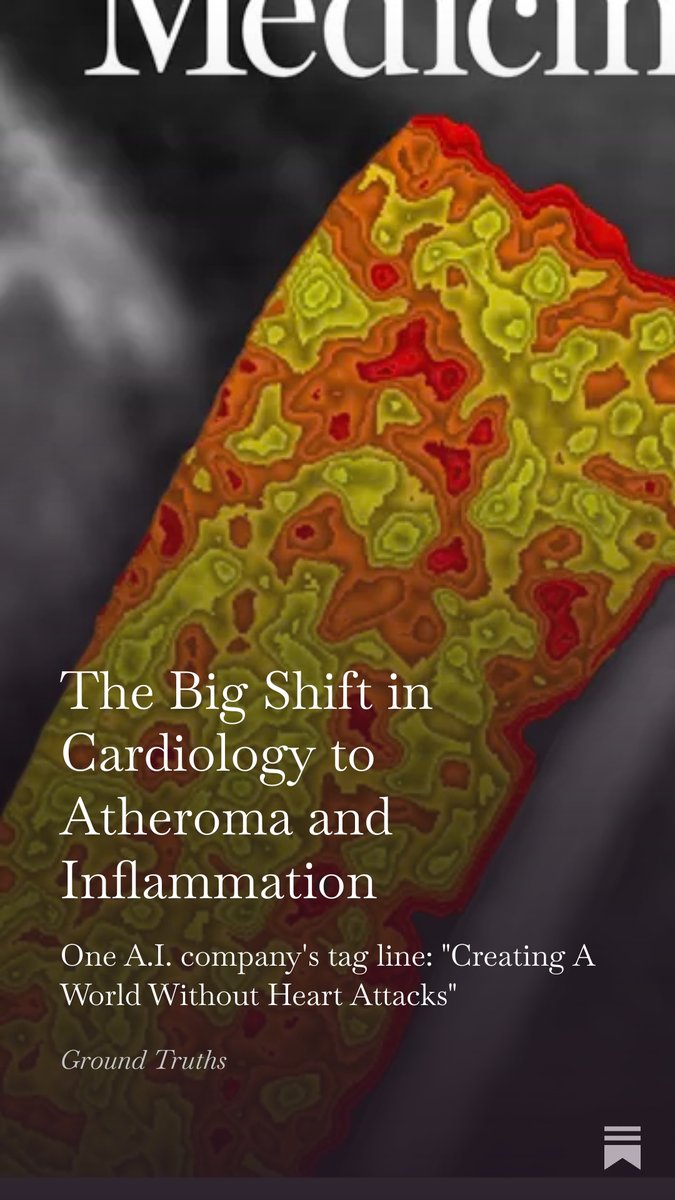
The challenge is to develop noninvasive screening methods to detect coronary atherosclerosis in its earliest stages.
Detection of the high-risk atheroma has been made possible without a catheter placed into the artery using CT imaging with an injection of contrast dye (angiography), known as CCTA (for coronary computed tomography angiography).
CLEERLY detects plaque features (total plaque volume, low-density non-calcified plaque volume) and has a clinical validation study to link their detection to events.
Artificial intelligence-guided quantitative coronary CT angiography (AI-QCT) automated detection and occlusion length estimation of chronic total occlusions.
Analysis was performed for 50 consecutive CTO PCIs. As compared to advanced cardiac imagers who identified CTO lesions in 40 patients (80 %), AI-QCT-based automated CTO detection resulted in a comparable detection rate and identified CTO lesions in 41 patients (82 %).
Re-thinking consumer medical devices, @apple has a steady stream of FDA clearances for Apple Watch, over-the-counter use:
2022: Atrial fibrillation history
2023: Irregular rhythm notification
2024: Sleep apnea notification feature
2025: ?
We are moving from narrow AI to general AI. But for now, hospitals need to review a large number of organ specific systems for each modality. This means that hospital may be able to review just 1% of all such systems. #SCCT2025
Cleerly Aims to Reinvent Coronary Artery Diagnostics with AI
The company's comprehensive management platform uses AI algorithms to increase accuracy of interpreting CT scans, avoid false positives, and make the diagnosis stage of treating the disease more efficient for the doctors and hospitals.
Have your AI talk to my AI: Healthcare edition
Last week, FDA released Elsa, LLM-based tool to assist with reading, writing, and summarizing to improve operational efficiency. It can summarize adverse events, perform faster label comparisons, and generate code to help develop databases.
Meanwhile, ArgusQuery's AI Doc Creator automates the drafting of complex FDA filings, including 510(k), De-Novo, and PMA submissions.
RightSubmission by Setfive finds substantially equivalent devices by understanding nuanced language in FDA 510(k) submissions.
More efficient regulatory pathways will unlock true speed of innovation in healthcare!
Hyperfine announces FDA clearance of the next generation Swoop system powered by new Optive AI software platform!
The new system incorporates learnings from five years of real-world experience and features innovations specifically engineered to deliver the highest signal-to-noise ratio, which achieve exceptional image quality, including improved resolution, uniformity, and faster acquisition times.
Exciting to see an #ASNR25 sneak peak of @Hyperfine's next DL reconstruction algorithm! 🧲
The progress they've made since my first scan in 2019 is incredible! Just got a new scan, going to dig up my 2019 scan for a side-by-side.
Let's make super-resolution the norm!
Coronary CT angiography is the fastest-growing imaging test used in cardiology.
Most heart attacks occur not from serious blockages of coronary vessels but when smaller, nonobstructive plaques rupture and form a clot that triggers a heart attack. These can be imaged with coronary computed tomography angiography (CCTA).
Compared to standard-of-care, patients who had CCTA were more likely to be taking preventive drugs and were 41% less likely to die of cardiovascular disease or to have had a heart attack.
AI can be used to analyze CCTA results in greater detail and quantify the exact amount of plaque a person has — especially the nonobstructive type — and further refine a person's risk calculation.
For AI to fulfill its promise in healthcare, it needs to be employed in a manner that prioritizes patient care over mere operational efficiency.
AI enhances outcomes by aiding physicians in faster diagnosis and enhancing productivity among multidisciplinary teams throughout the hospital by ensuring the right information about a patient case is being delivered to the right teams.
Loved seeing Cleerly’s approach featured in Forbes as an example of how AI can empower providers and protect patients.