.@annnnhe and I won the @agihouse_org ai x commerce hackathon on saturday! we built taste space: a 3d representation of 1500 clothing items that, through rating, you can place yourself in.
built with CLIP, UMAP, synthetic labeling, react three fiber, and more. thread 👇
Muse Spark is agentic, which means you can ask it to leverage different test-compute scaling methods to improve quality. Here I ask the model to use parallel subagents to do counting and the results are greatly improved!
https://t.co/W5KKfSN6JW
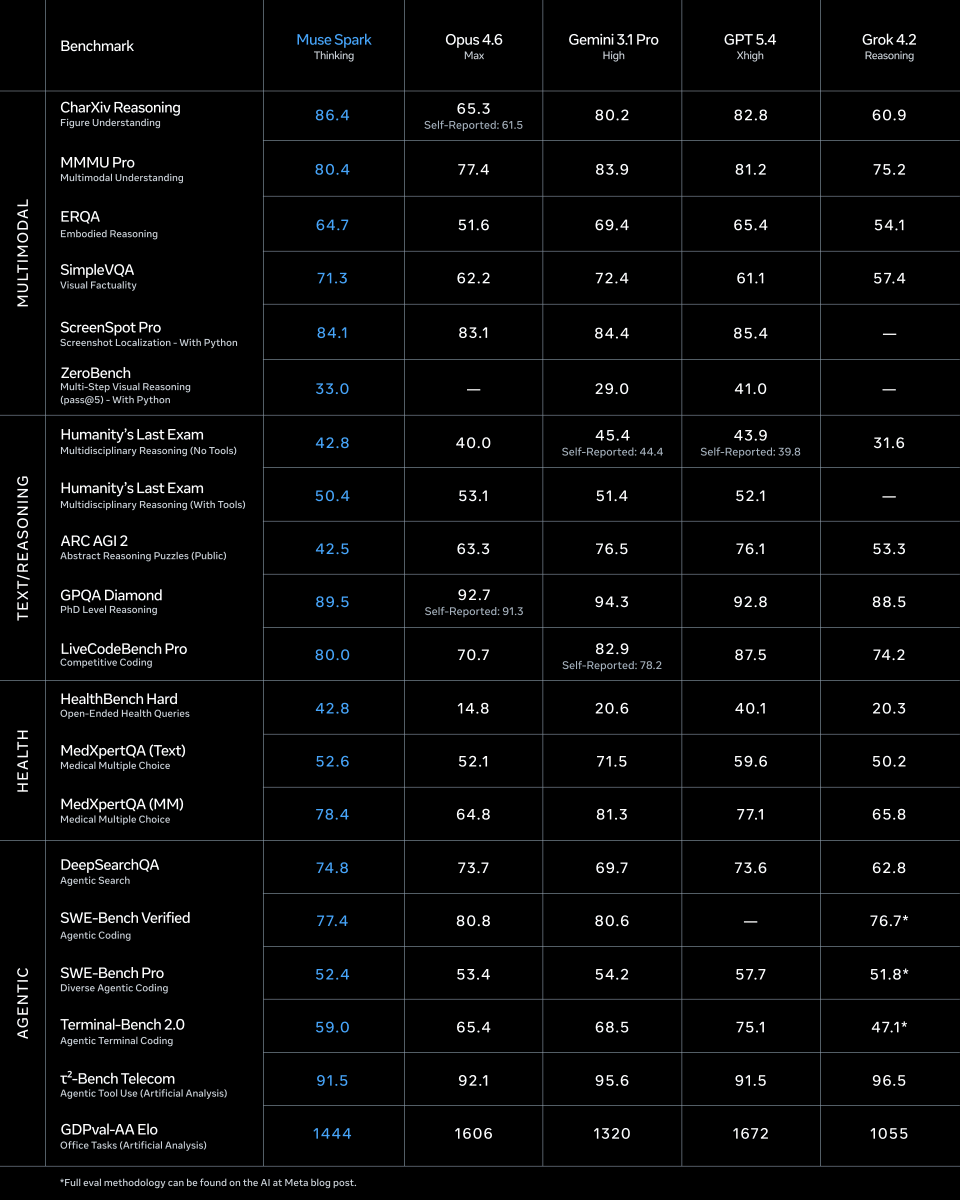
1/ today we're releasing muse spark, the first model from MSL. nine months ago we rebuilt our ai stack from scratch. new infrastructure, new architecture, new data pipelines. muse spark is the result of that work, and now it powers meta ai. 🧵
Excited to announce that @ManusAI has joined Meta to help us build amazing AI products!
The Manus team in Singapore are world class at exploring the capability overhang of today’s models to scaffold powerful agents.
Looking forward to working with you, @Red_Xiao_!
Manus is entering the next chapter: we’re joining forces with Meta to take general agents to the next level.
Full story on our blog: https://t.co/huPrnbITCi
.@annnnhe and I won the @agihouse_org ai x commerce hackathon on saturday! we built taste space: a 3d representation of 1500 clothing items that, through rating, you can place yourself in.
built with CLIP, UMAP, synthetic labeling, react three fiber, and more. thread 👇
EdgeTAM, real-time segment tracker by Meta is now in @huggingface transformers with Apache-2.0 license 🔥
> 22x faster than SAM2, processes 16 FPS on iPhone 15 Pro Max with no quantization
> supports single/multiple/refined point prompting, bounding box prompts
the more something becomes commoditized (content, clothing, food etc), the more people crave a scarce and more meaning-infused version of the thing.
often, lost in all the excitement for abundance and agency is an understanding for what people will crave more of in this future.
Evolution of the Scaling Era cover:
“It’s hard to find unique ways of visualizing AI without defaulting to the obvious,” says @pablodelcan.
“In our design process, we experimented with unexpected metaphors—flowers growing out of neural networks, abstract mathematical puzzles like the Knight’s Tour—before arriving at a graphic visualization of an LLM: input, transformers, attention, multilayer perceptrons, and output. The result is a cover that is both direct and sculptural.”
https://t.co/au8g0XJZ3f