June 19th 1982: Sir Anthony Parsons reports back to London on yesterday's note to the UNSC by Argentina; and it seems the push is back on to represent the Argentine surrender as a UN compliant ceasefire, in order to restart negotiations... his report is in the thread below:
1/3
June 19th 1982: Despite military defeat for Argentina, the trend in Latin America is now for supporting Argentine diplomatic efforts to gain the Falklands. Venezuela, Peru and Panama are vocal in the OAS and the press, and now call for the USA to intercede...
1/2
June 19th 1982: Venezuelan Ambassador to the US, Marcial Perez-Chiriboga, goes on record to say that US-Venezuelan relations are "damaged" since the Falklands War, but that an "equitable" settlement of the Falklands issue "would heal the wounds".
1/2
June 19th 1982: In the Latin-controlled OAS, statements are made against the UK, and pressure is brought against the USA to play a central role in working out a diplomatic formula that, despite military defeat, would eventually leave the Islands in the hands of Argentina...
1/2
June 19th 1982: President Luis Herrera Campins of Venezuela seems to be leading this coordinated new pro-Argentine movement, along with Panama and Peru, and states that; ''Whatever the outcome of the war, Argentina will definitely come out a winner in this controversy.''
June 19th 1982: On NBC's 'Today' programme, Al Haig dismisses speculation over US pressure on Britain for a compromise on Falklands sovereignty: ''It's not a question of pressure," he says, "but rather a question of consultation among allies..."
1/3
June 19th 1982: Potentially cutting across Haig's carefully ambiguous words, the US State Department claims that: "The Administration sees itself as playing no constructive role in a long-range settlement of the dispute, which has to be resolved by Britain and Argentina."
June 19th 1982: Larry Birns, Director for the Council on Hemispheric Affairs, looks at new LATAM policies regarding the Falklands issue:
"Just as Argentina has been defeated, the policy of strongly supporting Argentina has become a strong domestic issue..."
1/3
June 19th 1982: Interviewed on UK Radio, Francis Pym discusses the ongoing plans to cease hostilities: "We were getting no answers of any kind from Galtieri and the Junta before. I have ground for some hope that a new regime will come to a rapid conclusion..."
1/3
June 19th 1982: Asked for a statement on reports that Argentina has asked the United Nations to intervene in obtaining a total ceasefire and had said the war would end only when British troops were withdrawn, the Foreign Office issue the following statement:
1/2
June 19th 1982: Argentine Hospital Ship ARA Almirante Irizar docks at Comodoro Rivadavia in Argentina to offload 420 wounded men, although two have died on the voyage. The streets are blocked off by the military so that nobody sees the wounded men...
1/2
June 19th 1982: Meanwhile, hospital ship ARA Bahia Paraiso departs Port William loaded with an overwhelming 1,660 more wounded, headed for Punta Quilla in Santa Cruz. On the two hospital ships alone are more wounded than the 1,657 Argentina claims for the entire Falklands War!
June 19th 1982: As regular Argentine soldiers are being sent home, officers are retained in the Falklands as a bargaining chip against renewed Argentine aggression. Meanwhile, a specialist technical team of volunteer engineers and technicians stay behind to help clear mines.
1/2
June 19th 1982: A rusted SS Canberra nears Puerto Madryn in Argentina to begin unloading her POWs. One Argentine with a concealed knife plans to hijack the ship, but is informed on by a Sergeant with more common sense, and the man is disarmed quietly...
June 19th 1982: As SS Canberra approaches the Argentine 12-mile limit, she receives a radio call: "Canberra, Canberra, this is Delta 2 - you are now in Argentine territorial waters." - as the Type 42 Destroyer ARA Santisma Trinidad sails to meet her and escort her in...
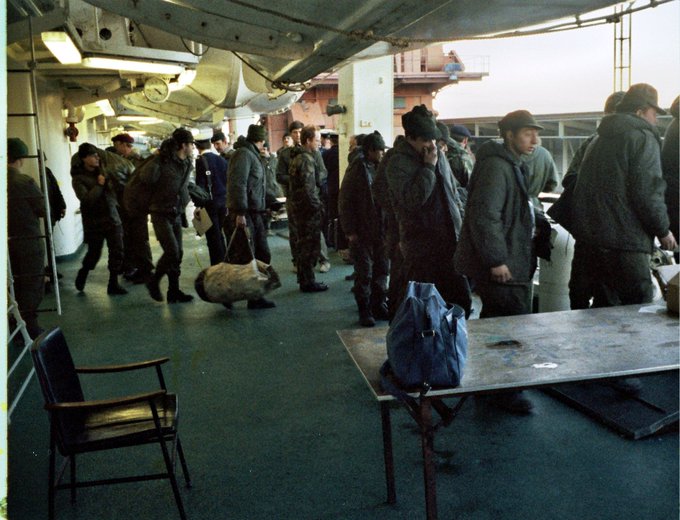
June 19th 1982: Canberra makes port as the Argentine prisoners gather their packs and prepare to set foot back on home soil. Some of the prisoners are just children: "In some of their packs, we discovered children's crayoning books," remembered Captain John Ware RM...
1/2
June 19th 1982: SS Canberra arrives in Puerto Madryn bearing 4,172 Argentina prisoners of war, whilst MV Norland is set to join with over 1,000 more, just a little behind. The Argentine prisoners return to empty docks, with the Junta hiding them away...
1/2
June 19th 1982: Known as "The day Puerto Madryn ran out of bread" the people of the town get word of the men's return, and joined by hundreds of desperate relatives, run to hand them food, mostly bread, as the trucks pass by: it is still a day celebrated in the town to this day.
June 19th 1982: The 4,136 returned Argentine POWs are first stored in abandoned factories and then taken to one of three bases; the largest being Puerto Belgrano. There they will be kept isolated, any cameras confiscated and made to sign a document never to speak about the war.
June 19th 1982: "I don't care if you did capture him, Smith, you can't take him with you as a souvenir!"
Another moment of comic levity from the "Carry on Yomping" & "Up the Falklands" series, as Argentine prisoners are sent home and some more units prepare to depart...
1/2