In Kurdistan, black snakes are often regarded as creatures that should not be killed.
Traditionally believed to be non-aggressive unless provoked, they are respected for controlling rodents & other harmful animals, reflecting appreciation for nature’s balance.
📸 Duhok province
@Conception_King@God_Questioner buddy a quick clue:
youre mixing up sidereal day with solar day. Earth orbits while spinning! Over a year it adds up to exactly one extra rotation that's why we get 366 sidereal days in 365 solar ones. no AM/PM swap, no globe conspiracy. 😂
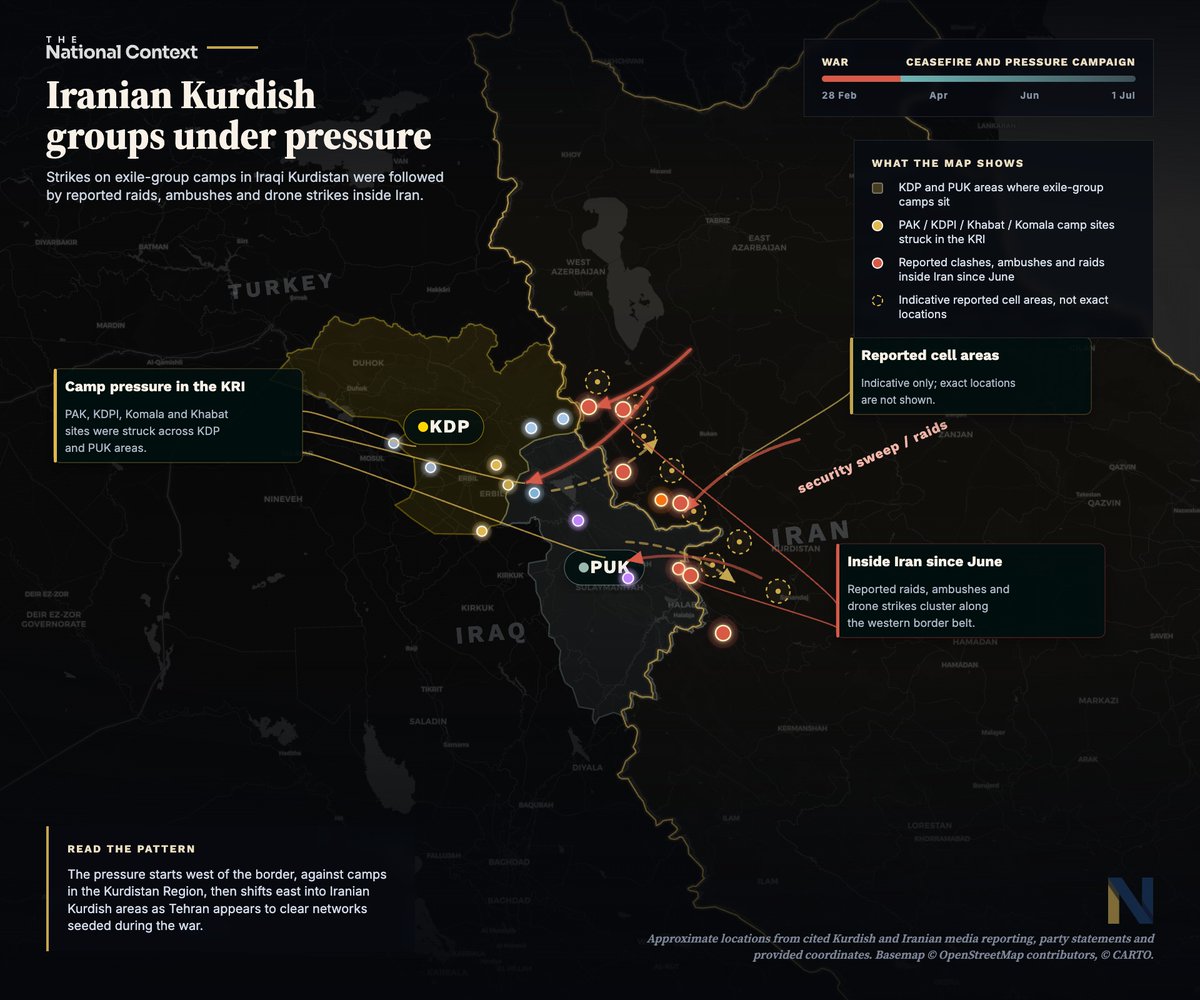
The recent clashes inside Iran between Iranian Kurdish armed groups and Iranian security forces were largely initiated by the IRGC. This suggests that, after months of pressure on the groups' camps inside Iraq's Kurdistan Region, the IRGC has begun dismantling the armed cells that infiltrated the border in the early days of the war, cells that had aimed to unite with a larger contingent of fighters reportedly planning to launch an attack inside Iran.
The most violent clashes against both PJAK (the PKK's Iranian offshoot) and KDPI took place in Qezqapan, where six KDPI fighters were killed in an ambush, and in Musalan, also in the southern section of West Azerbaijan province, where a further five were killed in a second ambush by the IRGC. Four more PJAK fighters were killed in the Gagash highlands, in the same province, in an IRGC operation against PJAK hideouts. In every key incident it was the IRGC that initiated the attack, pointing to pre-planned, intelligence-driven operations to dismantle and thin out Iranian Kurdish cells inside Iran. The likely goal is twofold: to prevent this card being used again by Israel and the US should the two-month ceasefire expire without an agreement, and to close off this route for groups that might hope to leave Iraq's Kurdistan Region. Iran is now negotiating a new security agreement with Baghdad that would require these groups to be expelled and relocated to a third, non-neighbouring country. More on the recent clashes inside Iran: https://t.co/mIzP7fifYb
We have also argued, since the ceasefire began, that Iranian Kurdish groups may prove to be among the war's biggest losers should it end, given that they were widely reported to have launched a ground operation against the regime and are now largely abandoned: https://t.co/DROEBIVsv5
Since the war began, Iran has relentlessly attacked the camps of the opposition groups in the Kurdistan Region, attacks that continued even after the April ceasefire. For Iran, the goal was to keep these groups under sustained pressure, paralysing their movement and denying their fighters access to their camps: https://t.co/fQ7mIow3WP
At the same time, during the war, Iran pursued a strategy inside the country, using a range of security measures to prevent any ground operation by these groups: https://t.co/RUmdFsmXyp
After the Ceasefire, Iran's Kurdish War Moves Inside
A two-week escalation across Iranian Kurdistan has killed at least 21 people. It is the deadliest confrontation between Tehran and the Kurdish armed parties in over a decade, and the first major test of the US-Iran understanding.
The bloodiest phase came in the final week of June. On 26 June, fighters of the YRK, the armed wing associated with PKK's Iran offshoot PJAK, attacked a checkpoint on the Baneh-Saqqez road, killing three government personnel, including a Kurdish conscript from Saqqez, Mardin Ahmadi, and wounding at least two others and a civilian. From the night of 27 June, the IRGC conducted a multi-day operation with artillery, drones and heavy weapons against a YRK unit around Gagash village near Mahabad. The party confirmed four fighters killed, two women and two men, while the IRGC claimed six. On 29 June, a previously unknown group calling itself Khori Hiwa shot dead two locally recruited IRGC-linked personnel outside their homes in Paveh, its first claimed operation.
The escalation peaked on the night of 1 July. The IRGC ambushed one confirmed KDPI unit at Qezqapan, roughly three kilometres from Piranshahr, killing six peshmerga according to the party's statement. The party described the unit as being on a political and organisational mission.
A second Kurdish unit was intercepted the same night near Musalan, in the Sardasht area, in a clash that later reports also identified as involving the KDPI; at least four members were killed, with later reports giving five, and neither names nor a final toll have been released.
...
Reports from the early days of the war indicated that some party units moved toward or across the frontier in anticipation of the ground offensive that Washington encouraged and then abandoned, though the KRG and party officials denied any general incursion. The KDPI's own statement confirms that a clandestine unit was inside Iran on an organisational assignment, without establishing when it entered. Some of the units now being intercepted may be remnants of the wartime preparations, while others may represent a renewed attempt to build internal networks before pressure on the parties' Iraqi bases becomes intolerable.
The 60-day negotiating window may have added urgency to the Iranian campaign, whether because Tehran fears renewed war and wants the Kurdish card destroyed before it can be played again, or because it wants the western border consolidated before a final settlement freezes the postwar order. A secondary motive should not be discounted: after visible wartime losses, the Kurdish theatre offers the IRGC a low-risk arena in which to restore deterrence, publicise tactical victories and reassert control over a region that was central to the January protests, all without directly violating the memorandum.
The full analysis: https://t.co/mIzP7fifYb
من خودم ایرانیم ولی میخوام هر چه زودتر از طریق نیروهای ائتلاف بینالمللی و سازمان ملل یک #رفراندوم استقلال در کوردستان برگزار بشه تا نتیجه واقعی آن مشخص بشه.
ما برای روبرو شدن با واقعیت ترسی نداریم
#ایران#کوردستان#فاشیسم