A circulating video showing the Chairman of Talata Mafara LGA of Zamfara State, Hon. Yahaya Yari, has raised serious questions about the nature and financing of political mobilisation in Nigeria.
In the video, he speaks about an alleged arrangement in which 10 people are to be mobilised from each polling unit, with N1 million allocated per polling unit. He further explains that N23 million is meant for 23 polling units, as an enthusiastic crowd cheers and prays for him.
Beyond the spectacle, Nigerians deserve answers.
Who is providing these funds? What exactly is the money intended to achieve? Is this private campaign financing, or are public resources involved? What mechanisms exist to ensure transparency and accountability?
These questions are particularly important in a country where government borrowing in the name of development continues to place significant demands on public finances. At a time when Nigeria is accumulating debt to finance development, citizens should not have to wonder whether public resources are being diverted to finance political interests.
A polling unit represents a community, not merely a centre for political mobilisation. Those communities need functional hospitals, equipped schools, potable water, decent roads, electricity and opportunities to earn a living.
The people cheering and praying today will still need these basic services tomorrow. They will still have to confront abandoned projects, poorly equipped health centres, deteriorating infrastructure and unfulfilled promises long after campaign vehicles have disappeared.
We therefore call on the @officialEFCC and @icpcnigeria to urgently examine the claims, establish the source of the funds, determine their intended purpose and investigate whether any public resources or violations of existing laws are involved.
If these are legitimate campaign funds, there should be transparency and proper documentation. If public resources have been diverted or financial inducements are being used to compromise the electoral process, those responsible must be held accountable.
Political mobilisation must never become a substitute for public service delivery.
To those distributing money in the name of winning political support, remember that the people you are mobilising today are the same people who will demand explanations for how their communities are governed tomorrow.
There shall be a people to answer to after the election and we will continue to follow the money, ask the difficult questions and demand accountability.
#Publicmoneymustworkforthegoodofthepeople
Anyone who says Abuja does not have the best road network in Nigeria is in one of these categories
- They are new to Abuja
- Visited Abuja only
- Do not know Abuja but live here ( possible )
Benin and Calabar are designed same way.
These are old compact European-like designs
First off, Benin or Calabar are small cities and there are roads connecting everywhere in the small cities. basically streets.
You cannot compare that with the network of roads in Abuja. You cannot. Benin & Calabar are like Gwarinpa. Made up of streets
Practicing democracy is a sign that you are not serious with your progress as a developing nation (e.g Nigeria), because you simply cannot develop with that system.
I get asked all the time, “what is your alternative?” Well, here you have it.
Plus, a confession from someone who has been in the system.
NIGERIANS, GO AND VERIFY (7)
LIFTING THE VULNERABLE : ANAMBRA’S BLUEPRINT FOR POVERTY ALLEVIATION AND SUSTAINABLE EMPOWERMENT (2006–2014)
Economic growth that does not translate into improved living conditions for ordinary citizens is incomplete. This is one of our fundamental concerns with President Bola Ahmed Tinubu's government. Development must ultimately be measured by its impact on human lives, particularly those of the poor and vulnerable. This was underpinned by the Anambra Integrated Development Strategy (ANIDS). We believed that infrastructure, education, healthcare, agriculture, and social protection must reinforce one another. Poverty was not merely a shortage of money; it was also a lack of access to opportunities, productive resources, and the basic conditions necessary for a decent life.
Our poverty alleviation strategy, therefore, went beyond temporary handouts. It focused on restoring dignity, creating economic opportunities, and equipping vulnerable citizens with the means to become self-reliant.
Our approach attracted recognition beyond Anambra. In May 2010, Magnus Kpakol, then National Coordinator of the National Poverty Eradication Programme (NAPEP), commended our commitment to poverty reduction, declaring: “We are prepared to support you in the excellent work you are doing in Anambra State.”
1. POVERTY MAPPING: KNOWING WHERE POVERTY LIVES
We recognised that poverty could not be effectively addressed without knowing where it was concentrated and what caused it. We, therefore, undertook a poverty-mapping exercise to identify the most deprived local government areas and communities.
The exercise revealed that some of our poorest communities were also important food-producing areas. Their challenges included poor access to markets, agricultural inputs, electricity, water, and other economic opportunities.
Areas including Anambra West, Orumba South, Awka North, and Ogbaru required particular attention. The findings informed our development priorities, enabling us to direct roads, agricultural support, and social interventions toward neglected communities.
2. EMPOWERING WOMEN, WIDOWS, AND COOPERATIVES
We recognised that rural women, widows, and indigent households bore a disproportionate burden of poverty. Across the 21 local government areas, we provided financial assistance and productive support to thousands of beneficiaries.
Our administration provided financial assistance to support the establishment and expansion of small businesses and farming activities. We also introduced revolving loan schemes to promote enterprise development, economic self-reliance, and improved livelihoods.
We distributed productive equipment, including sewing machines, generators, ovens, cookers, hair dryers, shoe-making machines, and welding equipment. The objective was to help beneficiaries establish sustainable livelihoods rather than remain dependent on government assistance.
We also promoted access to microcredit and cooperative financing to enable small entrepreneurs to expand their businesses, improve their incomes, and create employment.
Our philosophy was simple: rather than merely giving people money to survive today, the government should help them acquire the means to earn a living tomorrow.
3. AGRICULTURE AND FADAMA: MAKING RURAL COMMUNITIES PRODUCTIVE
Agriculture was central to our poverty-reduction strategy because many rural households depended on farming.
Through partnerships with the Federal Government, the World Bank, and other development partners, particularly under the FADAMA programme, we supported farmers with finance and productive assets.
In November 2009, our administration disbursed millions to FADAMA Community Associations across the state. By October 2010, the National FADAMA office was commending Anambra’s commitment. Its National Project Coordinator, Buka Tijjani, represented by Charles Ugwuona, described Anambra as the leading state in the programme.
My senior aunty sent me this video asking what the way forward is.
We know INEC’s tactics. We know how to deal with these too.
You should hear and know these things too.
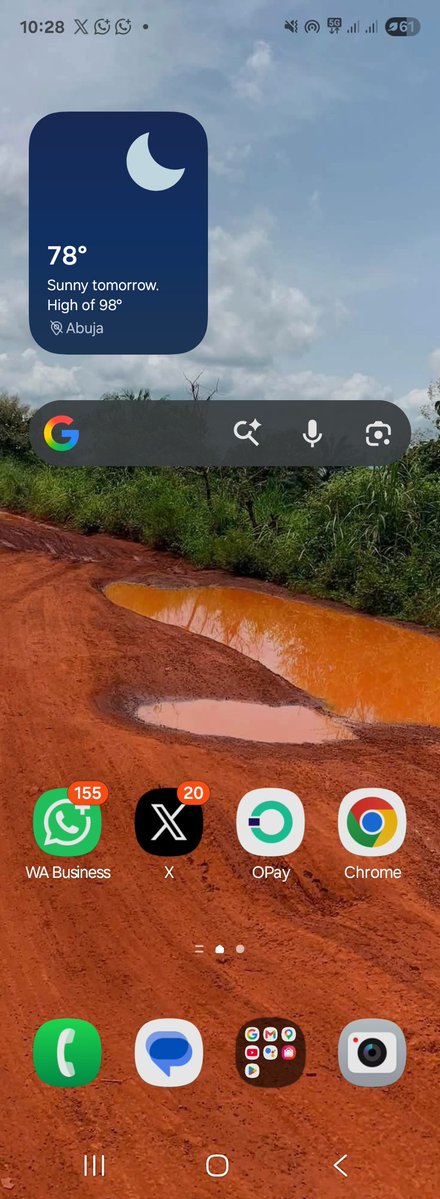
If posting Authentic state of Roads in my sate translates to malicious intent then Yes I agree I have malicious agenda..
Use this one as your Lock screen wallpaper just like I have