Assistant Professor at University of Houston | Former @MIT and @penn_state | Ph.D. in Chemical Engineering, Electrochemistry 🔋 | A climate change activist 🌍
Honored to receive the 2024 NSF CAREER Award, which supports our team's research on electrochemical carbon capture processes. Special thanks to our research team and all the mentors.
#CarbonCapture
Very glad to see Abdelrahman’s recent publication on advancing polarized liquid-liquid interfaces for carbon capture featured on the front cover of ACS Electrochemistry.
Link to the article: https://t.co/qtb3EvYkTa
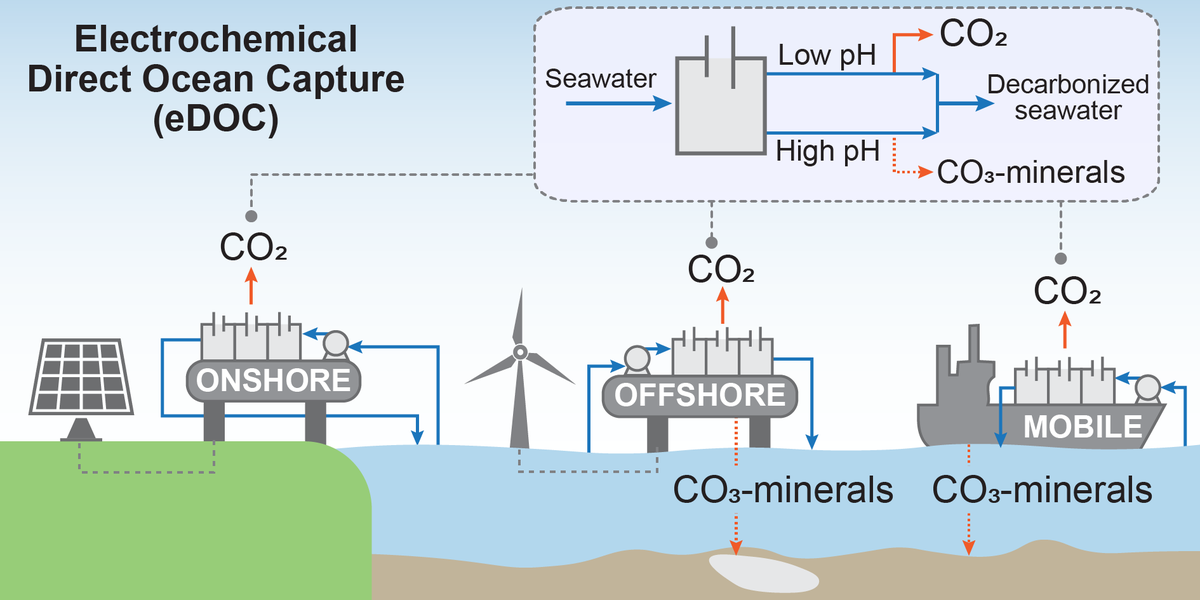
Electrochemical marine carbon dioxide removal (mCDR) is gaining attention as an emerging engineered pathway for durable carbon removal.
In this work, we identified five U.S. coastal hubs with potential for large-scale deployment of electrochemical mCDR.
https://t.co/u3KYkMLf3o
Happy to contribute to a recent piece from Nature (@NaturePortfolio), examining how researchers are using AI tools during peer review.
The article also references a small experiment I conducted: https://t.co/mnehI0kziZ
https://t.co/BYmsSdWSaJ
Lately, I've noticed more peer-review reports that feel unusually polished, generic, or shallow, so I ran an experiment to see how well AI can review a scientific paper.
Here is the full video: https://t.co/2Jo1HBvAdx
In our new paper, we explored how enzymatic depolymerization and electrocatalytic hydrodeoxygenation can work hand‑in‑hand to convert underutilized lignin into valuable aromatic compounds.
https://t.co/fD351DFUlg
Excited to share our latest work published in Nature Communications:
A Membraneless Electrochemically Mediated Amine Regeneration for Carbon Capture
This study presents a redesigned carbon capture process that eliminates the need for membranes.
https://t.co/l6wr5JuPVi
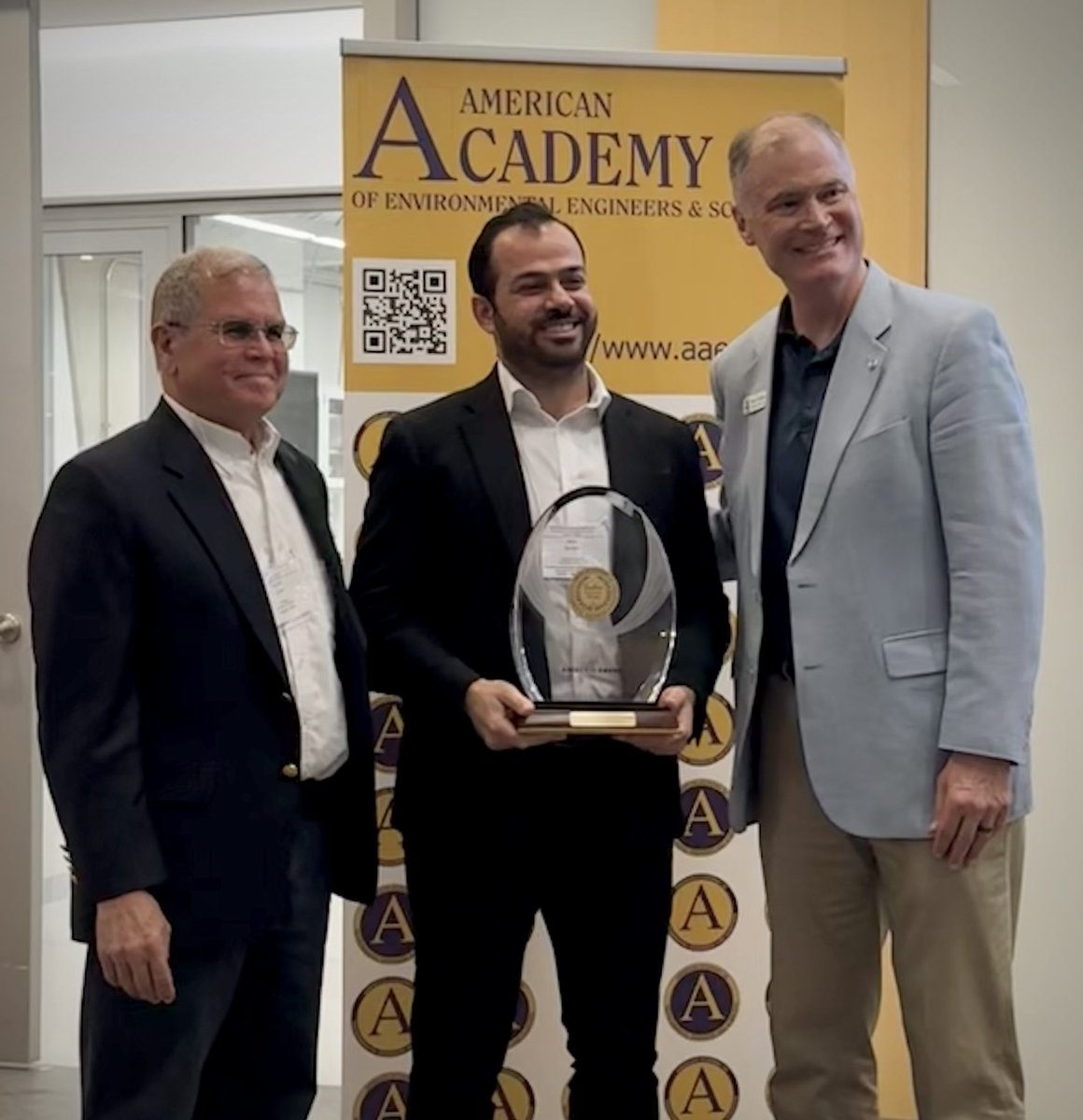
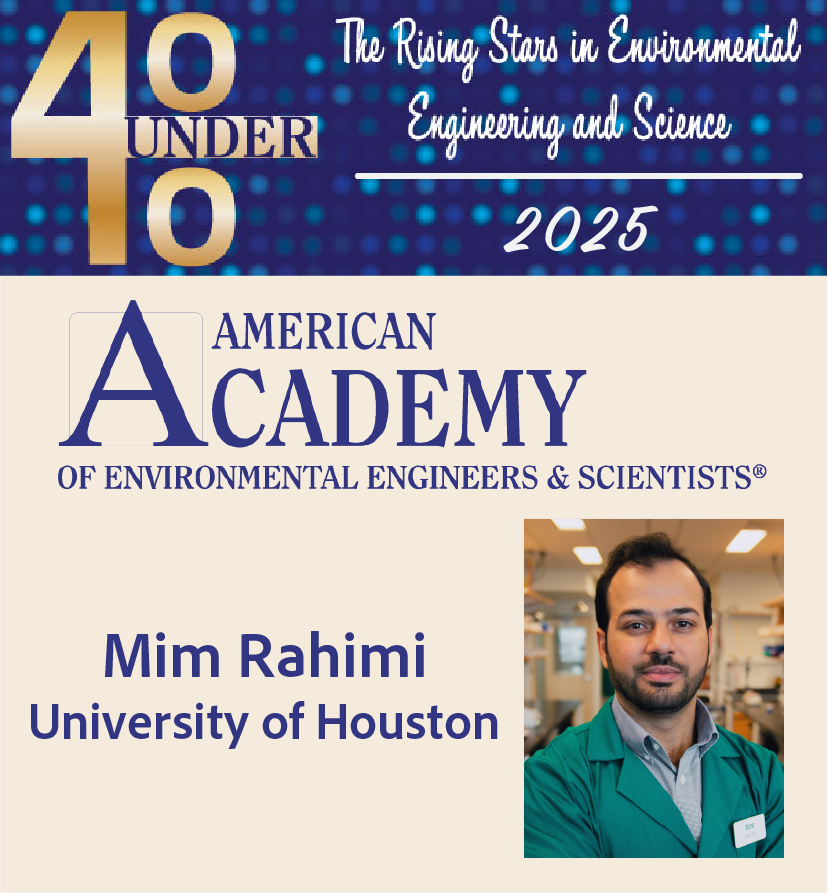
Honored to receive the 2025 Excellence in Environmental Engineering and Science® Award from AAEES! Had a great time delivering the award talk in Washington, DC.
Special thanks to my incredible research team and mentors whose support made this possible!
New electrochemical process combines CO2 capture with energy storage! Inspired by redox flow batteries, this system captures carbon using renewable power during day & releases energy to grid at night 🌞🔋♻️.
Read more in ACS ES&T Engineering: https://t.co/frLytuFt2c
Submit an abstract to our new symposium on Climate Change Solutions at the @AEESProfs Research and Education Conference (May 20-22, 2025 in Durham, North Carolina)!
https://t.co/r1sJADemvL
Abstracts due Jan. 6, 2025 at 5 pm EST.
Thanks to UH Energy for facilitating a great conversation on carbon dioxide removal (CDR). Prof. Tracy Hester provided valuable insights on leveraging the power of policy and I had the opportunity to cover the technological advancements in CDR. https://t.co/sImrvdklsF
I’m #hiring a postdoctoral associate in the area of PFAS biological transformation, fate and transport.
Details on the project, collaboration and career development opportunities, and how to apply can be found in the job description. I look forward to seeing your application!
A big shoutout to our team for becoming a finalist in the DOE's EnergyTech University Prize, winning under the Hydrogen Fuel Technologies Office category. Chosen from among 225 competing teams across 117 schools.
https://t.co/IOVtN6c0vc
Find out more about “Direct ocean capture: the emergence of electrochemical processes for oceanic carbon removal” in this #EESJournal Perspective by @MimRahimi et al. ⬇ https://t.co/ArZXFRjXfM
Direct ocean capture (DOC) of #CO2 has been gaining momentum in recent years. In our recent paper published in EES, we highlighted the emergence of #electrochemical processes that advance DOC methods:
https://t.co/VN2NIL1MPj
Direct ocean capture (DOC) of #CO2 has been gaining momentum in recent years. In our recent paper published in EES, we highlighted the emergence of #electrochemical processes that advance DOC methods:
https://t.co/VN2NIL1MPj
#ClimateChange#CarbonCapture
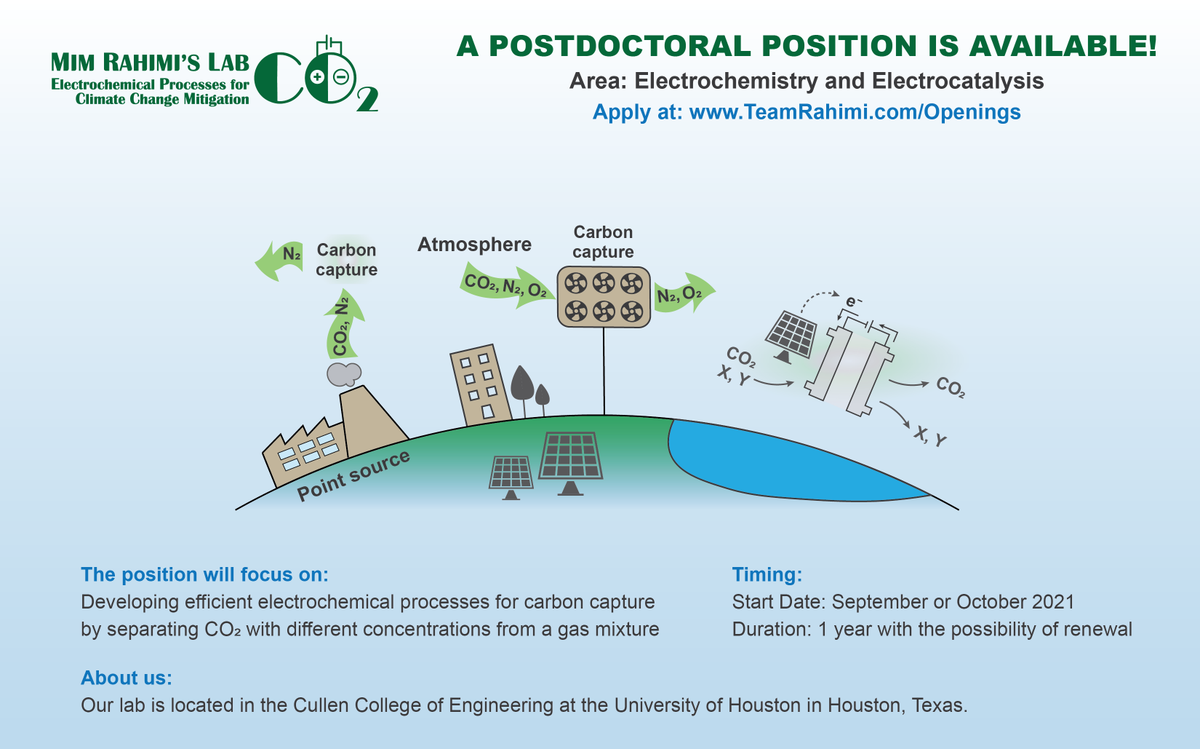
Our team at the University of Houston is seeking a Postdoctoral Researcher (September or October 2021), with a focus on developing electrochemical processes for environmental applications.
To apply, please visit https://t.co/Y28JZyx8eL
Please RT 🙏
#postdocjobs#AcademicChatter