Al-Qaeda in Yemen (AQAP) has again praised the co-pilot behind the 30 Sep Flydubai incident, explicitly inciting copycat attacks against American and Israeli targets and urging attackers to make no distinction between civilians and combatants.
In messages issued on 20 Oct, senior AQAP figure Khubayb al-Sudani appealed to Muslim pilots to emulate Hammam al-Hammami, invoking al-Qaeda's 9/11 attacks and framing further violence as revenge for Gaza. He urged mass-casualty attacks and argued that post-9/11 aviation security measures had failed.
This is AQAP's second round of incitement over the incident in just over a week. https://t.co/WzwtaKrk1N
The repeated messaging suggests the group is keen to extract maximum propaganda value from the incident, using it to revive its 9/11 narrative and encourage further attacks.
However, despite portraying Hammami as inspired by 9/11, al-Qaeda has so far claimed no direct links to him or the incident, nor suggested it had any prior knowledge of his actions.
Al-Qaeda's Yemen branch (AQAP) has showered praise on the Omani co-pilot behind the 30 September Flydubai incident and sought to exploit his actions to incite similar attacks against Israeli and American targets. However, the group did not suggest that the co-pilot, identified in the media as Hamam (or Hammam) al-Hammami, had any affiliation with al-Qaeda or had directly acted on its instructions.
In an official statement dated 11 October and three accompanying posters presented as "tweets" attributed to AQAP leader, Saad bin Atif al-Awlaqi, AQAP lauded Hammami, repeatedly describing him as a "hero", a "lion" and "great".
The group portrayed the incident as a success despite Hammami's failure to bring down the aircraft, arguing that it had sent a powerful message of revenge over Israel's actions in Gaza.
One one of the AQAP posters hailed Hammami for allegedly attempting to revive some of the "glory" of the 9/11 attacks, while another praised him for acting without instructions, declaring: "You are great, our hero, Hammam, when you did not wait for someone to tell you what you need to do as a responsible Muslim". This suggested that AQAP viewed Hammami as having acted independently, on his own initiative, rather than on instructions from a group.
The messaging echoed that of the pro-al-Qaeda magazine al-Bayan on 3 October and a subsequent editorial on 8 October in a magazine published by al-Qaeda's South Asia branch, AQIS. Both similarly praised Hammami and incited copycat attacks without suggesting any direct jihadist affiliation. However, AQAP's latest messaging went a step further by focusing entirely on the Flydubai incident and repeatedly naming and praising Hammami, whereas the earlier references formed part of broader publications.
#ISIS#AlNaba#fake
A fake issue of IS's weekly al-Naba newspaper circulated on 8 October, around four hours before the official release, duping some supporters into sharing it.
The parody appeared to originate from a Telegram account impersonating a prominent IS supporter known for sharing authentic releases.
Using al-Naba issue 557 from 23 July as its template, it retained much of the original text, layout and imagery, but inserted satirical passages mocking IS militants and their battlefield performance.
Among the fabricated stories were militants failing to catch a 60-year-old "spy", an IS member dying from a "TikTok overdose", 36 "Crusader chickens" being slaughtered, marinated and cooked, and two goats being released after "repenting". A mocking addition to the editorial described a 14-year-old IS recruit living in Belgium who supposedly died after misunderstanding bomb-making instructions.
Some supporters admitted sharing the fake issue, while others feared it might contain malware.
We covered the full fiasco and reactions to it
We covered the full fiasco, including how the fake issue spread and how IS supporters reacted. https://t.co/PkKdBxRBbJ
The unofficial pro-al-Qaeda publication al-Bayan has hailed the 30 September Flydubai incident and used it to encourage similar "attacks" on aircraft carrying Americans and Israelis.
But it stopped short of saying the incident was jihadist- or al-Qaeda-linked. Instead, it argued that such attacks would benefit "Islam and Muslims" regardless of who carried them out, including non-Muslims or non-practising Muslims.
The al-Bayan editorial where the remarks appeared was not solely focused on the Flydubai incident, but offered broader commentary on recent events, including the 30 September withdrawal of US troops from Iraq. It presented these alongside 9/11 as significant September events either caused by, or seen as benefiting, jihadists.
🧵A few takeaways from my fuller BBC Monitoring analysis on JNIM’s evolving relationship with the al-Qaeda brand 👇
Is JNIM in the Sahel moving away from the global al-Qaeda brand?
https://t.co/fKiN203tSR
IS, via al-Naba, portrayed international “turmoil”, unresolved conflicts and divisions amongst its enemies as creating favourable conditions for its revival, with its cryptic references possibly also encompassing tensions surrounding the UN General Assembly, marked by deep divisions, disputes and walkouts
IS's latest al-Naba editorial was another sermon-style affair, but with a notably more upbeat and galvanising tone, presenting the return of the caliphate as imminent and using that prospect to urge IS followers to intensify both militant activity and religious outreach.
The editorial said Muslims were standing at “a critical historical juncture”, with God preparing to grant them inheritance of the earth.
It presented current conflicts and rivalries among IS's enemies (presumably including the US-Iran conflict) as evidence that conditions were moving in the group’s favour. It therefore urged followers to exploit what it portrayed as its enemies’ preoccupation with one another to work towards the ultimate goal of restoring the caliphate and Muslim power.
The editorial therefore combined an unusually hopeful prediction of imminent revival with a familiar IS message of perseverance and sacrifice: victory was supposedly approaching, but followers had to prove themselves worthy of it by redoubling their efforts.
@G88Daniele Good point @G88Daniele, and perhaps that partly explains why it was able to address its followers with greater confidence and a more clearly victorious tone
IS's latest al-Naba editorial was another sermon-style affair, but with a notably more upbeat and galvanising tone, presenting the return of the caliphate as imminent and using that prospect to urge IS followers to intensify both militant activity and religious outreach.
The editorial said Muslims were standing at “a critical historical juncture”, with God preparing to grant them inheritance of the earth.
It presented current conflicts and rivalries among IS's enemies (presumably including the US-Iran conflict) as evidence that conditions were moving in the group’s favour. It therefore urged followers to exploit what it portrayed as its enemies’ preoccupation with one another to work towards the ultimate goal of restoring the caliphate and Muslim power.
The editorial therefore combined an unusually hopeful prediction of imminent revival with a familiar IS message of perseverance and sacrifice: victory was supposedly approaching, but followers had to prove themselves worthy of it by redoubling their efforts.
@caleb_weiss7 True, and very much consistent with al-Qaeda’s response to the Arab uprisings in 2011, which effectively left the group looking increasingly irrelevant. That was the context in which the Ansar al-Sharia name/franchise emerged, starting in Yemen - an attempt to adopt a more locally rooted identity and broaden appeal, without the al-Qaeda name/baggage.
There's an important difference with JNIM, though. Ansar al-Sharia was presented from the outset without visible public al-Qaeda branding, whereas JNIM was much more overtly embedded in the al-Qaeda media ecosystem. Its propaganda prominently carried al-Qaeda branding and featured senior AQ figures, before those markers were gradually stripped away in recent years.
So my piece isn’t arguing that this kind of pragmatism or localisation is new to al-Qaeda - quite the opposite, and it goes into the 2012 Droukdel guidance in some detail. Its value is more in documenting when and how these changes became visible in JNIM’s own propaganda and media behaviour, and examining why it's important to pay attention now.
Moreover, not publicly highlighting the AQ brand or link is itself a longtime strategy of AQ. See the myriad “Ansar al-Sharia” groups in the Middle East and Africa during the early 2010s as an example. Or Shabaab prior to 2012, etc.
🧵A few takeaways from my fuller BBC Monitoring analysis on JNIM’s evolving relationship with the al-Qaeda brand 👇
Is JNIM in the Sahel moving away from the global al-Qaeda brand?
https://t.co/fKiN203tSR
6/6 So is JNIM following the HTS model? Perhaps partly. But there is an important twist: much of what JNIM is doing today closely resembles al-Qaeda’s own guidance from 2012.
Late AQIM leader Abdelmalek Droukdel urged jihadists in Mali in 2012 to practise patience, pragmatism and gradualism; cooperate with Tuareg separatists; reassure neighbouring states; avoid provoking foreign intervention; and not alienate local populations by imposing too much too quickly.
Most strikingly, Droukdel advised jihadists to lower their profile and let Tuareg allies become the public face of the rebellion - even suggesting they hold outward-facing portfolios such as foreign affairs. Jihadists should “blend in”, play down al-Qaeda’s role and avoid drawing attention to the global jihadist connection.
So the question may be less whether JNIM is simply breaking with al-Qaeda, and more whether it's recalibrating how visibly it pursues the shared project.
Droukdel’s guidance did not envisage abandoning jihadist objectives. It advocated strategic patience, compromise and a lower al-Qaeda profile while jihadists remained vulnerable and sought to consolidate power.
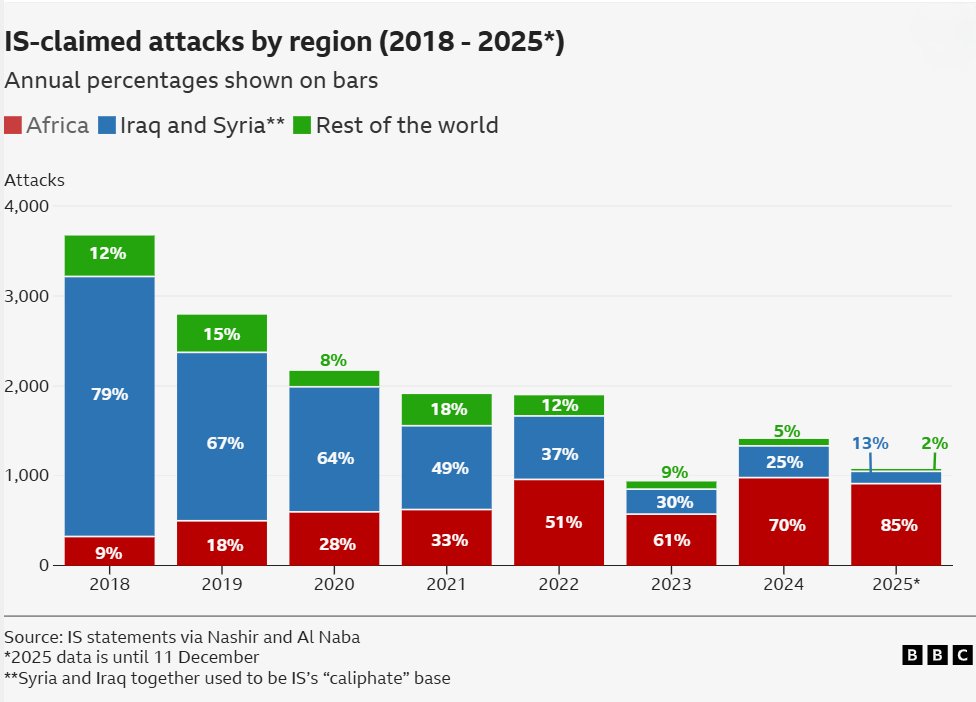
Islamic State (IS) attacks this week were lower than any week previously observed by BBCM. In al-Naba, IS claimed 9 attacks worldwide (the average is 20-30 per week)
IS has suffered a number of major setbacks recently including the reported killing of its spokesman in #Yemen
1/ In its latest al-Naba editorial, IS once again compares itself to the prophets: both in having a duty to spread "the true" message of Islam and in enduring the lonely, harsh path that supposedly follows.
The message: hardship is not evidence of failure, but a test.
2/ The theme runs through the issue. Other pages urge "perseverance", dwell on the benefits of trials and tribulations and quote a former/deceased IS spokesman on the hardships endured by prophets.
It continues a run of largely sermon-style editorials since August, alongside a dip in IS attack claims and no comment yet on fate of current spokesman, Abu Hudayfa.
Ironically, the issue had prompted some excitement among IS supporters because its publication was notably delayed, appearing only after 21:00 GMT. Some predicted "big news" and even "surprises". Instead, it was largely underwhelming, with several pages featuring religious and preaching content, clearly as fillers.