🚀 Are hypersonic weapons really a game changer for South Asia?
You have probably heard that hypersonic weapons travel at more than five times the speed of sound and are much harder to track and intercept.
But here is the more interesting question:
Do they fundamentally change deterrence between India and Pakistan?
Some analysts argue that hypersonics could reduce warning time, increase uncertainty, and place greater pressure on decision-makers during a crisis.
Others point out that South Asia already operates under extremely short missile flight times and compressed decision windows.
So what is the real challenge?
In this episode of #OneMinuteProfessor, I unpack:
🚀 What makes hypersonic weapons different
🌎 Which major powers are developing or deploying them
🇮🇳 India's hypersonic ambitions and why they matter
⚖️ The debate over whether Pakistan should be concerned
🤖 How AI, advanced surveillance, missile defenses, and hypersonics may interact in the future
Because the debate is not really about speed.
It is about whether emerging technologies are shrinking the time available for judgment, communication, and crisis management.
In a region where minutes already matter, every second may become more important.
🎙️ Mind Over Mic with Dr. Rabia Akhtar
Mushkil concepts, seedhi zubaan mein.
🚀 Can a technology designed to strengthen deterrence also create new security dilemmas?
That is the paradox at the heart of MIRVs.
A MIRV allows a single missile to carry multiple warheads, each capable of striking a different target. For some, this strengthens deterrence by ensuring that missile defenses cannot easily neutralize a retaliatory capability.
For others, it raises difficult questions about arms competition, crisis stability, and strategic calculations.
In this episode of #OneMinuteProfessor, I unpack:
🚀 What MIRVs actually are
🛡️ Why they are closely linked to missile defense systems
⚖️ How they affect strategic stability
🌏 Why MIRVs matter in the South Asian strategic environment
🤖 How AI, advanced surveillance, hypersonic systems, and missile defenses are shaping the future of deterrence
The debate is not really about putting more warheads on a missile.
It is about a much bigger question:
Can strategic stability survive when both sides are trying to see more, strike faster, and defend better?
Because the future challenge may not be a single technology.
It may be the interaction of multiple technologies at the same time.
🎙️ Mind Over Mic with Dr. Rabia Akhtar
Mushkil concepts, seedhi zubaan mein.
#MindOverMic #OneMinuteProfessor #MIRV #StrategicStability #Deterrence #MissileDefense #NuclearStrategy #SouthAsia #EmergingTechnologies #Hypersonics #ArtificialIntelligence #StrategicStudies #NationalSecurity
⚡ What makes a technology truly disruptive?
It is not how powerful it is.
It is whether it changes the rules of competition.
Today, militaries around the world are investing heavily in Artificial Intelligence, drones, cyber capabilities, space systems, and quantum technologies because these innovations are beginning to reshape how wars are fought, how decisions are made, and how deterrence works.
In this episode of #OneMinuteProfessor, I unpack:
🤖 How AI is transforming military decision-making
🐝 Why drone swarms are changing the economics of warfare
💻 How cyber operations can disrupt systems without firing a shot
🛰️ Why space has become a critical military domain
⚛️ How quantum technologies could challenge today's assumptions about security
For South Asia, the question is not simply who has more weapons.
The question is:
⚡ Who can adapt faster?
📡 Who can process information better?
🤖 Who can integrate emerging technologies more effectively?
🎯 And how will these technologies affect deterrence and crisis stability?
Because the most disruptive technologies are not always the most destructive.
They are the ones that change how states think, decide, communicate, and compete.
🎙️ Mind Over Mic with Dr. Rabia Akhtar
Mushkil concepts, seedhi zubaan mein.
Experts ascribe PAF's success in the May 2025 crisis to the creation of a better kill chain. What is it, and why is it important ? @Rabs_AA tackles these questions in @mindovermic11.
https://t.co/JR9y1XNhHU
Has deterrence failed in South Asia?
The May 2025 India-Pakistan crisis suggests a more complicated answer.
Deterrence did not disappear. It evolved.
In this episode of Mind Over Mic, I unpack five key lessons from the crisis and explain why future conflicts in South Asia may look very different from those of the past.
🔹 Why escalation no longer resembles a ladder but a web
🔹 The dangerous illusion of limited war under the nuclear shadow
🔹 How drones, cyber tools, and long-range precision strikes are expanding the geography of risk
🔹 Why emerging technologies are compressing decision time for leaders
🔹 How information warfare, disinformation, and narrative entrapment are becoming central to crisis dynamics
My central argument is simple: South Asia has not entered a post-deterrence environment. Deterrence remains. But its character is changing.
Watch now and join the conversation.
The fire effects of nuclear use may go on to become the most deadly of all consequences. @Rabs_AA ,in @mindovermic11 ,explains the concept of nuclear winter.
https://t.co/uT5WMoo9JQ
🎯 Modern warfare is no longer just about who has the better fighter jet, missile, or radar.
It is increasingly about who can connect them all together faster.
Welcome to the world of the Kill Chain.
In this episode of #OneMinuteProfessor, I unpack one of the most important concepts in modern military strategy:
📡 How militaries find targets
🛰️ How sensors, satellites, radars, AWACS and drones work together
⚡ Why speed of information can be as important as speed of missiles
🎯 Why the platform that finds a target is not always the one that strikes it
✈️ What lessons analysts drew from the May 2025 India-Pakistan air engagements
The real story of modern warfare is no longer:
Jet vs Jet.
Or
Missile vs Missile.
It is increasingly:
Network vs Network.
Because in the battlespace of the future, victory may belong not to the side with the most weapons but to the side that can find, track, decide, and strike faster than its adversary.
🎙️ Mind Over Mic with Dr. Rabia Akhtar Mushkil concepts, seedhi zubaan mein.
Full-Spectrum Deterrence, a part of credible minimum deterrence, does not mean Pakistan is interested in arms racing or nuclear superiority. @Rabs_AA ,in @mindovermic11 ,explains what it is.
https://t.co/Vlc5YvcAa5
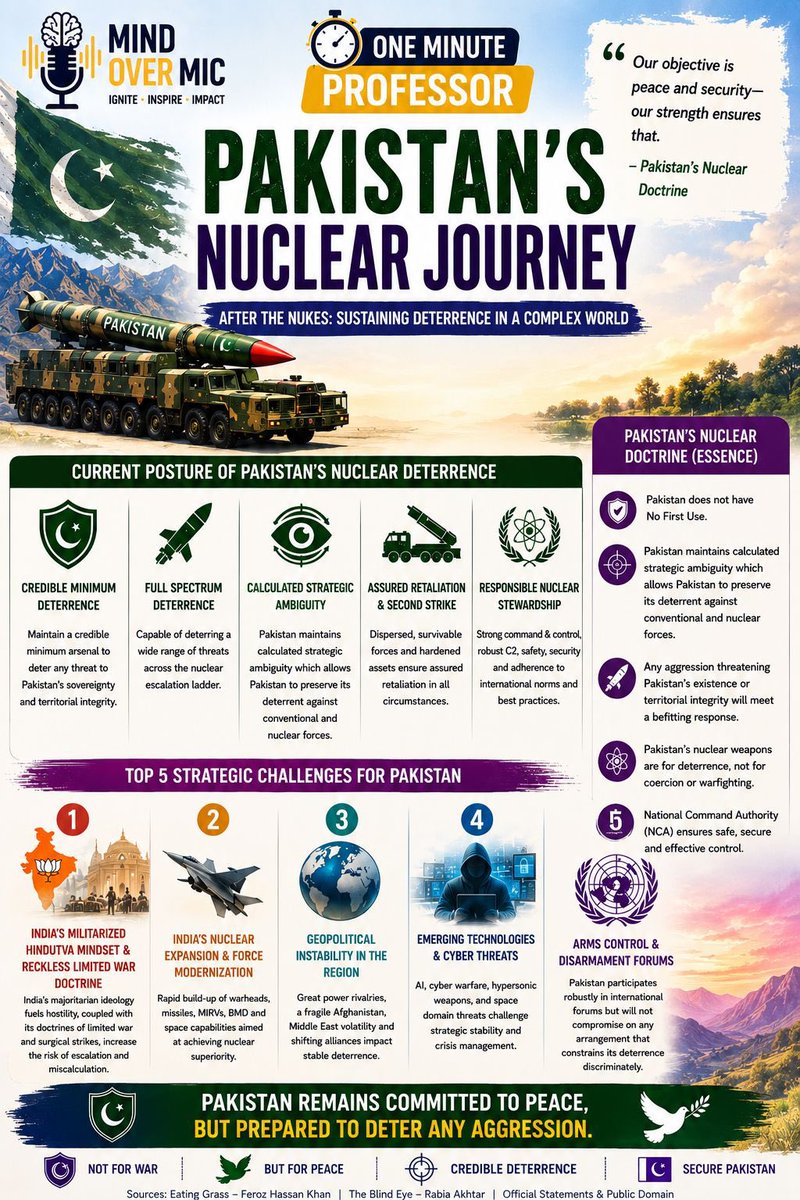
Pakistan’s Nuclear Journey: The Bomb, The Doctrine, The Challenges 🇵🇰☢️
Why did Pakistan become a nuclear-weapon state 28 years ago? What changed after 1998? And what are the biggest strategic challenges facing Pakistan’s deterrence today?
In this video, I unpack:
🔹 Why Pakistan went nuclear — from 1947 insecurities to 1971, India’s 1974 nuclear test, and the logic of deterrence.
🔹 Pakistan’s nuclear posture today — strategic ambiguity, credible minimum full spectrum deterrence, and sustaining strategic stability in a rapidly changing region.
🔹 Top strategic challenges — India’s militarised Hindutiva mindset, evolving military posture, emerging technologies, regional instability, and arms control pressures.
Pakistan’s nuclear story is not just about the bomb. It is a story of survival, deterrence, doctrine, and difficult strategic choices.
What do you think is Pakistan’s biggest nuclear challenge today?
#MindOverMic #OneMinuteProfessor #PakistanNuclearJourney #StrategicStudies #Deterrence #NuclearPolicy #Pakistan #SouthAsiaSecurity #InternationalRelations #Geopolitics