AI "high performers" are 1.6x more likely to aim AI at growth and innovation, not just efficiency. Everyone automates costs. The gap opens when you point AI at where the business actually grows. (McKinsey, State of AI 2025)
$582B went into corporate AI last year. 5-10% of companies are capturing real value. Everyone calls it a technology gap. It's a clarity gap. The winners didn't buy better models. They got clearer about what AI was for.
As we enter the era of AI agents, one of the defining questions is how you develop competitive advantage when your competitor has access to the same AI models and intelligence as you.
The companies that are able to best harness their internal institutional knowledge, existing data assets, and domain-specific workflows -- connected with AI -- will be those that are able to stay ahead in the future.
Whether a company decides to build out the tech stacks themselves, or leverage a variety of best-in-class tools is certainly one core variable. But the key is to find the way that the enterprise can capture and protect the value created by their unique data, processes, and expertise over the long run. Each industry will have their own version of this, and the competitive advantage will vary by vertical.
We’re increasingly seeing this at Box, where customers want to ensure that they can take advantage of their institutional knowledge and have the flexibility of bringing any AI model and intelligence to their data at any time. This is a pattern that will increasingly become a core principle of strategy in the future.
Had meetings and a dinner with 20+ enterprise AI and IT leaders today. Lots of interesting conversations around the state of AI in large enterprises, especially regulated businesses.
Here are some of general trends:
* Agents are clearly the big thing. Enterprises moving from talking about chatbots to agents, though we’re still very early. Coding is still the dominant agentic use-case being adopted thus far, with other categories of across knowledge work starting to emerge. Lots of agentic work moving from pilots and PoCs into production, and some enterprises had lots of active live use-cases.
* Agentic use-cases span every part of a business, from back office operations to client facing experiences from sales to customer onboarding workflows. General feeling is that agentic workflows will hit every part of an organization, often with biggest focus on delivering better for customers, getting better insights and intelligence from data and documents, speeding up high ROI workflows with agents, and so on. Very limited discussion on pure cost cutting.
* Data and AI governance still remain core challenges. Getting data and content into a spot that agents can securely and easily operate on remains a huge task for more organizations. Years of data management fragmentation that wasn’t a problem now is an issue for enterprises looking to adopt agents. And governing what agents can do with data in a workflow still a major topic.
* Identity emerging as a big topic. Can the agent have access to everything you have? In a world of dozens of agents working on behalf, potentially too much data exposure and scope for the agents. How do we manage agents with partitioned level of access to your information?
* Lots of emerging questions on how we will budget for tokens across use-cases and teams. Companies don’t want to constrain use-cases, but equally need to be mindful of ultimate token budgets. This is going to become a bigger part of OpEx over time, and probably won’t make sense to be considered an IT budget anymore. Likely needs to be factored into the rest of operating expenses.
* Interoperability is key. Every enterprise is deploying multiple AI systems right now, and it’s unlikely that there’s going to be a single platform to rule them all. Customers are getting savvier on how to handle agent interoperability, and this will be one of the biggest drivers of an AI stack going forward.
Lots more takeaways than just this, but needless to say the momentum is building but equally enterprises are acutely aware of the change management and work ahead. Lots of opportunity right now.
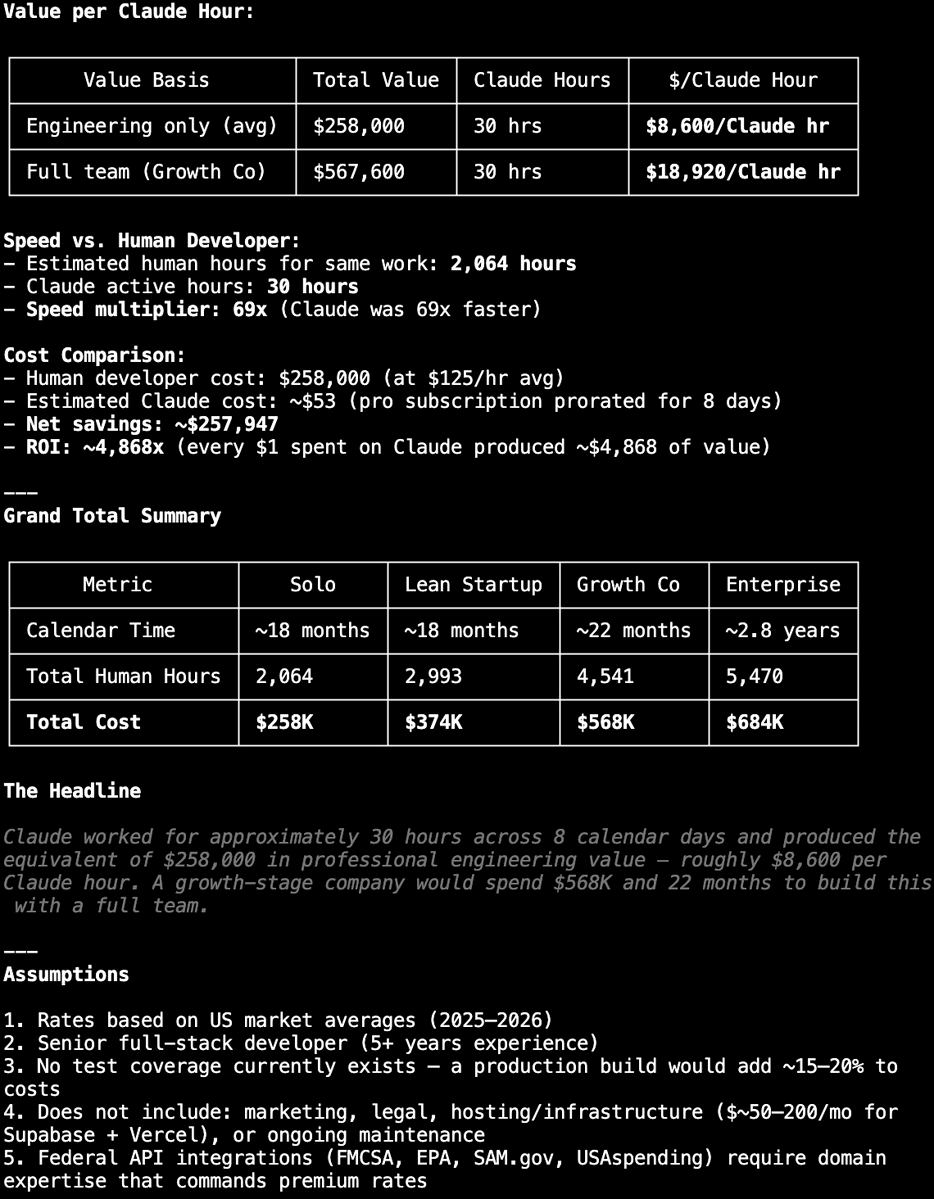
Fun command built in Claude Code: /cost-estimate
It scans your codebase and cross-references current market rates to calculate what your project would've cost a real team to build.
It looks at all the APIs, integrations, everything.
Without AI: ~2.8 years. ~$650k.
With AI: 30 hours.
It's absurd when you start to think about it like this.
Agents will be the biggest users of software. They’ll often need their own computers, identities, file systems, and tools to do their work. As a result, software will increasingly become API-first to be as useful to agents as they are to people. This is a huge opportunity.
Straight from @Shopify's latest partner briefing:
- AI agents are pulling the first ~6,000 characters of your product descriptions as their source of truth.
- Meta descriptions, SEO titles, theme presentation logic, none of it gets touched.
- If your product data isn't structured for AI discovery, it just doesn't show up.
In a world of openclaw, codex, claude code/cowork, manus, and other agentic systems, it’s becoming clear that the future of software has to be API-first, but also enable human interaction for verification, collaboration with agents and people, and working on the output.
It’s generally been the case that software was built for people first and foremost, and then APIs are exposed for other systems to connect into that tool or data. But if we imagine a world where AI agents are doing 10X or 100X more work with software than people, then this paradigm is flipped.
Software becomes API-first, with ways of having humans be able to work effectively with the agent, either through a UI as relevant, or chat. If you’re not API-first, then you’re nearly DOA to agents.
The CMO's real AI question isn't "what can it do?"
It's "what should we stop doing manually so we can focus on what matters?"
Subtraction before addition.
Hot take: Most AI "transformations" are just automation projects with better PR.
That's fine! Automation is valuable.
Just don't mistake it for competitive advantage.
@big_duca Someone has to prompt the Claudes, talk to customers, coordinate with other teams, decide what to build next. Engineering is changing and great engineers are more important than ever.
The companies winning with AI aren't chasing features.
They're building feedback loops:
→ Deploy small
→ Measure what matters
→ Learn fast
→ Repeat
Iteration beats innovation every time.
Roses are red,
Violets are blue,
Your AI strategy
Should start with the "who"
(Who's the customer? Who's the user? Who's accountable?)
Happy Valentine's Day 💝
This Valentine's Day, remember:
The best relationships are built on trust.
So are the best AI implementations.
If your team doesn't trust the tool, they won't use it.
No matter how good the demo was.
Global AI optimism, by country:
🇨🇳 China: 83%
🇮🇩 Indonesia: 80%
🇹🇭 Thailand: 77%
🇺🇸 United States: 39%
🇨🇦 Canada: 40%
🇳🇱 Netherlands: 36%
The West is skeptical. The East is all in.
Source: Stanford HAI AI Index Report 2025
The 70% Iceberg:
Most organizations focus on the visible 30% (algorithms, platforms, infrastructure).
They ignore the 70% that actually determines success:
→ Strategic clarity
→ People & skills
→ Culture & mindset
→ Change management
Source: BCG, Where's the Value in AI
The AI cost curve is staggering:
Inference costs for GPT-3.5-level performance dropped 280x in just two years.
What was expensive in 2022 is essentially free in 2025.
Source: Stanford HAI AI Index Report 2025
89% say AI enhances employees's skills.
But 43% are already seeing declines in skill proficiency.
The productivity gains may come at a cost we're not tracking.
Source: Wharton Human-AI Research & GBK Collective, 2025
The AI perception gap:
VPs who say their org is moving fast on AI: 56%
Middle managers who say the same: 28%
Leadership thinks they're ahead. The people doing the work aren't so sure.
Source: Wharton Human-AI Research & GBK Collective, 2025