Muslim Intellectual Network for Empowerment (MINE)
@MINEGlobalLearn
MINE is an association for intellectual empowerment of Muslim community in the field of Liberal sciences through motivational and educational initiatives
If success were only about talent or opportunity, outcomes would be far more equal. Self-efficacy is the hidden powerful behind who tries, persists, and ultimately succeeds. This post explores Albert Bandura’s concept of self-efficacy, showing how belief in one’s ability directly influences effort, resilience, and performance. From role models to small wins and community support, it outlines how this mindset is built, and why it matters for education, careers, and empowerment. If you want to understand what truly drives action in uncertain environments, this is a must-read.
https://t.co/yGpZYacIho
The Making of a New World (Dis)order
We are entering a turbulent global transition shaped by AI, energy shifts, and geopolitical competition. This post, based on MINE’s biweekly presentation series, explores how globalization, securitization of nation-states, and emerging regional powers are redefining the future world order. Understand the forces shaping the next 50 years of global political economy.
https://t.co/LAlLyG2qJN
The Making of a New World (Dis)order
We are entering a turbulent global transition shaped by AI, energy shifts, and geopolitical competition. This post, based on MINE’s biweekly presentation series, explores how globalization, securitization of nation-states, and emerging regional powers are redefining the future world order. Understand the forces shaping the next 50 years of global political economy.
https://t.co/5jIx7ZzmJW
The multiplier effect explains how an initial increase in spending, job and investment activity has a snowball effect. When income is spent again and again across the economy, each round of spending creates additional income for others.
https://t.co/A0HhxH1GiO
Alhamdulillah, Muslim Intellectual-Network for Empowerment (MINE) has crossed 5,000 subscribers.
When this project started, the intention was very simple: to create a small space where we can explore ideas beyond the narrow boundaries that often define our intellectual conversations today. Economics, history, technology, political economy, and civilizational questions are all areas that shape the world we live in, yet they often remain underexplored within our communities.
Many of you read quietly. Some share articles, and a few of you actively engage in comments and discussions. Each of you, in your own way, is helping build a small but meaningful intellectual network. Thanks to all the readers, subscribers and contributors for being part of this journey.
If you are coming across MINE for the first time and like the concept, please join us in this effort.
#europe ’s #Renaissance, which laid the foundations of modern Europe and contributed to #modernity, the #scientific revolution, the Industrial Revolution, and capitalism, did not emerge from comfort but from profound crisis. Plague, famine, war, and institutional failure shattered #medieval certainties and forced a rethinking of knowledge, power, and human agency. This post traces how crisis gave rise to renewal, and why that transformation still shapes our world today. https://t.co/6rXPE1dUfW
Learn how different schools of economics offer different lenses on the same economy, including #Classical/#Neoclassical, #Keynesian, #Austrian, #Developmentalist, and #Monetarist approaches. A final moral-values lens asks not only which policies maximize output, but also what counts as justice, dignity, and legitimate distribution in the first place.
https://t.co/vmgHcYJ3ud
#Modernity promised truth, progress, and rational order. The 20th century exposed cracks in that promise. This post explains #postmodernism in plain language, showing how it challenges “obvious” certainties, asks who benefits from them, and explores the work of #Lyotard, #Foucault, and #Derrida through their three tools: doubt of grand stories, #power, and language.
https://t.co/GK6CrcyCMJ
The Return of the Polymath: Why Broad Knowledge Matters Today
https://t.co/qqD8ebe145
This week’s post goes to the heart of MINE’s work.
The return of the polymath thinking is not a romantic dream for #Muslims but it is a necessity. The world is interconnected, multidimensional with a complex power dynamics. Only those who learn how different systems fit together will be able to guide their communities and shape the future. A polymath is not simply a scholar of many subjects but someone who can see the whole picture and synthesize knowledge to form a coherent and convincing understanding. In this world filled with #Islamophobia and #GazaGenocide, MINE is particularly focused on encouraging polymathic thinking at the grassroots level in the #Muslim community to be taken as #Islamic obligation.
https://t.co/LKtAHlXS8b
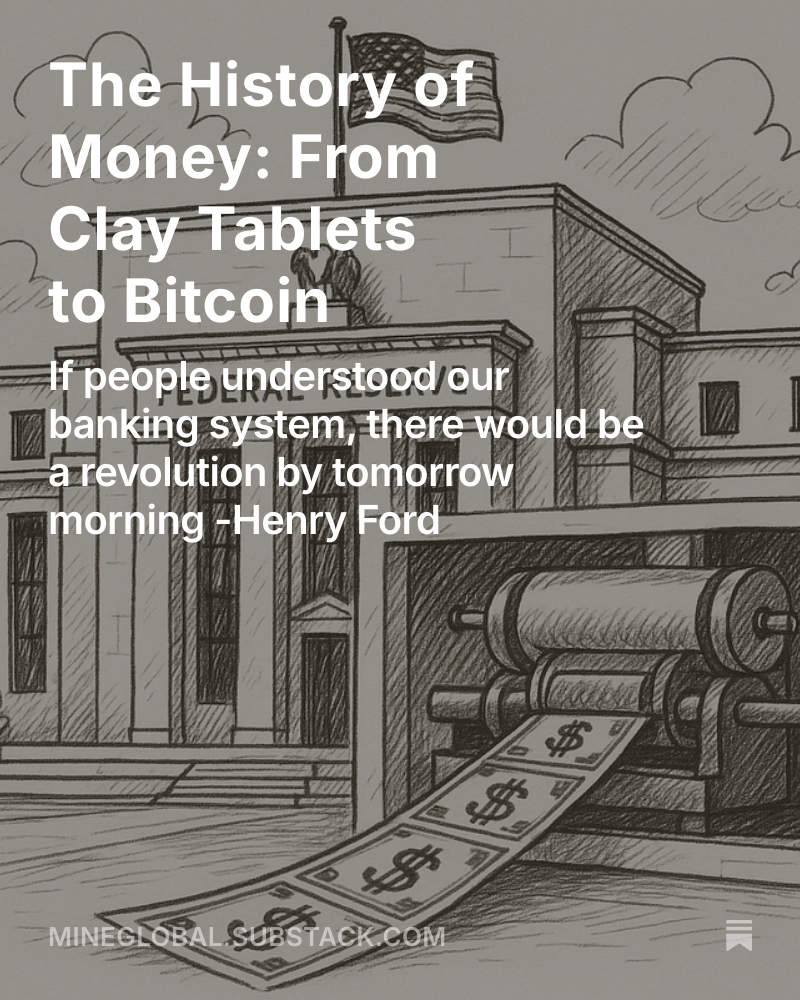
The history of money is a story of evolving trust. From Mesopotamian clay tablets to gold coins, from paper receipts to fiat currency, each step reflected humanity’s attempt to balance convenience, security, and fairness. Yet each system carried trade-offs. The fiat currency era we have entered is extremely flexible, but this very flexibility makes it dangerously fragile, inflationary, and opaque. It also poses systemic risks to the entire economy, as seen in the 2008 financial crisis.
https://t.co/XwqUKhZRV1
The history of money is a story of evolving trust. From Mesopotamian clay tablets to gold coins, from paper receipts to fiat currency, each step reflected humanity’s attempt to balance convenience, security, and fairness. Yet each system carried trade-offs. The fiat currency era we have entered is extremely flexible, but this very flexibility makes it dangerously fragile, inflationary, and opaque. It also poses systemic risks to the entire economy, as seen in the 2008 financial crisis.
https://t.co/XXEmQp46Wu
The history of money is a story of evolving trust. From Mesopotamian clay tablets to gold coins, from paper receipts to fiat currency, each step reflected humanity’s attempt to balance convenience, security, and fairness. Yet each system carried trade-offs. The fiat currency era we have entered is extremely flexible, but this very flexibility makes it dangerously fragile, inflationary, and opaque. It also poses systemic risks to the entire economy, as seen in the 2008 financial crisis.