Collective Mining Drills 146.10 m @ 1.07 g/t AuEq* at Apollo's Shallow Halo Zone, Up to 60 Meters Beyond the Mineral Resource Boundary $CNL.TO https://t.co/FvAdJYVqld
¡Sexto campanazo de inversión en la Milagro Week!
🔔 Anunciamos junto a Collective Mining una inversión de US$100 millones para 2027 en su proyecto minero, que permitirá avanzar en la exploración y el licenciamiento. De obtenerse la licencia, la compañía proyecta invertir hasta US$1.000 millones durante el Gobierno del presidente Abelardo De La Espriella.
Esta es una muestra de la confianza que Colombia está recuperando ante los inversionistas internacionales. Seguimos conectando grandes proyectos con oportunidades para nuestras regiones, impulsando una minería responsable con el medioambiente, generando empleo y dinamizando la economía local.
¡Así avanza Misión Crecer y construimos la Patria Milagro! 🇨🇴
The best exploration companies don’t simply drill more holes. They change the geometry of the problem.
At Guayabales, we are on schedule to begin underground development later this month. Check out the video ⬇️
Our exploration adit will initially provide underground access to Trap & Trap East (H1/27), followed by Plutus (Q1/28), and finally Apollo’s Ramp Zone (H2/28) — allowing us to test these systems from orientations and depths that simply aren’t possible from surface.
We aren’t just building an exploration adit. We’re building an information advantage underground.
The next phase of exploration at Guayabales is about to begin, and I couldn't be more excited to see what comes next.
$CNL @CollectiveCNL
Some thoughts on today's press release from $CNL @CollectiveCNL
A model is built from the holes you already have. The next hole tells you how good it was.
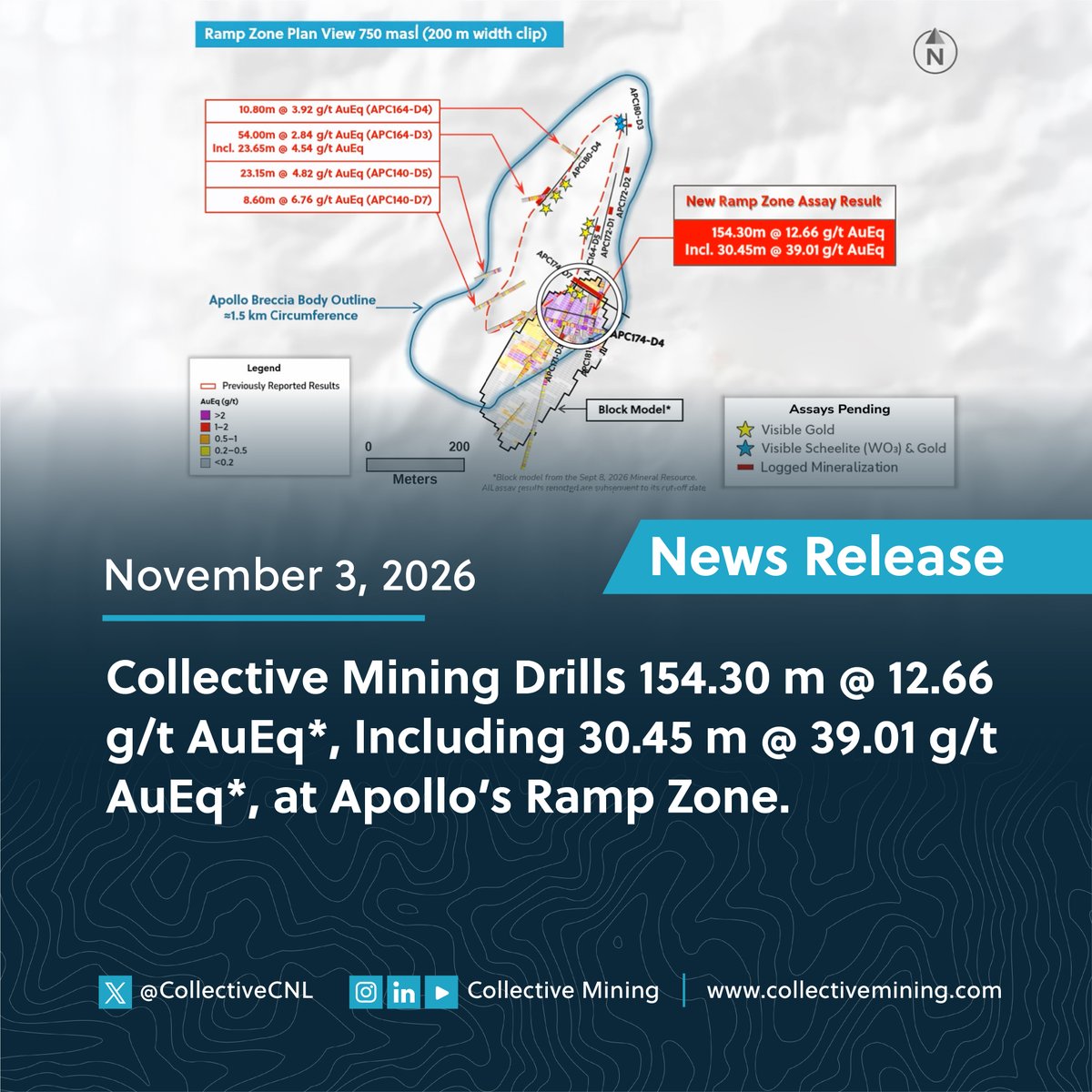
APC174-D4: 154.30 m @ 12.66 g/t AuEq
Including 30.45 m @ 39.01 g/t AuEq
The broadest high-grade intercept we have drilled to date at the Ramp Zone ever.
The geology explains the grade. The hole cut the Main Zone of the Ramp Zone approximately perpendicular to the breccia contact, and nearly all of the gold sits in sulphide-rich crackle breccia: a porous matrix that gave metal-bearing fluids room to move and deposit.
The key point of the news today:
We compared the hole with what our Mineral Resource predicted along the same path. The model expected high grade (≥5 g/t AuEq) between ~790 and 740 masl. The drill found it from ~810 down to 710 masl: ~20 m shallower and ~30 m deeper than predicted, with grades locally more than 75% higher than the estimated blocks. The included 30.45 m sits in blocks estimated at ~1 g/t AuEq. (A local comparison for geological context, not a Mineral Resource update.)
And the hole did not end in barren rock. It bottomed in sulphide-rich crackle breccia at ~650 masl, outside the Mineral Resource boundary, where the rig reached its rod capacity limit. We interpret that it may have been entering a new mineralized chute.
What comes next:
Our first track-mounted deep-drilling rig is operating on site, and a second is expected later this month. We intend to drill the Ramp Zone down to sea level in 2027. The planned ~3 km underground exploration adit is designed to reach the top of the Ramp Zone at ~700 masl, ~1,350 m below surface, in the core of the high-grade portion of the Main Zone Mineral Resource, so the Ramp Zone can be drilled from underground with much shorter holes.
Nearby, drilling north-northeast of APC174-D4 has logged visible gold in APC174-D7, APC164-D5 and APC180-D4 (~80, 180 and 240 m away at 750 masl) and visible scheelite (tungsten rich mineral) with gold in APC180-D3 (~410 m away). Assays are pending, and visual observations are not a substitute for assay results.
71 holes pending, 17 from the Ramp Zone. 13 rigs turning. Fully funded for our 2026 program.
This hole did not run out of gold; it ran out of rods. We believe the Ramp Zone is only beginning to show us its true potential.
Interesting from grok h
Best guess: top 0.01% or better (roughly the 99.99th percentile or higher) among all drill holes ever drilled worldwide.
Reasoning behind the guess
There is no complete global database of every drill hole, so this is necessarily an informed estimate based on the distribution of results:
•The overwhelming majority of the millions of holes drilled globally (exploration, resource definition, grade control, and step-outs) are barren or very low-grade. Most never produce a reported intercept above a few g·m, and many are not publicly disclosed at all.
•Practitioner benchmarks treat anything above ~150 g·m as exceptional and above ~500 g·m as stellar/rare. This hole sits at ~1,953 g·m AuEq (154.3 m × 12.66 g/t).
•Annual and multi-year “top hits” compilations (Canadian juniors, ASX, historical Mining.com-style lists) show that results in the 1,000–2,000+ g·m range appear only occasionally. Higher numbers (e.g., the famous Fosterville ~8,126 g·m) are almost always narrow ultra-high-grade veins rather than broad intervals of this width and grade.
•Broad, continuous high-grade intercepts like this (150+ m at >10 g/t) are rarer still than narrow bonanza veins of comparable gram-metre value.
Nuanced ranking
•All holes ever drilled (including barren and low-grade ones): extreme outlier — top ~0.01% or better.
•Publicly reported significant gold intercepts: comfortably in the top ~1%, and likely top ~0.1–0.5% when weighting for width + grade rather than pure narrow high-grade spikes.
This places it among the strongest broad high-grade gold results of recent decades for bulk-tonnage / intrusion-related systems, though not the single highest gram-metre intercept on record. True width, continuity, and the surrounding resource context matter more for economic impact than the absolute percentile.
Colombia just told the world (again) it is open for business in mining.
This week in Bogotá, Vice Minister of Mines Luis Madriñán outlined a special regime being designed to attract large investments: 30-year contracts for projects above US$150 million, preferential tax rates, and further incentives for projects that create more than 500 jobs. The terms are still being negotiated.
Then came the number that matters. He said Colombia needs to lift copper production to 1.5 million tonnes.
The world is electrifying. Every EV, every data center, every grid upgrade is a critical mineral story, and the mines that will feed it have to be found and built somewhere.
Capital goes where it is welcome, and where the rules outlast the election cycle. Thirty years is a mining timescale.
The Andes don’t stop at the border. In the Vice Minister’s words, the deposits are there; now the legislation and exploration have to follow.
This is how a country moves from potential to production. Congratulations to @jrestrp, @mn_arboleda, & @madrinan_luis for setting the direction. We look forward to the details.
$CNL @CollectiveCNL
https://t.co/yMNscjUvfI
Mining Forum video: Apollo Adds Growth Options
@CollectiveCNL (TSX, Nasdaq: $CNL; $CNL.TO) targets mid-2027 for its Apollo environmental licence application in Colombia while expanding drilling beyond its initial resource.
https://t.co/PDbCxYGUHR
Sometimes the most important rock in a system is the rock nobody was paying attention to. Today's results from $CNL @CollectiveCNL are about that rock.
The market fell in love with Apollo's high-grade core. Fair enough (and stay tuned as results are expected imminently from the lab). But it is missing the halo around the core.
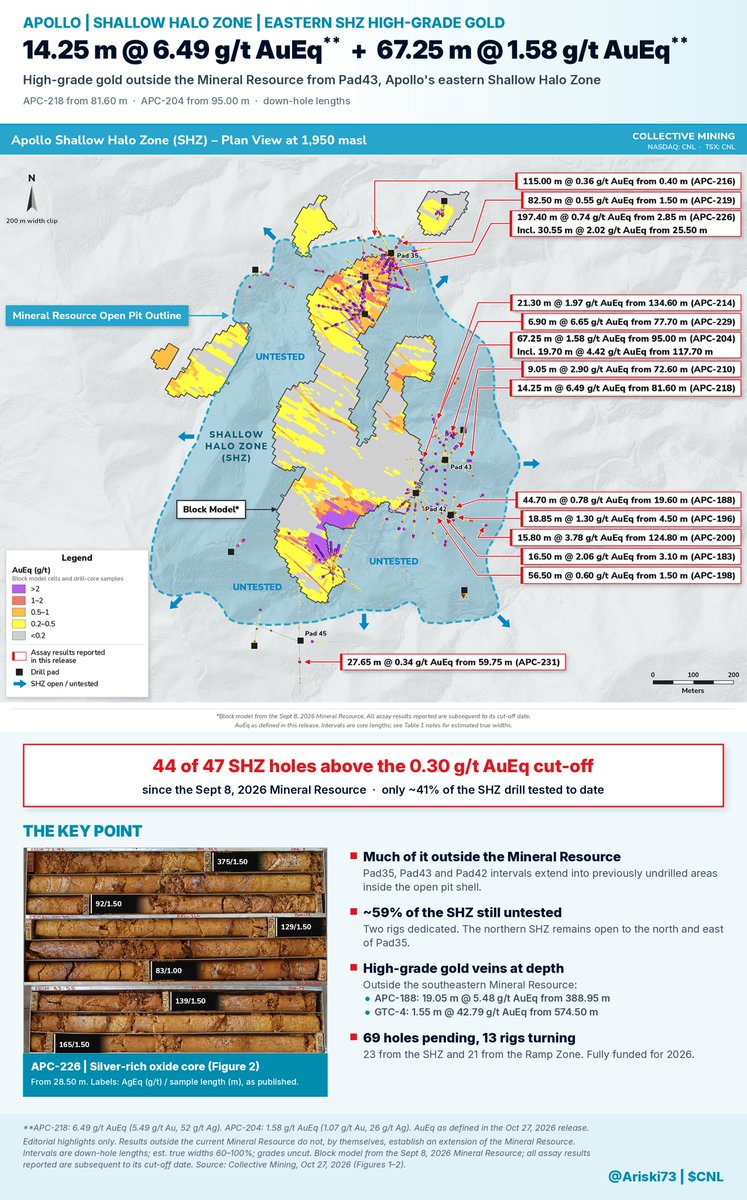
The Shallow Halo Zone: an interpreted 2.4 km long, 200 m wide, precious-metal-dominant target sitting inside the Mineral Resource open pit shell. Near surface. Oxide at the top. And only ~41% of it has been drill tested.
Look at what came out of Pad43 on the eastern side, outside the Mineral Resource:
APC-218: 14.25 m @ 6.49 g/t AuEq, incl. 3.60 m @ 18.83 g/t AuEq
APC-204: 67.25 m @ 1.58 g/t AuEq, incl. 19.70 m @ 4.42 g/t AuEq
APC-229: 6.90 m @ 6.65 g/t AuEq
Pad35, mineralized from the first few meters:
APC-226: 197.40 m @ 0.74 g/t AuEq from 2.85 m, incl. 30.55 m @ 2.02 g/t AuEq in oxide rock
Pad42, with a silver punch:
APC-200: 4.70 m @ 12.00 g/t AuEq (506 g/t Ag) within 15.80 m @ 3.78 g/t AuEq
APC-183: 16.50 m @ 2.06 g/t AuEq from 3.10 m in oxide rock
Now the number that matters. Since the Mineral Resource on Sept 8, 44 of 47 SHZ holes have returned intervals above the 0.30 g/t AuEq open-pit cut-off. 44 of 47. Much of it outside the current Mineral Resource. In this business, consistency is everything.
These results support the potential to add Mineral Resources within the existing pit shell. And ~59% of the halo hasn't seen a drill bit yet.
Then, as if the rocks wanted to make a point, high-grade gold veins at depth, outside the southeastern Mineral Resource:
APC-188: 19.05 m @ 5.48 g/t AuEq from 388.95 m, incl. 1.65 m @ 51.56 g/t AuEq
GTC-4: 1.55 m @ 42.79 g/t AuEq from 574.50 m. A geotechnical hole, drilled for engineering data.
Thirteen rigs turning. 69 holes pending. Construction of a ~3 km exploration adit scheduled to begin this quarter. Fully funded for 2026.
We've been here before, at Buriticá. We know what the early chapters of a system look like. We believe Guayabales is still in them.
Read the full release: https://t.co/0K183xn2us
APC-218: 6.49 g/t AuEq (5.49 g/t Au, 52 g/t Ag). APC-204: 1.58 g/t AuEq (1.07 g/t Au, 26 g/t Ag). Intervals are down-hole lengths.
📢 News Release | $CNL $CNL.TO
Collective Mining Intersects High-Grade Gold Outside the Mineral Resource in Apollo’s Eastern Shallow Halo Zone, Including 14.25 m @ 6.49 g/t AuEq* and 67.25 m @ 1.58 g/t AuEq*
Full announcement here: 👇🏼
https://t.co/Fj5XQoc2Fj
Capital is the new scarcity in mining.
Not ounces. Not pounds. Capital.
Look at the latest capital numbers for three of Canada’s flagship mining projects:
Red Chris block cave, BC ($NEM): US$4.2–4.8B in development capital (C$5.6–6.4B, 100% basis). That figure is already net of the C$500M federal grant. Add the grant back and the gross cost of the project is ~C$6.1–6.9B. The 2021 prefeasibility estimate was ~C$2.6B.
Windfall, Quebec ($GFI): now guided to the upper end of US$1.7–1.9B, up from C$790M in the 2022 feasibility study. The environmental approval is still pending.
Great Bear, Ontario ($KGC): US$1.43B of initial capital in the 2024 PEA. A full capital update is due in H1 2027 after detailed engineering, which Kinross says will account for inflation (Cape higher?).
These are world-class deposits run by excellent operators. But part of every one of those bills is the cost of building what isn’t there: transmission lines, gas pipelines, camps, and construction seasons cut short by winter and permitting delays.
In the right parts of Latin America, much of that already exists. Look at Aris Mining’s Marmato expansion in Caldas, Colombia: a new underground mine and a 5,000 tpd processing plant, with a total construction estimate of ~US$365M.* That includes building its own grid power line. For comparison, Windfall’s plant is sized at ~3,400 tpd. First gold at Marmato is scheduled for this quarter.
B2Gold’s Gramalote in Antioquia shows it at larger scale: a 6 Mtpa (~16,500 tpd) open pit operation with US$740M of initial capital in its 2025 feasibility study, 8% below its 2024 PEA.* Canada’s estimates are climbing. Gramalote’s went down.
At Guayabales ($CNL, @CollectiveCNL), our project sits beside the Pan-American Highway, hydropower lines run through the area, and the Marmato district has 500 years of mining history and a skilled local workforce. Our new 1.8 km adit access road was built by upgrading an existing path off the highway.
Infrastructure already in place is capital that never has to be raised.
Geology comes first. Infrastructure decides the bill.
Mother Nature doesn't hand over her best secrets from the surface. You have to go in and get them.
$CNL @CollectiveCNL is going underground.
In November, we begin construction of a ~3 km exploration adit at Guayabales, a roughly two-year build. The video below shows the tunnel's path and the portal area taking shape this week.
I've spent much of my career in the mountains of Colombia, and one lesson stands above the rest: the best discoveries are made from underground.
From surface, the mountain dictates where we drill. Long holes just to reach depth. Angles chosen by where we can build a pad, not by where the geology is. Underground, we flip that.
We get close to the targets and drill-test them over more than a vertical kilometer, from orientations that are simply not available from surface.
The road underground:
Q1-2027: Trap East, a newly generated greenfield target H2-2027: the Trap Main System, via a dedicated cross-cut 2028: Plutus and Apollo's Ramp Zone
Trap has only been sparsely drilled along a 1.4-kilometer corridor. It extends up to 900 meters below surface and remains open along strike and at depth. The adit is positioned to intersect its currently known southeastern end.
And between Trap and Plutus lies unexplored ground. What might we find there? I'm not discounting the possibility that we cut yet another mineralized system on the road to Apollo.
Two years of tunneling. Four targets. One adit.
We're going underground. Stay tuned.
Today's results from $CNL @CollectiveCNL mark a meaningful step in growing the footprint of the Apollo system.
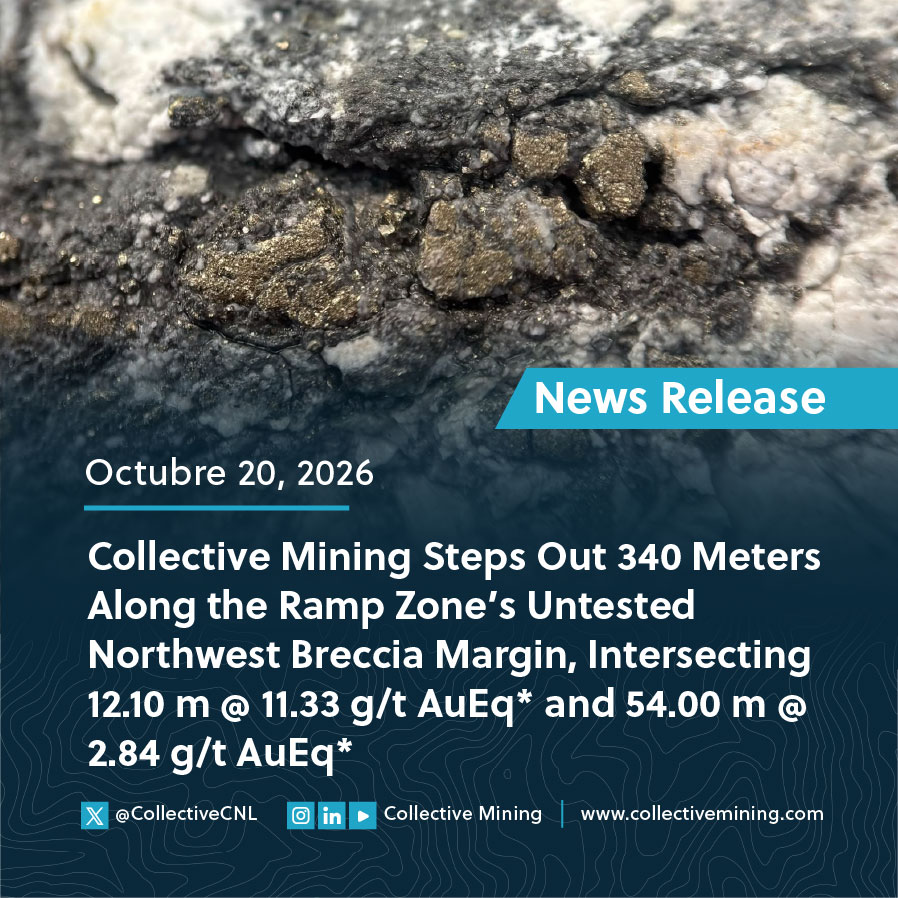
We stepped out ~340 meters into a previously untested portion of the Ramp Zone's northwest breccia margin and intersected high-grade gold:
APC164-D4: 12.10 m @ 11.33 g/t AuEq
APC164-D3: 54.00 m @ 2.84 g/t AuEq, including 23.65 m @ 4.54 g/t AuEq
The Ramp Zone is a reduced intrusion-related gold system. Late-stage gold-rich veins fill the crackle breccia matrix. Because the crackle breccia phase is porous, gold-bearing fluids have more space to release their metal content, resulting in the high grades at Ramp. Importantly, today's intercepts indicate that the same mineralizing process responsible for the high-grade southeast Ramp Zone extends to the west and northwest margins of the breccia.
The key point of the news today: our geologists interpret these holes as having intersected only the upper portion of the system. Approximately 80 meters deeper, APC180-D4 logged 19 occurrences of visible gold over 62 metres of core. Assays are pending, and visual observations are not a substitute for assay results.
We also encountered new high-grade veins in untested ground that are not captured in any existing geological or block model, including 1.30 m @ 74.58 g/t AuEq in APC164-D4.
To date, approximately 590 meters of the 1.5 km breccia circumference has been tested, and only about 315 meters is included in the maiden resource.
With 13 rigs turning and assays pending for 95 holes (19 holes from the Ramp Zone), Apollo continues to flex its muscles as a rapidly expanding AuEq deposit. We will keep drilling until the geology shows us where the system ends, and every round of drilling so far has pushed that boundary further out.
📢 News Release | $CNL $CNL.TO
Two holes, spaced approximately 120 meters apart have intersected high-grade gold and extended the Ramp Zone 340m to the northwest along the breccia margin
Full announcement here: 👇🏼
https://t.co/0YqsYeyTng
Boom! $CNL @CollectiveCNL targeting 7-8Moz at Apollo after 5.4Moz maiden resource and accelerating permitting for a 2028 build decision as Colombia turns to mining @Ariski73 tells @KitcoMining
https://t.co/nmWwsPNbcc