@rizzdevit@Da7_Tech@SpaceXAI@grok@elonmusk For some reason never tried it, great tip. However I just checked it out and it only seems to show top-level sessions, no subagents visable there.
@Da7_Tech Grok 4.5 is definitely my favorite model right now. Best balance of speed and intelligence without feeling lazy.
Sol 5.6 is most capable, but also slower and more expensive.
Opus just sucks these days. Feels lazy and looks for shortcuts, GLM 5.2 beats it for my usecase.
Getting seriously tempted to go full balls-out with a massive Giveaway contest
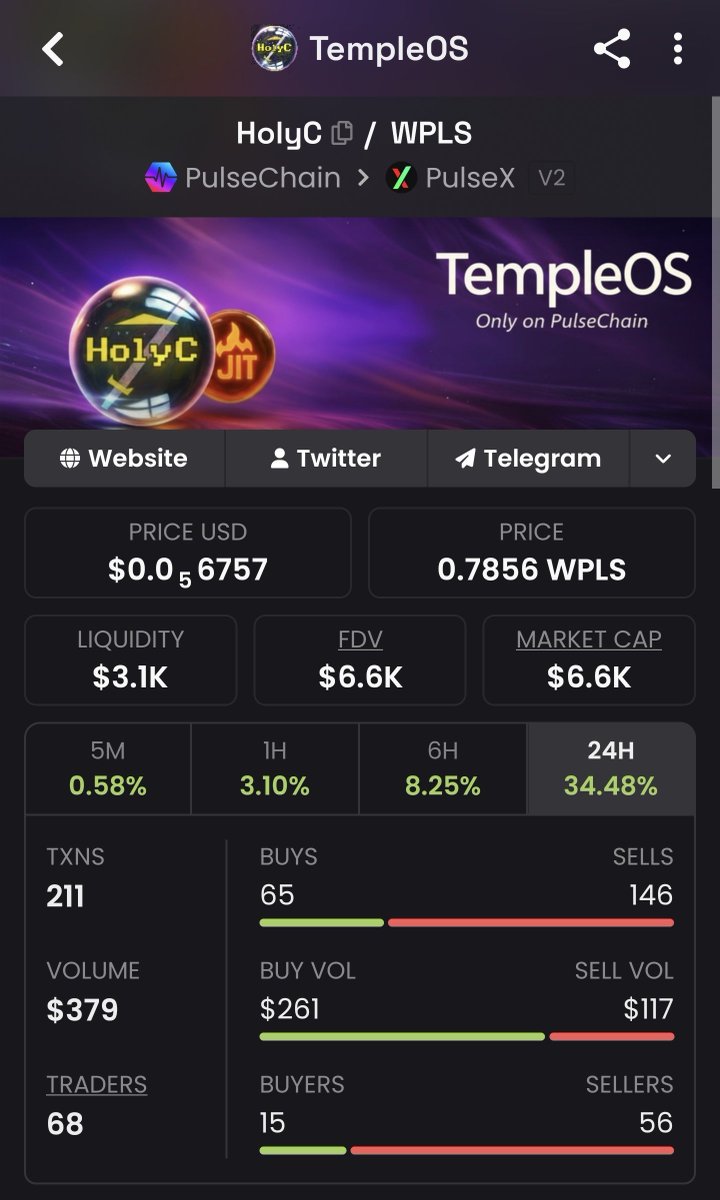
Find me one project under 10k MC with better Tokenomics, a more fleshed-out Website/dapp, and 18+ months of real development.
I’ll wait. 🔥
@LibertySwapFi Feel free to add to the prize pool 👀
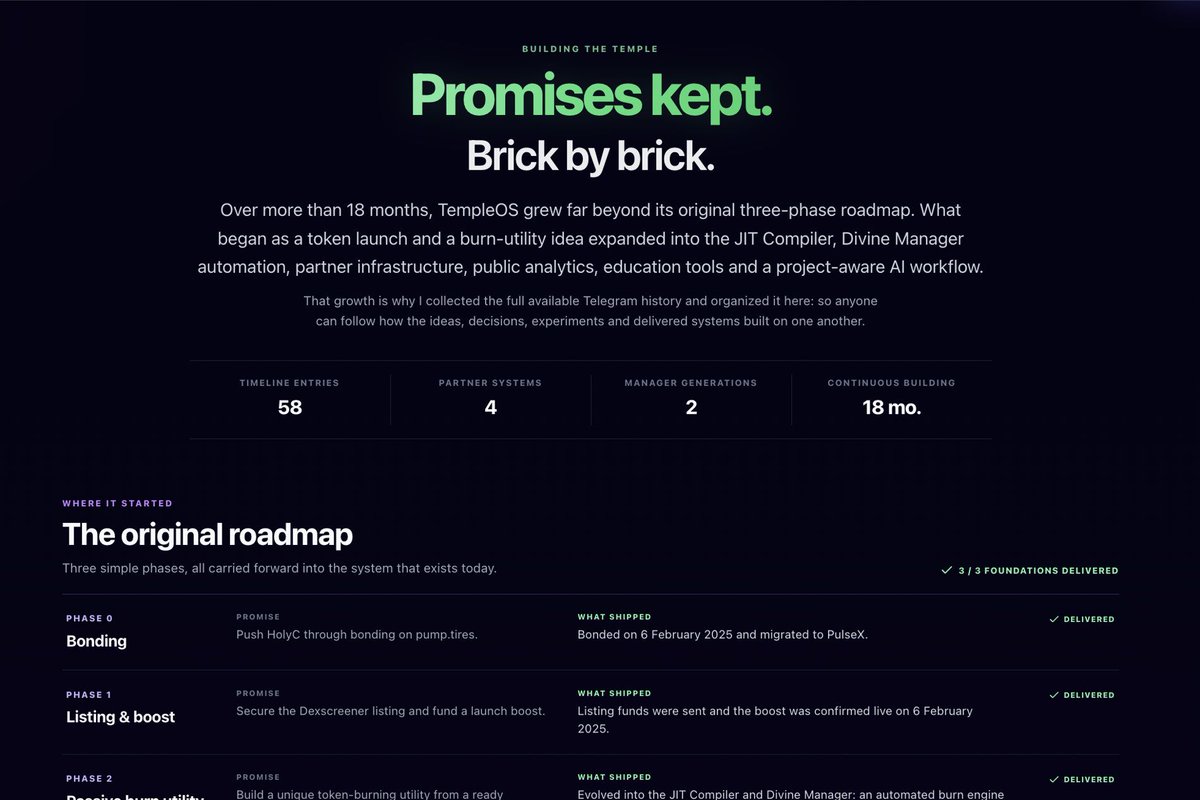
Promises kept. Brick by brick.
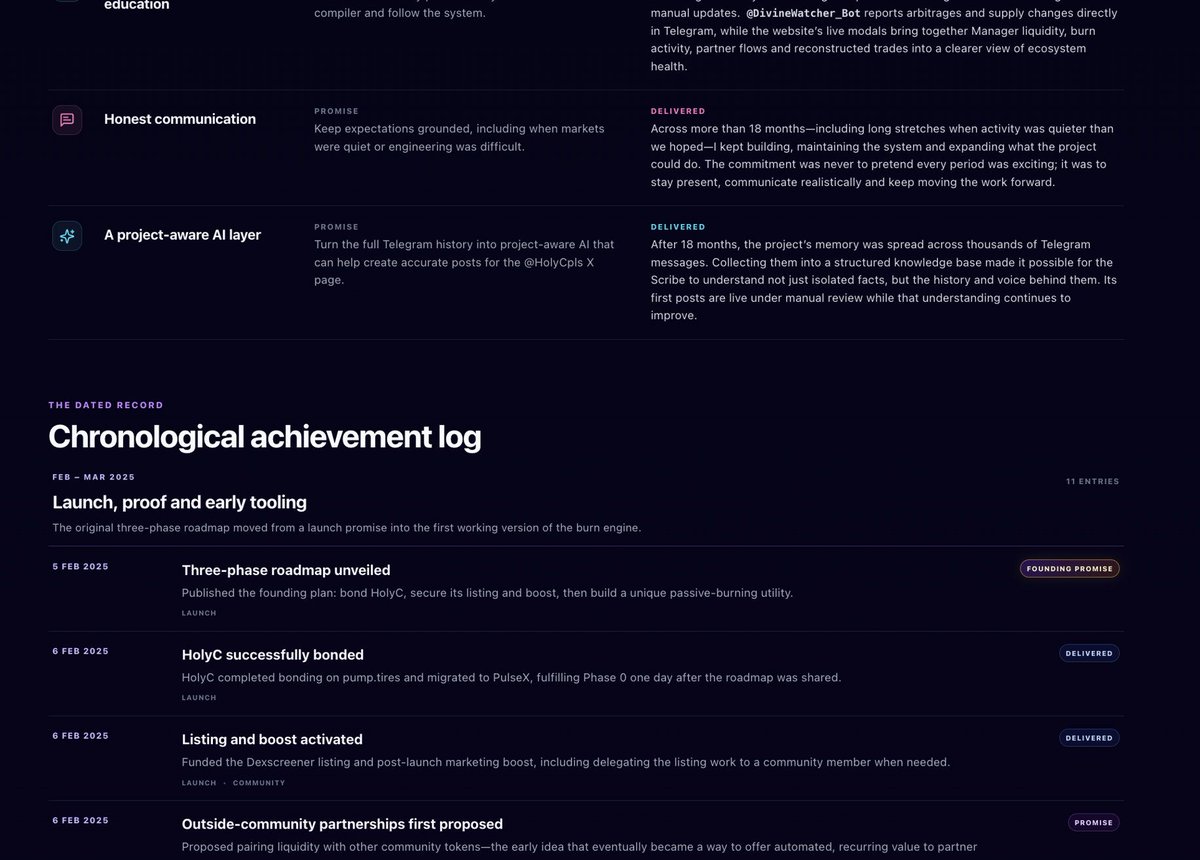
The new Promises Kept page is a full chronological overview of the commitments made in the TempleOS Telegram group and beyond: each promise paired with what actually shipped as the deliverable, so you can follow how the work stacked up over more than 18 months.
JIT Compiler, Divine Manager automation, Partner infrastructure, Public analytics, Education tools, and more! Open and declined items stay labeled honestly.
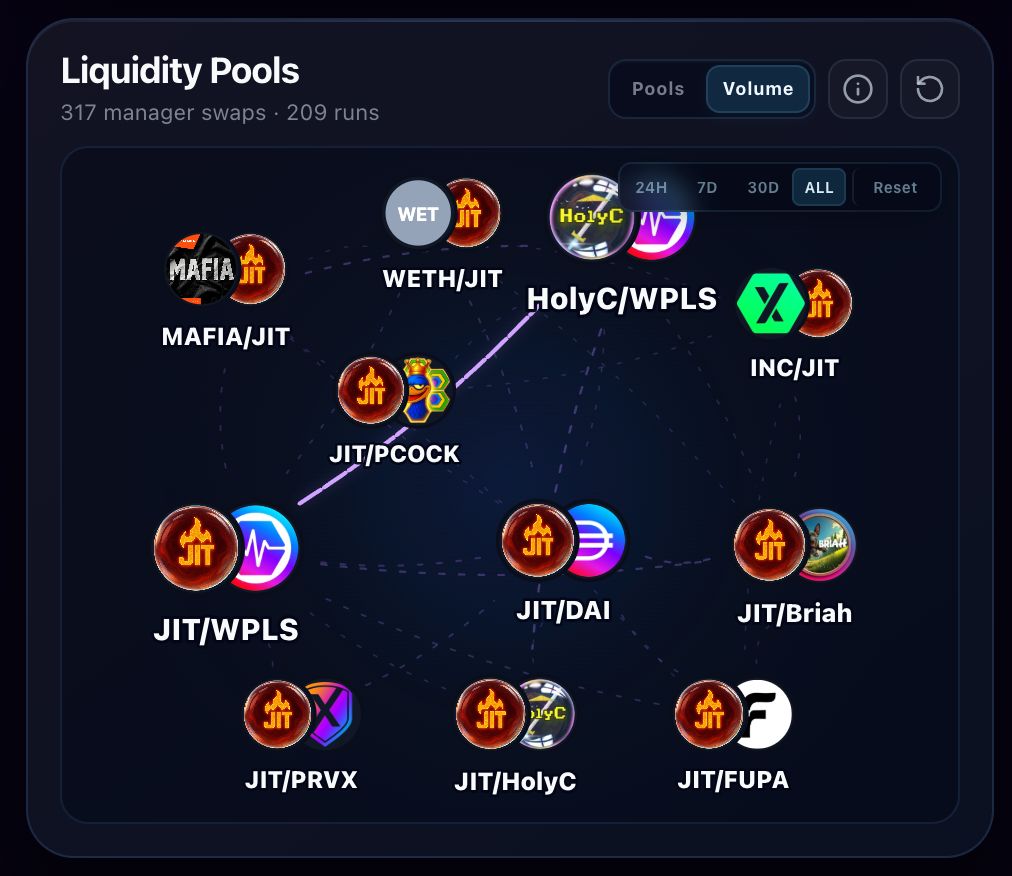
To celebrate, because we know you guys love this kind of stuff, the Liquidity Pools modal now has a 'Volume' view.
Drag and slide the token-pair bubbles. They move with physics. Lines between them are real Divine Manager routes, so you can compare route volume across our ecosystem.
Pools show what is available. Volume shows how activity moved, have fun!
https://t.co/4oU7nZTJ9W
Back on X.
The account went quiet for a stretch. The project did not.
Since March, TempleOS has kept shipping: more routes, a stronger Divine Manager, and the website now loads full arb history instantly so you can follow every step without waiting. Partner buy-and-burn now covers $BRIAH $COINMAFIA $DUMB and $FUPA, and a clearer dashboard shows live arbs visually, with the pools actually used.
Join Telegram for live updates:
https://t.co/QDV4nfFPCG
Explore the dashboard:
https://t.co/EgjHVLSLiR
@yourfriendSOMMI Honestly? Try TempleOS: $HolyC , Genuinely tried my best to build something cool. You can check it out on the site: https://t.co/ryjUyD7DwJ
There's speculation the OA could be spinning up validators, among other things.
Either way, it's worth establishing what validator stake actually buys you, and what it actually costs to take over a blockchain (because why not).
Bitcoin 51%, control the chain ~$20B, ~1.5% of mcap
Ethereum 33%, stall finality ~$37B, ~16% of mcap
Ethereum 51%, control blocks ~$78B, ~33% of mcap
Ethereum 66%, rewrite history ~$150B, ~64% of mcap
But the $ figure is kind of irrelevant, because neither one is actually obtainable by any realistic measure.
Bitcoin's $20B means adding ~960 EH/s of hash power which is roughly 3.5 million ASICs and ~13 GW of electricity looool. About the entire electricity draw of the Netherlands. Those machines don't exist on a shelf, they'd take a year or two to produce and even if you could get them which you cant, you'd need to build and finance dozens of substation to power them which would take the best part of a decade and 10 figures to get over the line. Long story short, it ain't happening.
And Ethereum is even more cooked for an attacker. 66% means getting your hands on 78M of the 82M unstaked coins that even exist, so you're trying to buy 94% of every loose ETH out there.... cold wallets and ETFs included. Good luck. The exit queue for staking is basically empty bc nobody wants out, and the entry queue is backed up for a couple months rn. So even if you somehow had the coins you couldn't switch them on in any reasonable timeframe. Oh and even if you could get 94% of the unstaked supply, which you cant, you're going to be pushing the market against yourself while buying them so $150B easily becomes several hundred billion.. maybe even a trillion.. Better call Elon 😁
That's what real security looks like.. It's not expensive, it's just flat out unavailable. Infinite money doesn't get it done. And even if it did, the moment you attacked Ethereum, a big chunk of that stake gets slashed and burned anyway. It ain't happening.
* * *
Now PulseChain.
PulseChain 33%, stall finality ~$5M
PulseChain 51%, control the chain ~$10.5M
PulseChain 66%, rewrite history ~$20M
On the bridge today, the real extractable value actually liquid on the chain today. There’s ~$43M gated by $10M of stake.
Two thirds of PulseChain's entire consensus costs less than half of what's sitting on the bridge.
Bitcoin and Ethereum, on top of the exorbitant amount of money required, are protected by physics and supply and infrastructure that's very hard to obtain, so no amount of money actually solves them. PulseChain is protected by a number. And that's not a dig, it's just what a young chain is. Bitcoin itself was attackable with a few laptops in 2010. Security's a ratio.
Nobody puts a big lock on a cheap bike, but the moment it's worth something, the lock needs to catch up.
And yess, scooping up $20M of PLS in a market this thin isn't easy ofc. The liquidity isn't there to just buy it outright. But that's the only real friction. There are already big holders sitting on big cumulative stake, whales who could port into validators, or a few of them banding together, and suddenly you're most of the way there. Orders of magnitude easier than on BTC or ETH. Difficult but nowhere near impossible.
(Side note, the bridge waits 96 blocks for a reason. That's roughly the finality window, so it won't release funds until the source chain has finalized and a cheap reorg can't undo it. But the bridge is only one door. That value doesn't sit still once it's on chain, it's spread across DEXs, LPs and contracts, and none of that waits 96 blocks for anything.)
So anyway, back to the OA...
No idea what they're doing, maybe nothing. But if that PLS is for validators, ask yourself why. If anyone were putting serious money onto a chain this green, you'd want the lock sorted before the bike's worth stealing.
Just saying.