Когда срывают былинку – вздрагивает Вселенная!💥Россия — великая страна, захваченная головорезами. Душа Народа выражена в Песне.
Captain⚓️MELODIST 🎼God's Gr.😊
During a solar eclipse, the gaps between leaves on trees act as multiple pinhole cameras,
and each gap projects its own crescent-shaped image of the eclipsed sun onto the ground.
📹gottigreen
@Rainmaker1973 This little Miracle gives some reason to be proud of rotten Humanity❣️
😇
Это маленькое Чудо ��аёт некоторое основание гордиться прогнившим Человечеством...
🇷🇺🇺🇦⚡️ Russian soldier asked Ukrainian soldier, "Will you take us prisoner or kill us?"
Ukrainian: Prisoner
2nd Russian soldier : Prisoner?
Ukrainian: we are not you
They Expected Death. They Heard Something Else.
I witnessed something on a flight from Denver to Atlanta last Tuesday that I haven't been able to stop thinking about.
There was a young mom, couldn't have been older than 25, sitting a few rows behind me with a toddler who was completely losing it. Not a "spoiled kid" meltdown. A full-blown, terrified, sensory-overloaded meltdown. The kind where the child can't breathe between screams.
People were turning around. One man, expensive watch, laptop open, muttered something under his breath loud enough for half the plane to hear. A woman near the window yanked her AirPods in and shook her head.
The mom's eyes were glassy. She was bouncing him, whispering to him, completely alone in a tin can at 30,000 feet while strangers quietly judged her.
Then a man stood up from the aisle seat across from me.
He had to be in his late 60s. Wore a flannel shirt, work boots with actual dried mud on them, and a John Deere cap with a bent brim. His hands, I noticed his hands, were the hands of a man who had spent his life fixing things that were actually broken.
He walked back to her without hesitating. No announcement. No fanfare.
"I got eight grandkids, sweetheart. Give him to me. Go drink some water."
She hesitated. He just held out his arms.
She handed him the baby.
He didn't bounce him. Didn't shush him. He just held that boy against his chest and started walking the aisle, talking to him in a low, slow voice about what the wing flaps were doing. About cumulus clouds. About how jet fuel gets made.
The kid was asleep in twelve minutes.
The man with the expensive watch had gone very quiet.
The mom was asleep before the old man even made it back to her row.
So he sat down next to her empty seat. And he just... stayed. Held that sleeping stranger's child for the rest of the flight. Never woke her. Never asked for anything. Just stared out the window and kept that rhythmic, slow pat going on the little boy's back, the muscle memory of a grandfather who has done this a thousand times.
When we landed and she woke up in a panic, he handed her son back like it was nothing.
She tried to thank him. He was already putting on his jacket.
"You're doing a good job, mama. It doesn't look like it right now. But you are."
And he was gone into the crowd before she could say another word.
I don't know that man's name. I don't know where he was going or where he came from. But I have thought about him every single day this week.
Because nobody asked him to get up. No one would have blamed him for staying in his seat. He just saw someone drowning and decided that was enough of a reason.
Be that person. You don't need a reason. You don't need to know them. You just have to decide the moment in front of you is worth showing up for.
La niña que escondió a su hermanito en una bolsa para que no los separaran
Agosto de 1905.
Ruth Patterson, de catorce años, ya había sufrido más dolor del que muchas personas adultas conocen en toda una vida. Un incendio le arrebató a sus padres y, con ellos, su hogar, su seguridad y su infancia.
Solo le quedaba su hermanito Daniel, un bebé de apenas seis semanas.
Los llevaron a un orfanato en Nueva York. Allí, Ruth escuchó una regla fría y devastadora: los niños de edades diferentes no eran colocados juntos en una misma familia.
Daniel sería enviado a otro lugar.
Ruth se quedaría sola.
Pero Ruth se negó a aceptar ese destino.
Cuando llegó el día en que el llamado “tren de huérfanos” partía hacia Nebraska, hizo algo que solo puede hacer alguien que ama más de lo que teme.
Sacó al pequeño Daniel de la sala de bebés y lo escondió dentro de una vieja bolsa de cuero.
Para todos los demás, era solo equipaje.
Nadie sabía que dentro había un bebé.
Ruth había hecho pequeños agujeros en el fondo de la bolsa para que su hermano pudiera respirar. Durante tres días viajó con él en el tren, cargando su miedo en silencio.
En cada parada, su corazón latía tan fuerte que parecía que todos podían escucharlo.
Por las noches lo alimentaba. Lo calmaba cuando estaba a punto de llorar. Lo cambiaba en el baño del vagón. Y durante todo ese tiempo sabía una cosa: si alguien descubría la verdad, los separarían para siempre.
Pero nadie los descubrió.
Cuando el tren llegó a Nebraska, una pareja de granjeros, los Johnson, eligió a Ruth. Les impresionó su fuerza tranquila y la mirada seria de una niña que había tenido que crecer demasiado pronto.
La subieron a su carro junto con la bolsa y la llevaron a casa.
Solo cuando Ruth sintió que por fin estaban a salvo, abrió la bolsa.
Dentro estaba Daniel.
Los Johnson se quedaron inmóviles.
Lo que tenían delante no era un engaño. No era desobediencia. No era un problema.
Era una niña agotada que había hecho lo imposible para no perder a la última persona que amaba.
Escucharon su historia: el incendio, el orfanato, la regla, el miedo y ese amor que se negaba a soltar.
Luego se miraron y tomaron una decisión que cambió para siempre la vida de dos niños:
“Si llegaron dos, criaremos a dos.”
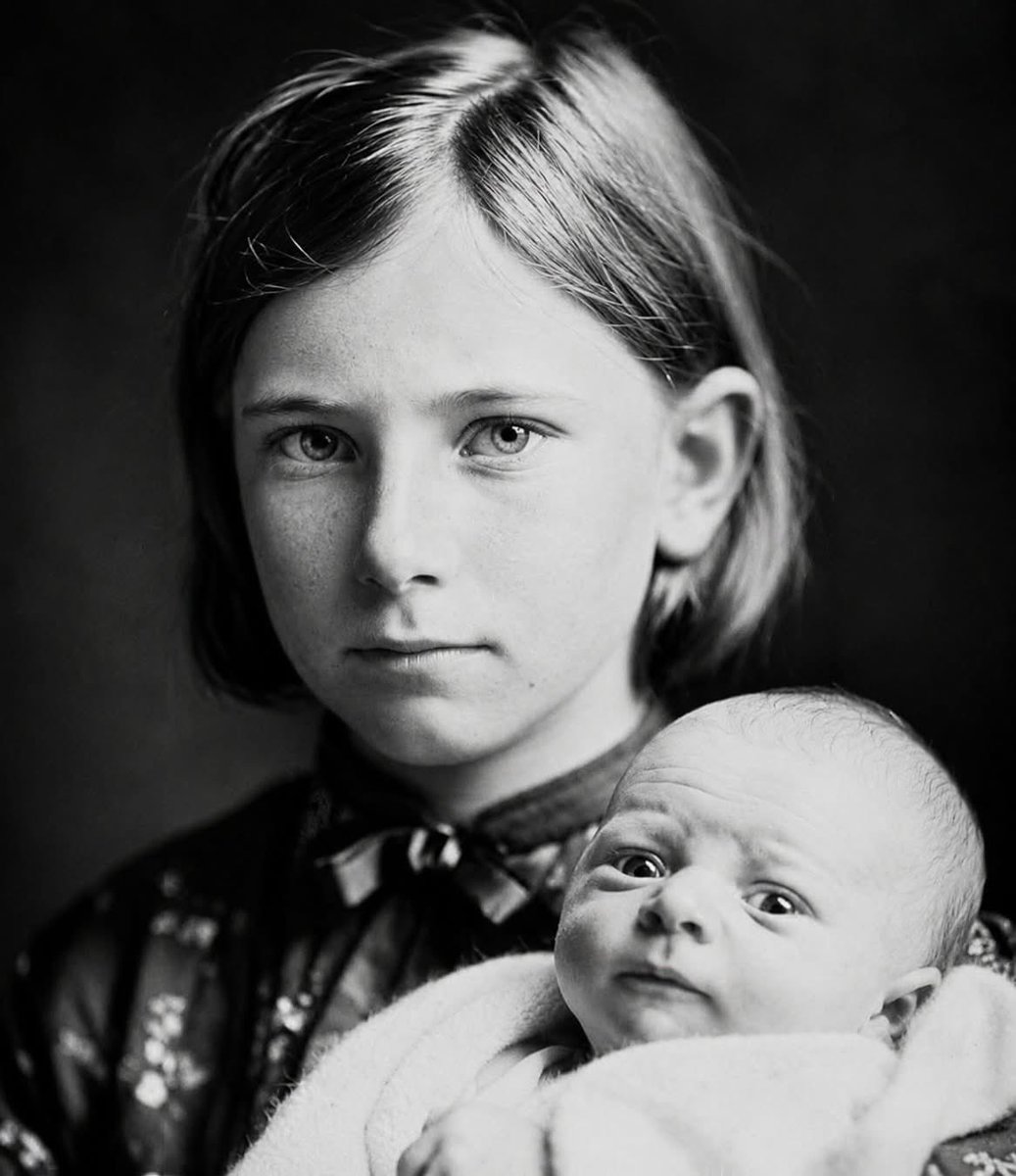
Ese mismo día tomaron una fotografía. En ella, Ruth sostiene a Daniel con fuerza entre sus brazos. A sus pies está la vieja bolsa que salvó su futuro.
En su rostro no hay victoria.
Solo alivio.
Ruth y Daniel crecieron juntos en la granja. Él adoptó el apellido Johnson, pero siempre supo la verdad: su hermana lo había arriesgado todo para que no se convirtieran en extraños.
Los Johnson nunca denunciaron lo que Ruth había hecho.
Porque a veces la compasión vale más que las reglas.
Ruth y Daniel compartieron casi setenta años de vida porque una niña se negó a permitir que el destino le arrebatara a su hermano — y porque una familia vio en su acto no una falta, sino amor.
Años después, Ruth lo resumió de la forma más simple:
“Eso era el amor: hacer lo imposible para que no nos separaran.”
Y quizá no exista una definición mejor.
Imaginaos esto:
— Tu hija de 12 años fue violada repetidamente por cuatro hombres negros.
— La llevas a la policía y presentas una denuncia.
— Los agentes se niegan a aceptar la denuncia.
— Desesperado, describes lo sucedido en las redes sociales.
— Dos días después, la policía te detiene y te encarcela. Un juez te condena a una pena de prisión incondicional.
— Los agresores quedan impunes.
— En el Parlamento, esta decisión es aprobada por amplia mayoría porque no quieren ser tachados de islamófobos.
Esto ha ocurrido cientos de veces en Gran Bretaña, y la Cámara de los Comunes en Londres votó en consecuencia hace tan solo unos días.