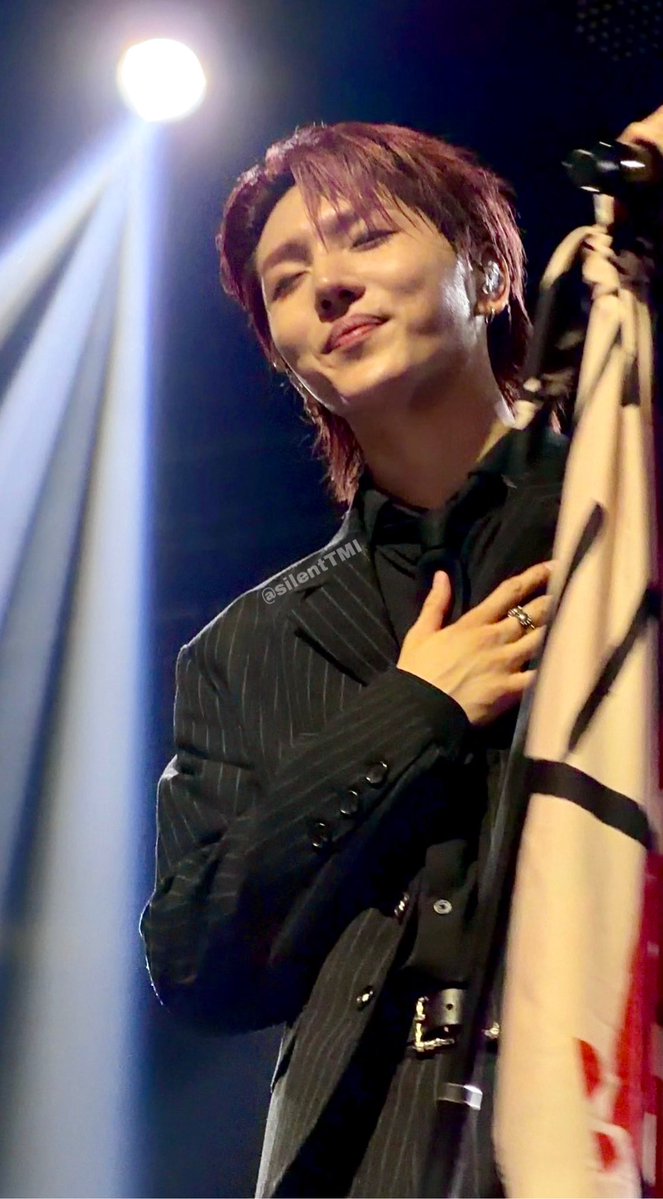
DAZED korea - SAN
Q.
I imagine there are also some new fields you’d like to explore.
SAN.
I actually have a lot of dreams and a lot of things I want to do. I want to try acting, sports, and musicals too. But I know very well that wanting to do something doesn’t automatically mean I can just do it.
There are people who dedicate themselves to that work as if their lives depend on it. And I’m just as serious and sincere about my own work. So I think that if I’m going to take on a new field, I should at least have the basic attitude and mindset it requires.
I’d like to try all of them someday, but for now, compared to the mindset and effort of the people already working in those fields, I don’t think I’ve even reached the starting point yet. If I want to properly show what I’m capable of in a new field, I think I need enough time to prepare and fully immerse myself in it. To do that, I’d need to research and study the field and take lessons too.
I want to get to even one tenth of their level first, and take on the challenge when I can finally tell myself, “Now I’ve at least reached the starting point.”
—————
Q.
Just the thought of seeing you take on those challenges is already exciting.
SAN.
Thank you. (Laughs) I’ve actually been taking lessons here and there whenever I can. Because you never know when a project might come my way. I feel that, at the very least, when I’m in the same frame as them, I need to make sure I clearly show the character of “Choi San”.
That’s why I’ve been preparing whenever I get the chance. If an opportunity comes my way someday, I don’t want to miss it. I’m continuing to prepare so that I can seize the opportunity when it comes.
cr. @/SANBABOofficial
#Choisan #최산 #san #산 #ateez #에이티즈 #サン #エイティーズ
<겁쟁이>는 결국엔 다시 만나는 관계에 대한 곡이거든요. 이번 프로젝트와 지난 10년을 통해 알게 된 건 저희 팬분들이랑 저희 펜타곤은 그냥 운명적으로 계속 서로 옆에서 공전을 하고 있는 관계라는 거예요. 결국엔 다시 돌아오는 거죠. 떠나간 줄 알고 슬퍼했던 것도, 끝난 줄 알았는데 끝나지 않았던 것들도, 멀게 보였는데 사실은 생각보다 많이 가까웠던 것들도 시간이 지나면 우리는 다시 계속 만나는구나,를 알게 된 것 같습니다.
사랑이죠. 그리움이겠죠.
Lan Sizhui and Wei Wuxian are such a painful parallel because both became embodiments of families they weren’t born into, but Sizhui was actually given the belonging Wei Wuxian spent his life earning without ever being allowed to claim.
WY: Lan Zhan, Lan Zhan, Lan Zhan ☺️
LZ: Mn ☺️
WY: Lan Zhan, Lan Zhan, Lan Zhan ☺️
LJY: How annoying that must be for Hanguang-Jun!!
LXC: He went many years without hearing Young Wei say his name. This is something they both need.
the fact that someone who teamed up with Gunil during the show, when he was the leader, is now supporting him through all this scary legal stuff is so heartwarming
thats why you always treat people with kindness and respect, bc it comes back to you when you need it the most
Sung Jaehwan, a lawyer and contestant from The Logic, the show Gunil recently appeared on, has released an official statement regarding Gunil on Instagram.
🔗: https://t.co/mxZqgnjaU8
Vernon’s point here is actually much more nuanced than “old K-pop was better” or “K-pop is becoming American.”
K-pop has always been hybrid. Its history is deeply connected to American and European pop, R&B, hip-hop, dance music, and also to the Japanese music industry. Even the formation of what we recognize as modern K-pop in the 1990s happened through taking foreign musical forms and recontextualizing them within Korea’s own language, industry, performance culture and audience.
That’s why the important part of what Vernon is saying is not that K-pop suddenly started borrowing from American pop. It has ALWAYS done that.
The interesting change is how much the distance between the source material and the Korean reinterpretation has narrowed.
Think about the difference between earlier generations and now. A 2nd-gen song could be heavily influenced by an American genre and still sound unmistakably like a Korean production because the influence was being filtered through a very particular Korean arrangement style, vocal structure, songwriting approach, choreography and idol-production system.
Wonder Girls, BIGBANG, 2NE1, Girls’ Generation, etc. were absolutely not “uninfluenced” by Western music. Quite the opposite. But you could often hear the process of localization more clearly.
And that localization was actually one of K-pop’s strengths.
Korea didn’t simply import American pop and reproduce it. Producers took global trends, adapted them to Korean audiences, combined them with Korean industry practices, and eventually developed a system capable of exporting that localized product back into the global market.
That is basically the fascinating paradox of K-pop’s globalization: something can be heavily influenced by global pop while becoming more distinctly Korean through the way those influences are reorganized.
What Vernon is noticing now is almost the reverse side of that process.
The global music industry has become so interconnected that producers, songwriters, choreographers and labels are working across the same international networks, using the same DAWs, sample libraries, trends, genres and songwriting camps, and responding to increasingly similar global market expectations.
So naturally, the “filter” becomes less audible.
It’s not that K-pop stopped being influenced by American pop. It’s that the global pop vocabulary has become so shared that sometimes there is less sonic distance between “K-pop” and “Pop” to begin with.
And honestly, this is why his comment about the 2000s/early 2010s makes sense to me. He isn’t necessarily saying those songs were more original. He’s talking about a period when the process of taking a global influence and turning it into something recognizably K-pop was easier to hear.
That distinction matters.
And honestly, I could yap about this for much longer if anyone is interested 😭 There are some genuinely fascinating articles and discussions on K-pop’s musical hybridity, localization, globalization, and the changing relationship between K-pop and global pop.
The more you look into the history, the more interesting Vernon’s observation becomes.


![CUBE_PTG's tweet photo. [📸] PENTAGON 10th Anniversary Tour <101010> Concept Photo
[Osaka]
📅 2026.10.01
[Tokyo]
📅 2026.10.03
[Seoul]
📅 2026.10.09 - 10.10
[Hong Kong]
📅 2026.11.01
#펜타곤 #PENTAGON
#PENTAGON_101010
#PENTAGON_10th_Anniversary https://t.co/852rbsKxLx](https://pbs.twimg.com/media/HPaCX7Ha0AEN_eS.jpg)


![CUBE_PTG's tweet photo. 펜타곤(PENTAGON) 10th Anniversary Single
[겁쟁이]
Promotion Timetable
2026.09.11 6PM (KST)
#펜타곤 #PENTAGON
#겁쟁이
#PENTAGON_10th_Anniversary https://t.co/Gw6gt6S8WJ](https://pbs.twimg.com/media/HQpIM3IbkAA93Ns.jpg)


![CUBE_PTG's tweet photo. [📸] PENTAGON 10th Anniversary Tour <101010> Concept Photo
[Osaka]
📅 2026.10.01
[Tokyo]
📅 2026.10.03
[Seoul]
📅 2026.10.09 - 10.10
[Hong Kong]
📅 2026.11.01
#펜타곤 #PENTAGON
#PENTAGON_101010
#PENTAGON_10th_Anniversary https://t.co/852rbsKxLx](https://pbs.twimg.com/media/HPaCakra4AAqX0N.jpg)


