“People like to look for systems that have worked over the past 20 years or so. If you could make money based on what has worked the past 20 years, all of the richest people would be librarians.”
— Warren Buffett
Stan Druckenmiller made 1 trade - earned $1B destroying the UK economy, Paul Tudor made 1 trade - earned $100M predicting Black Monday
on one JPMorgan stage they showed for the first time exactly how they made $1.1B in 24 hours
35-min from the two greatest traders alive - how they think, how they size, how they win
bookmark & watch - no course, no book, no podcast comes close to this
"I read five daily newspapers. I read a fair number of magazines. I read 10-Ks. I read annual reports, and I read a lot of other things, too... I love reading biographies, for example."
"Read 500 pages like this every day. That's how knowledge works. It builds up, like compound interest."
"I just read. I read and read and read. I probably read five to six hours a day."
— Warren Buffett
Taking a profit is often a "damned if you do, damned if you don't" dilemma.
While taking a profit is always better than taking a loss, there are times when taking a profit can create anxiety and outright regret.
Let's say you buy a stock at 50 with a mental target of 100 and maybe the possibility of 150.
Next let's say the stock goes to 100 but you do not take profits.
Next let's say that your trailing stop (if you use these) takes you out of the trade at 80.
Do you then regret not taking profits at 100? Of course you do if you are even part human being.
But what if you would have taken profits at 100 but then the stock kept running? Chances are you would have also regretted the decision to take profits at 100.
You see, taking profits is a damned-if-you-do-damned-if-you-don't business.
I hate regret. I decided many decades ago in my 50 year career that regret is something a trader needs to avoid. Living in a cycle of regret is not healthy for trading will sooner or later come back to bite you.
So I made a decision to create rules and stick by them. Rules created process for me so that my emotions were not led around by my last or current trade.
I take profits at targets when I have a light position on. If I take a heavier position I will then take profits at the initial target on a portion of my trade and hold out for a 2X profit on the other portion.
Do I miss the occasional rocket-ship market by taking profits? Of course. There is no perfect trading plan.
There is an alternative way that from time to time I will employ in a trade. That is using a simple moving average on a partial position so that I adopt a trend following approach on some of the risk I take.
In a trade following approach inevitably the top cannot be picked so some money is given back at the trend change or major correction. But again, there is no perfect model.
My recommendation to new traders is to commit yourself to the path of least regret, whatever that might be.
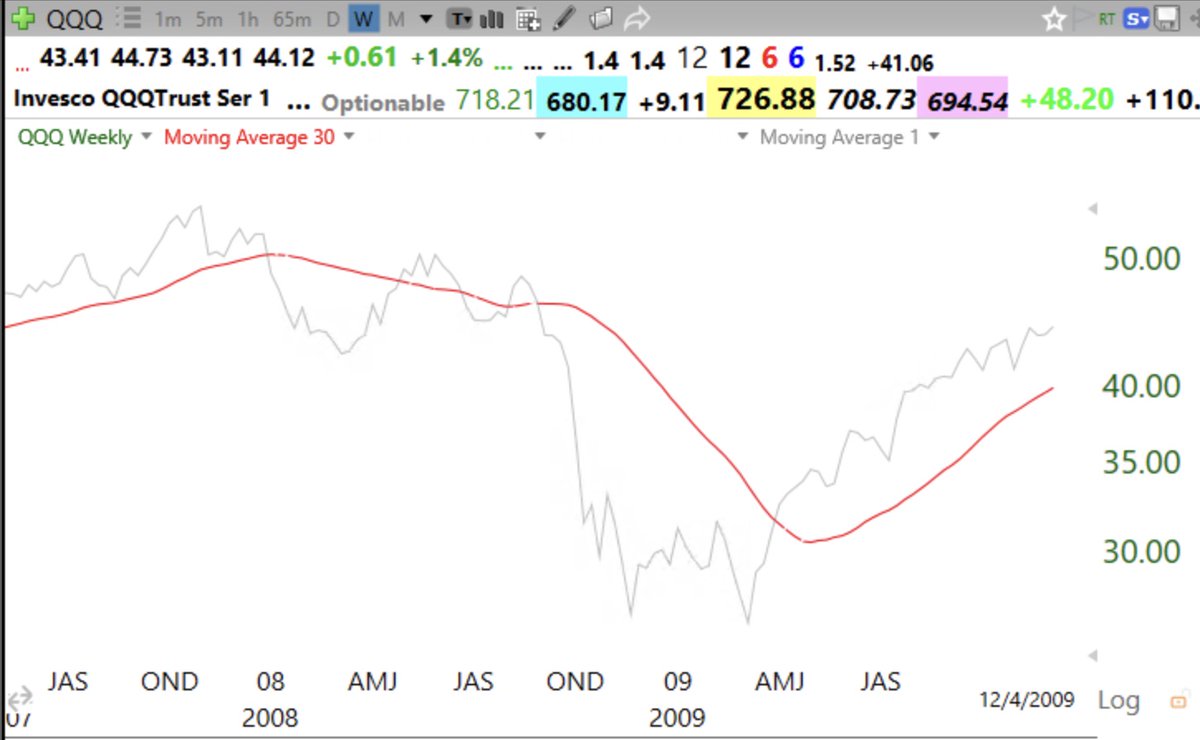
The same chart pattern I posted yesterday for the 2000 top also got me out of the market just before the 2008 decline. Market tops take time to develop. I ignore the news and gossip and watch the 30 week average. https://t.co/5SREpexZJj
Join TSAA-SF on June 2nd, 5PM PT for our June monthly virtual gathering, “2026 Mid-Year Stock Charting Session” with Nick Chong, James Domino, and Rachel Dashiell! 👉 Register: https://t.co/9ddvjrs4MN #TSAASF#TechnicalAnalysis#stockcharting
They call me stupid when I lose money for 5 years.
They laugh.
They judge.
They think I’m wasting my time.
See: long journey
But the same people go silent
when one month of my results
beats their entire annual salary.
See: delayed payoff
That’s trading —
the grind looks foolish
until the payoff makes perfect sense.
See: payoff
I keep going.
Because consistency turns losses into lessons,
and lessons into domination.
See: consistency
A harsh reality
Are you out to turn a little into a lot in a hurry?
Look folks, there has been tons of research done on the success rate of retail traders. By exchanges, regulatory agencies, brokerage houses, trading platforms, academic researchers and the like.
The numbers are in and you are a fool to begin with if you think your are an outlier -- although all retail traders think they are outliers (and they usually are on the left side of the bell curve distribution).
Expectations and eagerness to trade for the sake of money are inversely correlated with success. Sorry, but true (of course except for in your dream world).
You want to turn $50k into $5 million in five years? Well, go for it if you that is your dream. But know that professional career traders in zero-sum markets (like futures, day trading anything and crypto) plead with you to trade their asset class. Please, I beg you to trade futures (my asset class).
Fresh meat is always welcomed.
Maybe you are among the 2 in 1,000 that can with a few years of experience achieve back-to-back-to back-100% years. I do not want to do anything to prevent your effort. I wish you well. In 50 years I've witnessed many try.
Or, do you have realistic profit expectations and want to become excellent in some niche of market speculation?
Then you have a chance.
But your chance depends on your ability to protect your capital and avoid big losses.
Here is the reality folks -- the real world where 99% of us live.
Pick your asset class. Now have adequate capital (the amt is disputable but I use the figure of $50k). Next know that no matter what you do it will take three to five years to even pick up the scent of where your excellence might be hiding.
Your challenge will be to develop some scheme or system or approach that is repeatable. Every successful trader has a different method. No exceptions. You cannot copy anyone. There are reasons why I won't go into.
You might have to try a few different approaches to find what methods are suitable to you.
But here is the HUGE challenge you face.
You will have to keep your capital intact (relatively speaking) or have deep pockets to get through the three to five years of the steep learning curve.
You will also need to avoid the fast talkers who want you to believe they have your answers.
Following are appeals I received via email in just the past week from "reputable" trading services (these are verbatim):
-$10,000 into $30,417. 14 out of 20 trades doubled
-that's a 1,004% return in 6 days, turning a $605 bet into $6,684
-1004% on UMAC
- +100% on BBAI in a day
-See how stock flips could have made $92,000 in one year!
-Soured 1,025% in just six months
-convinced this could be this year's next 1,000%
You fall for these lines, you are done for. Another reality is that not everyone is made for crazy success in trading. Most people would be better off living frugally and putting as much money as they can into a 50% SPY, 30% fixed income, 10% energy and 10% precious metals portfolio and let it work over time. Then pursue a day job that excites you.
So, don't be conned by the circus acts that promise you the moon. Trading is hard work. Tedious. Boring often. Stressful.
My standard recommendation to most young people is to get an education in a field that you like and where jobs are available. Like welding. Or supply chain management. Or engineering.
98% of you young folks will thank me for this advice someday.
HOW I IDENTIFIED AND EXITED AT THE MARKET TOP IN 2000--WHEN THE 30 WEEK AVERAGE CURVED DOWN. TO IDENTIFY A LIKELY TOP, I JUST WATCH THE 30 WEEK AVERAGE. Compare the weekly charts of QQQ from 2008 and now. https://t.co/IKjYitC96s
A defining characteristic of great traders is not that they make great calls; sure, they make some, but so does everyone. It doesn’t come from catching a trend and staying with it until it dies, nor from being the best at leaning into breakouts, or excelling at mean reversion—those are merely what they are supposed to be doing, if their process so requires.
The defining characteristic comes from being able to own the moments when it matters, from adhering to the plan, staying on script, and trusting the process when everything is screaming at them to change course. - This battle occurs in their mind, when they are able to push back against their ego, and to challenge themselves to do something in defiance of their ego—something which makes them vulnerable, and they do it anyway.
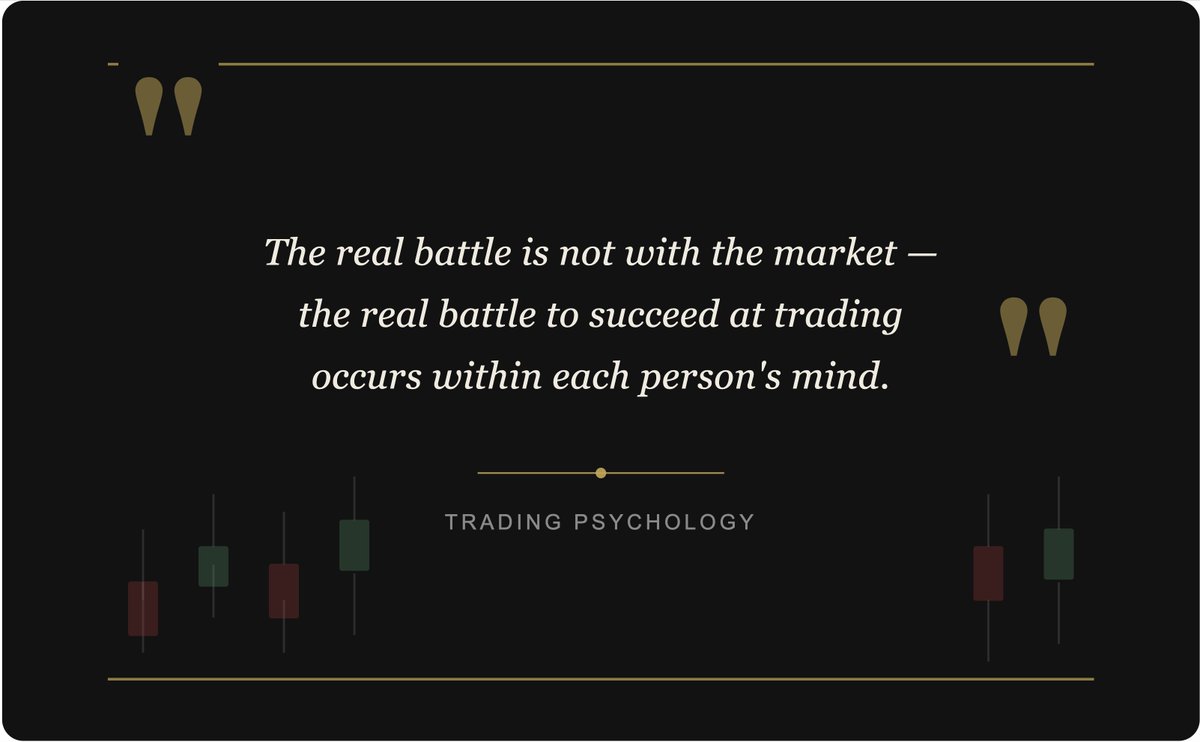
That is the character I see in great traders. - This defines them, and is a reminder that the real battle is not with the market, the real battle to succeed at trading occurs within each person's mind
Rick Rieder, CIO of Global Fixed Income, explains why today’s bond market may offer some of the most compelling opportunities in over a decade, and why capturing them requires “dynamic patience.” Learn more in our latest quarterly outlook: https://t.co/lntwbx2ysP
We upgrade developed market (DM) stocks to overweight and downgrade high yield to neutral over a long-term investment horizon. Why? AI-driven earnings momentum is strengthening, and we prefer to take growth risk in equities.
More here 👉 https://t.co/U8pOAQ3O5i
Goldman Sachs Research has lowered its US recession probability. Despite the possibility of adverse outcomes from the Iran conflict, US economic activity has remained strong and oil prices have not risen as much as expected. Sign up for our weekly newsletter, Briefings, for more insights: https://t.co/GmNzbMrZyh
Does the AI stock rally signal a bubble? Shawn Tuteja, who oversees ETF and custom baskets volatility trading within Goldman Sachs Global Banking & Markets, discusses: https://t.co/tUku3KKGWQ
Trading is a performance activity — not an intellectual one.
Over-intellectualising it pulls you toward analysis and formulas and perfectionsim, and away from the thing that actually matters, taking risk🥅
TAKING RISK IS THE GAME: You can be the best analyst on the planet, but if your risk-taking capabilities are sub-optimal, your analytical skills are meaningless, and you're not a player🤾, your'e just a commentator🎙️.


![burrytracker's tweet photo. Breaking: Leopold Aschenbrenner just filed his Q1 2026 13F
Here's everything you need to know about his recent 13F
Top 10 positions:
1. VanEck Semiconductor ETF $SMH [Put] — $2.04B
2. Nvidia $NVDA [Put] — $1.57B
3. Oracle $ORCL [Put] — $1.07B
4. Broadcom $AVGO [Put] — $1.01B
5. Advanced Micro Devices $AMD [Put] — $969M
6. Bloom Energy $BE — $879M
7. SanDisk $SNDK — $724M
8. Micron $MU [Put] — $584M
9. CoreWeave $CRWV — $556M
10. Taiwan Semiconductor $TSM [Put] — $535M
New positions:
• $SMH, $NVDA, $ORCL, $AVGO, $AMD, $MU, $TSM, $ASML, $INTC, $GLW — all puts
• $MU [Call] — $422M
• $TSM [Call] — $355M
• $SNDK [Call] — $389M
Biggest adds:
• CleanSpark $CLSK: +648% shares
• Riot Platforms $RIOT: +87% shares
Biggest trims:
• CoreWeave $CRWV [Call]: -83% shares
• Bloom Energy $BE: -36% shares
Full exits:
• Intel $INTC [Call] — was $747M
• Lumentum $LITE — was $479M
• EQT Corp $EQT — was $133M
• Tower Semiconductor $TSEM — was $85M
Summary: He kept his AI infrastructure longs and opened $8.45B in new puts against tech and semiconductor](https://pbs.twimg.com/media/HImdd4AWkAAzOqm.jpg)






![burrytracker's tweet photo. Breaking: Leopold Aschenbrenner just filed his Q1 2026 13F
Here's everything you need to know about his recent 13F
Top 10 positions:
1. VanEck Semiconductor ETF $SMH [Put] — $2.04B
2. Nvidia $NVDA [Put] — $1.57B
3. Oracle $ORCL [Put] — $1.07B
4. Broadcom $AVGO [Put] — $1.01B
5. Advanced Micro Devices $AMD [Put] — $969M
6. Bloom Energy $BE — $879M
7. SanDisk $SNDK — $724M
8. Micron $MU [Put] — $584M
9. CoreWeave $CRWV — $556M
10. Taiwan Semiconductor $TSM [Put] — $535M
New positions:
• $SMH, $NVDA, $ORCL, $AVGO, $AMD, $MU, $TSM, $ASML, $INTC, $GLW — all puts
• $MU [Call] — $422M
• $TSM [Call] — $355M
• $SNDK [Call] — $389M
Biggest adds:
• CleanSpark $CLSK: +648% shares
• Riot Platforms $RIOT: +87% shares
Biggest trims:
• CoreWeave $CRWV [Call]: -83% shares
• Bloom Energy $BE: -36% shares
Full exits:
• Intel $INTC [Call] — was $747M
• Lumentum $LITE — was $479M
• EQT Corp $EQT — was $133M
• Tower Semiconductor $TSEM — was $85M
Summary: He kept his AI infrastructure longs and opened $8.45B in new puts against tech and semiconductor](https://pbs.twimg.com/media/HImdgEMXcAApr8J.jpg)


