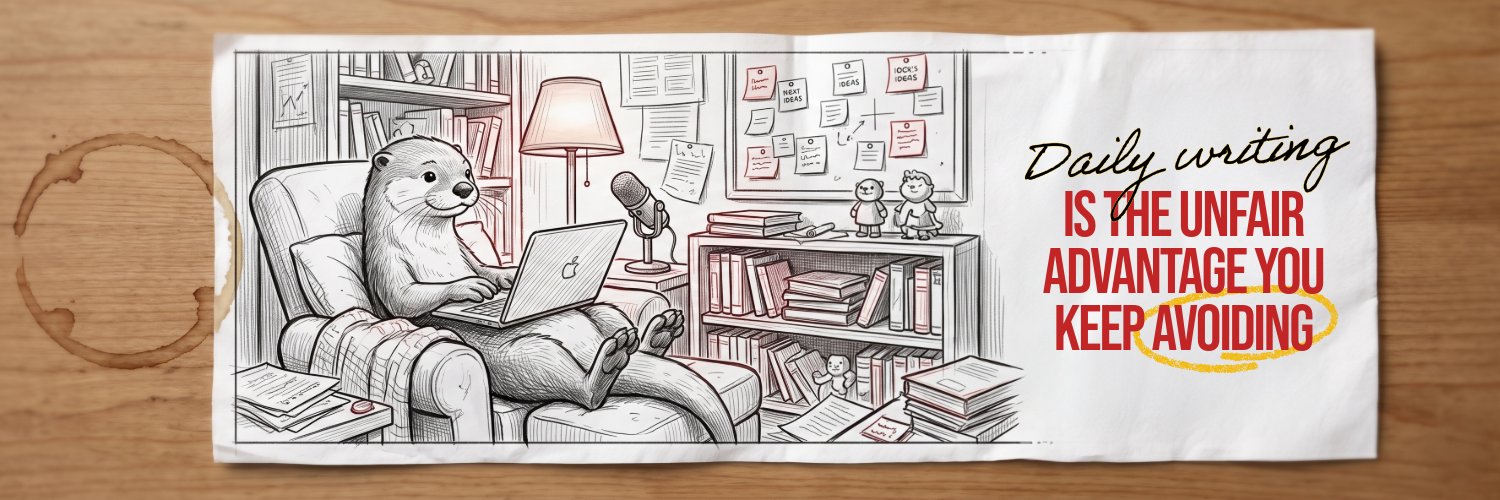
I helped creators w/ marketing for 10+ years, but procrastinated on growing my personal brand. Now I'm writing daily. Stop procrastinating and start writing 👇
“Marketing is such a chore!”
That’s what I hear a lot in my full-time job, working with creators.
I also procrastinated for years on writing content to build my own creator brand.
But now I’m enjoying writing again.
That’s why I launched my newsletter at https://t.co/hOAdpYjnQn
Feel free to join if this resonates!
Once you judge every idea by search volume, headline conversion, and virality, you've stopped writing and started optimizing. Optimizing a boring practice is not a renewable energy source. It burns out fast.
Perfectionism is fear. A draft that's still being tweaked can't be judged, so you polish and polish and never ship. The unfinished piece is the only one that never gets to hurt you.
Creators are obsessed with efficiency.
Batch your content!
Optimize your workflow!
Cut writing time in half!
I mean, who doesn't want to save time?
But this obsession with efficiency is killing your content.
Because when you're hyper-focused on speed and output, you strip away the exact things that make content stand out.
The rambling thoughts that lead somewhere interesting.
The personal tangent that makes people feel connected to you.
The time to sit with an idea until it becomes something original instead of reheated.
You end up with content that's... fine.
Perfectly formatted. Posted on schedule. Completely forgettable.
Meanwhile, the creator who spent an extra hour noodling with an idea, following a weird tangent, or rewriting the same paragraph five times...
Using their creativity, I mean!
They wrote something that actually sticks.
So how about embracing creative inefficiency?
It involves rabbit holes, deleted drafts, and time spent staring at the ceiling.
It requires you to care more about the work than the productivity metrics.
Some creators write with discipline and gritted teeth.
Others have fun writing.
Which one do you want to be?
I mean, sure, writing can be grueling at times. But it can bring you joy if you just let it.
It feeds the side of you that sees writing as a chore, not as fun.
By "it," I mean using AI to write.
One of the biggest downsides to AI writing that nobody talks about.
Your audience craves human perspective, personality, and connection.
Treat AI as your replacement, and you get slop.
It’s a productivity lever, not a replacement for creative, high-trust work.
Just finished reading Big Magic.
This is exactly the kind of book creators need now (when AI is so prevalent).
It’s about ”creative living.”
Here’s just one idea that stood out to me: The differences between ”a martyr” and ”a trickster.”
Martyr says, ”Writing is pain.”
Trickster says, ”I write to entertain myself.”
Martyr says, ”The system is rigged against all that is good (good = me)”
Trickster says, ”The system is in constant play, and it wants to play with me.”
Martyr says, ”People just don’t understand me.”
Trickster says, ”I write to understand, and aren’t entitled to be understood.”
Martyrs are serious, angry, and rigid.
Tricksters are lighthearted, sly, and endlessly shapeshifting.
Definitely worth a read!
Most brands run on maybe two or three of these.
The origin story. A few customer testimonials. Maybe some anecdotes if they're doing personality-based content.
And then they wonder why their marketing feels... incomplete. Why some campaigns land and others disappear. Why competitors with worse products seem to get more traction.
Marketing isn't one story. It's a whole system of stories, each one handling a different job.
X and LinkedIn have roughly 100 billion coaches who will tell you that storytelling built their audience.
But most creators think ”storytelling” means posting random stories they find on Wikipedia.
Then they wonder why their content doesn't convert.
After 10+ years working with creators, I've identified 13 distinct story frameworks that actually build audiences and drive sales.
Here's what nobody tells you:
12. The Parallel Parable – Two people. Same starting point. One small different choice. Wildly different outcomes years later. Eliminates the "but my situation is different" objection by showing identical baselines. Look up "$2 Billion Wall St. Journal Letter" by Martin Conroy for a classic example.
13. The Zeitgeist – The story of the market right now. What people are collectively feeling, talking about, experiencing, fearing, and hungry for right now?
Underrated traits of respected digital writers:
• Show your personality
• Write to leave an impact
• Follow the data AND your instincts
• Write about what’s occupying your mind
• Don’t sacrifice impact and personality for the sake of brevity
• Don’t cater to the attention-deficit reader but to your ideal customer
• Write not for attention but to entertain yourself and serve your peeps
The secret to making writing feel effortless:
Just heard one creator describe posting content as…
”A vehicle of expanding your dharma, your purpose, and your identity” so that you can ”attract the connections that are the most aligned to you.”
Cringe? Who cares. I love this.
I see so many creators avoid creating because it feels like factory work.
And that’s caused by how most experts in this field talk about creating. They talk about ”following the data,” ”researching viral hooks,” etc.
But if that doesn’t appeal to you, you don’t have to think about it like that.
When you find your own way of viewing this whole content game, it starts feeling like something you want to do instead of something you have to do.