President Trump signed this executive order on June 2, 2026.
The order, titled “Promoting Advanced Artificial Intelligence Innovation and Security,” marks a shift from the administration’s earlier strongly deregulatory stance on AI. It encourages (but does not mandate) tech companies to voluntarily submit their most powerful “frontier” AI models for government review up to 30 days before public release.
1️⃣ Voluntary pre-release review: Companies are asked to give federal agencies (involving national security and cyber experts) access to advanced models for testing, particularly for cybersecurity risks like discovering zero-day vulnerabilities
2️⃣ Shorter timeline: The final version uses a 30-day window (reduced from a proposed 90 days in an earlier draft that was shelved due to industry and competitiveness concerns)
3️⃣ AI Cybersecurity Clearinghouse: The Treasury Secretary is directed to establish a new body to review security vulnerabilities found by AI models and coordinate fixes with agencies and companies
4️⃣ Classified benchmarking: Agencies (including the NSA) will develop processes to assess advanced cyber capabilities of frontier models.
For anyone tracking model release timelines:
expect the next wave of frontier launches
whatever follows
GPT-5.8,
Opus Mythos,
Gemini 3.5 PRO
to include a quiet 30-day government review period baked into the schedule
Introducing Claude Opus 4.8 Anthropic Ultra Code Workflows.
The Beginner’s Guide to Getting the Most Out of It
Fast Mode
Boss Mode
Dynamic Workflows
40+ Best Practices and Pro Tips
People are starting to live inside the media they generate for themselves
Public platforms will turn into quick snacks between longer, deeper private sessions. Shared hits will matter less. Collective taste will fade.
Suno already shows the pattern in music. endless tracks shaped around one person’s mood and loop
Stories and images are next.
Most attention will move into private media ecosystems no one else ever sees.
The mainstream becomes a rumor
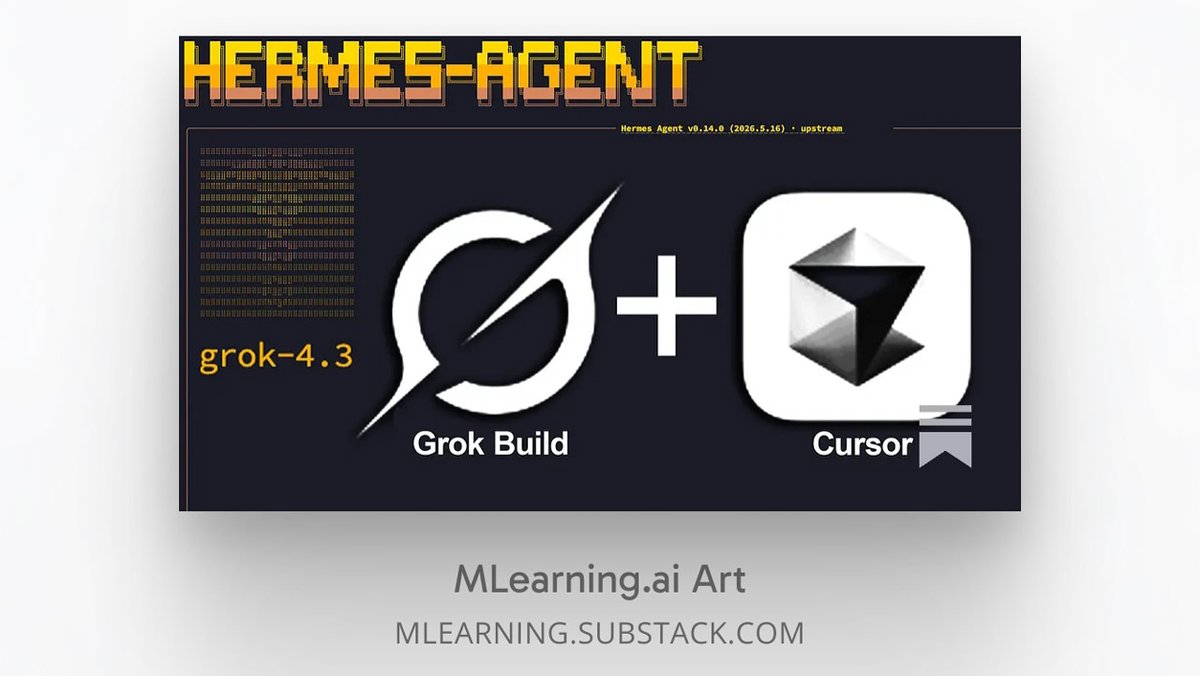
Connect Grok Build xAI with Hermes Agent (Nous Research): A Practical Guide
🟠
30+ Tips & Tricks. How Hermes Agent by Nous Research works with Grok Build xAI, a practical guide covering models, API keys, SuperGrok, prompt caching, context window, VPS setup Ready to use shortcuts
do you understand what Google's AI just did to an artist..
His entire Google account got permanently banned. Not just Drive. Gmail.. YouTube.. Every single service..
His appeal was rejected. No human reviewed it. An algorithm decided his life's work was a violation.
He never shared the files publicly. It was a private backup of his own creations. The AI flagged it anyway - probably the filename or art style - and that was enough.
- Google banned a developer's 14-year-old Gmail account over a research dataset that contained no illegal content
- Google expanded its automated ban policy in October 2025 - violations now trigger immediate termination with zero warning period
- No lawsuit against Google for wrongful account termination has ever succeeded in US courts
Your Google account is not yours. You are renting access to your own digital life from a company whose AI can end it in seconds - with no appeal, no human, and no recourse.
Here's the Erdős unit distance problem explained as simply as possible.
The Core Question
Imagine you have n dots scattered on a piece of paper. You pick one fixed distance, say, exactly 1 inch. The question is: how many pairs of dots can be exactly 1 inch apart?
That's it. That's the whole problem.
Why It's Tricky
Say you have 4 dots. You could arrange them so many pairs are exactly 1 inch apart, but you can't make every pair that distance. Geometry fights back. The question Erdős asked in 1946 was: what's the maximum possible count, and what arrangement achieves it?
The Old Belief (80 Years of It)
Mathematicians found that arranging dots in a square grid like graph paper, gave really good results. A grid of 100 dots might produce hundreds of unit-distance pairs. For decades, experts believed grid-like arrangements were basically the best you could do.
What OpenAI's Model Did
The AI found a completely different family of arrangements not grid-shaped at all, that squeezes out more unit-distance pairs from the same number of dots. It's like everyone assumed checkers was the best board game layout, and suddenly someone showed up with a totally different design that scores higher by its own rules.
Why This Matters
Two reasons:
Math reason: It disproves a decades-old intuition and pushes the boundary of what's known about geometry and combinatorics.
AI reason: The model didn't just assist a mathematician, it found the discovery autonomously, making it the first AI to independently solve a prominent open problem in a core math field.
Think of it as AI graduating from calculator to collaborator
Today, we share a breakthrough on the planar unit distance problem, a famous open question first posed by Paul Erdős in 1946.
For nearly 80 years, mathematicians believed the best possible solutions looked roughly like square grids.
An OpenAI model has now disproved that belief, discovering an entirely new family of constructions that performs better.
This marks the first time AI has autonomously solved a prominent open problem central to a field of mathematics.
Google just bet the farm on AI agents… did it pay off?
this clean summary of Google I/O 2026 shows how hard they’re pushing the “agentic Gemini era”
Agents doing the heavy lifting, massive Search redesign, Spark as your 24/7 helper, they’re playing full offense.
Still, the video makes it clear the only real standout tool is Gemini Omni (the video gen beast that likely made this summary itself)
The rest feels like aggressive positioning more than must-have new stuff. Mixed crowd reaction makes sense
The winners are definitely not yesterday's announcements
Connect Grok Build xAI with Hermes Agent (Nous Research): A Practical Guide
🟠
30+ Tips & Tricks. How Hermes Agent by Nous Research works with Grok Build xAI, a practical guide covering models, API keys, SuperGrok, prompt caching, context window, VPS setup Ready to use shortcuts