In public health research, accuracy is not just about getting the right answer; it is about understanding how we arrive at that answer.
This is where sensitivity and specificity matter.
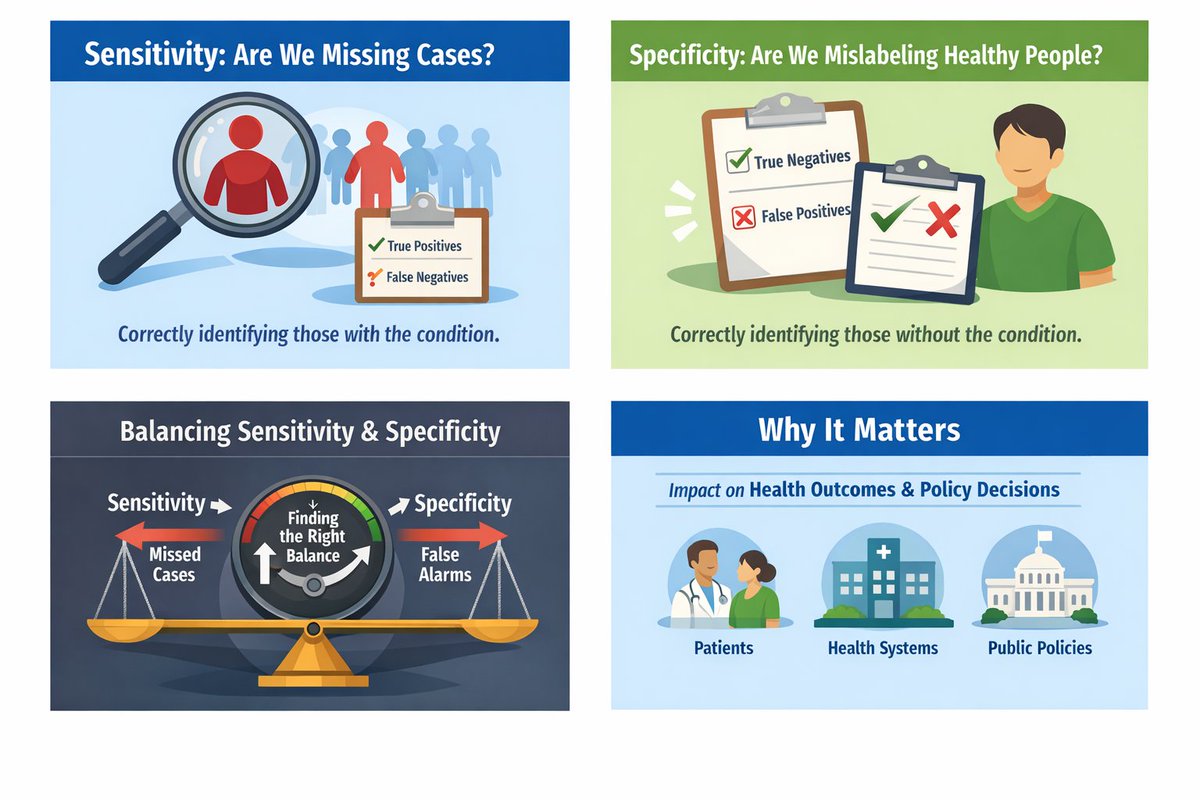
Sensitivity asks: Are we missing cases?
Specificity asks: Are we wrongly labelling healthy people?
There is always a trade off. Improving one often reduces the other. The right balance depends on context, consequences, and health system capacity.
In screening programmes for infectious diseases, NCDs, and nutritional deficiencies, this balance shapes individual care, resource use, and policy decisions.
No measurement tool is perfect. The goal is informed choice, not perfection.
Precision in concepts leads to better evidence, better decisions, and better health outcomes.
#PublicHealth #Epidemiology #HealthResearch #Screening #EvidenceBased #GlobalHealth
Why “Big Data” Does Not Eliminate Bias
More data does not automatically mean better or fairer insights. Bias is not a problem of sample size, it is a problem of how data are generated, collected, and measured.
If certain populations are systematically excluded, or if data reflect who can participate rather than who truly exists, increasing volume only amplifies distortion.
Epidemiology reminds us that data quality and study design matter more than data quantity. Big data is powerful, but only when guided by sound methodological reasoning.
#HealthcareAI
#EpidemiologyAI
#EpidemiologyAI
#Nigeria
Bias and confounding are related but not the same.
Bias is a systematic error introduced by study design, data collection, measurement, or analysis. It directly threatens the validity of results and cannot be fully corrected after the study.
Confounding arises from the relationship between variables. It distorts the interpretation of the exposure–outcome relationship and can often be reduced through good study design and appropriate analysis.
Understanding the difference is essential for accurate public health and research conclusions.
#Ref
#PublicHealth
#HealthResearch
#DataQuality
Today, let’s talk about bias.
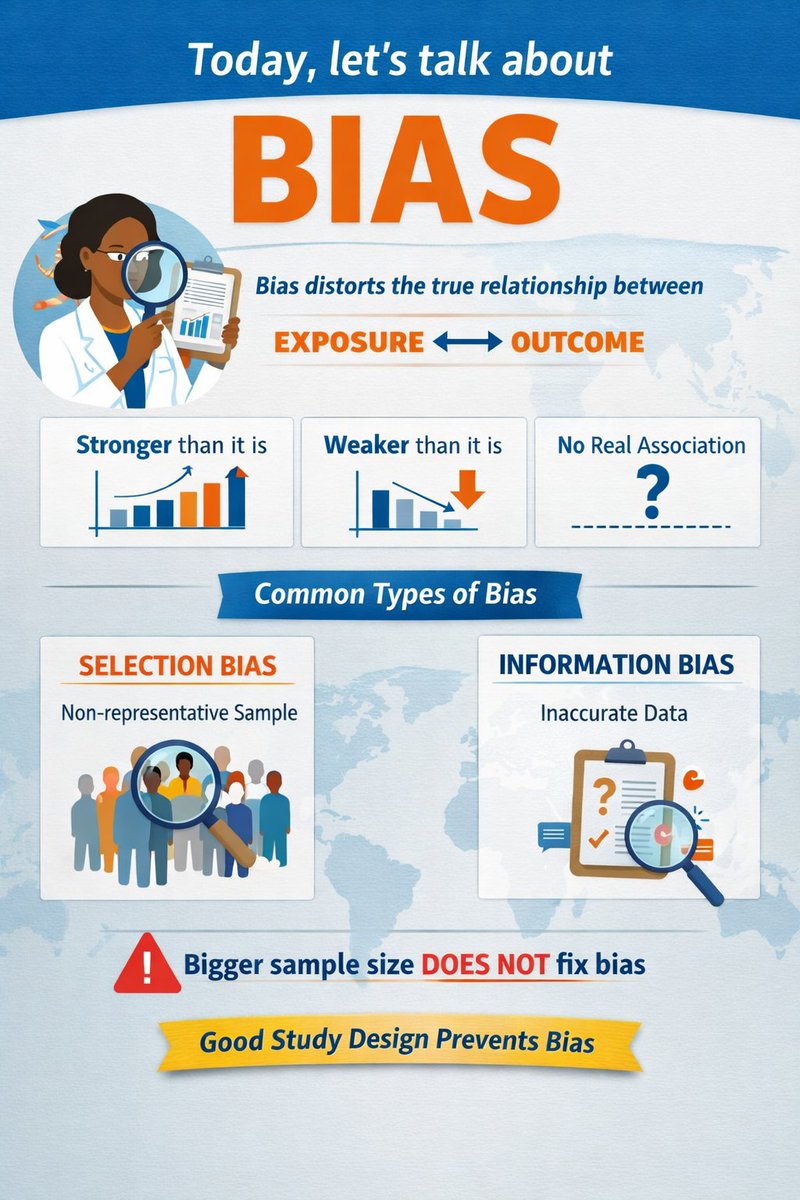
Bias occurs when the way data are collected, measured, or analysed systematically distorts the true relationship between an exposure and an outcome.
It can make an association appear stronger, weaker, or even suggest a relationship where none exists.
Common examples include selection bias and information bias. Importantly, increasing sample size does not fix bias. A large study can still be precisely wrong.
This is why good study design and data quality matter as much as statistical analysis in public health research.
#Super Eagles
#healthcare
#Health
#Jarvis
One word for Alex Iwobi's performance this AFCON 2025: MASTERCLASS That pass to Osimhen was pure magic – world-class vision! If you rate this guy and love what he's doing for the Super Eagles, smash that LIKE + RETWEET right now! Who's with me? #AFCON2025#SuperEagles#Iwobi
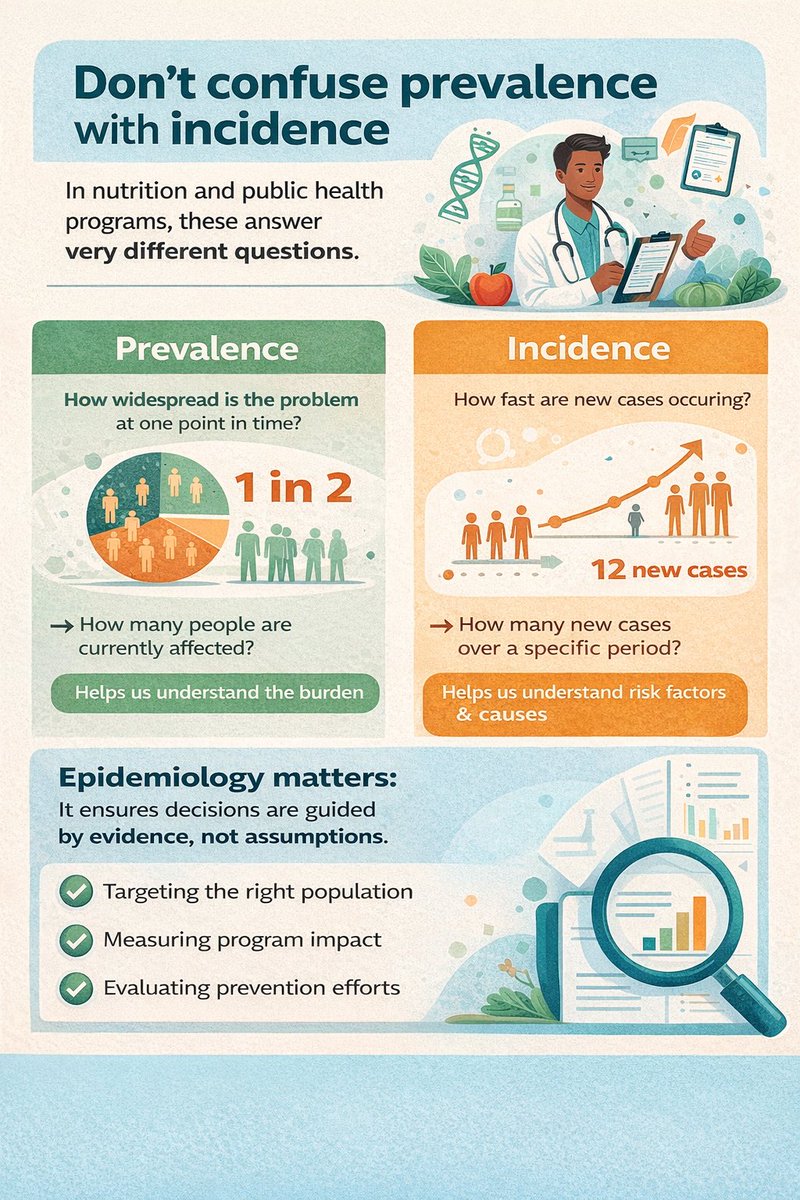
A common mistake in nutrition programs is confusing prevalence with incidence.
Prevalence = how widespread a problem is.
Incidence = how fast new cases occur.
Mixing them up can mislead interventions and impact evaluation.
Epidemiology helps us ask better questions.
#Boniface
Not every association in public health research is a cause. Just because diet and disease are linked doesn’t mean one causes the other.
Confounding, bias, and context matter.
Epidemiology helps us move beyond correlation to evidence-based action.
#WeRise#Big13#PublicHealth
If we ignore this, we risk designing interventions that target the wrong factors.
Epidemiology helps us move beyond correlation to evidence-based public health action.
Not every association in public health research is a cause. Just because diet and disease are linked doesn’t mean one causes the other.
Confounding, bias, and context matter.
Epidemiology helps us move beyond correlation to evidence-based action.
#WeRise#Big13#PublicHealth
That association could be explained by:
• Confounding factors
• Bias in data collection
• Or chance
For example, diet and disease may both be influenced by income, education, or access to healthcare.
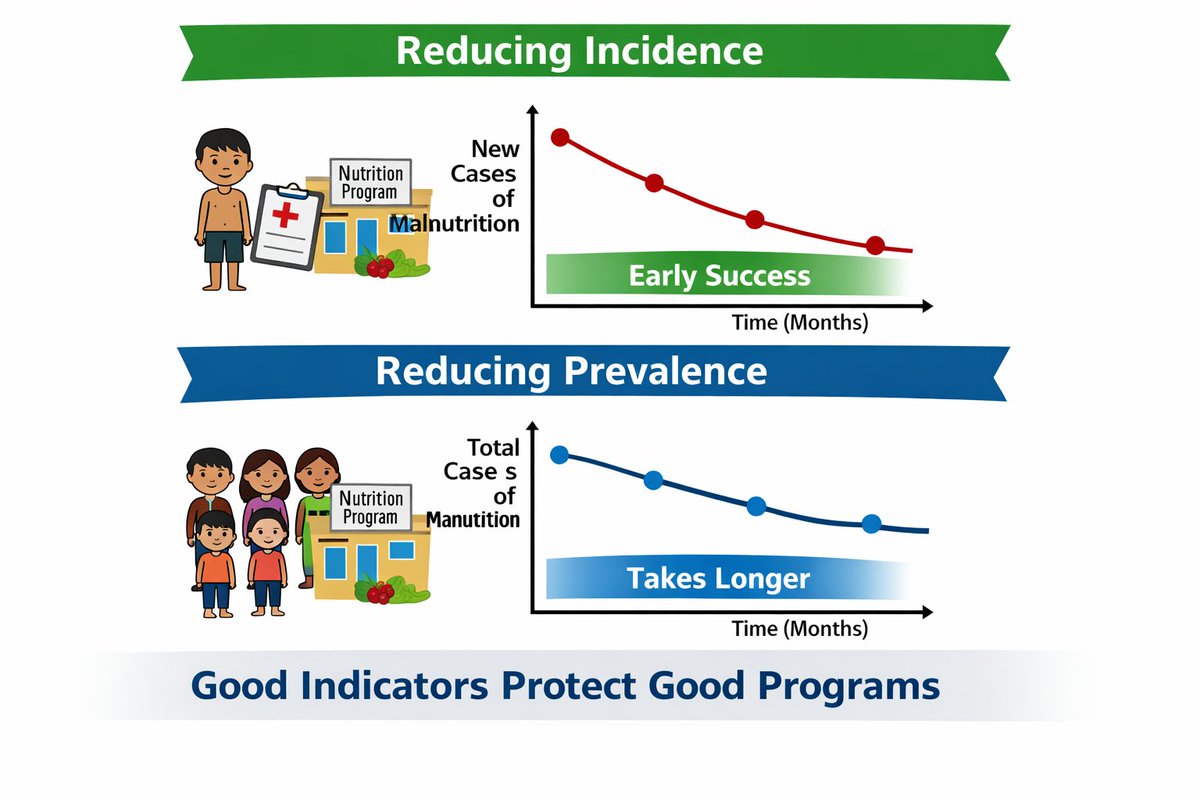
Many nutrition and public health programs are judged ineffective because the wrong indicator is used. Reducing incidence is often the first sign of success. Prevalence may take many years to decline.
A common mistake in nutrition programs is confusing prevalence with incidence.
Prevalence = how widespread a problem is.
Incidence = how fast new cases occur.
Mixing them up can mislead interventions and impact evaluation.
Epidemiology helps us ask better questions.
#Boniface