Published today, our reasons for optimism that success rates in drug discovery can be improved by picking the right targets using human genetics: https://t.co/kgh9q05buE
I break the key findings down panel by panel in this thread: https://t.co/5h6q4EYYrw
Lightning summary:
- Drug programs supported by human genetics are more successful, almost regardless of the nature of the genetic evidence
- Increase in success rate may be especially large for disease-modifying therapies
- Genetics still underutilized in picking targets
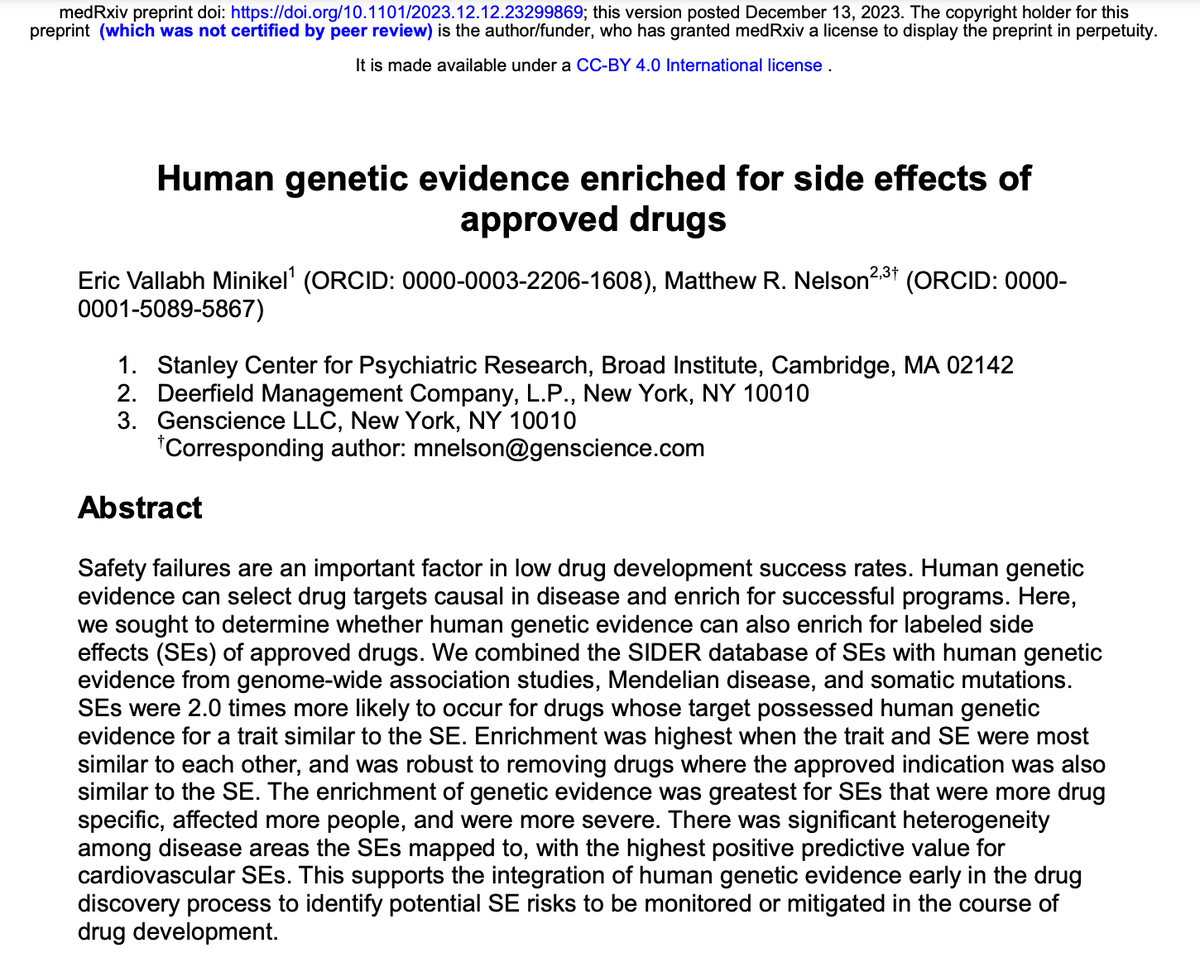
Today @mnelsonxy and I have posted to @medrxivpreprint an analysis showing that labeled side effects of approved drugs are enriched for genetic evidence https://t.co/GJ8AbFWtdK
@BrentRichards19 Second, R99H (rs143944501, MAF = 0.9%) is associated with measures of lung function (beware, results from Neale analysis) https://t.co/TgUtO3wftp
and phecode 514, abnormal findings in lungs
https://t.co/OxM2tIhPsf
@BrentRichards19 Well done! Not to pile speculation on top of uncertain associations, but there are a couple of low frequency coding variants in LDLRAD4 with curiously relevant, though not statistically significant, associations.
@BrentRichards19 First, the most significant UKB SAIGE association for the splice variant c.-51+1G>T (rs148754658, MAF = 0.75%) is with pseudomonal pneumonia. https://t.co/uYXVQOLbWE
@karls_es Hey @karls_es, really useful analysis, i.e. looking at the rate of change. Any chance you have updated it this weekend? Would be a great addition to https://t.co/AEFVNrLxmm.
@bogglesmith@trvrb This is a really important question to address as early as possible. With the large numbers of patient virus samples being sequencing in Washington, is it possible to estimate the effective viral population size in that state versus known cases? Any insights @trvrb?
@spen7cer Wearable makers could be in a powerful position to track some of this. I wear an Oura ring, that takes my temperature while I sleep each night.