1/ Do neuron-specific splicing factors mediate neuron-like mRNA splicing when they are expressed in tumors? Our new study suggests that in some breast tumors, the answer is yes! Read on for a quick summary of the brief report: https://t.co/OT0WOhKunN
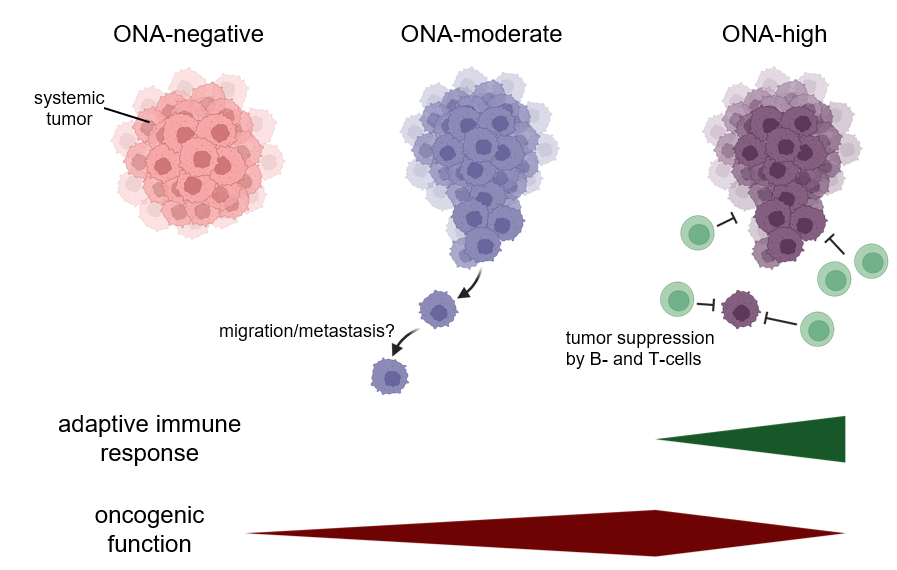
9/ Our findings support a model in which ONA expression is oncogenic, but at high levels can trigger a protective immune response. Further work is needed to outline the complex consequences of ONA function and immunogenicity to tumor phenotypes.
1/ Do neuron-specific splicing factors mediate neuron-like mRNA splicing when they are expressed in tumors? Our new study suggests that in some breast tumors, the answer is yes! Read on for a quick summary of the brief report: https://t.co/OT0WOhKunN
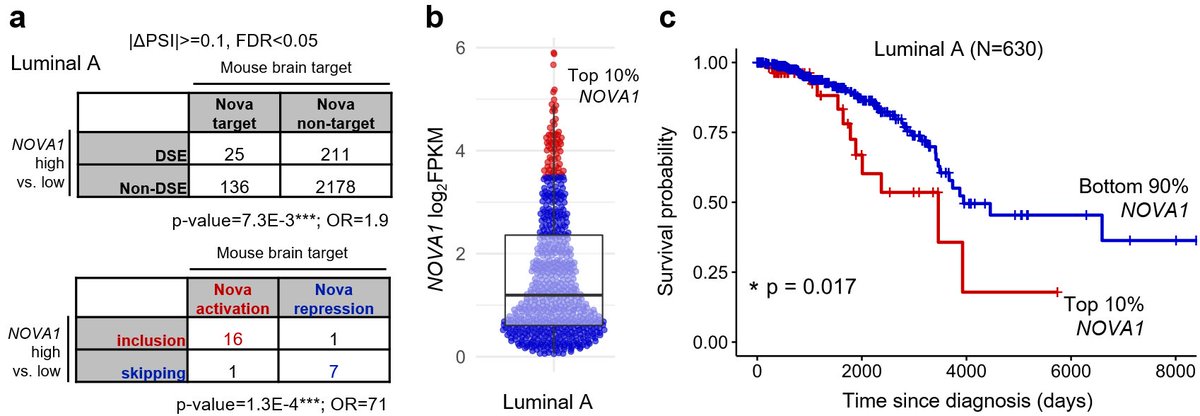
8/ BRCA tumors are heterogeneous, and we found that NOVA1 seems to be most active in “Luminal A” subtype tumors, confers survival risk in that subtype, and shows higher expression in invasive lobular carcinoma, a pathological presentation with unique metastatic patterns.
12/ Thank you to all the coauthors for their crucial contributions: Melissa Campbell @sciclyst, Miquel Anglada-Girotto @m1quelag, Huijuan Feng @Huijuan_Feng, Andrea Califano @califano_lab, Edmund Au, and Chaolin Zhang @chaolinzhang.
1/ Very happy to share that our preprint is now online! Check it out here: https://t.co/OPKWApLmVp In the study, we model RNA alternative splicing regulation in the neocortex and validate both neuron type-specific and type-orthogonal regulatory programs. Read on for a summary!
11/ Overall, we hope that the manuscript provides a tool to help researchers explore the AS regulatory landscape. We believe that regulatory maps can help disentangle cell type-specific programs from those driven by biological properties that are independent of neuronal type.