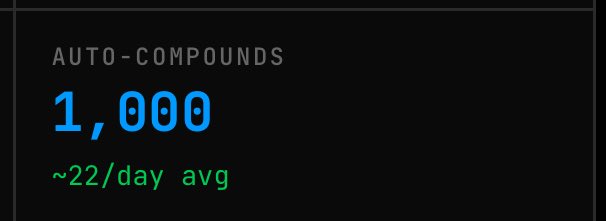
We’re introducing Auto-Rebalance for concentrated liquidity on @hyperion_xyz.
It automatically repositions your concentrated LP when conditions are met. You select the preset range, automation slippage, minimum cooldown window and other configurations. Moar executes for you.
The Moar team built and scaled a product from $0 to $7.5M in TVL in one of the most challenging market environments.
To those who used the product and supported us as it evolved: thank you.
Post launch, we shipped features, consistently, growing usage and serving our user base. We continued to grow to a peak of $7.5M TVL in January 2026, in the months following the October crash that reset the entire market. Moar is a strong execution story in a challenging environment.
When we started Moar, I wanted to build and scale a DeFi primitive. For me, Moar gave me the opportunity to do this. To experience the full product life cycle, from R&D to launch, to iterating towards usage and revenue. We consistently shipped features and sub-products post-launch that directly improved outcomes. The learnings I’ve made during my time as an operator working on Moar have been incredibly valuable.
I have deep respect for my team who worked tremendously hard. They were everything you would want to see in a DeFi team. Proactive, high integrity and reliable.
Grateful for the team at @Aptos with whom we worked closely in scaling Moar. Particularly, I would like to thank @ASHAWONN, @Jay__0x as well as @0xSong and @Cdatho.
A special thank you to Claire @0xsuperkings and the rest of the @hyperion_xyz team. Their support and professionalism was outstanding.
Thank you to @adamcader_ a friend who was instrumental in Moar’s early stages and Thala Foundry for backing us. I would also like to thank @neilhar for his support at the beginning of this journey. As well as @zacharyr0th who was the first person I spoke to at Aptos!
Lastly, thank you to @iwillpat for his continued support as a friend and mentor.
Incredibly grateful to those who supported Moar. Thank you. You know who you are. We built something cool together.
A few of the friends we made along the way are @0xobsessed@thecaptaingates@im_rajaali@Deguywithstyle@thisttv@0xandrewxyz@yarhuter@_sonji@realjaysneezy@ssadkov and many more!
“I suppose in the end, the whole of life becomes an act of letting go but what always hurts the most is not taking a moment to say…”
Goodbye!
Moar is entering reduce-only mode. All user assets are secure and available for withdrawal.
Since inception, we built and scaled a DeFi primitive to $7.5M in TVL, and shipped continuously post-launch — including leveraged CLMM, auto-rebalance, and LP position analytics.
To everyone who used Moar or supported us: thank you. You shaped the product.
We’re proud of what we built together.
Wind-down timeline
Today, April 17 2026 — No new positions can be opened. Existing positions enter reduce-only mode.
April 29, 2026 — Pyth is no longer pushing feeds on Aptos, effective April 30. The protocol is migrating supported collaterals to Chainlink push feeds. Assets for which Chainlink is pushing feeds will continue through the wind-down. Assets without Chainlink push feeds will be force-closed on April 29, one day before Pyth stops pushing feeds. Affected assets:
- KAPT/USD
- xBTC/USD
- wBTC/USD
- AMI/USD
If you hold a position in these or you have any of these assets as collateral in your credit account, please close and withdraw before April 29.
May 15, 2026 — Frontend will be taken offline. After this date, withdrawals will only be possible via direct smart contract interaction on-chain.
Thank you for building with us.
The next great exchange was always going to be onchain.
For over a decade, traders have been forced to choose: the speed of a CEX or the transparency of a DEX. Never both.
Traders deserved better. We built better.
Decibel is LIVE!
Welcome to the new sound of trading 🔊
Stablecoin yields are looking juicy on @MoarMarket this week
Leading the way: USD1-USDT-USDC Tri-pool at 28.37% APY. Efficiency is the name of the game. Put those idle assets to work!
🚜 Farm now: https://t.co/2YXUKnHT6Q
Built a terminal to visualize @MoarMarket → @hyperion_xyz liquidity flows. Real-time Sankey diagram showing:
- How much Moar provides to each pool
- What % of each pool is Moar liquidity
Been using Claude Code to level-up our internal tooling & monitoring over the holidays. This was a side quest.
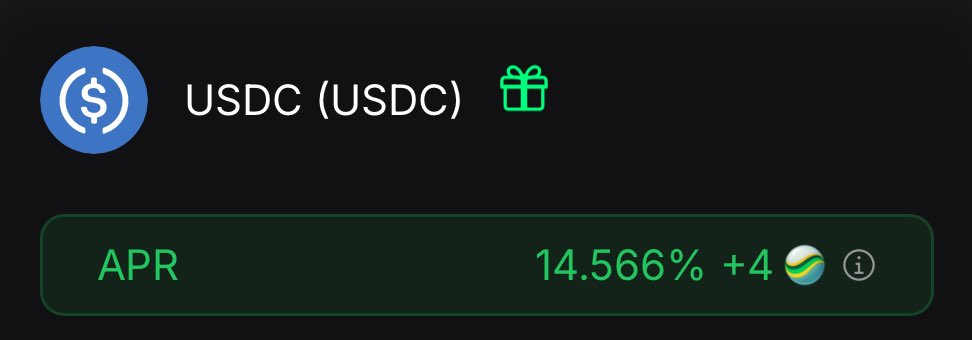
USDC lending on moar is paying 14.5% APR right now on @Aptos.
Near 90% utilization means your deposits are being borrowed for @hyperion_xyz concentrated liquidity positions, not sitting idle.
its been a good year for moar: 1) launched on mainnet 2) $0→$5M+ TVL 3) $0 revenue → top 10 highest revenue app on @aptos
some of the things I’ve learned:
1) the first version created surface area for users to react to
we launched the basic primitive first, and compounded the product publicly later.
when we first deployed moar, it was only the core composable leverage protocol. we didn’t launch with our core offering (leverage CLMM), and knew it would be a tame launch, but we weren’t afraid to have a small, contained launch and release the core application later. 2 weeks post-launch, we released leveraged concentrated liquidity on top of hyperion. this is where the surface area appeared to which users could react to. it was the basic primitive, without a lot of the features you see live today.
2) features were prioritized to improve user outcomes
as soon as we released leverage clmm, our observed usage began to determine our roadmap. over the next few months, we shipped a heavy load of features that make the product what it is today.
collateral farming
rebalance
multi-positions
debt mix slider
single asset exit
PnL
liquidation prices
telegram bot for notifications about your positions
LP simulator
debt management
SDK for those running bots
dual collateral support and most recently
auto-compounding
auto-rebalancing.
these features solved real constraints users were facing.
3) building products is a search for insights
we've been very honest to ourselves as product builders and we understand that we dont have all the answers, we've treated building this product as a search for insights. insights emerge from data points and data points emerge from giving your users surface area to interact with. we've tried to be as low-ego as possible and let data points shape the roadmap. this has led to a process oriented approach for surfacing insights, and i think it has led us closer to the truth. we shipped the core primitive, iterated publicly later through feedback cycles with users and on-chain outcomes.
we gave many users direct access to us. people DM’d me. a lot. we made groups with many of our power users. asked them questions, much of what they said often translated into what we built next. power users do know what they want. more often than not, they’ll tell you, but only if the product has surface area for them to react to
in parallel, we analyzed a lot of on-chain data, we treated each user outcome as a case study. looking at both user data + user feedback together was important. the overlap between the two is where we found the highest signals.
we relentlessly laser focussed on improving user outcomes, which led to many of the features we built. these features compounded overtime and through that compounding outcomes materially improved
building this product over the last 1.5 years has been a very important learning experience for me from both a product and protocol ops perspective.
excited about what we build next.